A clock tattoo is one of the few designs that means something different on every person who wears it, and that is exactly why it never goes out of fashion. The dial is a blank slate: the hands you set, the case you choose and the objects you wrap around it carry the entire message.
I have been writing about tattoo design for years, and clocks come up in more consultations than almost any other object except roses. Artists tell me the same thing — half the people who walk in asking for a clock already know the exact time they want on the face.
What most people have not decided is the harder part: which kind of clock, how big, and where it sits on the body. Those three choices decide whether the piece still reads clearly in fifteen years or turns into a grey smudge.
This guide walks through the styles that actually hold up, the meanings behind each variation, and the practical stuff nobody mentions until you are already in the chair. If you want a companion piece with more sketch-style references, my collection of clock tattoo drawings covers the linework side in more depth.
Which Clock Tattoo Style Is Right for You?
Every clock design carries a different tone. This is the comparison I sketch out for people who cannot decide between them.
| Style | Usual Message | Best Placement | Detail Level |
|---|---|---|---|
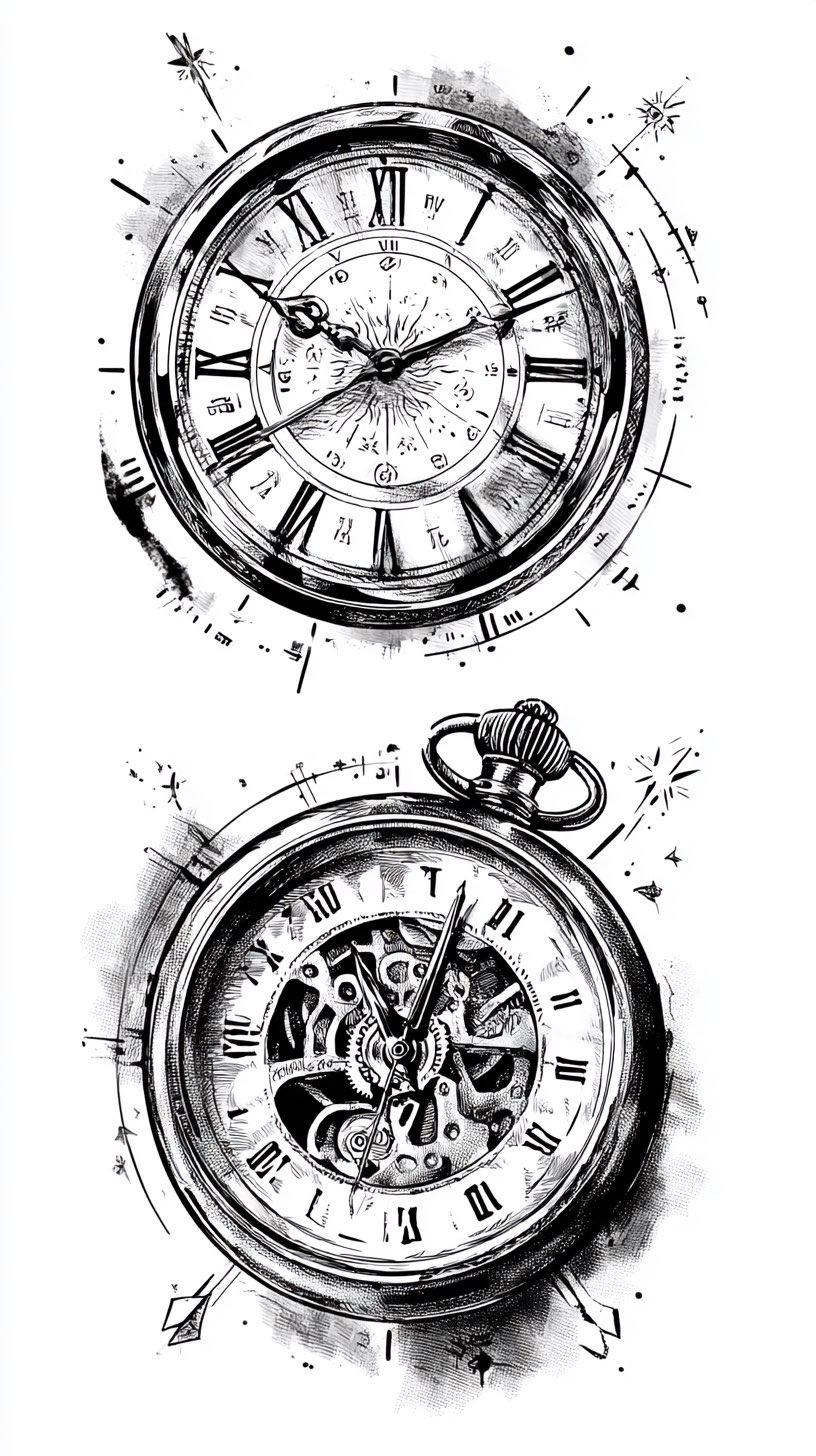
| Antique pocket watch | Nostalgia, inheritance, a moment worth keeping | Inner forearm, upper arm, calf | High — needs room |
| Roman numeral dial | A specific date or birth time | Forearm, chest, shoulder | Medium |
| Melting or surreal clock | Time distorting, memory, loss of control | Thigh, back, half sleeve | High |
| Broken or shattered clock | A turning point, grief, starting over | Upper arm, ribs, back | High |
| Fine-line minimal clock | A quiet personal marker | Inner wrist, ankle, behind ear | Low — ages best small |
| Clock with gears exposed | Mechanics of a life, biomechanical themes | Forearm, sleeve panel | Very high |
| Hourglass instead of dial | Time running out, urgency | Forearm, thigh, spine | Medium |
If the last row is where your eye landed, the hourglass tattoo ideas guide goes deeper on that particular symbol.
What a Clock Tattoo Actually Says
The clock is a memento mori object with a long history in Western art — a reminder that the thing being measured is finite. That is the baseline reading most people bring to it.
But in my experience the meaning almost always narrows down to something personal once you talk to the wearer. The generic symbol is a shell; the details are the message.
Setting the hands is the single most powerful decision available to you. A time on a dial can mark a birth, a death, a diagnosis, a sobriety date or the moment something ended.
What surrounds the clock shifts the tone just as much. Roses soften it toward love and remembrance, skulls push it toward mortality, and gears pull it toward a mechanical, almost industrial reading.
Numbers matter too. Roman numerals feel formal and old-world, while a plain numeral dial reads modern and slightly colder.
There is no obligation to explain any of it. Plenty of people I have spoken to keep the reference private and let everyone else assume it is just a nice clock.
Clock Tattoo Ideas That Work in Practice
These are the design directions I see holding up best over time, roughly in order of how often they get requested.
1. The Antique Pocket Watch
This is the default clock tattoo and the reason is simple: a pocket watch already looks like an heirloom, so it carries emotional weight before the artist adds anything.
The chain is what makes or breaks it. A watch floating with no chain tends to look like a sticker, while a chain that wraps around the arm or trails into another element grounds the whole piece.
Ask for the case to be open rather than closed if you want the design to feel alive. An open case gives the artist a second surface — the inside of the lid — for engraving, a portrait or a date.
In every consultation I have sat in on, the artist has pushed for more size than the client expected here. A pocket watch under about three inches loses the fine engraving almost immediately. If you want the sketch-level detail first, look at pocket watch tattoo drawings before you book.
2. Clock With Roses or Florals
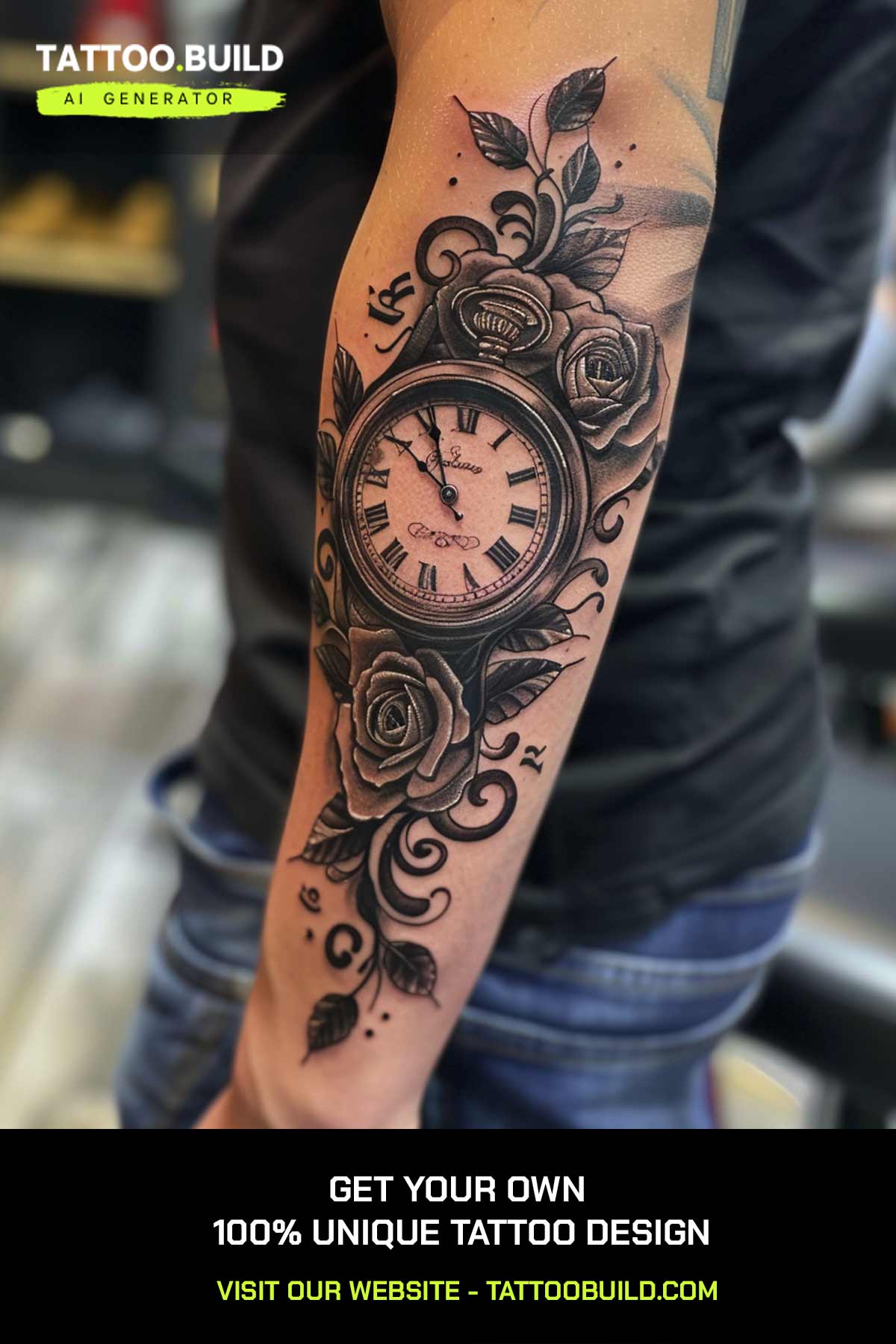
Pairing a clock with roses is the most common combination in the whole category, and it works because the two symbols pull in opposite directions.
The clock says time passes; the flower says something bloomed anyway. That tension is what gives the piece its emotional range.
Practically, florals also solve a composition problem. Roses fill the awkward negative space around a circular object and let the design taper naturally to fit an arm.
Black and grey is the safer long-term choice here, though colour roses look striking when they are fresh. If you are leaning floral, browse rose tattoo ideas for shape and shading references you can bring to your artist.
3. Exposed Gears and Mechanisms
Opening the clock up and showing the movement inside turns a symbolic object into a technical one. It reads as engineering rather than sentiment.
This is the most demanding version to execute well. Gears require crisp, consistent linework, and if the teeth do not line up believably the eye catches it instantly.
Some artists take it further and blend the mechanism into the skin itself — the biomechanical approach, where gears appear to sit under torn flesh.
I would only book this with someone whose portfolio already shows mechanical work. It is not a design to hand to a generalist.
4. Forearm Clock Tattoos
The inner forearm is the placement I would recommend to most people asking about a clock for the first time.
It gives a long vertical field, which suits a watch with a trailing chain or floral tail, and it sits at a moderate pain level compared with ribs or elbow ditch.
The outer forearm holds ink slightly better over decades because it takes less friction than the palm side, though both age acceptably with sun protection.
Size honestly matters more than placement. A forearm clock that runs from wrist to elbow gives the artist room to keep numerals and gears legible for years. There are more layout options in my forearm tattoo ideas collection.
5. Broken, Shattered or Melting Clocks
A cracked face or a clock dissolving into shards is the version people choose when the piece marks something that went wrong.
Shattering also gives an artist somewhere to put movement. Fragments can scatter into birds, ash, smoke or numbers drifting off the dial.
The melting clock owes its whole visual language to surrealist painting, and most artists will recognise the reference immediately.
A caution worth stating plainly: heavily fragmented designs need generous negative space between pieces, or they blur together as the ink spreads slightly with age.
6. Clock and Skull Combinations
Putting a skull beside a clock removes any ambiguity — this is a memento mori piece and it is not trying to be subtle.
It is a staple of traditional and neo-traditional flash, so you will find no shortage of artists comfortable drawing it.
The best versions I have seen let one element dominate rather than giving both equal weight. A large skull with a small watch tucked into the eye socket reads better than two competing focal points.
If the darker end of the spectrum appeals to you, the skull tattoo drawings archive is a useful starting point for composition.
7. Minimal and Fine-Line Clocks
Not everyone wants a half sleeve. A small line-drawing clock on the inner wrist or ankle is a legitimate option and increasingly common.
The trade-off is real and worth knowing before you commit: very fine lines placed close together tend to soften over the years, and small dials are the first thing to lose definition.
You can protect against that by asking for fewer elements. A plain circle, two hands and four numerals will outlast a tiny dial crammed with twelve numerals and a second hand.
Every artist I have asked about fine-line work has said the same thing — expect a touch-up eventually, and budget for it.
Variations Worth Considering
If the standard dial does not feel like yours, these adjacent ideas cover similar ground.
Compass Instead of Clock
A compass keeps the circular face and the vintage engraving but swaps the meaning from time to direction.
People choosing between the two are usually deciding whether their story is about when or about where. The compass forearm tattoo guide covers that design in full.
Sundial and Astronomical Dials
A sundial or astrolabe gives you the time theme with far less visual clutter than a mechanical watch.
These also sit comfortably alongside celestial elements, which opens up sun, moon and constellation work in the same piece.
Clock as Part of a Larger Scene
Rather than a standalone object, the clock can be a component — hanging in a tree, held by a hand, or built into a portrait background.
This is often the smarter move for a sleeve, because it gives the design somewhere to go instead of stranding a single circle mid-arm.
Memorial Clock Pieces
Setting the hands to a time of passing is one of the most frequent reasons people book a clock tattoo at all.
If that is your reason, it is worth reading through memorial tattoo ideas first — there are gentler ways to carry a date than a dial, and some of them may suit you better.
Getting a Clock Tattoo That Ages Well
Go bigger than feels necessary. This is the advice artists repeat most often about clocks, and it is the one people most often ignore.
Ink spreads very slightly under the skin over decades. Detail that sits tight together when fresh will merge, so the space between numerals and gears is doing long-term work.
Bring a reference photo of the exact watch if it is a real object — a grandparent’s watch, a specific model. Artists draw a real thing far better than a description of one.
Decide the time on the dial before your appointment, not in the chair. Changing it mid-stencil throws off the whole composition, since hand position affects balance.
Follow your artist’s aftercare instructions rather than anything you read online, including here. General guidance from the American Academy of Dermatology is a reasonable baseline, and my own tattoo aftercare guide covers the routine week by week.
Sun exposure is the main thing that fades black and grey detail. Once healed, keep it covered or use sunscreen — the Mayo Clinic has a plain overview of tattoo risks and care worth reading before you book.
If you notice spreading redness, swelling that worsens after a few days, discharge or a fever, contact a doctor rather than waiting it out. Allergic reactions to certain pigments can also appear weeks later and are worth having looked at.
Still Not Sure? Common Clock Tattoo Mistakes
The most frequent regret I hear about is size — a design chosen small to keep the cost down, then reworked larger two years later at greater total expense.
The second is booking with an artist whose portfolio does not include the style you want. A great traditional artist is not automatically a great realism artist, and a mechanical watch is a realism job. If budget is the constraint, what tattoo designs actually cost is worth reading before you compromise on the artist.
A third is picking a time on the dial for aesthetic reasons and later wishing it meant something. Hands at ten-past-ten look balanced, which is why watch adverts use it — but balanced is not the same as personal.
Finally, do not rush the placement decision. Where a clock sits changes how often you see it, and that changes your relationship with it — sitting with a printed stencil on your arm for a day is a cheap way to test that.
Frequently Asked Questions
What does a clock tattoo symbolise?
Most commonly it symbolises the passage of time and the fact that life is finite — the memento mori idea. In practice, the specific meaning usually comes from the details rather than the object: the time set on the hands, whether the clock is intact or broken, and what surrounds it. A clock with roses tends to read as remembrance, while a shattered clock more often marks a turning point. There is no fixed meaning you are obliged to adopt.
Where is the best place for a clock tattoo?
The inner or outer forearm suits most clock designs because it offers a long vertical space for a watch and chain, and the pain level is moderate. Upper arms, calves and thighs also work well for larger, detailed pieces. Small fine-line clocks sit comfortably on the inner wrist or ankle, though they will need touch-ups sooner. Your artist will have a view based on your specific design, and it is worth deferring to it.
How much does a clock tattoo cost?
It depends entirely on size, detail and your artist’s rate, so any figure quoted online will be wrong for someone. A detailed realistic pocket watch is a multi-hour piece and is usually priced by session or by hour rather than as a flat fee. Small minimal clocks are often shop-minimum work. Ask for a quote at consultation, and be sceptical of prices that seem far below local norms.
Do clock tattoos age well?
Larger clock tattoos with generous spacing between elements generally age well, because there is room for the small amount of ink spread that happens over decades. Very small dials packed with numerals and gears are the ones that tend to blur first. Sun exposure is the biggest single factor in fading, so keeping the piece covered or protected makes a real difference. Occasional touch-ups are normal and not a sign of poor work.
Should the clock show a specific time?
Only if that time means something to you. Setting the hands to a birth, a loss or a milestone is the most common approach and it gives the tattoo a private layer nobody else can read. If no time is meaningful, many people ask the artist to choose a position that balances the composition instead. Decide before the stencil goes on, because hand position affects the whole design.
Quick Summary
- A clock tattoo means whatever the details say — the object alone is a blank symbol.
- Setting the hands to a meaningful time is the strongest personalisation available.
- Antique pocket watches are the most requested version and need real size to hold detail.
- Roses and florals solve the composition problem around a circular design.
- Exposed gears and biomechanical work require an artist with mechanical pieces in their portfolio.
- The inner forearm is the safest first placement for most people.
- Going bigger than feels necessary is the single best defence against blurring with age.
- Follow your artist’s aftercare advice, protect it from the sun, and see a doctor if healing goes wrong.