I have been collecting compass tattoo references for years, and the forearm keeps coming back as the placement that actually works. A compass forearm tattoo gives guys a design that reads clearly at arm’s length, ages well, and carries real meaning without needing an explanation.
The forearm is flat enough to hold a circular design without distorting it, and long enough to give an artist room for a map, a rose, or a skull underneath the dial.
Every artist I have asked about compass work says the same thing: the dial is the easy part, and the shading around it is what separates a good piece from a flat one. That is worth remembering when you are comparing portfolios.
Below are the designs I keep coming back to, along with what each one costs in chair time and how it holds up after a few years. If you want a broader look at the placement first, my guide to meaningful forearm tattoos for guys covers the same ground for other subjects.
Which Compass Style Is Right for You?
I built this table from the pieces I have seen come out of shops and how they looked on follow-up. Prices are the shop rates I have personally been quoted in North America, so treat them as a starting point rather than a fixed number.
| Style | Best For | Typical Chair Time | How It Ages |
|---|---|---|---|
| Traditional / nautical | First tattoo, high visibility | 2–4 hours | Excellent — bold lines hold shape longest |
| Black and grey realism | Skulls, pocket watches, portraits | 5–9 hours, often two sittings | Good, but soft grey can fade lighter |
| Fine line / minimal | Small inner-forearm pieces | 1–2 hours | Needs the most care; thin lines soften |
| Geometric / dotwork | Symmetrical, modern designs | 3–6 hours | Strong if the dots are packed properly |
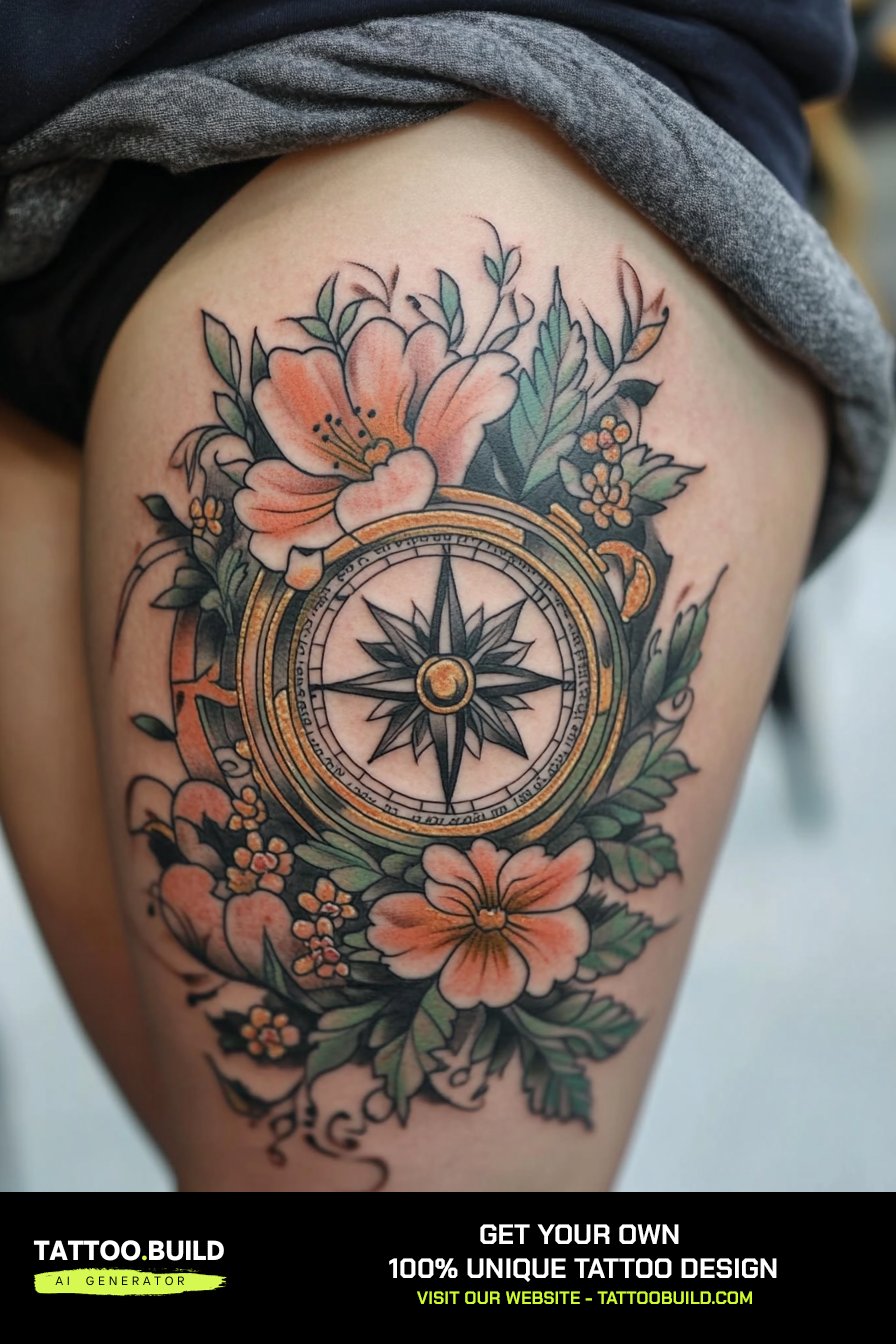
| Neo-traditional | Colour, roses, ornate dials | 4–7 hours | Very good; colour needs sun protection |
If colour and ornate framing are what pull you in, the neo-traditional compass tattoo route is worth a look before you commit to black and grey.
What Makes the Forearm Work So Well for a Compass
A compass is a circle, and circles are unforgiving. Put one on a curved, high-movement area and the dial reads as an oval from most angles.
The outer forearm stays relatively flat and does not stretch much, so the dial keeps its shape as you move. That is the single biggest reason artists steer compass work here.
The inner forearm is softer and more sensitive, but it also fades a little faster in my experience, mostly because it sees less sun and gets less consistent moisturising than people assume.
You also get length. A forearm gives you roughly the space between wrist and elbow, which is enough to run a map, waves, or a rose down from the compass without crowding it.
And it is a placement you can cover with a sleeve when you need to. That matters more than people admit when they are choosing their first visible tattoo.
Best Compass Forearm Tattoo Ideas for Guys
1. Nautical Strength
This one merges a compass with a ship’s wheel, and the two shapes share a centre point so the design reads as one object rather than two stacked ones.
The black and grey shading is doing most of the work here. Dark clouds sit behind the wheel, and the needle points north through the middle of them.
When I have seen this design done well, the artist kept the wheel spokes slightly lighter than the compass rose so your eye lands on the dial first. When it is done badly, everything is the same value and the whole thing turns into a grey blob at three feet.
It wraps the arm rather than sitting flat, which suits guys with more forearm mass. Budget a full afternoon.
2. Skull Navigator
A skull tucked behind or inside the compass housing is the most requested variation I come across, and it is genuinely hard to do well.
The problem is contrast. A skull needs bright highlights in the cheekbones and brow, but a compass dial needs crisp lines. Put them in the same square inch and one usually swallows the other.
The versions that work give the skull its own space and let the compass frame it, rather than overlapping the two. Ask to see healed photos of skull work specifically, not just fresh ones.
This is a five to nine hour piece in most shops, and I would not be surprised to be booked across two sittings for it.
3. Anchored Direction
An anchor through the compass is the classic pairing, and it is classic for a reason: the vertical anchor shank gives the circular dial something to sit against.
Some versions swap the anchor for a sword, which reads sharper and a little more aggressive. Rope detailing around the outside frames the whole thing and hides the transition to bare skin.
In my experience this design holds up better than almost anything else on the list, because the shapes are simple and bold. It is a good pick for a first tattoo.
If the nautical direction appeals, the same symbolism runs through anchor and maritime work generally, and it pairs naturally with forearm black and white tattoos if you want to keep the whole arm in one palette.
4. Timeless Voyage
Compass plus pocket watch. Direction plus time. It is on the nose, but it looks good, and that is usually enough.
Roman numerals on the watch face give the artist somewhere to put fine detail, and the chain can be run down toward the wrist to fill space that would otherwise sit empty.
The trap here is detail density. Two dials side by side means two sets of tiny numbers, and tiny numbers blur first as a tattoo ages.
Every artist I have asked recommends sizing the watch face slightly larger than looks necessary on the stencil. What looks oversized on paper usually looks correct on skin.
5. Winged Navigator
Wings spreading out from either side of the compass turn a static object into something with movement, and they solve a real design problem: they fill the width of the forearm.
Feather texture is where you can judge an artist quickly. Good feather work has varied line weight and does not look like a row of identical hooks.
Some versions layer the compass over an antique map instead, with faint latitude lines and a soft grey wash behind. That reads quieter and works well on the inner forearm.
I have seen the map version fade unevenly when the wash was laid too light, so ask your artist to keep the background greys mid-range rather than whisper-thin.
6. Roses and Compass
Roses soften a compass without making it look floral, and the petals give an artist a place to put deep black that balances the fine dial lines.
Wrapping the rose around the compass housing works better than placing it underneath, because the overlap creates depth.
This is the variation I would pick if the rest of your arm is already heavy in black. The petals break up the density.
7. Celestial Guide
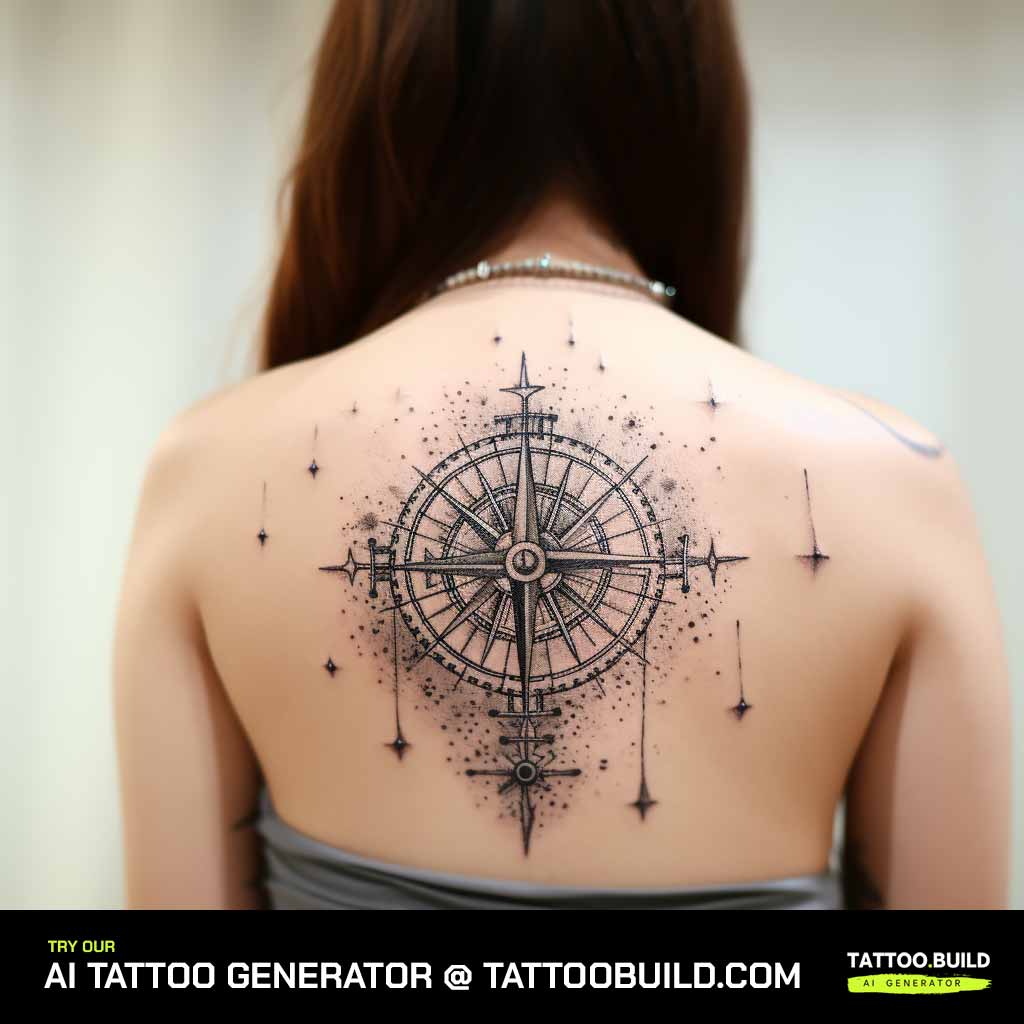
Stars, moon phases, and constellation lines around the dial move the compass from nautical to celestial, and it changes the meaning as much as the look.
Moon phases in a row along the forearm read cleanly and give the piece a natural top-to-bottom flow. Keep them evenly spaced or the whole line looks like a mistake.
I have seen constellation dots placed to match a real date or birth sky. It is a small detail nobody else notices, which is usually the point.
8. The Right Path
Sometimes the simplest version wins. A clean compass, no skull, no map, no wings — just the dial and the needle.
This is the design I recommend most often to guys who are nervous about committing, and the one I see the fewest regrets about.
It also leaves room. If you decide in three years that you want a full sleeve, a simple compass is easy to build around; a busy one is not.
Plan for where the tattoo might go next, not just where it is now. If a sleeve is even a possibility, my guide to half sleeve tattoos for men is worth reading before you book.
Variations Worth Considering
If none of the eight above are quite right, these are the directions I would look at next.
Minimal and Fine Line
A single-needle compass on the inner forearm is quiet, fast, and cheap by comparison. It is also the version that needs the most aftercare discipline, because thin lines have the least ink to lose.
Geometric and Dotwork
Angular geometry replaces the traditional compass rose with sharp facets, and dotwork builds shading dot by dot instead of with smooth greys.
Dotwork takes longer than clients expect. It also holds up well when the stippling is packed densely, and poorly when it is not.
Landscape and Animal Pairings
A mountain range, a forest treeline, or waves behind the compass turn it into a travel piece rather than a navigation one.
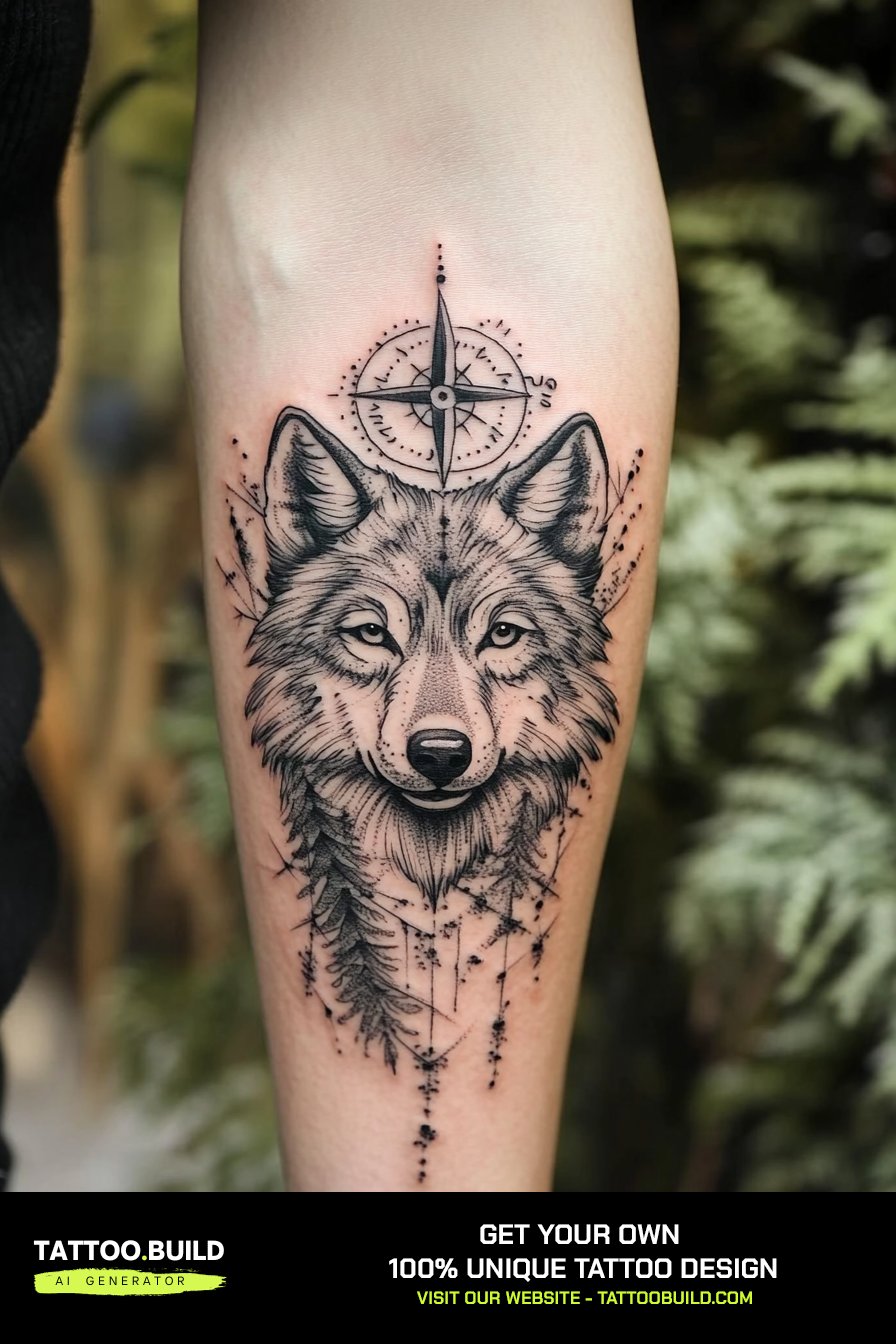
Animals work too. A wolf compass tattoo leans protective and loyal, while a snake compass design reads more transformation than direction.
Sizing Up to a Half Sleeve
A compass makes an excellent anchor point for a larger piece, because it is a strong focal shape that everything else can radiate from.
If that is the plan, get an idea of what a sleeve actually costs before you start, so the first session is not also the last one.
Aftercare and Practical Advice
Your artist’s aftercare instructions override anything you read online, including this. Follow the sheet they give you, and call the shop before you improvise.
Broadly, most artists I have dealt with ask for a thin layer of fragrance-free moisturiser two or three times a day once the wrap comes off, and no soaking — no baths, pools, or hot tubs — until the surface has fully closed. That usually takes about two to three weeks, though deeper healing runs longer.
Sun is the main long-term threat to a forearm tattoo, and the forearm is the part of you that gets the most of it. Once healed, use sunscreen on it. The American Academy of Dermatology has straightforward guidance on caring for tattooed skin.
If you see spreading redness, swelling that gets worse after day three, pus, or a fever, that is not normal healing — contact your artist and see a doctor. The US FDA also publishes consumer guidance on tattoo ink safety and reactions, which is worth reading if you have sensitive skin or a history of allergies. Nothing in this article is medical advice.
Still Not Sure? Common Mistakes to Avoid
Going too small is the most common one. A compass needs internal detail, and detail needs room — a two-inch dial that looks tidy on the stencil often turns muddy within a few years.
Picking the artist by price rather than portfolio is the second. Compass work is technical, and the difference between a clean dial and a wobbly one is entirely down to who is holding the machine.
Copying a reference image exactly is the third. Bring three or four references and let the artist draw something for your arm, at your size. Browsing a wider range of compass tattoo designs first makes that conversation much easier.
And ignoring placement flow. If the compass sits at an angle that only looks right when your arm is hanging straight down, you will notice it every day. Ask to see the stencil on your arm in a mirror, standing up, before any needle touches skin.
Frequently Asked Questions
How much does a compass forearm tattoo cost?
It depends almost entirely on size, detail, and your artist’s hourly rate rather than the subject itself. A simple line-work compass is usually a one to two hour job, while a skull or pocket watch version can run five to nine hours across one or two sittings. Ask the shop for a rate and an hour estimate rather than a flat quote, since the estimate is what actually moves. Always confirm the deposit policy before booking.
Does the forearm hurt a lot for a tattoo?
The forearm is generally considered one of the more tolerable placements, though pain varies a lot between people. The outer forearm, where there is more muscle, tends to be easier than the inner forearm, which is softer and closer to nerves. The wrist end is usually the sharpest part of the session. Eat properly beforehand and tell your artist if you need a break.
Should a compass forearm tattoo go on the inner or outer arm?
The outer forearm is flatter and holds the circular dial’s shape better as you move, which is why most artists recommend it for compass work. The inner forearm is more private and slightly more sensitive during the session. If you want other people to read the design easily, go outer. If it is mainly for you, inner works well.
How long does a compass forearm tattoo take to heal?
The surface usually closes within about two to three weeks, but the deeper layers take longer and the tattoo can look slightly cloudy for a month or more before it settles. Keep it out of pools, baths, and direct sun during that time. Follow your artist’s aftercare sheet rather than general advice. If anything looks infected, see a doctor.
Can a compass forearm tattoo be extended into a sleeve later?
Yes, and it is one of the better designs to build a sleeve around because the circular shape works as a natural focal point. The key is to keep the surrounding skin relatively open when you get the compass done. Tell your artist upfront if a sleeve is a possibility so they can size and place it accordingly. Adding to a crowded forearm is much harder than adding to a clean one.
Quick Summary
- The outer forearm is the best placement for a compass because it stays flat and keeps the dial circular.
- Traditional and nautical styles age the best; fine line ages the fastest and needs the most care.
- Skull and pocket watch versions are the most technical — check healed photos, not just fresh ones.
- Size up rather than down; small dials with fine numerals blur first.
- Anchors, roses, maps, wings, and mountains are the five pairings that consistently work.
- Bring several references and let the artist draw for your arm rather than copying an image.
- Once healed, sunscreen is the single most effective thing you can do for the tattoo’s longevity.
- If a sleeve is a possibility later, keep the surrounding skin open now.
Try Our AI Tattoo Generator
If you want to see a version of any of these on screen before you book a consultation, you can sketch it out in seconds.
Our AI tattoo generator takes a written description — “black and grey compass with a skull behind it, forearm placement” — and returns design concepts you can take straight to your artist.
It is a starting point for the conversation, not a replacement for a real tattoo design. Every artist I have shown AI concepts to has redrawn them properly for the body, which is exactly how it should work.