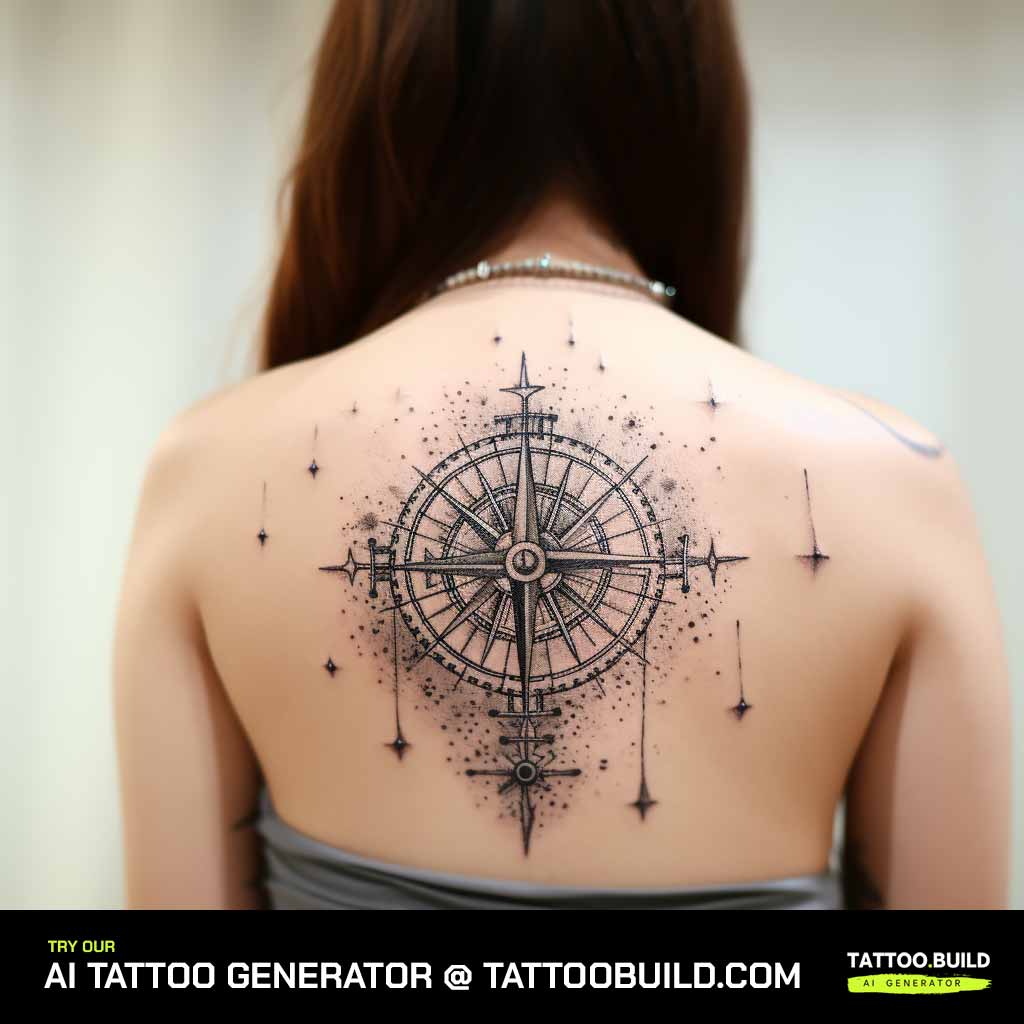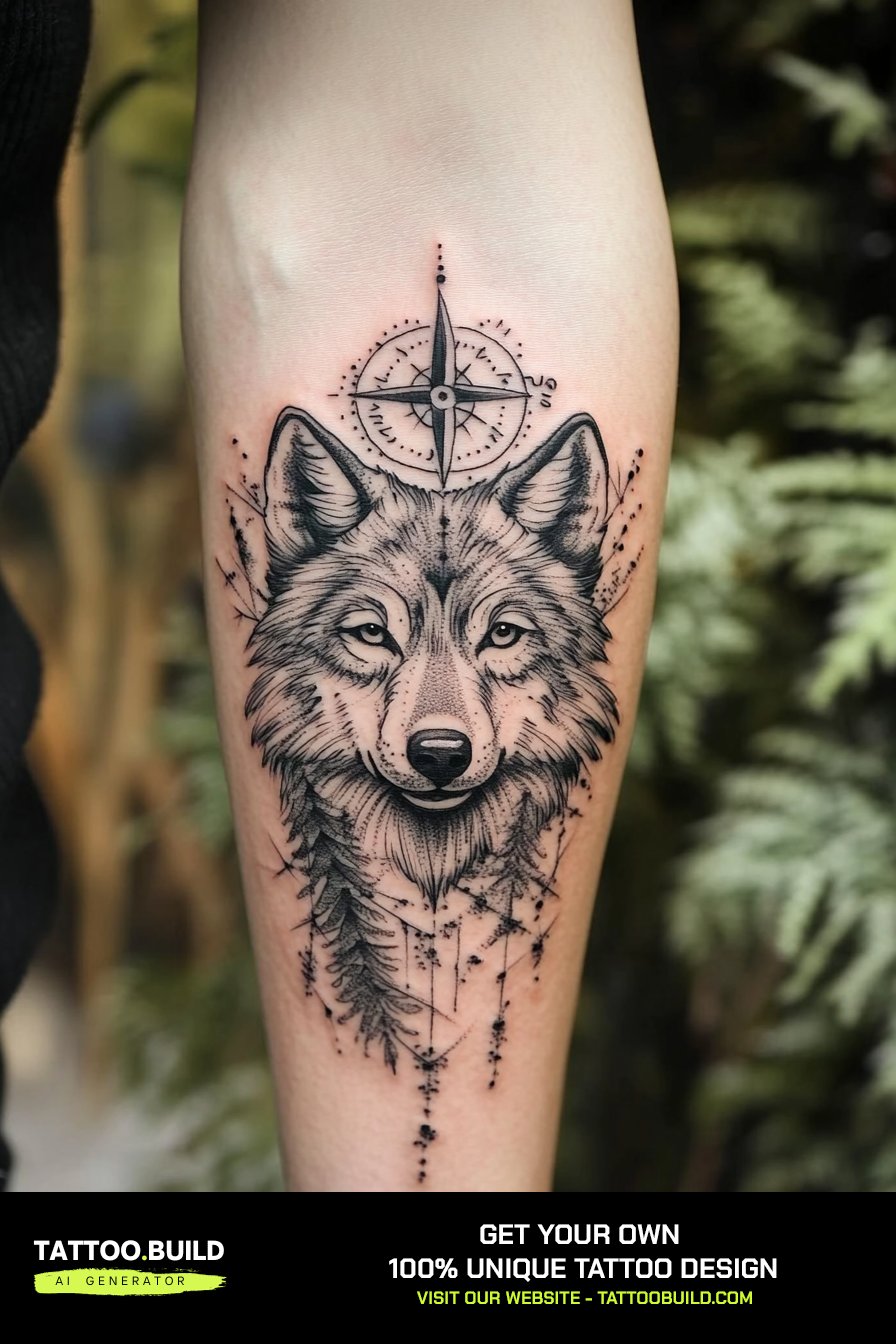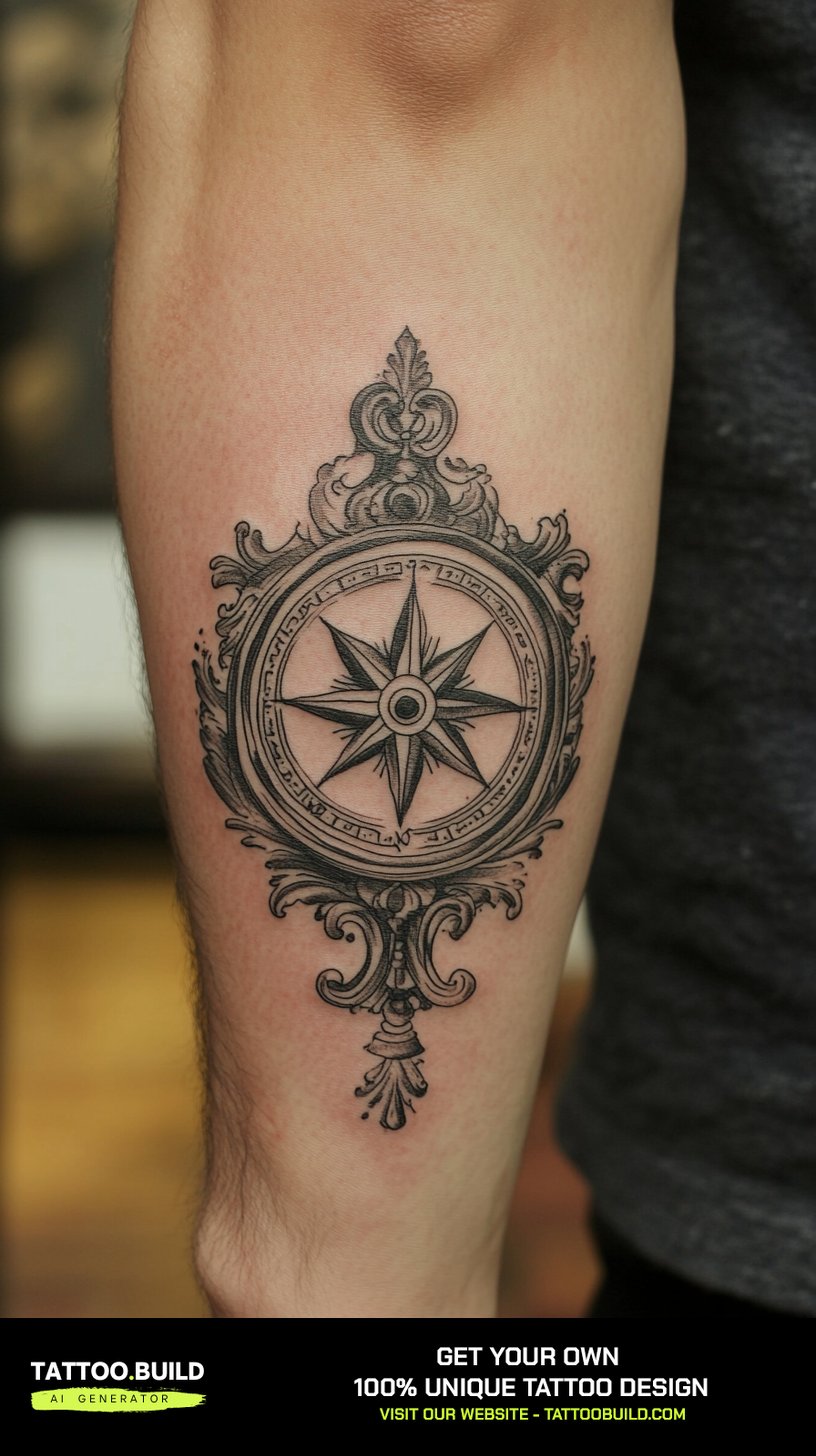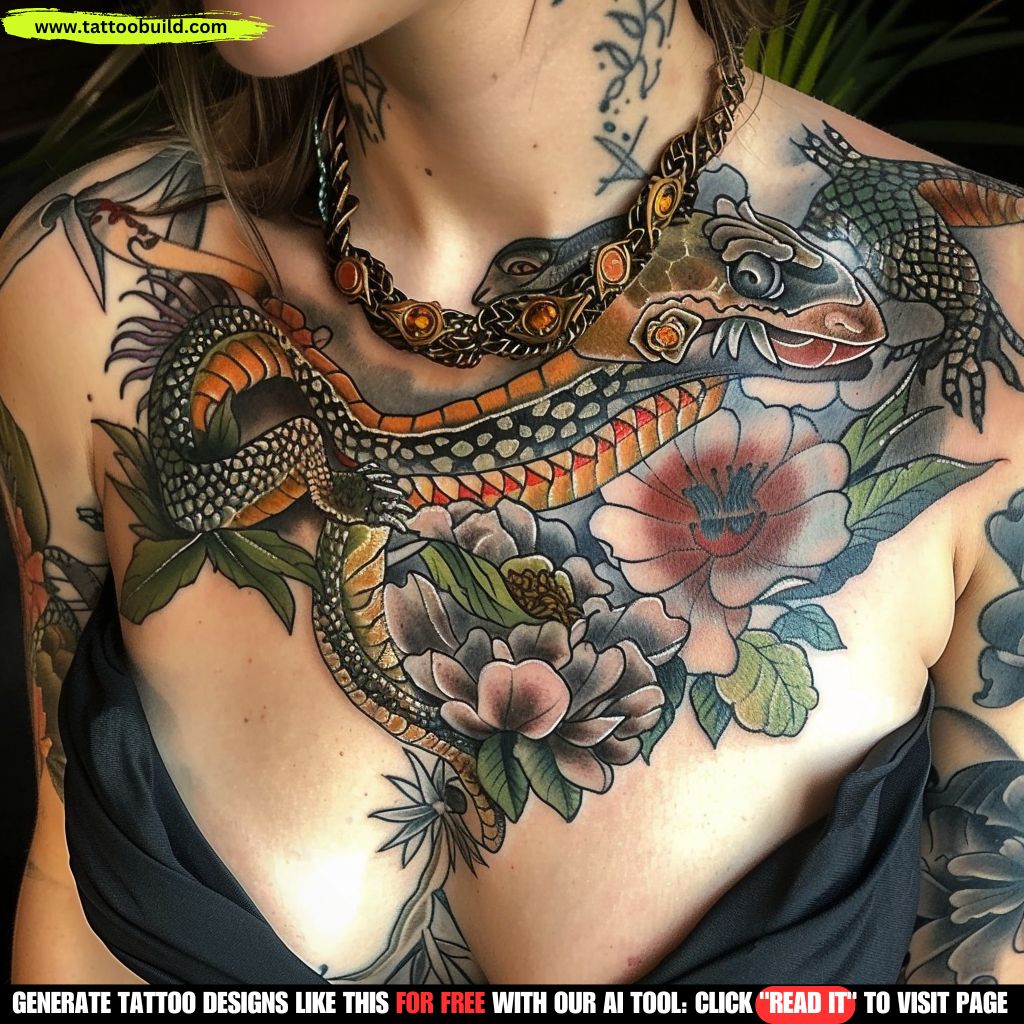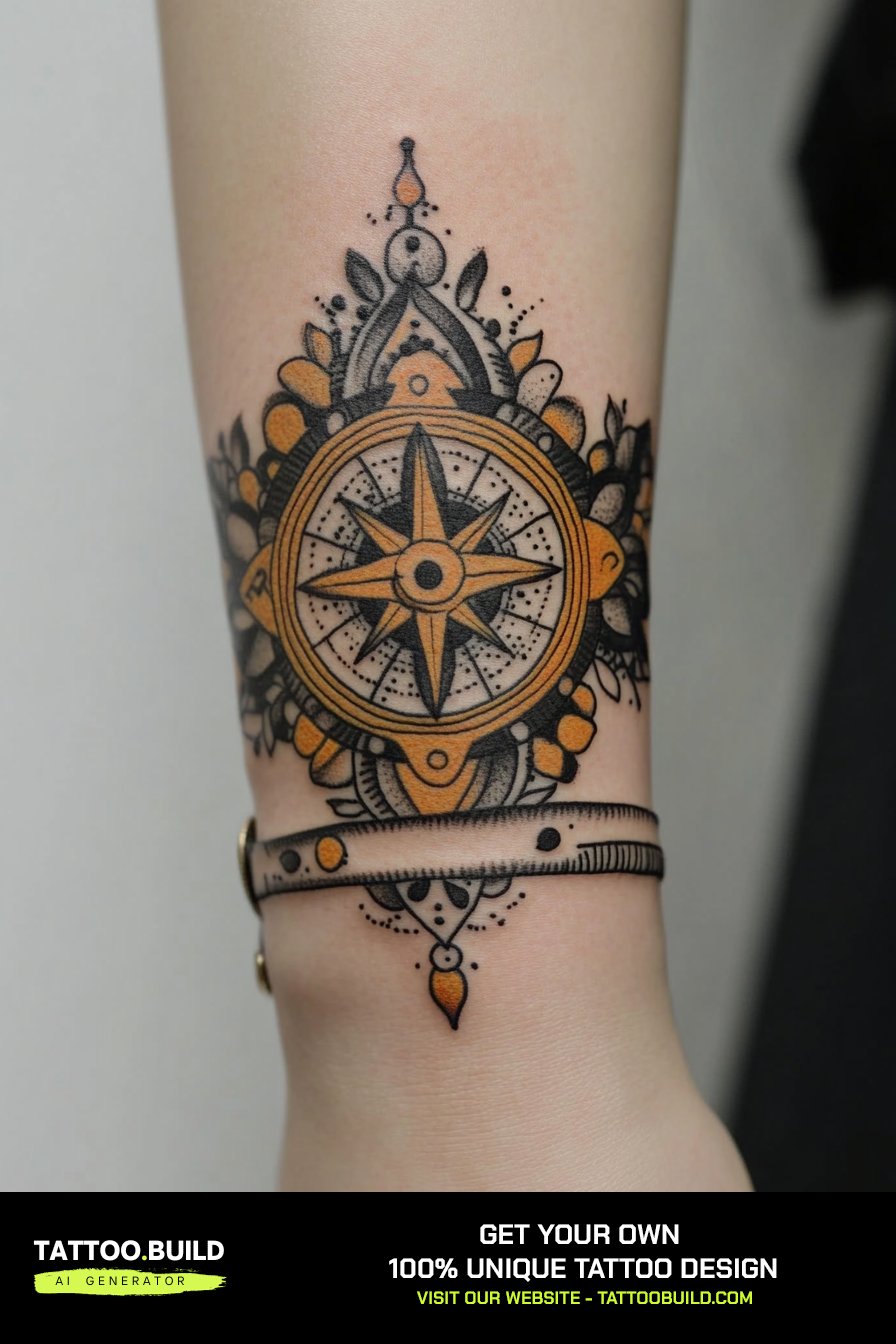
A neo traditional compass tattoo takes the plain sailor compass and rebuilds it with heavy outlines, deep colour and the kind of ornamental detail you normally only see in art nouveau posters.
I have been writing about and photographing tattoo styles for years, and the compass is the design I see re-drawn more often than almost any other.
The neo traditional treatment is what saved it from becoming a cliché. Instead of a thin outline and a bit of grey wash, you get a bold black frame, a jewel-tone dial and layered petals or feathers spilling out of the bezel.
Below are more than thirty designs I have collected, plus what I have learned from artists about placement, cost, ageing and the mistakes that make a compass go muddy. If you want a wider view of the shape first, the general compass tattoo designs guide is a useful starting point.
Which Compass Tattoo Style Is Right for You?
Most people arrive knowing they want a compass and not knowing which style will hold up on their skin. This is the comparison I sketch out for anyone who asks.
| Style | Line & Colour | Best Size | How It Ages | Suits You If |
|---|---|---|---|---|
| Neo traditional | Bold outline, varied line weight, rich saturated colour | 4 in / 10 cm and up | Usually very well — the heavy frame holds the shape | You want colour and detail that stays readable |
| American traditional | Uniform bold outline, flat limited palette | 3 in / 7.5 cm and up | Excellent, the most forgiving of all | You want the simplest, longest-lasting version |
| Blackwork | Black only, heavy fill and negative space | 3 in / 7.5 cm and up | Very well, though solid fill may need a touch-up | You prefer graphic contrast over colour |
| Fine line | Thin single-weight lines, little or no fill | Any, often small | Softens fastest; expect blur over years | You want something subtle and discreet |
| Realism | No outline, tonal shading, brass and glass texture | 6 in / 15 cm and up | Loses contrast without care and touch-ups | You want an object that looks physically real |
In my experience the neo traditional row is the safe middle: more visual interest than American traditional, far more durable than fine line.
What Actually Makes a Compass Tattoo Neo Traditional
Neo traditional is not just “traditional but prettier”. It has rules, and once you can see them you cannot unsee them.
The first is line weight variation. A traditional compass uses one thickness everywhere; a neo traditional one thickens the outer bezel and thins the internal needle and tick marks, which is what gives the design depth without shading.
The second is palette. Neo traditional leans on jewel tones — teal, ochre, plum, forest green — instead of the red, yellow, green and black of the older style.
The third is decoration borrowed from art nouveau and art deco: filigree, gemstones, drop pearls, stained-glass panelling. When artists I have spoken to describe a compass as “neo trad”, this ornamental layer is almost always what they mean.
The fourth is subject blending. A neo traditional compass is rarely alone — it grows roses, mountains, waves or animals out of its frame, which is why it works so well as the anchor point of a larger piece.
30+ Neo Traditional Compass Tattoo Ideas Worth Stealing
These are grouped by what the compass is paired with, because that is the decision that actually changes the design.
1. Compass and Rose Combinations
The rose is the compass pairing I see most often, and there is a reason it works. A rose is round, layered and roughly the same visual weight as a compass dial, so the two shapes balance instead of competing.
In neo traditional hands the rose stops being a flat red spiral and gains real petal separation, with darker plum in the recesses and a lighter coral on the outer edges.
The symbolism doubles up nicely too — the compass reads as direction, the rose as love or memory, so together they usually stand for someone or something that keeps you oriented. If you want to see the flower on its own first, browse these rose tattoo ideas.
My one caution: ask for space between the petals and the compass bezel. When those two elements touch, the piece tends to blur into a single blob after a decade.
2. Full Colour Thigh Pieces
The thigh is the placement I recommend most for a first big neo traditional compass. It is flat, it is wide, and it is one of the least painful large areas on the body for most people.
It also gives an artist room to go past 8 inches, which is where neo traditional detail really starts to earn its keep.
Every artist I have asked says the same thing about thigh work: the skin there takes colour beautifully but it stretches, so a design that sits partly on the inner thigh can distort more than one on the front or outer quad.
If placement is the open question rather than style, this collection of thigh tattoo designs shows how differently the area can be used.
3. Upper Arm and Shoulder Compasses
The outer bicep and shoulder cap are the classic compass spots, and they suit a circular design almost too well — the curve of the muscle lets a round dial sit naturally.
When I tested placements by drawing stencils on friends, the outer bicep was the only one where a compass looked correct from both the front and the side.
Shoulder placement also makes a compass an easy anchor for a future sleeve. Artists often plan the compass first and grow waves, roses or a map outward from it over several sessions.
Expect roughly 3 to 5 hours for a detailed colour piece at this size, and budget for a second session if you want heavy colour packing done properly rather than rushed.
4. Nautical Compasses with Ships and Waves
The nautical version keeps the compass closest to its original meaning: safe passage, a way home, a job at sea.
Neo traditional treats the ocean as flat stacked shapes rather than realistic water, with white caps drawn as solid highlights instead of blended spray. It reads far better from a distance than realism does.
A ship in the background is the traditional partner, but I have seen equally strong versions with just a rope border and a wave crest cutting across the lower third of the dial.
The anchor tattoo is the other obvious nautical companion, and the two pair well on a forearm running vertically.
5. Blackwork and Muted Palettes
Not every neo traditional compass needs colour. Some of the best I have seen use black with one restrained accent — a dusty green or a faded ochre — and let the line weight do the work.
This approach is the practical choice on darker skin tones, where saturated teal and yellow often do not read the way the flash drawing suggests they will.
It is also the cheaper route. Colour packing is what pushes session length up, so a bold blackwork compass with a single spot colour can come in noticeably under a full-colour version of the same design.
Ask your artist for a healed photo of their blackwork, not a fresh one. Solid black looks perfect on day one on everyone; how it looks at two years is the real test.
6. Compasses with Mountains and Landscapes
The mountain-and-compass combination has become the standard “I travel” tattoo, which means it is worth putting some effort into making yours specific.
The versions that work best replace a generic peak with a real skyline someone can recognise, or set the landscape inside the dial as though you were looking through a porthole.
Neo traditional handles landscape well because it can flatten distant ranges into bands of colour rather than trying to render haze.
I have watched several of these age, and the ones with a clear black frame around the whole scene stay legible far longer than the ones that fade out at the edges.
7. Forearm and Lower Arm Designs
The forearm is the placement most people ask about second, usually because they want to see the tattoo themselves.
A compass suits the inner forearm if it is drawn as a vertical composition — dial at the top, roses or waves trailing down toward the wrist — rather than as a single circle floating in the middle.
The outer forearm handles a larger round design better, and it fades less than the inner arm because it gets more consistent sun exposure only if you use sunscreen, which brings me to the honest caveat: it also gets more UV damage if you do not.
For more of this placement specifically, the compass forearm tattoo gallery is worth a look.
8. Ornamental and Art Nouveau Compasses
This is the corner of the style I find most interesting, and the one closest to where neo traditional came from.
Here the compass stops pretending to be a navigational instrument and becomes a piece of jewellery: filigree scrollwork, drop pearls hanging from the bezel, a faceted gemstone at the centre where the needle pivot would be.
The reference points are Alphonse Mucha and turn-of-the-century poster art, and good artists in this lane will tell you so unprompted.
It demands a competent artist. Ornamental detail is unforgiving — uneven filigree spacing is obvious in a way that a slightly wobbly rose petal never is.
Variations Worth Considering Before You Commit
If the standard compass-and-rose is not quite it, these are the directions I would explore next.
Compass and Animal Pairings
Pairing the compass with an animal shifts the meaning from “direction” to “what guides me”, which a lot of people find more personal.
The wolf is the most common and works because a wolf head fills the space beside a circular dial neatly — see these wolf compass tattoo designs for how the composition is usually solved.
Snakes are the other strong option, because a snake can wrap the outer ring and turn the frame itself into part of the subject. The snake compass tattoo variation shows this well.
Compass with a Clock or Map
A compass with a pocket watch reads as time and direction together, usually marking a date that changed something.
The antique map version leans harder into travel, with the dial sitting over parchment texture and faded coastline detail behind it.
Both add a lot of small detail, so both need size. Under about 5 inches the map lines and the roman numerals tend to merge. If maps are the appeal, these map tattoo ideas cover the shape on its own.
Small and Simplified Compasses
Neo traditional can be scaled down, but only by removing detail rather than shrinking it.
A small version keeps the bold outer frame and the varied line weight, drops the filigree and gemstones, and uses one or two colours instead of a full palette.
This is the version I would suggest for a first tattoo. It costs less, it heals faster, and if you love it you can build outward from it later — a neo traditional compass makes an unusually good sleeve anchor, as this neo traditional chest piece shows in a different placement.
Getting It Done Well: Cost, Sessions and Healing
A detailed colour neo traditional compass is a multi-hour commitment. Most artists I have asked quote by the hour or by the day rather than by the piece, and rates vary enormously by city and by artist demand, so ask for a written quote at consultation rather than trusting a number from an article.
For a rough sense of scale on larger work, this breakdown of sleeve tattoo cost gives a useful frame, though your local rates are the only ones that matter.
On healing: follow the aftercare your artist gives you, not the aftercare you read online, because they know what ink and technique they used. Colour-heavy neo traditional work often scabs more than linework, and picking at those scabs is the single most reliable way to pull colour out and end up needing a touch-up.
Keep it out of direct sun while healing and use a high-SPF sunscreen on it for life once healed. UV exposure is the main cause of colour fading, a point the American Academy of Dermatology makes in its guidance on caring for tattooed skin.
If you see spreading redness, swelling that increases after the first few days, pus, or a fever, that is not normal healing — see a doctor rather than asking a tattoo forum. Allergic reactions to specific pigments, most often red, are uncommon but real, and the US Food and Drug Administration has a plain-language summary of tattoo risks worth reading before a large colour piece.
Common Mistakes I See With Compass Tattoos
Going too small is the mistake that costs the most. A neo traditional compass needs room for its ornamental layer, and shrinking a detailed design instead of simplifying it produces a grey circle within a few years.
Choosing an artist by price rather than portfolio is the second. Ornamental and colour work are specialisms; a brilliant blackwork artist may not be the right person for a jewel-tone compass.
The third is not asking to see healed work. Fresh photos flatter everyone. Healed photos, ideally at a year or more, tell you whether an artist packs colour properly.
And the fourth is copying a design you found online exactly. Bring three or four references and let your artist draw something for your body — the results are consistently better, and every artist I have spoken to prefers it.
Frequently Asked Questions
What does a neo traditional compass tattoo mean?
Most people choose it for direction, guidance or finding your way back to something that matters. The neo traditional style does not change that core meaning, it just adds ornamental and decorative layers to it. What the compass is paired with shifts the reading — a rose leans toward love or memory, a mountain toward travel, an animal toward a guiding instinct. In practice, the meaning is whatever you decide it is, and artists are used to hearing very personal reasons.
How big does a neo traditional compass tattoo need to be?
As a rough guide, around 4 inches or 10 cm is the smallest I would go for a design that keeps recognisable neo traditional detail. Below that the filigree, gemstones and fine tick marks tend to merge as the tattoo heals and settles. If you want something smaller, ask your artist to simplify the design rather than shrink it. A simplified small compass with bold lines will outlast a shrunken detailed one every time.
Does a thigh or upper arm compass tattoo hurt more?
Pain varies a lot between people, so treat any ranking as approximate. Generally the outer thigh and outer upper arm are among the more tolerable large areas because there is more muscle and fat between the needle and bone. The inner arm, inner thigh and anywhere close to bone tend to be sharper. Eating beforehand and booking a session you can sit through without rushing makes more difference than most people expect.
How well does neo traditional colour age?
Neo traditional generally ages better than realism or fine line because the bold outline holds the shape even as colour softens. That said, all colour fades, and how fast depends heavily on sun exposure, skin type and how well the piece healed. Expect that a heavily coloured compass may want a touch-up somewhere in the 8 to 15 year range. Daily sunscreen is the single most effective thing you can do to delay it.
Can I add to a neo traditional compass tattoo later?
Yes, and it is one of the better designs for it. A compass is a self-contained circular anchor, so waves, roses, mountains or map detail can grow outward from it without the original piece looking crowded. Tell your artist at the first session that you may extend it — they will place and frame it differently if they know. Building a sleeve over several sessions from a strong central piece is a common and usually successful approach.
Quick Summary
- Neo traditional means varied line weight, jewel-tone colour and ornamental art nouveau detail — not just a prettier traditional compass.
- Aim for at least 4 inches or 10 cm so the decorative layer survives healing and time.
- The thigh and outer upper arm are the most forgiving placements for a large colour piece.
- Roses, mountains, ships and animals are the four pairings that consistently compose well with a round dial.
- Blackwork with one accent colour is the cheaper, often longer-lasting alternative to full colour packing.
- Choose your artist on healed portfolio photos, not fresh ones and not price.
- Follow your artist’s aftercare, protect it from UV for life, and see a doctor — not a forum — if healing looks wrong.
- A compass makes an unusually good anchor for a future sleeve, so say so before the first session.