The thigh is the most forgiving place on the body for a large floral tattoo, and after years of looking at healed work I still think it is the placement that flatters botanical designs best.
It gives an artist a wide, gently curved panel with no bone directly under the skin, which is why flowers laid out here tend to keep their shape as they settle.
Every piece below is a real floral thigh tattoo, and most of them are black and grey — that is simply what people ask for most often. I have grouped them by flower so you can see how the same placement changes depending on whether you go with a heavy rose or a thin fine line spray.
What follows is the practical version of this guide: what each style costs you in session time, what actually holds up after five years, and where on the thigh each layout tends to sit best.
Which Floral Style Is Right for You?
I put this together after comparing the pieces on this page side by side. Sitting times are rough ranges for a piece roughly the size of a hand span — your artist’s quote is the one that counts.
| Style | How it reads | Best thigh placement | Rough sitting time |
|---|---|---|---|
| Fine line botanical | Light, airy, drawn rather than painted | Front or inner thigh, vertical layout | 2–4 hours |
| Black and grey illustrative | Soft shading with defined outlines; the safest long-term bet | Outer thigh and hip | 4–8 hours, often two sittings |
| Bold blackwork florals | Heavy leaves, high contrast, visible from a distance | Outer thigh, wrapping toward the back | 5–9 hours |
| Full colour | Bright and literal; needs the most upkeep | Outer thigh, where sun exposure is lowest | 6–10 hours plus touch-ups |
| Dotwork / ornamental | Textured, patterned, often symmetrical | Front of thigh, centred | 4–7 hours |
What Actually Decides How a Floral Thigh Tattoo Ages
Two pieces can look identical the day they are finished and completely different four years later. The difference is almost always spacing, contrast and sun.
Petals need open space to stay readable. Ink spreads slightly in the skin over time, so a flower centre packed with thin grey lines will gradually close up into a grey patch.
Contrast is the second factor. Look at how the heavier black leaves in several of these pieces push the pale petals forward — that separation is what keeps a design legible once everything softens.
The thigh also moves and stretches more than an arm, particularly across the front and inner surfaces. In my experience artists compensate by keeping outlines a touch heavier here than they would on a forearm.
As for the sitting itself, the outer thigh is one of the more comfortable large placements, while the inner thigh is genuinely rough — the tattoo pain chart is worth a look before you commit to a wraparound.
Floral Thigh Tattoo Ideas, Flower by Flower
Each of these groups behaves differently on the leg. I have noted what to ask your artist for in each case.
Roses: The Default for a Reason
Roses are the flower I see most often on thighs, and they hold up better than almost anything else because the layered petals give an artist natural places to put deep shadow.
A pair of open roses sized to the upper thigh, like the ones below, fills the space without needing a full leg commitment. The leaf work between the blooms is doing quiet structural work — it stops the two flowers from reading as one shapeless mass.
If you want the piece to sit lower and wrap slightly, ask for the leaves to be extended toward the back of the leg rather than making the roses themselves bigger. More rose tattoo ideas for women are worth browsing before your consultation, because rose styling varies enormously between artists.
Peonies: Soft Edges, Big Coverage
Peonies cover more skin per hour of tattooing than roses because the petal edges are looser and shading can be softer. That makes them a practical choice if you want a large piece without a very long booking.
The trade-off is that peonies rely on delicate mid-greys. In my experience they benefit most from a touch-up around the one-year mark, once the skin has fully settled.
A single large peony at the hemline is one of my favourite layouts on this page — it looks deliberate whether it is covered or not. If peonies are the direction you are leaning, these peony tattoo ideas for women show how differently they can be styled.
Sunflowers: One Bold Subject
A sunflower is a strong choice when you want a tattoo that reads clearly from a distance, because the dark seeded centre acts as an anchor point for the whole design.
The single-flower version works well on the front or outer thigh. The two-flower version below runs from the hip down, which suits anyone who wants the piece to be visible in swimwear but hidden in trousers.
Ask your artist to keep the seed centre textured rather than solid black — solid centres tend to flatten out as they heal, while dotwork or stippling holds its detail much longer.
Wildflowers and Fine Line Botanicals
This is the lightest category here, and the one I most often recommend to people getting their first large piece. Thin stems and small blooms heal quickly and hurt less than solid shading.
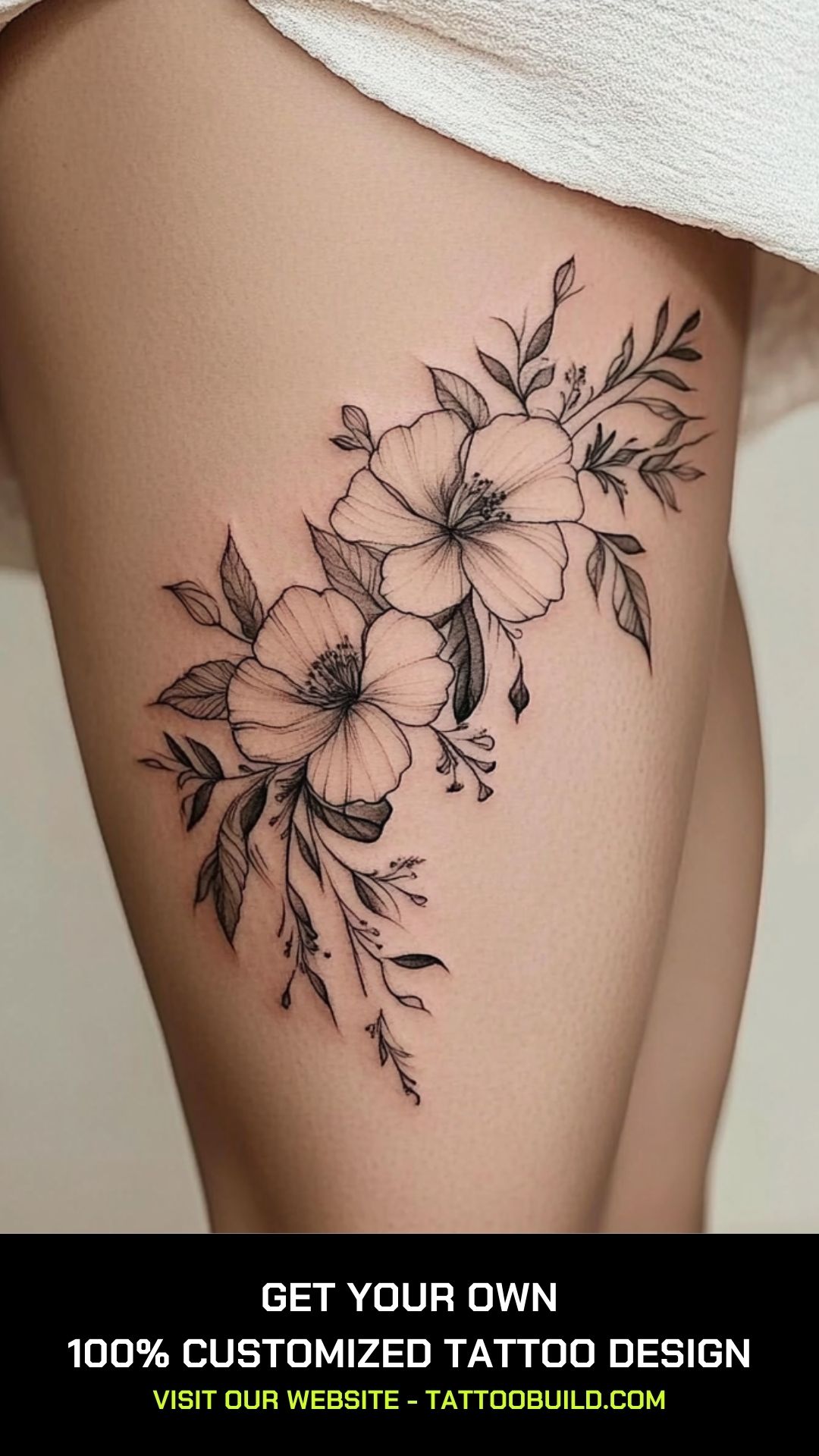
The vertical bouquet layout suits the front of the thigh particularly well because it follows the natural line of the leg.
The honest limitation is longevity: very fine lines soften faster than heavier work, and some fine line pieces need a refresh sooner than a bold design would. That is a fair trade if you like the delicacy of it. There are more wildflower tattoo ideas if you want to see the range.
Blossom Clusters and Sprigs
Blossom clusters sit between fine line and full illustrative work — light enough to feel airy, structured enough to stay readable.
Both pieces below use whip shading, where the artist lifts the needle as they pull, producing a gradient that fades out instead of stopping abruptly. It is what keeps these from looking heavy on the hip.
Every artist I have asked about this style says the same thing: leave the negative space alone. The instinct to fill gaps with extra small flowers is what ruins otherwise good blossom pieces. If this is your direction, cherry blossom tattoos use much the same logic.
Full Colour Florals
Only one piece on this page is in full colour, which reflects what people actually book for thigh work.
Colour is beautiful and it is the highest-maintenance option here. Purples and yellows in particular are the first to fade, and the thigh gets more incidental sun than people expect in summer.
If you want colour, plan for it properly: a good artist will talk to you about pigment choices, and you should expect to sit for touch-ups. It is a commitment rather than a problem.
Flowers Plus a Second Motif
Adding a butterfly, a moth, a snake or a small ornamental detail is the usual way to break up a block of petals and give the eye somewhere to land.
The rule I would apply: one secondary motif, placed off-centre, sized smaller than the main bloom. Two competing focal points on one thigh almost never works.
Placement matters more than the motif itself. Sitting the butterfly above the roses, as below, creates an upward movement that lengthens the whole piece.
Variations Worth Considering
If none of the layouts above fit, these are the directions I would look at next.
The Hip-to-Knee Wraparound
Instead of one contained piece, the design runs the length of the thigh and curves toward the back of the leg. It is a multi-session project and usually the most expensive option here.
It also solves a problem that catches people out: a single flower that looked large on paper can look stranded on a thigh once it is healed.
Building Toward a Leg Sleeve
A lot of floral thigh pieces end up as the first panel of something larger. If there is any chance of that, tell your artist at the consultation — they will plan the negative space differently.
These half leg sleeve ideas show how upper-leg florals get extended downward without the join looking obvious.
Inner Thigh Placement
The inner thigh is the most private placement and, by most accounts including my own, the most painful one on the leg. The skin is thin and the area is sensitive.
Fine line work suits it better than heavy shading, mostly because the sitting is shorter.
Small Florals, Spaced Out
Not everything has to be a statement piece. Three or four small blooms placed with deliberate gaps between them can look more considered than one crowded design — and they are far easier to add to later.
Aftercare on the Thigh: What Actually Matters
Thigh tattoos have one specific complication that arm tattoos do not: clothing sits directly on them all day. Loose trousers or a dress for the first week make a real difference to how cleanly the piece heals.
Beyond that, follow the instructions your artist gives you, since they know what they used on your skin. General guidance from the American Academy of Dermatology covers gentle washing, a thin layer of fragrance-free moisturiser, and keeping the healing tattoo out of the sun.
Long term, sunscreen is the single most useful habit for keeping a floral piece crisp — particularly for colour work. The full tattoo aftercare guide goes through the healing timeline in more detail.
If you see spreading redness, swelling that increases after a few days, pus, or you develop a fever, contact a doctor rather than waiting it out. Allergic reactions and infections do happen; the AAD’s page on tattoo skin reactions describes what to look for. Nothing in this article is medical advice, and your artist and your doctor are the right people to ask.
Common Mistakes — and What to Do If You’re Still Not Sure
The mistake I see most often is going too small. A flower that looks generous on a phone screen can look lost on a thigh, and shrinking a detailed design is how you end up with a grey blur in three years.
The second is booking from a single reference photo. Bring three or four images that show the qualities you want — the shading, the layout, the line weight — and let the artist draw something for your leg.
The third is choosing an artist who does not specialise in the style you want. A brilliant traditional artist and a brilliant fine line artist are not interchangeable.
If you are torn between directions, it usually helps to look at adjacent ideas. Butterfly thigh tattoo ideas are a good comparison point, because they use the same placement with a very different visual weight.
Frequently Asked Questions
How much does a floral thigh tattoo hurt?
Most people find the outer thigh one of the easier large placements, because there is muscle and fat between the needle and the bone. The inner thigh and the area close to the knee are noticeably sharper. Pain is individual, so treat every ranking including mine as a rough guide rather than a promise. If you are worried, book a shorter first session and see how you handle it.
How long does a large floral thigh tattoo take?
For a piece around the size of a hand span, expect somewhere between four and eight hours of tattooing, often split across two sittings. Full colour and heavy blackwork sit at the longer end of that range. Fine line work is usually quicker. Your artist’s estimate at the consultation will be far more accurate than any general figure.
Will a thigh tattoo stretch if my weight changes?
Moderate weight change usually has a modest effect, and most floral pieces tolerate it well because organic shapes distort more gracefully than straight lines or lettering. Larger changes, including pregnancy, can shift a design more visibly. Nobody can predict this precisely for your skin, which is another reason to leave open space in the design.
Is black and grey a better choice than colour for the thigh?
For low maintenance, generally yes. Black and grey holds its contrast longer and needs fewer touch-ups, which is part of why most of the pieces on this page are black and grey. Colour is not a bad decision, it is just a bigger one, involving longer sessions, more diligent sun protection and periodic refreshes.
Can a floral thigh tattoo be extended later?
Usually, and this is one of the strengths of the placement. Flowers and foliage extend naturally in almost any direction. Tell your artist at the first consultation if you might expand it, so they can leave the composition open at the edges rather than closing it off with a border.
Quick Summary
- The thigh is the most forgiving large placement for floral work — wide, curved, and no bone directly under the skin.
- Black and grey illustrative work is the lowest-maintenance choice and makes up most of the pieces on this page.
- Roses and peonies give the best coverage per hour; sunflowers give the strongest read from a distance.
- Fine line botanicals heal fastest and hurt least, but soften sooner than heavier work.
- Full colour is the most demanding option: longer sessions, strict sun protection, planned touch-ups.
- Leave negative space. Crowded petals close up as ink spreads over the years.
- Expect roughly four to eight hours for a hand-span piece, often across two sittings.
- Say at the consultation if you might extend the piece later, so the edges are left open.