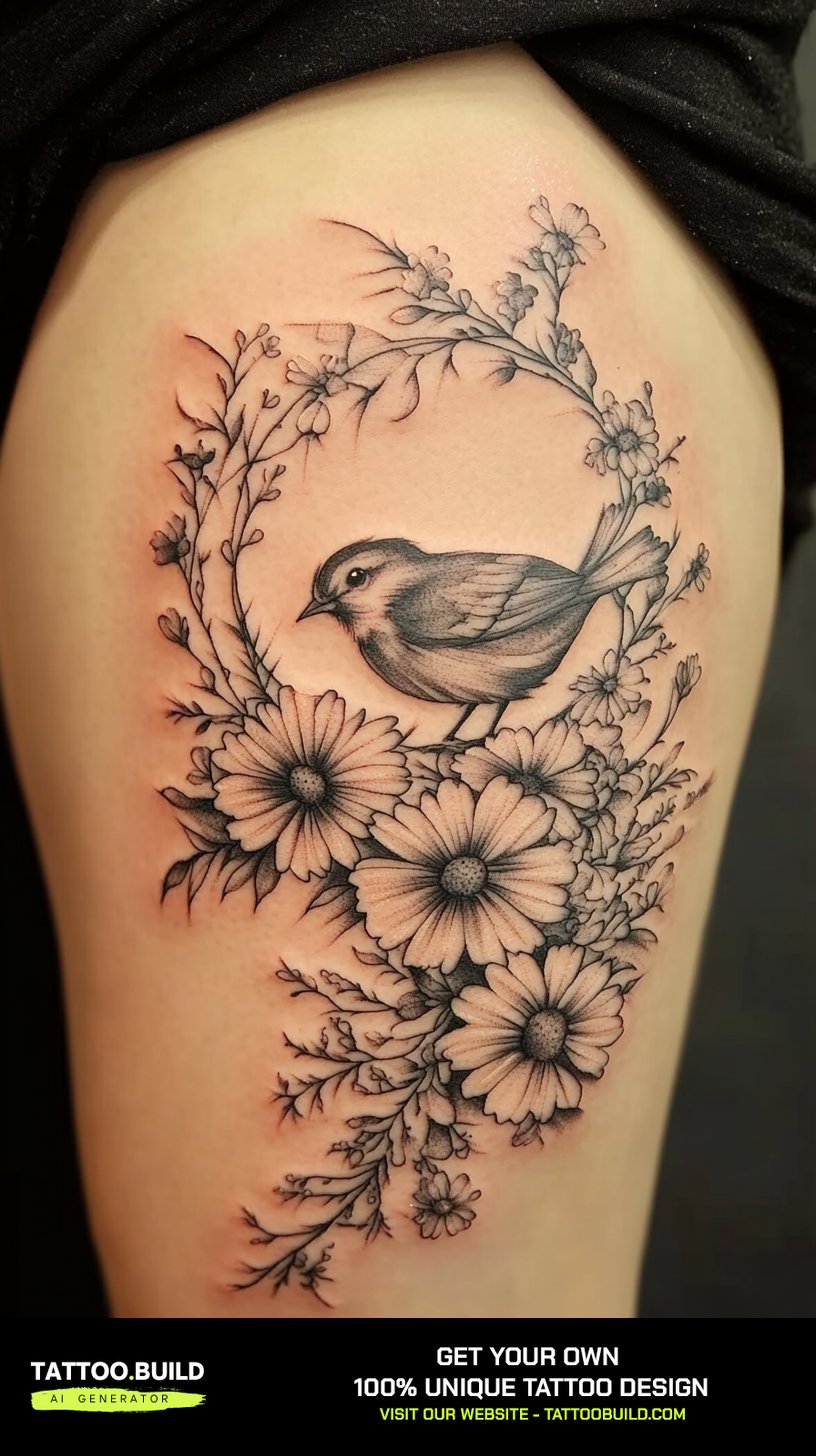
The thigh is the piece of skin I recommend most often when someone tells me they want a flower tattoo but keep hesitating. It gives you a large, gently curved canvas that you control the visibility of completely — covered on a work day, on show at the beach.
I have watched dozens of floral thigh pieces go from stencil to healed, and the ones that age best are almost never the ones that looked busiest on day one.
Flowers work here for a practical reason as much as a poetic one. Petals and stems are curved shapes, and the thigh is a curved surface, so a design that would fight a flat forearm sits naturally on a leg. If you want a broader look at the placement itself before you commit to a subject, this guide to classy feminine thigh tattoos covers the shape and sizing side.
Below are the flower choices I see most often, what each one actually costs in chair time, the styles that hold up over ten years, and the mistakes that send people back for cover-ups.
Which Flower Suits You Best?
Every flower behaves differently under a needle. This is the rough shape of the decision, based on the pieces I have seen sit in a healed state.
| Flower | Common Meaning | Typical Session Time | Best For |
|---|---|---|---|
| Rose | Love, resilience, grief | 3–6 hours | A first large piece that reads clearly from across a room |
| Peony | Prosperity, romance, honour | 4–8 hours | Filling a wide upper thigh with soft, layered volume |
| Lotus | Rebirth, coming through hardship | 2–5 hours | Symmetrical, centred designs on the front of the thigh |
| Sunflower | Warmth, loyalty, optimism | 3–5 hours | One bold focal bloom rather than a crowded composition |
| Cherry Blossom | Impermanence, renewal | 3–7 hours | Long trailing branches that follow the line of the leg |
| Orchid | Rare beauty, refinement | 3–6 hours | Subtle colour work with unusual petal shapes |
| Daisy | Innocence, new beginnings | 1–3 hours | Small, low-commitment starts you can build on later |
| Wildflowers | Freedom, memory, place | 4–9 hours | Scattered, unstructured pieces that grow over time |
Times are chair time, not calendar time. Anything past roughly five hours is usually split across two sittings, because skin stops taking ink cleanly long before you stop being willing to sit.
Why the Thigh Suits Floral Work So Well
The thigh has more soft tissue over the bone than almost anywhere else you would put a large tattoo, and that single fact drives most of its advantages.
More padding generally means a more tolerable session and a cleaner heal, which is why artists so often steer nervous first-timers here rather than to the ribs or the sternum.
It is also wide. A peony that would have to be shrunk to fit a forearm can be inked at the size it was drawn, and detail that survives at full scale is detail that will still be readable in fifteen years.
The trade-off is friction. Thighs rub against each other and against clothing all day, and that matters enormously in the first two weeks of healing — more on that further down.
One more thing worth knowing early: the inner thigh is a genuinely different experience from the outer thigh. The skin there is thinner and considerably more sensitive, and every artist I have asked confirms it is the part of the leg clients ask to stop on.
Flower Thigh Tattoo Ideas, One Bloom at a Time
These are the eight subjects that account for most floral thigh work I see. Each one has a different failure mode, so it is worth reading the one you are drawn to before you book.
Roses on the Thigh
Roses are the default for a reason: the layered petal structure gives an artist somewhere to put contrast, and contrast is what keeps a tattoo legible as it softens with age.
When I have compared healed roses against healed fine-line florals of the same age, the rose almost always wins on readability — there is simply more black holding the shape together.
The mistake is asking for too many. Two or three well-spaced roses with real negative space between them will outlive a solid thigh of a dozen small ones. If roses are where you are landing, there are more compositions in this collection of rose tattoo designs for the thigh.
Ask your artist to draw the darkest shadow first — if the piece still reads as a rose in pure black, the colour will only improve it.
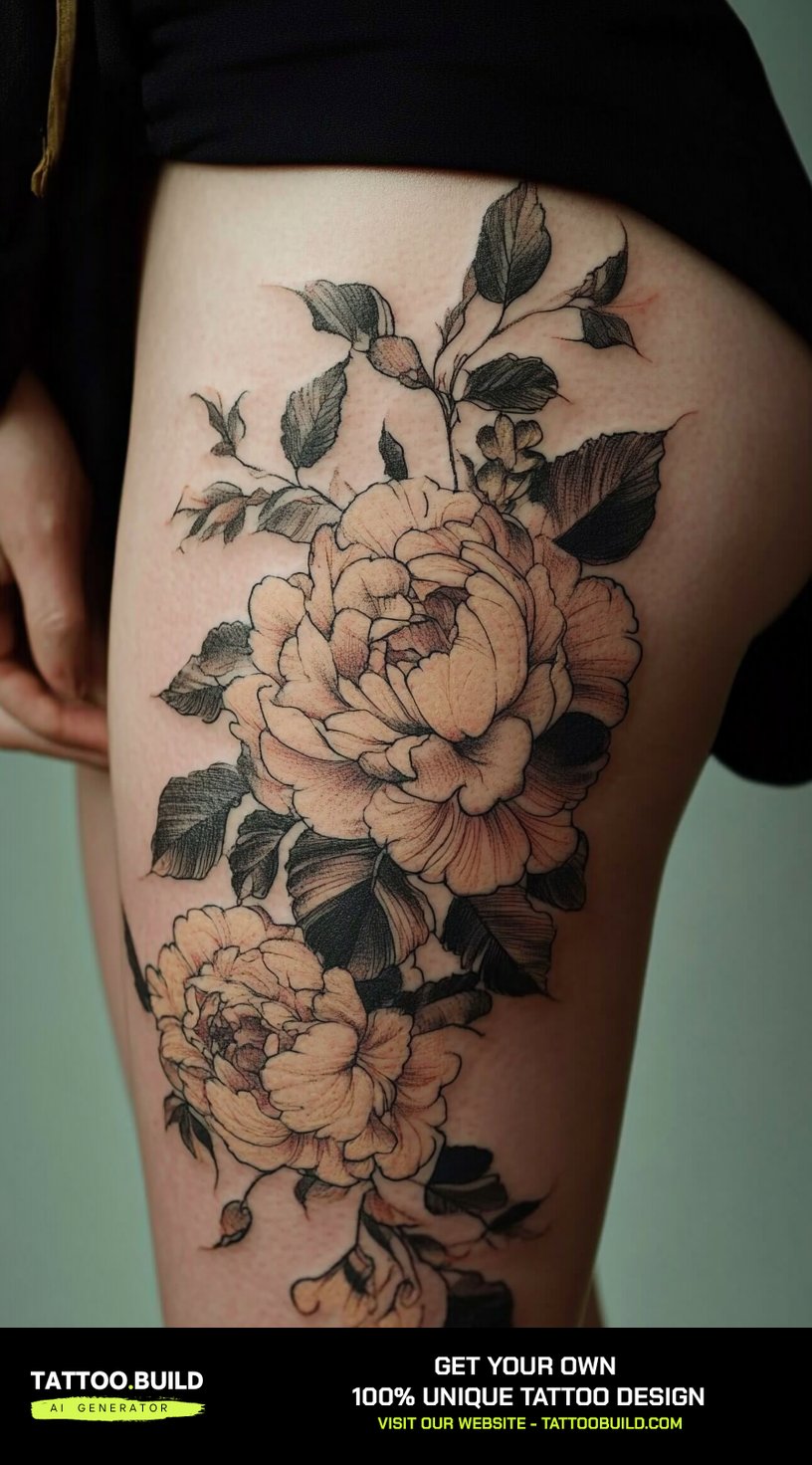
Peonies for Soft, Full Coverage
Peonies are the flower I suggest when someone wants the thigh to look filled without looking heavy.
They are made of many overlapping soft-edged petals, which lets an artist build volume with grey wash instead of hard outlines — the result reads as fabric rather than as a diagram.
They take longer than they look. A single large peony with proper internal shading has taken artists I know four hours on its own, and a three-bloom arrangement can easily run past eight.
Peonies suit the upper and outer thigh best, where there is enough width for the flower to open out rather than getting clipped by the curve of the leg.
Lotus Designs and Symmetry
The lotus is the most symmetrical flower on this list, and that is both its appeal and its risk.
A symmetrical design sits beautifully centred on the front of the thigh, but any wobble in the line work is instantly visible because the eye has a mirror image to compare against. This is not a piece to hand to an apprentice. There is a wider set of options in this guide to the lotus tattoo for women.
Meaning-wise, the lotus carries strong associations with rebirth and coming through hardship across several Buddhist and Hindu traditions — it is one of the few florals people choose for what it says before they choose it for how it looks.
Ask to see healed photos of the artist’s symmetrical work specifically, not just their portfolio of fresh pieces.
Sunflowers as a Single Focal Bloom
Sunflowers photograph brilliantly and heal unpredictably, which is a combination worth understanding before you book.
The dark centre is a large area of packed black or deep brown, and packed areas need a confident hand or they scar and patch. The petals, by contrast, are simple and forgiving.
In my experience the sunflower thigh pieces that hold up are the ones built around one large bloom rather than three or four medium ones. The flower is already visually loud; repeating it dilutes the effect.
If you want colour, sunflowers are one of the strongest arguments for it — the yellow-to-brown transition is where the whole design lives.
Cherry Blossoms and Trailing Branches
Cherry blossom is the best subject on this list for following the shape of the leg rather than sitting on top of it.
A branch can start high on the outer thigh and trail toward the knee, and because the blossoms are small and scattered, the design can be as sparse or as dense as you want without redrawing it.
That flexibility is genuinely useful if you are unsure about size. I have seen people start with a branch and thirty blossoms, live with it for a year, then add more — which is much harder to do with a single large peony.
The small scattered petals are also the first detail to blur, so keep them a little larger than feels necessary and leave clear skin between them.
Orchids for Something Less Common
Orchids are the flower people choose when they have seen too many roses.
The petal shape is asymmetric and strange, which makes an orchid piece look bespoke almost automatically — no two artists draw one the same way.
They do need a competent colour hand. Orchid petals are usually rendered in soft purples, pinks and whites, and pale colours are the least reliable part of any tattoo over decades.
A grey-wash orchid is the safer long-term bet if you are not prepared to go back for touch-ups every several years.
Daisies for a Low-Commitment Start
Daisies are the smallest and cheapest entry point on this list, and I think they are underrated for exactly that reason.
A small daisy cluster can be done in an hour or two, sits comfortably on the outer thigh, and tells you honestly how you feel about having a tattoo there before you commit to a nine-hour piece.
They also combine well later. Several of the large wildflower thighs I admire most started as a small daisy grouping that got built outward over two or three years.
Keep the line weight slightly heavier than the design seems to need. Very fine daisy outlines are among the most common regret-and-retouch requests artists mention.
Wildflower Arrangements
Wildflower thighs are the most personal pieces in this category and the most likely to go wrong without a plan.
The appeal is that you can choose blooms that mean something specific — the flowers that grow where you are from, or the ones from a particular garden. Poppies come up constantly here, and there are more of those in this set of poppy flower tattoo ideas.
The risk is that a collection of individually pretty flowers with no shared composition just looks like a sticker sheet. Every good wildflower thigh I have seen had one dominant bloom and everything else in supporting scale.
Agree the full outline before the first session, even if you plan to fill it over years. Retrofitting a composition around existing tattoos is far harder than planning one.
Styles That Change Everything
The same rose drawn in four styles gives you four completely different tattoos, with different price tags and different ageing curves.
Black and Grey
Black and grey is the most durable choice on this page, and I say that without much hedging.
Black pigment holds its density far longer than most colours, so a heavily shaded grey-wash floral at fifteen years still looks like the thing it was meant to be.
It also suits every skin tone reliably, which is not true of pale pastel work. If you want the darkest end of this look, these black rose tattoos for women show how far the contrast can be pushed.
If you are unsure and want the safest long-term option, this is it.
Full Colour
Colour is louder, more expensive, and more maintenance. All three of those are worth it for some people.
A saturated colour thigh piece takes longer in the chair because packing colour evenly is slower than shading, and it will generally want a touch-up sooner than a black and grey piece of the same age.
It is also the only way to get certain effects. A sunflower without yellow, or a poppy without red, is a different tattoo — not a worse one, but not the same idea.
Budget for a touch-up in advance rather than being disappointed by one. Most artists I know expect colour work to want attention within roughly five to ten years, depending heavily on sun exposure.
Fine Line
Fine line is currently the most requested style and the one I am most cautious about recommending for large thigh pieces.
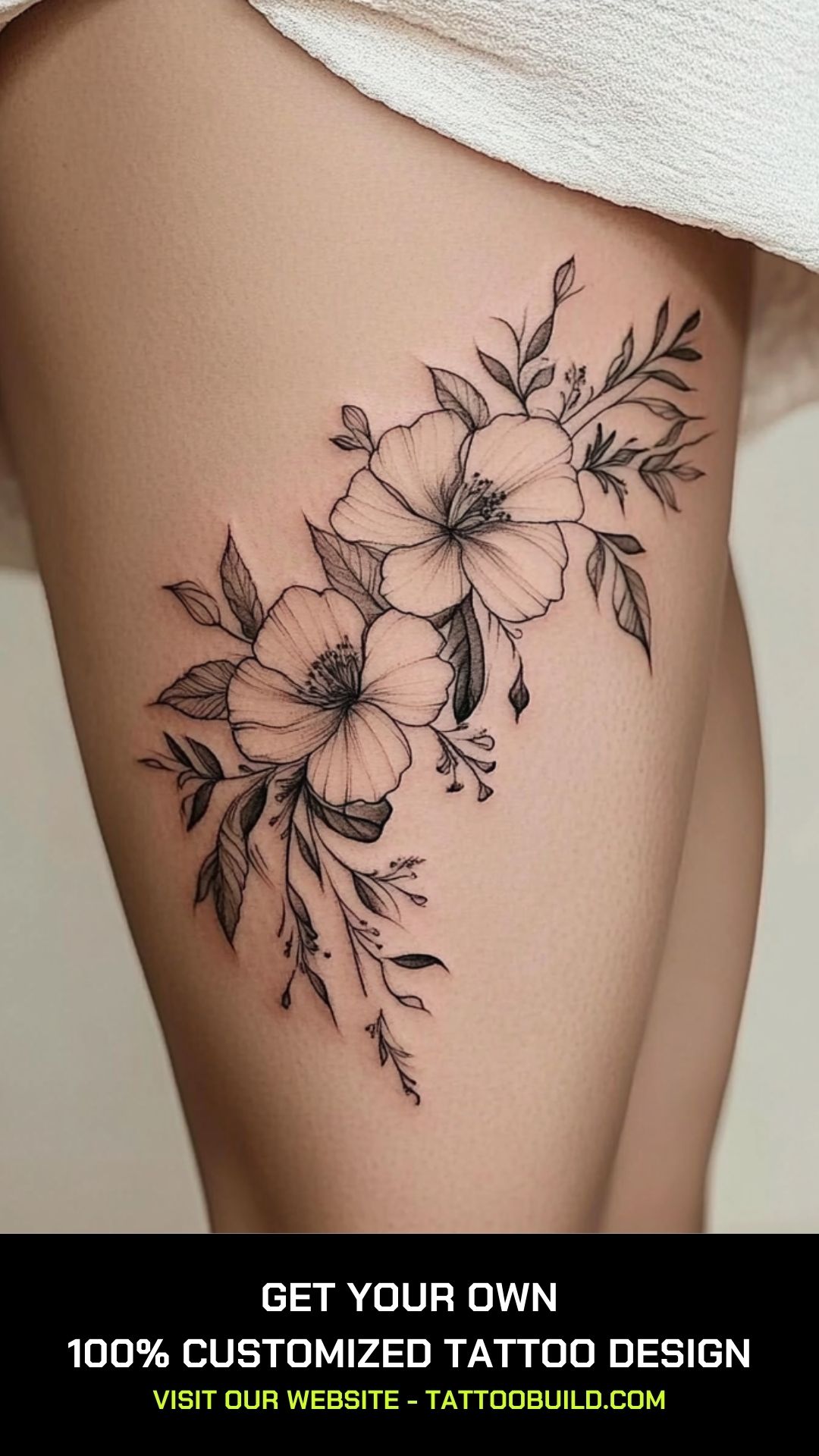
Very thin lines carry very little pigment. On a small wrist piece that is fine; on a large thigh design where the lines also have to survive years of friction from clothing and movement, thin lines can soften into grey haze faster than people expect.
That does not mean avoid it. It means go slightly heavier than the reference photo, leave more space between elements, and accept that a touch-up is part of the plan.
Ask the artist for a photo of their own fine line work at three years old or more. Fresh photos tell you almost nothing about this style.
Neo-Traditional and Illustrative
Neo-traditional is the middle ground I end up recommending most often: bold outlines like old-school work, but with modern shading and a much wider colour range.
The heavy outline is doing structural work. It holds the flower’s shape as the interior softens, which is exactly the problem fine line runs into.
It is also the style that best survives being seen from a distance — relevant for a thigh, which people generally see across a room rather than at arm’s length.
If you want colour but worry about longevity, this is the compromise.
Bigger Variations Worth Considering
If a single bloom is not enough, or the thigh turns out not to be the right spot, these are the directions people usually go.
The Full Thigh Wrap
A wrap runs the design all the way around the leg rather than sitting on one face of it.
It is a serious commitment — typically three or more sessions and a significant cost — and the inner thigh portion is the least comfortable tattooing most people will experience.
The payoff is that there is no awkward edge. A design that stops abruptly on the outer thigh always looks slightly unfinished from behind; a wrap never does.
Do not start a wrap unless you are prepared to finish it. A half-finished wrap is much harder to live with than no wrap.
Flowers Combined With Other Elements
Flowers are the most flexible supporting subject in tattooing, which is why so many thigh pieces pair them with something else.
Animals, portraits, lighthouses, snakes, daggers, script — the flowers frame the subject and fill the space around it, and the composition problem largely solves itself.
The one rule I would hold to is that the flowers should stay clearly secondary. When the floral work competes with the main subject for attention, neither one wins.
Decide what the tattoo is about before you decide what is in it.
If the Thigh Turns Out Not to Be Right
Plenty of people arrive wanting a thigh piece and leave with something else, and that is a good outcome, not a failed consultation.
The hip gives a similar curve with a smaller commitment. The lower leg and calf are easier to keep clean while healing and much easier to show off.
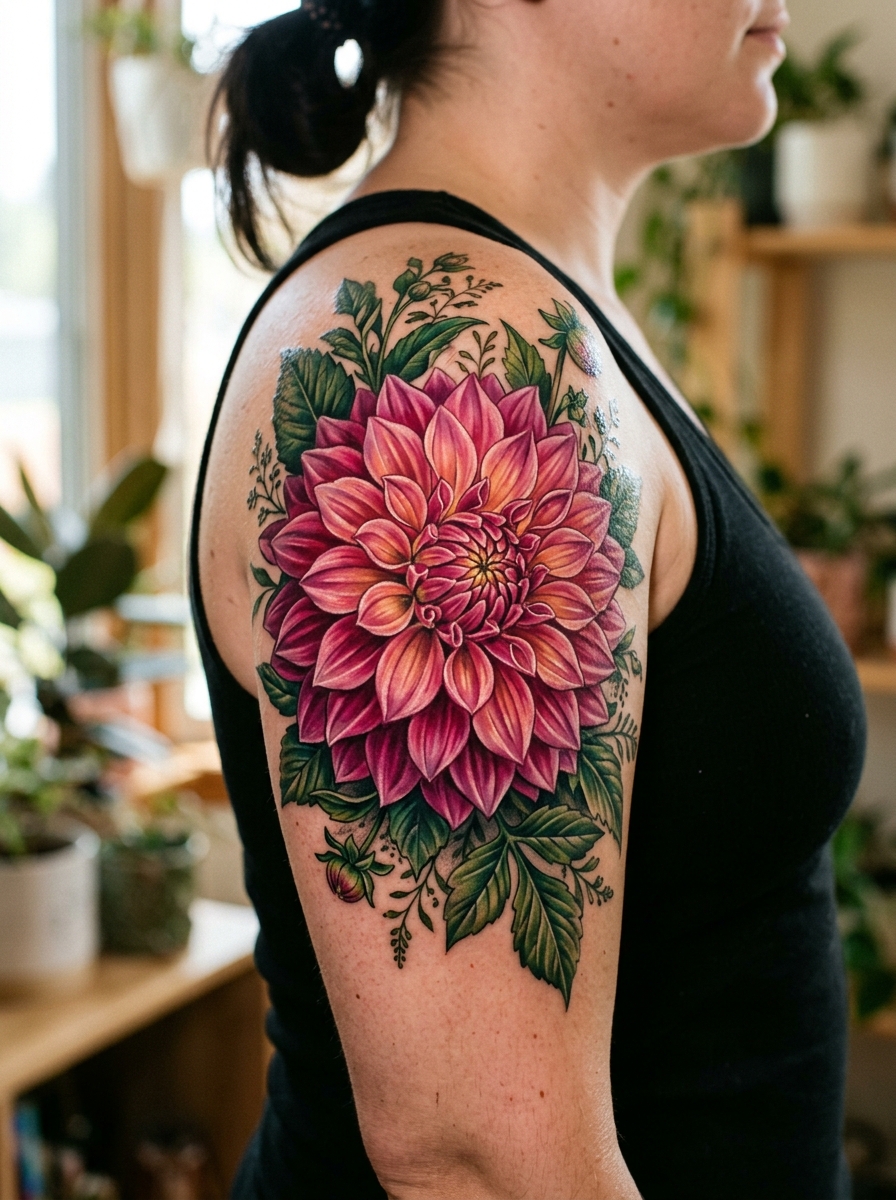
The shoulder is the placement I suggest for anyone who wants floral work visible in everyday clothing rather than hidden by it.
The best placement is the one you will still be happy to look at when the novelty wears off — usually somewhere you see naturally, not somewhere you have to twist to find.
Pain, Healing and Aftercare on the Thigh
The thigh is generally described as one of the more tolerable large placements, but the healing is fussier than the tattooing.
Friction is the whole problem. Thighs rub against each other when you walk and against fabric all day, and a healing tattoo that is constantly being rubbed is a tattoo that can lose pigment in patches.
Practically, that means loose clothing for the first two weeks, no gym leggings, and being deliberate about not sleeping with the healing thigh pressed against the other leg. I have seen more patchy heals caused by tight jeans than by anything an artist did.
Follow the aftercare your artist gives you rather than anything you read online, including here. If you want a reliable general reference, the American Academy of Dermatology publishes plain-language guidance on caring for tattooed skin, and the FDA covers tattoo ink safety and reactions.
Anything that looks like infection is a doctor’s question, not a tattoo forum’s. Spreading redness, heat, swelling that increases after a few days, pus, or a fever all warrant medical attention promptly — and a rash or persistent itching confined to one colour may be an ink reaction worth having looked at.
Once healed, sunscreen is the single highest-value habit. Sun exposure fades colour faster than age does, and the thigh sees a lot of it in summer.
Common Mistakes and What to Do Instead
These are the four regrets I hear most often, in roughly the order I hear them.
Going too small for the placement. A design sized for a forearm looks lost on a thigh. Print the reference at actual size and hold it against your leg before the appointment — it is a two-minute check that prevents a permanent mismatch.
Filling every inch. Negative space is not wasted space; it is what lets the eye find the flower. The pieces that look most expensive are usually the ones with the most clear skin left in them.
Choosing an artist by price rather than by portfolio. Floral work is a specialisation, and someone who does excellent lettering may not do excellent petals. Look specifically for healed floral photos in the style you want.
Booking a nine-hour piece as a first tattoo. Sitting is a skill. Starting with two or three hours tells you something real about your own tolerance before you commit to a full thigh.
Still weighing it up? It is worth browsing wider collections before you commit — this broader set of thigh tattoos for women covers non-floral subjects for the same placement, and if the thigh still feels like too much, rib tattoos for women are the usual next question.
Frequently Asked Questions
How much does a flower thigh tattoo cost?
It depends far more on time than on the flower. Most shops I have dealt with quote by the hour rather than by the piece, so a small daisy cluster at one or two hours sits at the low end while a full thigh wrap across multiple sessions sits at the high end. Hourly rates vary widely by city and by the artist’s reputation, so the only reliable number is the one your chosen artist gives you at consultation. Expect to pay a deposit that comes off the final total, and budget separately for aftercare products and a possible touch-up.
Does a thigh tattoo hurt more than other placements?
The outer thigh is usually described as one of the more manageable large placements because there is a good layer of soft tissue over the bone. The inner thigh is a different story — the skin is thinner and more sensitive, and it is the section people most often ask to pause on. Pain is genuinely individual, so treat rankings as a rough guide rather than a promise. Eating properly beforehand and booking a shorter first session both help more than most of the advice you will read.
How long does a floral thigh tattoo take to heal?
The surface usually looks settled in two to three weeks, but the deeper layers typically keep settling for a couple of months. On the thigh specifically, friction from clothing and from the opposite leg is the main thing that slows healing or causes patchy areas. Loose clothing and following your artist’s aftercare instructions matter more here than at most other placements. If anything looks infected — spreading redness, heat, pus, or fever — see a doctor rather than waiting it out.
Which flower lasts the best as a tattoo?
Roses and peonies with strong black shading tend to age best, because the contrast that holds the shape together is built from black pigment rather than fine detail. Very fine line work and pale pastel colours are the first things to soften over the years. That is not a reason to avoid them, only a reason to go slightly bolder than the reference image and to plan for a touch-up. Sun protection makes a bigger difference to longevity than the flower choice does.
Can I add to a floral thigh tattoo later?
Yes, and scattered subjects like wildflowers and cherry blossoms are especially easy to extend. The key is to have the artist sketch the eventual full shape at the start, even if you only ink part of it now, so later additions fit a plan rather than getting squeezed around what already exists. Going back to the same artist helps enormously with style consistency. If that is not possible, bring clear photos of the existing piece to any consultation.
Quick Summary
- The thigh is a forgiving placement — soft tissue over bone, plenty of width, and total control over who sees it.
- Roses and peonies give you the most reliable long-term readability; daisies give you the cheapest honest test run.
- Black and grey ages better than colour, and bold outlines age better than fine line.
- Leave negative space. Crowded thighs look worse every year; spaced ones look deliberate.
- Print your reference at actual size and hold it against your leg before you book.
- Friction is the main healing risk here — loose clothing for two weeks, no tight leggings.
- Anything resembling infection or an ink reaction is a question for a doctor, not for the internet.
- Choose the artist by healed floral photos in your chosen style, not by hourly rate.