Frida Kahlo-inspired tattoo ideas can begin with color, clothing, flowers or the act of making art. This collection explores 16 original object-based tributes: a palette, a blue garden arch, a floral garment and other personal compositions. Choose the connection you actually care about, then ask your tattoo artist to develop it into a drawing for your body.
All 17 images are AI-generated: 16 distinct design concepts plus a separate forearm placement mockup. They are not photographs of real tattoos or healed client work. The objects are editorial inventions, not verified belongings of Kahlo, reproductions of her paintings or museum-endorsed designs.
Build a tribute around a specific reference
Kahlo was a Mexican painter whose clothing and personal objects also formed part of her public image. The V&A’s account of her wardrobe archive describes garments, jewellery and other belongings preserved at La Casa Azul. Those objects provide a starting point for research rather than a fixed list of tattoo symbols. Source checked October 31, 2026.
Clothing deserves more specific attention than a generic “Mexican” label. In its guide to traditional Mexican dress, the V&A explains that Kahlo combined garments from different regions and discusses the Tehuana clothing she favored. The textile traditions have their own makers, histories and communities; they were not invented by Kahlo. The blouse and skirt below are simplified original studies, not exact regional garments. Source checked October 31, 2026.
For place-based inspiration, the Museo Frida Kahlo’s account of Casa Azul is a useful reference. Our blue architectural vignettes use color and a garden setting as a loose visual connection. They do not document the house’s floor plan, windows or collection. Source checked October 31, 2026.
The strongest brief explains the personal link: admiration for her painting, an interest in self-expression, a museum visit or your own creative practice. A flower or a paintbrush does not carry an automatic Frida Kahlo meaning on its own. Pair the visual idea with a reference you can describe, and let the artist decide how much detail belongs in the final composition.
1. A flower-covered artist palette
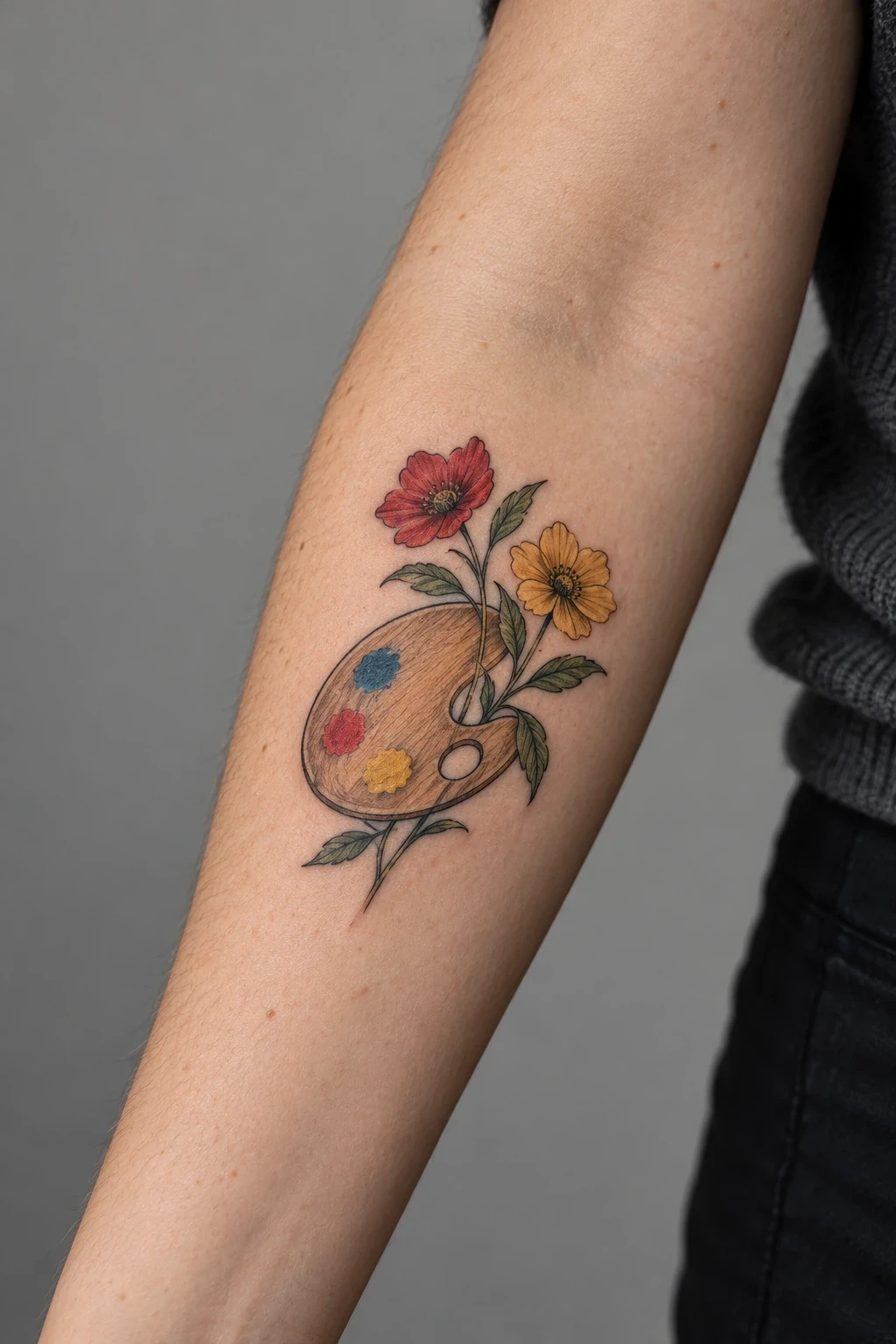
The oval palette creates an immediately readable art-making motif, while the blossoms give it an organic outline. Cobalt, red and mustard paint spots echo the limited palette used throughout this collection. The single thumb hole keeps the object recognisable without needing a hand, a face or an artist’s name.
Use this if your connection is creative work itself. Ask to compare the silhouette with and without the flowers at the proposed size. It is an invented palette, so describe it as your own tribute rather than a drawing of an object Kahlo used.
2. A blue arch with a potted plant
A solid blue arch makes a small garden scene feel contained. The terracotta pot provides a warm counterpoint, and the three leafy stems lead the eye upward through the opening. This option works through architecture and color rather than a recognizable portrait.
For someone remembering a Casa Azul visit, add a detail from their own photographs in consultation with the artist. The illustration is a fictional arch. If you want a particular doorway documented accurately, give the artist a reliable reference and identify the features that matter.
3. A standalone flower garland
Three large blossoms make a crescent with an open center. Red, pink and yellow petals stay distinct against sparse leaves, so the composition can be read as a garland without filling it with a face. The curve is the central design decision here.
Compare its arc with the chosen shoulder, upper arm or other placement before adding smaller flowers. A generic garland is not a unique biographical symbol. Make the connection personal through your choice of flowers and the wider brief, rather than assigning them an invented historical meaning.
4. An empty mirror with climbing leaves
The oval mirror offers a quiet way to explore looking, identity and self-expression. Its center remains empty; the red flower and curling stems carry the decoration. A pale reflection keeps the object readable while avoiding a miniature face inside a busy frame.
Those themes are an interpretation for the wearer to accept or reject, not a quotation from Kahlo. You might prefer plain glass, a darker center or fewer leaves. Keep the handle and frame clearly separated when reviewing the drawing at its actual size.
5. Crossed paintbrushes and one flower
Two brushes form a narrow X, with red and blue tips above and a small yellow blossom below. The crossed handles give the composition direction without the larger mass of a palette. Each brush should remain a separate object through the overlap.
This is a useful starting point if painting is the main personal connection. Ask the artist to preserve the bristle shapes before adding extra paint marks. For a quieter treatment, compare black-and-grey handles with just one colored tip instead of expanding to many colors.
6. A blank sketchbook with a pressed flower
An open book turns the tribute toward private creative practice. The pages are blank and the red flower crosses the central fold, leaving most of the paper unmarked. The design needs a convincing spine and page planes more than it needs a complicated cover.
It does not reproduce Kahlo’s diary or imply that a particular flower was pressed inside it. You can use your own notebook as a reference. If lettering matters, supply verified words separately and check every character on the stencil rather than treating this blank illustration as a text layout.
7. An original green pendant
A dark green oval pendant becomes the main shape, with a small red bead and a loose chain loop around it. Three shallow grooves add structure while keeping the surface abstract. The contrast between the broad stone and fine chain creates the visual interest.
Kahlo’s archive includes jewellery, but this pendant is newly invented. It is not a copy of an archaeological object, a deity or a protective symbol. If you want a particular historical piece, research its origin separately and keep that identity clear in the artist brief.
8. A floral blouse as a clothing study
The square-cut red blouse uses a broad yellow-and-green floral band as its focal point. Its simple sleeves and flat outline leave room for the chest panel to be read. The garment stands alone, without a body or mannequin inside it.
This drawing is an original blouse study, not a claim to authentic regional construction. If a particular textile tradition is central to your tribute, identify it with reliable references and learn about the makers. Avoid blending unrelated ceremonial details simply because they share a bright palette.
9. A teal skirt with a cream ruffle
The skirt makes a tall, flared silhouette, with folds leading down toward the light ruffled hem. A small row of red flowers separates the teal fabric from the cream edge. Compared with the blouse, this design puts more emphasis on movement and the lower outline.
Ask the artist which folds can be simplified without making the garment look flat. This is an invented clothing composition, not a replica of an item in Kahlo’s wardrobe. For a garment with a family or regional connection, use that specific source instead of this generic study.
10. A spool of red thread
The wooden spool and loose thread make a compact sewing still life. A single needle and yellow blossom add contrasting thin and rounded shapes. Keeping the needle beside the spool lets the composition remain about making and mending without showing an injury.
You could connect this motif to your own sewing practice or interest in textile craft. That personal reading should be distinguished from a claim about Kahlo’s own tools. Keep the thread path simple, with enough open space to follow it from the spool to its loose end.
11. A terracotta pot with a red bloom
This garden motif trades the blue architectural frame for a single rounded pot. Broad leaves rise around one red flower, while small decorative arcs give the clay surface some rhythm. The container and plant need to read as one balanced object.
Choose it if you prefer a compact botanical tribute and want the personal connection to stay understated. The plant is a stylized invention rather than an identified specimen from Casa Azul. Your artist could replace it with a plant you actually grow, while keeping the rounded pot silhouette.
12. A red heart between green stems
The simple heart is a graphic shape surrounded by leaves and a small yellow flower. It is deliberately non-anatomical, with no wounds or dramatic imagery. Red against green makes the center clear, while the foliage gives the outline a softer edge.
Use a meaning that belongs to you, such as affection for art or a personal relationship. Do not present this generic heart as a universal Kahlo symbol. If you prefer a subtler reference, reduce the red area and leave the leaf shapes as the strongest part of the design.
13. A pear-and-papaya still life
A yellow pear and a cut papaya form an asymmetrical pair, with dark seeds providing a small area of texture. The green leaves connect the fruit without enclosing it in a frame. It is a fresh still-life arrangement rather than a reduction of a known painting.
This option suits someone drawn to color and everyday objects. Keep the fruit forms recognizable before adding more leaves or shading. The artist can rearrange the objects around the intended placement, and your own favorite fruit may make the tribute more personal than the sample selection.
14. A blank easel with a flower sprig
A small wooden easel gives the design a stronger structural outline than the loose brushes. Its blank canvas is a quiet central shape, with the red-and-yellow sprig and blue ribbon adding color to one side. The support legs should connect in a convincing way.
This can represent an ongoing creative practice without pretending to show a finished Kahlo work. Decide whether the canvas should stay blank before the artist develops the drawing. If you want an image inside it, the scale and detail need a separate review rather than being squeezed into the sample.
15. A blue ribbon framing flowers
A broad ribbon curves into an open oval, leaving the center clear and gathering a floral cluster near the upper left. The cobalt band gives this design a stronger outer shape than the standalone garland. Two loose ends finish the lower edge.
Keep the folded surfaces readable before considering any lettering. The ribbon is not an attributed quotation banner or historical emblem. It can work as a color-focused tribute, or the artist can build a more personal composition around the empty center while preserving the clear loop.
16. A blue window with a trailing vine
The open shutters turn a small architectural detail into the main subject. A potted vine rests on the sill, breaking the straight lines with leaves. Blue and ochre create a contained color contrast, distinct from the rounder garden arch earlier in the collection.
This is a fictional window, not a measured depiction of Casa Azul. Choose it for a place-inspired atmosphere, or substitute a window from a meaningful photograph. Review the perspective of the shutters and the support beneath the pot so the vignette still makes sense when simplified.
Choose one focal object and a workable scale
Begin with the outer silhouette: a broad palette, a tall skirt, a curved garland or a rectangular window. Compare it with the area you want tattooed and any existing work nearby. A tall object may need a different orientation from a wide one, even when both use the same colors.
Ask the artist to show the drawing at the actual proposed size. Small chains, thread, flower centers and papaya seeds can quickly become the busiest parts. Simplifying secondary details may preserve the idea more effectively than shrinking every mark together. For more comparison, explore our minimalist tattoo ideas and patchwork tattoo ideas.
Keep color, context and interpretation clear
The mockup cannot predict how these colors will look on your skin or how a finished tattoo will settle. Ask to see the artist’s own work and discuss their approach to outline, shading and color. The illustrations show proposed compositions, not evidence of a technique’s results.
For a floral direction, compare our wildflower tattoo ideas. If saturated color is the main attraction, our colorful tattoo collection offers other compositions to discuss. Carry the reference you care about into the brief rather than treating any flower or blue object as automatically connected to Kahlo.
Prepare a clear artist brief
A useful brief might say: “An original artist palette with two flowers, a small cobalt accent and clear black contours, placed on the outer forearm.” Add the personal reason for the tribute, references you have checked and details you want preserved. Discuss the final stencil and ask the artist for aftercare instructions.
Frida Kahlo-inspired tattoo questions
Is the artist’s name Frida or Frieda Kahlo?
The artist is commonly known as Frida Kahlo; that is the name used by the museums linked here. If you arrived by searching “Frieda Kahlo tattoo ideas,” this is the same intended topic. Verify any spelling separately before adding a name to a tattoo.
Can a tribute work without a portrait?
Yes. It can focus on your connection to painting, clothing, color or a place. These designs explore that approach through objects. Explain the reference in your brief so the final composition has a personal purpose beyond sharing a color palette.
Do flowers or blue windows have one fixed meaning?
No. The meaning depends on your choice and context. The designs here are original interpretations, and the blue windows are fictional. Use the museum sources to distinguish documented references from your own associations.
Are these copies of Frida Kahlo’s paintings?
No. They are new AI-generated concepts using objects and color. They do not reproduce her paintings, show verified personal belongings or depict healed tattoos. Your artist should develop a separate final drawing and review its structure and placement with you.