Wildflowers are not cultivated. They grow where conditions allow — in hedgerows and meadows, along roadsides, in fields nobody is farming any more. That refusal to be arranged is exactly what makes a wildflower tattoo different from a florist-shop floral piece, and it is the single thing most people get wrong when they brief an artist.
I have spent a lot of time looking at botanical work in portfolios, and the wildflower pieces that succeed almost always share one trait: they look picked rather than designed. Uneven stem heights, a bloom facing away from the viewer, a bit of grass that serves no purpose except to be there.
The 21 ideas below cover the full range, from a fine line meadow the width of two fingers to a full watercolour field. Some are single species, some are whole landscapes, and a few are more about placement than about the flower itself.
If you are choosing a species for personal reasons rather than visual ones, it is worth reading about birth flower tattoos first — several birth flowers are wildflowers, and that can settle the decision quickly.
Which Wildflower Tattoo Style Is Right for You?
Style matters more than species here. The same poppy looks like three different tattoos depending on how it is rendered, and each approach makes a different trade between detail now and legibility in ten years.
| Style | Best For | How It Usually Ages | Typical Size to Stay Readable |
|---|---|---|---|
| Fine line | Delicate single stems, meadow strips, small placements | Softens noticeably; thin lines can blur or drop out, so touch-ups are common | 10–15 cm for a multi-species design |
| Botanical illustration | Accurate species, stippled shading, collector-style pieces | Holds up well when stippling is spaced properly; dense dotwork can fill in | 12–20 cm per stem |
| Watercolour | Whole-field impressions, colour-led designs | Soft edges spread; usually still reads because the style is loose to begin with | 15 cm and up |
| Blackwork / silhouette | Thistles, seed heads, strong graphic shapes | The most durable option in most cases — solid shapes stay solid | 6 cm and up |
| Neo-traditional | Bold colour, larger placements, decorative framing | Very well; heavy outlines keep the shapes contained | 15 cm and up |
If you are torn, the honest answer I give people is this: choose blackwork or neo-traditional if you want it to look the same in fifteen years, and fine line if you accept that a touch-up every few years is part of owning it.
What Actually Makes a Wildflower Tattoo Work
Wildflowers have a structural advantage over cultivated blooms: irregular silhouettes, varied heights, and a lot of built-in negative space. Skin is a difficult surface, and negative space is what keeps a botanical design from turning into a dark patch.
The second advantage is scale flexibility. A single chamomile head works at three centimetres; the same species repeated across a thigh works at thirty. Very few tattoo subjects stretch that far without redesign.
Species choice is also genuinely personal in a way that roses are not. Conservation charities such as Plantlife publish species guides for exactly this reason — people want to know what actually grows in the place they are thinking of.
Every artist I have asked about botanical work says the same thing about references: bring photographs of the real plant, not Pinterest screenshots of other tattoos. A photo of the living plant gives the artist the growth habit, and growth habit is what makes it read as wild.
The one limitation worth naming upfront: multi-species designs almost always need more space than people expect. In my experience a five-species meadow below about ten centimetres ends up as an unreadable tangle within a few years.
Meadow and Field Scenes
1. Meadow Scene on the Forearm
A miniature meadow running the length of the inner forearm: grasses, poppies, cornflowers, and cow parsley in fine line. The forearm is a natural strip of open countryside, and the shape of the limb does half the composition for you. Small enough to stay subtle, complex enough to reward close inspection. I would give this fifteen centimetres minimum — below that the species stop being distinguishable. The inner forearm also sees less sun than the outer, which helps fine linework last. If you want more placement options along the same arm, the lower arm floral guide covers how these designs sit on different builds.
2. Poppy Field
Red poppies, the most recognisable wildflower in most of Europe. In a loose watercolour style or a botanical illustration, a cluster brings warmth and movement to almost any placement. The poppy carries its own symbolism around remembrance and sleep, which deepens the design beyond aesthetics — worth knowing before you commit, because people will read it that way whether you intended it or not. Red is also one of the pigments most likely to need a touch-up over time. Our poppy tattoo guide goes deeper on the symbolism.
3. Cornflower and Wheat
Cornflower blue against the dry gold of wheat, or both in black linework. The pairing reads as farmland rather than florist, which is a distinction people feel even if they cannot name it. Cornflower is an arable weed — it belongs with cereal crops historically, and that logic shows in the design. I like this one at forearm or calf scale where the wheat awns have room to fan out. In black and grey the contrast between the round flower head and the spiked wheat carries the whole piece.
4. Cow Parsley and Grasses
Cow parsley is mostly air. That is the point: umbels of tiny white flowers on tall hollow stems, with seed grasses behind. As a tattoo it is almost entirely negative space, which makes it one of the few botanical designs that gets more delicate at larger sizes rather than heavier. It suits ribs, outer thigh, and the back of the arm. Fine line is the obvious choice, but a light stipple gives the umbels a bit more body without closing them up.
5. Wildflower Bouquet
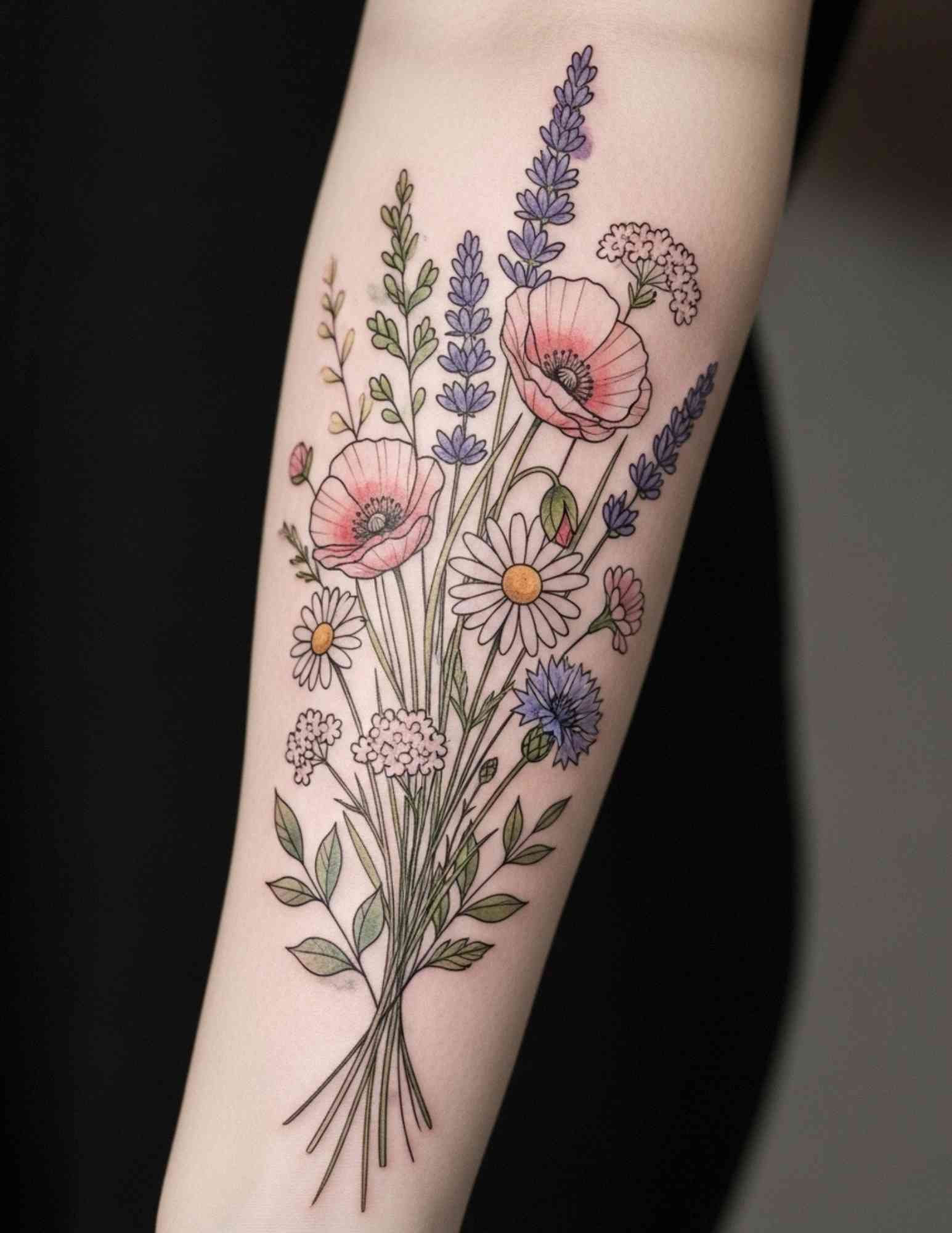
A gathered handful, tied at the stems, as if just picked from a verge. The bouquet format lets you combine species that would never flower together in the wild without it looking wrong, because the act of gathering explains the mismatch. This is the design I most often see people use to commemorate several people at once — one species each. Keep the tie simple; ribbon detail tends to date faster than the flowers do.
6. Watercolour Wildflower Field
A loose wash in the warm palette of a summer meadow, with silhouetted or line-drawn flowers emerging from the colour. The technique suits the subject exactly: wildflowers do not need precision to be recognised, and the impression of a meadow is as powerful as an inventory of its species. Watercolour does spread as it settles, so ask to see healed photos of the artist’s work rather than fresh ones. Anything under about fifteen centimetres loses the wash effect entirely.
Single-Species Wildflower Tattoos
7. Lavender Sprig
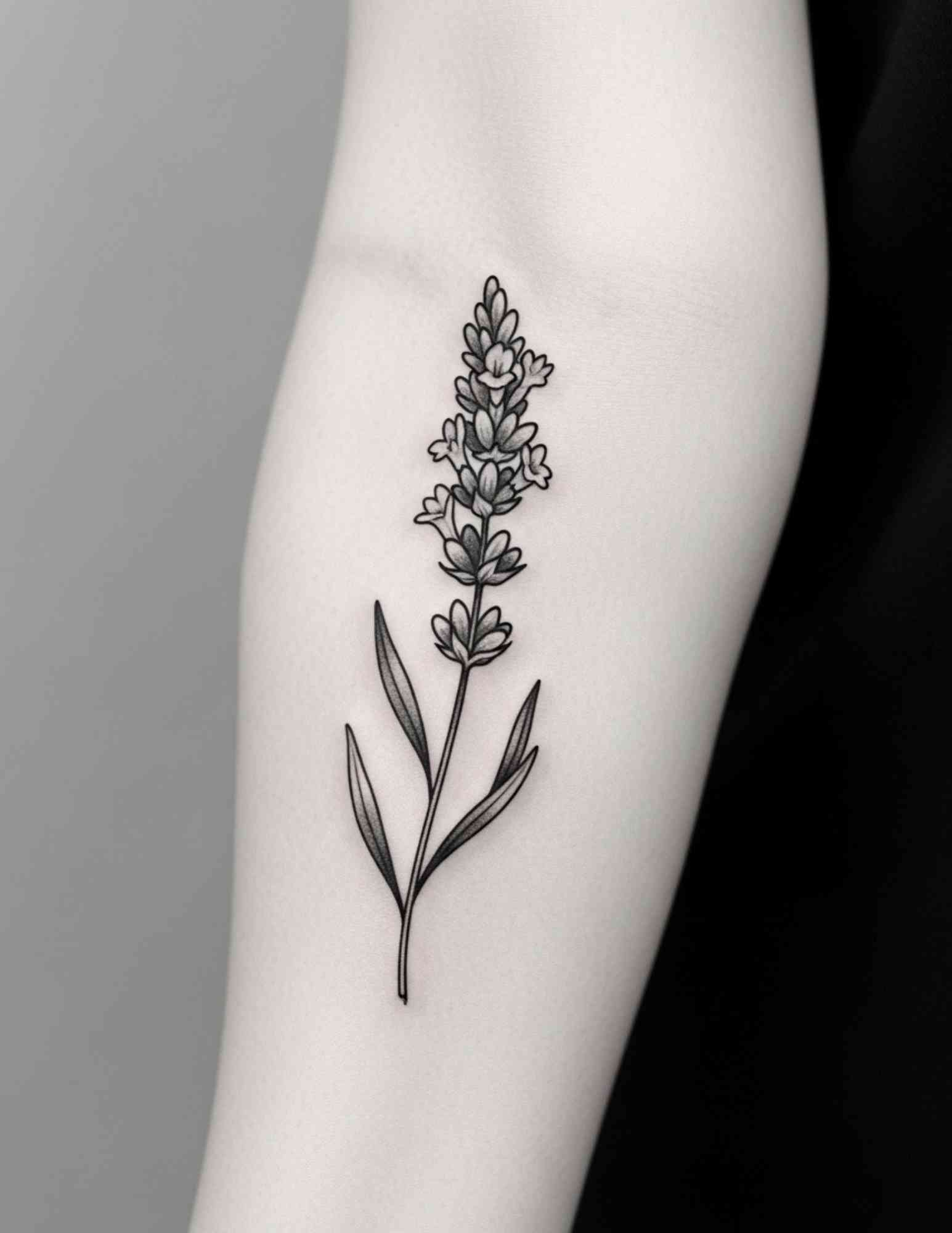
Technically a cultivated escape in much of the world rather than a true wildflower, but it grows wild across the Mediterranean and it behaves like one on skin. A single sprig is one of the most forgiving small botanical tattoos there is: a vertical stem, a repeated bud shape, no complicated silhouette to preserve. It works at five centimetres on a wrist or forty down a calf. See our full lavender tattoo collection for placement variations.
8. Dandelion in Seed
Not the yellow flower but the clock — the seed head mid-dispersal, seeds drifting off across the skin. It is a heavily used design, and the version that still looks good is the one where the seeds are drawn as actual pappus structures rather than generic asterisks. Ask your artist to vary the seed spacing; evenly distributed seeds look printed. The drifting seeds are also the easiest part of any tattoo to extend later if you decide to grow the piece.
9. Wild Rose
Five petals, an open face, visible stamens — nothing like the tight spiral of a florist rose. The dog rose and its relatives are hedgerow plants, and drawing them accurately instantly signals that you meant a wild rose rather than defaulting to the most common tattoo in the world. Add the hips and the thorns; they do more work than the bloom. If the symbolism side interests you, the meaning behind rose tattoos differs meaningfully between wild and cultivated forms.
10. Forget-Me-Not Cluster
Tiny five-petalled flowers in a loose cluster, usually blue with a yellow eye. The species is small enough that spacing matters more than detail: too tight and it becomes a smudge within a few years. In my experience these are best done slightly larger than people first want them — around six to eight centimetres for a cluster of seven or eight blooms. The memorial association is well established, so expect people to assume that is why you chose it.
11. Buttercup and Clover
The two flowers most of us met first, usually while being told to hold one under a chin. Simple round forms, three-lobed leaves, nothing technically demanding — which makes this a good first tattoo. It reads as childhood and common ground rather than anything grand. Fine line keeps it light; a little solid black in the clover leaves stops it from disappearing. Ankle, inner wrist, and behind the arm all suit the scale.
12. Wild Garlic in Bloom
Ramsons: broad pointed leaves and a burst of star-shaped white flowers. Wild garlic reads as woodland rather than meadow, which is a genuinely different mood — damp, shaded, spring rather than high summer. The star-shaped florets give a clean geometric repeat that suits blackwork surprisingly well. For anyone whose attachment to the outdoors is about foraging rather than views, this is the more honest choice than a poppy.
13. Heather Sprig
Dense little bell-shaped flowers packed along a woody stem. Heather is a texture problem rather than a shape problem, and stippling solves it better than linework does — individual flowers drawn one by one usually turn into a solid mass. Moorland and upland associations are strong, especially in Scotland and northern England. A single sprig works at wrist scale; a swathe of heather needs a thigh or a back.
14. Foxglove
Tall spires of bell-shaped flowers, each one spotted inside. Foxglove suits long vertical placements better than almost any other wildflower: spine, outer calf, the side of the ribcage. The nodding curve of the stem gives the design movement for free. Worth stating plainly — foxglove is a genuinely toxic plant, which is part of why people are drawn to it, and that duality reads clearly in a tattoo without needing any extra symbolism layered on.
15. Echinacea
Purple coneflower: drooping ray petals around a raised, spiky central cone. The cone is what makes it interesting to tattoo, because it gives the artist a genuine three-dimensional form to shade in an otherwise flat subject. It holds up well in black and grey for that reason. A prairie native rather than a European meadow plant, so it fits North American landscape pieces more honestly than a poppy field does.
16. Chamomile
Small white daisy-like blooms with a domed yellow centre and feathery foliage. Chamomile is plain, and plain is an advantage here — it stays readable at small sizes where fussier species do not. The calm and rest associations come from its use as a tea, which most people will read immediately. If you like the daisy shape but want other options, the daisy tattoo collection covers the wider family.
17. Thistle
Spiked bracts, a soft purple head, and a strong graphic silhouette. The thistle is probably the most durable wildflower design on this list — the shapes are bold, the contrast between spike and softness is built in, and it ages better than delicate species usually do. The Scottish national association is strong enough that it will be assumed, so choose it knowing that. Blackwork and neo-traditional both suit it.
Placement-Led and Conceptual Designs
18. Wildflower Ankle Bracelet
Small blooms and stems wrapping the narrowest part of the ankle like jewellery. The wrap is the design; the species almost do not matter, though smaller flowers work better than large ones around such a tight curve. Ankles are bonier and usually more tender than forearms, so expect a shorter session tolerance. Our flower ankle tattoo guide has more on how these wraps are laid out.
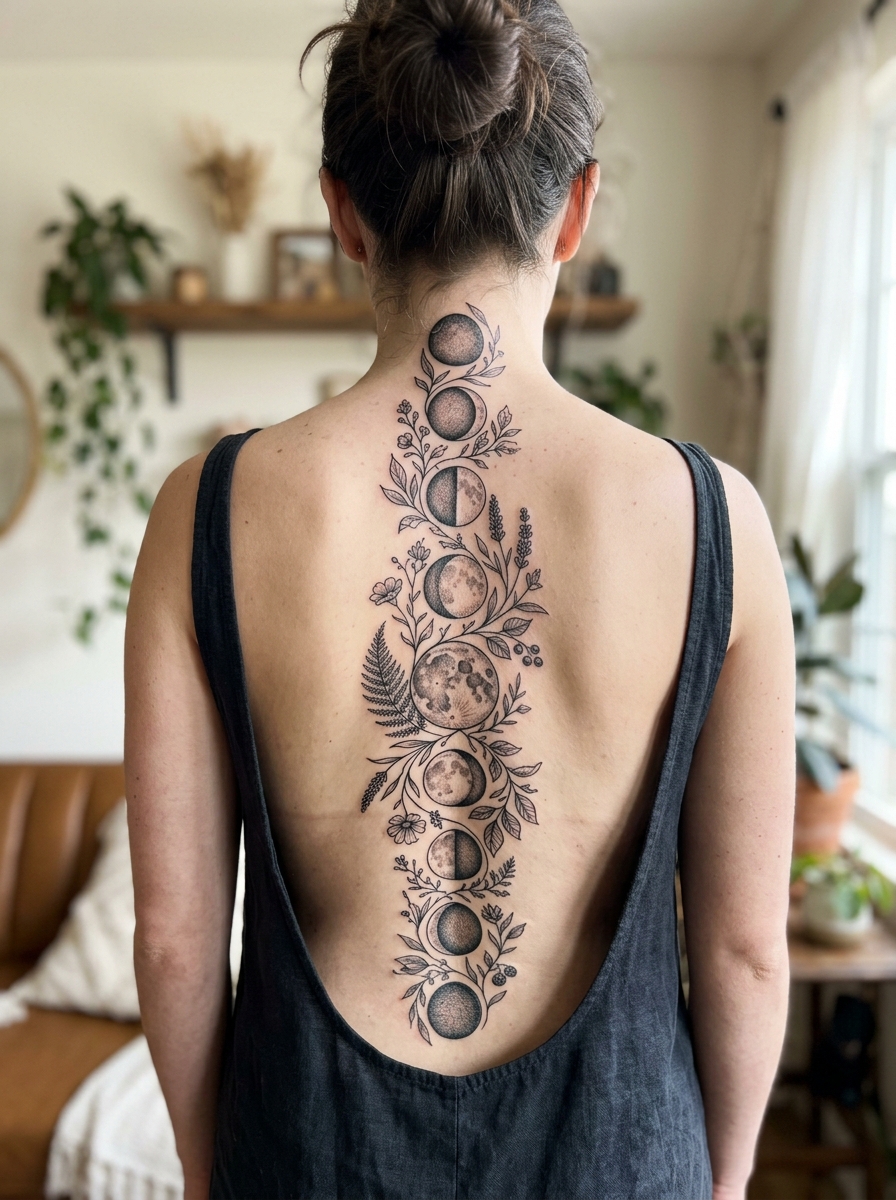
19. Wildflower Spine Piece
A single tall stem or a climbing arrangement following the line of the spine. Anatomically it is one of the best placements for wildflowers, because the vertical growth habit of most meadow species matches the vertical line of the back exactly. It is also one of the more uncomfortable spots for most people, particularly over the vertebrae themselves. Read the spine tattoo guide before booking if this is your first large piece.
20. Seeds and Roots
Not the flower but its beginning and its ending: seeds dispersing upward, roots reaching down, the plant itself implied rather than shown. Focusing on the invisible half of the life cycle produces a more unusual and conceptually interesting botanical tattoo, and it avoids the saturation problem that flower-heads have. Roots also fill awkward tapering spaces — inner bicep, the back of the calf — better than blooms do.
21. A Specific Location’s Flora
The wildflowers native to one place: the moorland where you spent childhood summers, the meadow near a first home, a stretch of coastline you keep returning to. A botanically accurate selection of species from a landscape that matters. The tattoo carries the place without depicting it, which is almost always more interesting than a literal skyline or map. This is the version I most often recommend to people who cannot decide on a single species — the location does the choosing for you.
Variations Worth Considering
If none of the 21 is quite right, these four adjustments change the character of a wildflower tattoo without changing the subject.
Pressed Flower Style
Flat, slightly flattened forms with visible venation, drawn as though taken from a herbarium sheet. It is a distinct look from botanical illustration — less dimensional, more archival — and it suits people who like the idea of a specimen rather than a living plant.
Negative Space and Silhouette
A solid black block with the flowers reversed out of it, or a bold silhouette with no interior detail. This is the most future-proof approach on the list, because there is no fine detail to lose. It works especially well with thistles, seed heads, and grasses.
Colour Versus Black and Grey
Colour makes species identification instant — cornflower blue, poppy red. Black and grey makes the design about form instead. Colour also usually needs more maintenance over time, particularly reds and yellows, and it behaves differently on different skin tones, which is a conversation to have with your artist rather than with a search engine.
Botanical Accuracy as a Deliberate Choice
Some people want the correct petal count and the right leaf shape; others want the impression. Both produce good tattoos, but they need different artists. If accuracy matters to you, look specifically for portfolios that cite botanical or scientific illustration, not just “floral”.
Placement, Sizing and Aftercare
Size first: a single stem can go as small as five centimetres, but every additional species adds roughly another five before things start merging. When I have seen wildflower tattoos fail, it has almost always been a size problem rather than an artist problem.
Placement should follow growth habit. Tall species — foxglove, cow parsley, grasses — want vertical space such as the spine, calf, or outer thigh. Low, spreading species — clover, chamomile, forget-me-not — suit the wrist, ankle, and collarbone.
For healing, follow the aftercare your artist gives you rather than anything you read online, including this. In general terms, fine line work needs particular care against sun exposure once healed, and the American Academy of Dermatology publishes plain guidance on tattoo care and warning signs.
If a tattoo becomes increasingly painful, hot, swollen, or starts weeping after the first few days, see a doctor rather than waiting it out. Allergic reactions to pigment — red is the most commonly reported culprit — can appear weeks or even years later, and that is a medical question, not a tattoo one. Never attempt to remove or alter a tattoo yourself; laser removal is a clinical procedure.
Common Mistakes, and What to Do Instead
The most common one is bringing references that are all other tattoos. Artists end up designing a copy of a copy, and the growth habit that makes a plant look wild gets lost two generations back.
The second is cramming too many species into too little space. Three species done well beat seven done small, in every case I have seen.
The third is treating the arrangement as symmetrical. Wildflowers are not symmetrical, and a balanced, evenly spaced design reads as a bouquet from a shop rather than something picked from a verge.
Still not sure? If the scale is your sticking point, look at how larger botanical work is composed in the fine line sleeve guide or the floral back tattoo collection — seeing the same species at a much bigger size often makes the decision obvious.
Frequently Asked Questions
How much does a wildflower tattoo cost?
It depends far more on size and detail than on species. A single small sprig is usually a shop-minimum piece, while a multi-species forearm meadow in fine line is typically several hours of work. Most artists price either hourly or by the piece, and botanical specialists often have waiting lists that affect availability more than price. Ask for a quote based on a specific size in centimetres rather than a vague description.
Do fine line wildflower tattoos fade faster?
Fine line work generally softens and spreads more visibly than bold linework, because there is less pigment holding the shape. That does not mean it fades away, but it does mean the design looks less crisp over the years and may benefit from a touch-up. Sun exposure accelerates this noticeably. If you want the fine line look, plan for maintenance rather than expecting it to stay sharp indefinitely.
What is the best placement for a wildflower tattoo?
Match the placement to the plant’s growth habit. Tall species with vertical stems suit the spine, calf, outer thigh, and ribs; low spreading species suit the wrist, ankle, and collarbone. Areas with less sun exposure and less friction, such as the inner forearm and upper thigh, tend to hold detail better over time. Your artist will also have opinions based on how your specific skin takes ink.
Can I combine several wildflower species in one tattoo?
Yes, and it is one of the most popular ways to do this — often one species per person being commemorated. The main constraint is space: each additional species needs room to stay distinguishable. In most cases three to five species is the practical limit for a forearm-sized piece, and a bouquet or gathered arrangement handles the mismatch between species better than a growing scene does.
Are wildflower tattoos meaningful, or just decorative?
Both, depending on the wearer. Individual species carry well-established associations — poppies with remembrance, forget-me-nots with memory, thistles with Scotland — and people will read those into your tattoo whether or not you intended them. Many people choose species for personal reasons instead: what grew where they were raised, or what a particular person loved. Neither approach is more valid, but it is worth knowing what your species already signals.
Quick Summary
- Wildflower tattoos read as picked, not arranged — irregular heights and imperfect spacing are the point.
- Blackwork and neo-traditional age most reliably; fine line looks best on day one but needs touch-ups.
- Allow roughly five centimetres per species — three species done well beat seven done too small.
- Match placement to growth habit: tall species vertically, low species on wrists and ankles.
- Bring photographs of the living plant as reference, never screenshots of other tattoos.
- Know what your species already signals: poppy, forget-me-not, and thistle all carry strong existing associations.
- A specific location’s native flora is the easiest way to choose when no single species stands out.
- Follow your artist’s aftercare, protect healed fine line work from the sun, and see a doctor about anything that looks infected or allergic.