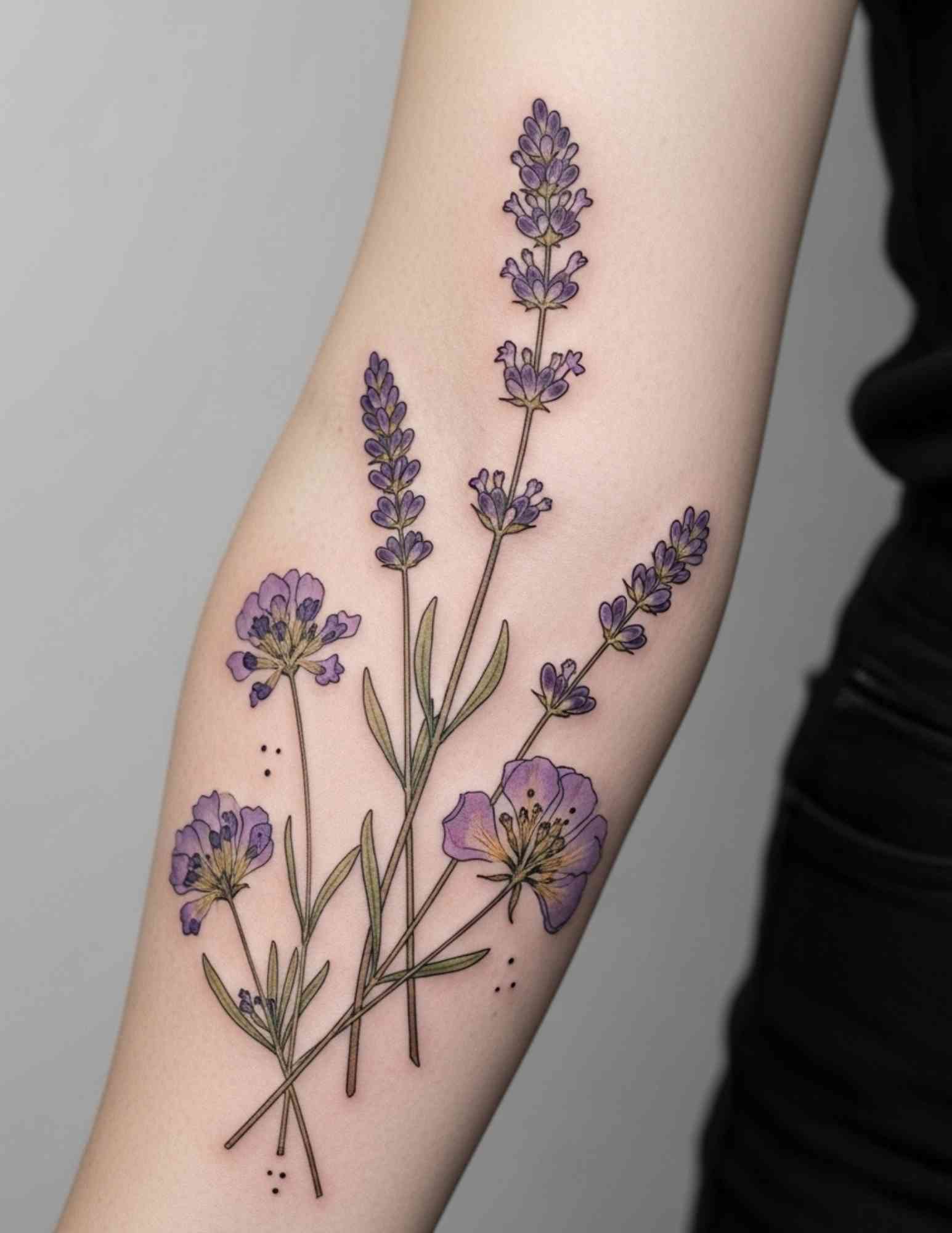
Lavender is one of the few floral subjects that gets easier to tattoo as it gets smaller, and that single fact explains most of its popularity.
The plant is built from a long bare stem carrying a dense spike of tiny florets. That shape is already graphic. It does not need to be simplified into a symbol the way a rose or a peony does, because the silhouette is doing the work before the artist adds a single detail.
I have watched artists reach for lavender when a client wants something floral that will not turn into a purple smudge on a wrist in five years. It sits comfortably beside other single-stem botanicals, which is why it turns up so often in birth flower tattoo collections even though it is not an official birth flower for any month.
Below are 21 directions worth considering, grouped by the decision you are actually making: style first, then placement. In my experience that is the order that saves people from a second consultation.
Which Lavender Tattoo Style Is Right for You?
Every lavender tattoo I have seen age well made a clear commitment to one of these five approaches. The table below is the shorthand I use when someone cannot decide.
| Style | Smallest size that works | Best placements | How it tends to age |
|---|---|---|---|
| Fine line | Roughly 4-5 cm of stem | Inner wrist, collarbone, behind the ear, ribs | Lines soften and thicken; usually the first style to need a touch-up |
| Blackwork silhouette | Roughly 5 cm | Forearm, calf, upper arm, spine | The most forgiving option; solid black holds its edge longest |
| Black and grey shading | Roughly 8 cm | Forearm, thigh, shoulder cap | Light greys lift first, so ask for a wider tonal range than looks necessary |
| Watercolour | Roughly 10 cm | Upper arm, thigh, back, ribs | Soft washes blur further over time; anchor lines help enormously |
| Coloured realism | Roughly 12 cm | Thigh, upper arm, back, shoulder | Purples are among the more fade-prone hues; sun protection matters most here |
Those size figures are working minimums from consultations, not rules. A confident artist can push below them, and a nervous one will struggle above them.
What Actually Makes Lavender Work in Skin
Lavender belongs to the mint family, and like most of its relatives it has a strict, almost architectural growth habit. Stems are straight. Leaves are narrow and paired. The flower spike is a repeating rhythm rather than a mass of overlapping petals.
That repetition is the whole trick. A rose asks the artist to render depth and curvature in a small space, which is where small floral tattoos usually fail. A lavender spike asks for a sequence of small marks along a line, and a sequence stays readable even when the individual marks blur together.
The species most people picture is Lavandula angustifolia, English lavender, described in detail by the Royal Horticultural Society. Bringing a reference photo of a specific cultivar to your consultation is genuinely useful, because the spikes differ noticeably in density between varieties.
Symbolically the plant carries calm, healing, devotion and remembrance across a lot of different traditions. Those meanings are broad enough that I would not lean on them as the reason for the tattoo, but specific enough to be worth knowing.
There is also a practical argument. Lavender scales in both directions without redesign, which means the same drawing can work behind an ear at 3 cm or across a forearm at 20 cm. Very few floral subjects do that.
21 Lavender Tattoo Ideas
I have grouped these by style rather than listing them flat, because the style decision constrains everything that follows.
Minimal and Fine Line Lavender (Ideas 1-3)
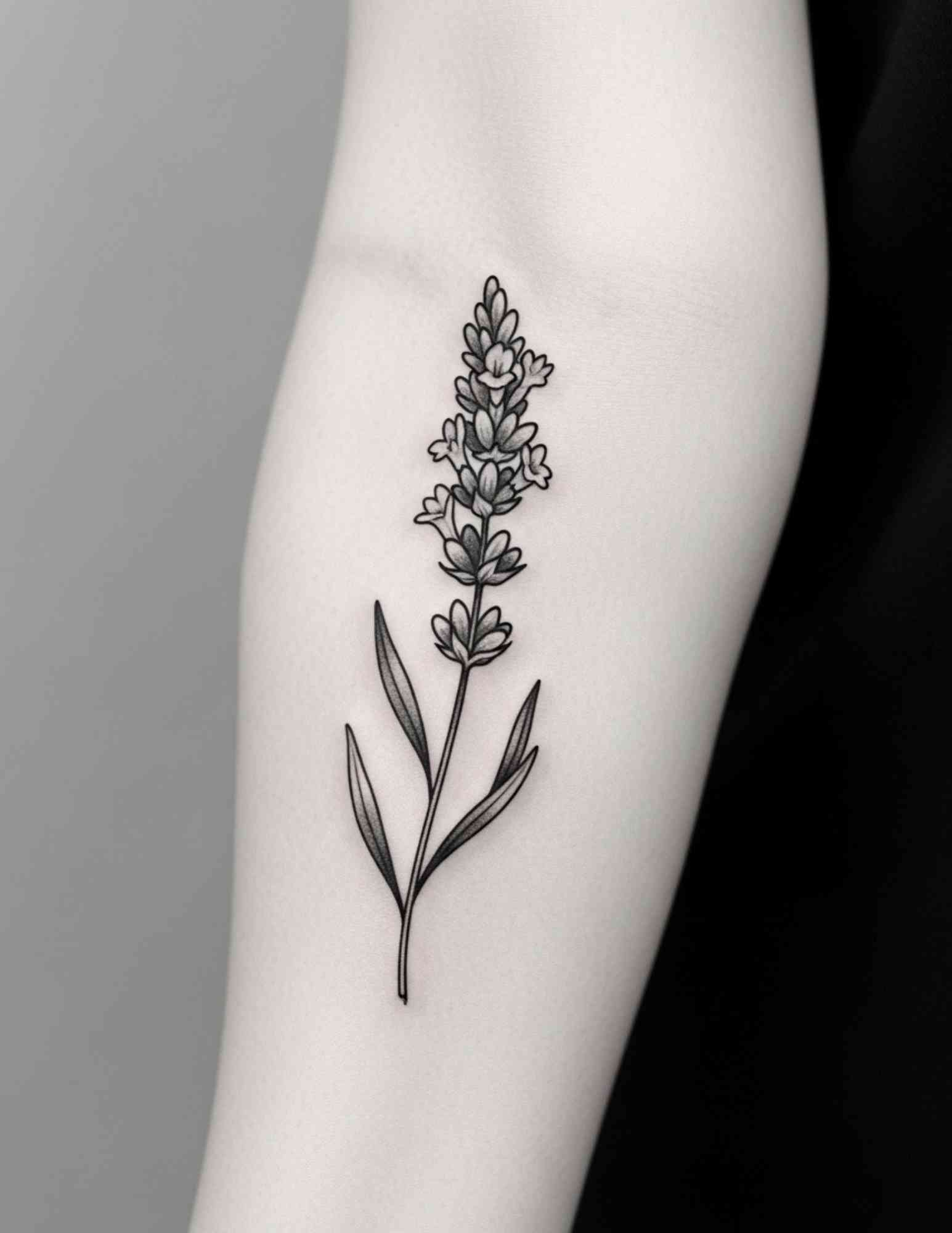
1. Single sprig fine line. One stem, one spike, nothing else. This is the version I recommend to most first-time floral clients: it is quick, it is cheap, and it survives being placed almost anywhere.
2. Minimal line art. The sprig reduced to a handful of continuous strokes, with the florets suggested by short ticks rather than drawn individually. It reads from across a room, which small fine line work often does not.
3. Behind the ear. A 2-3 cm sprig tucked along the hairline. Every artist I have asked about this placement says the same thing: simplify the drawing further than you think you need to, because skin behind the ear is thin and ink spreads.
If you are working at this scale generally, the same design logic runs through most tiny wrist tattoo ideas — fewer marks, more space between them.
Bouquets, Bundles and Wreaths (Ideas 4-7)
4. Loose bouquet. Three to five stems at slightly different heights and angles. The variation is what stops it looking like a stamp; ask your artist to draw it freehand on the skin rather than working from a symmetrical stencil.
5. Bundle tied with twine. Stems gathered and wrapped, the way dried lavender is hung. The twine introduces a second texture and gives the composition a visual base, which helps a lot on vertical placements.
6. Wreath. Sprigs curved into a circle with the stems crossing at the bottom. Round placements suit it: upper arm, back of the neck, between the shoulder blades.
7. Ankle wreath. The same idea wrapped around a much narrower limb. It needs less width than people expect, and it sits alongside most floral ankle tattoo designs without competing with them.
Watercolour and Painterly Lavender (Ideas 8-10)
8. Watercolour field. Loose purple and green washes that read as a field seen at distance rather than a specimen. This one needs room; below about 10 cm the washes have nowhere to develop and it turns muddy.
9. Coloured realism. Layered purples, greens and the greyish cast of the foliage, built up properly. It is the most expensive option on this list and usually the longest sitting.
10. Abstract lavender. The rhythm of the flower spike kept, the botany discarded — geometric marks, broken lines, deliberate gaps. When it works it is the most personal version of a lavender tattoo you can get.
A note I give everyone considering colour: purple pigments are generally among the less stable ones in skin over long periods, and sun exposure accelerates that. It is not a reason to avoid colour, only a reason to budget for a touch-up.
Lavender With Living Things (Ideas 11-13)
11. Lavender and bee. Ecologically accurate and compositionally useful. Lavender is a genuine pollinator plant, so the pairing does not feel arbitrary the way some floral-plus-animal combinations do.
12. Lavender and butterfly. Softer and more decorative. The risk here is two focal points fighting each other; I would ask the artist to render one of the two in lighter weight so the eye knows where to land.
13. Lavender and dragonfly. Less common and, in my opinion, more striking, because the dragonfly’s hard geometry contrasts with the soft flower spike instead of echoing it.
Any of these can be built out further using ideas from bee tattoo designs or dragonfly tattoo inspiration — the insect is usually the part that needs the most reference.
Botanical Illustration and Pressed Flower Styles (Ideas 14-15)
14. Victorian botanical illustration. Stem, paired leaves and flower spike drawn with the accuracy of a field guide plate, sometimes with a fine hatched shadow. Some clients add the Latin binomial in small serif type underneath.
15. Pressed flower style. The plant rendered as though flattened in a book: slightly squashed spike, splayed leaves, a faint outline suggesting the page. It is a subtler idea than it sounds and it ages well, because the flatness is intentional.
Both of these reward bringing your own reference. A single good photograph of a real stem will improve the result more than a folder of other people’s tattoos.
Blackwork and High Contrast (Ideas 16-17)
16. Blackwork silhouette. Pure black, no grey, no colour. The plant reduced to its outline. This is the most durable version of a lavender tattoo and the one I would choose for a placement that sees a lot of sun.
17. Lavender and crescent moon. A stem set inside or beside a thin crescent. The moon gives the composition a frame and a second symbol without adding visual noise.
If the graphic approach appeals more than the botanical one, it is worth looking through blackwork tattoo designs before committing to a style.
Placement-Led Pieces (Ideas 18-21)
18. Forearm branch. A long single stem running with the length of the arm. Following the limb rather than crossing it is the whole reason this placement looks natural.
19. Spine piece. Stems running vertically down the spine, sometimes mirrored on either side. It is a long sitting on a bony area, and it needs an artist who is comfortable with fine line spine work specifically.
20. Shoulder cap. Sprigs fanning over the deltoid so the composition curves with the muscle. Works particularly well as the start of a larger floral sleeve later.
21. Lavender with script. A name, a date, a short line of text woven through the stems. Decide early which element is the subject; when both compete the tattoo reads as cluttered within a year or two.
Variations Worth Considering
Swapping the Species
French and Spanish lavender carry showy bracts at the top of the spike that look like small purple flags. They are more distinctive than English lavender and considerably less common in tattoo form.
Dried Rather Than Fresh
A dried stem has a looser, slightly broken spike and drooping leaves. It suggests memory rather than growth, which suits a memorial piece better than a pristine botanical rendering does.
Lavender as a Supporting Element
A few sprigs filling the gaps around a larger subject — a portrait, an animal, a piece of lettering. This is how most lavender ends up in sleeves, and it is a reasonable way to test the motif before committing to a standalone piece.
Negative Space Lavender
The stem left as bare skin inside a solid black or heavily shaded panel. Technically demanding and it needs a sizeable area, but the effect is unusual enough to be worth asking about.
Aftercare That Protects Fine Lavender Linework
Fine botanical work has less ink in the skin than bold traditional work, so the healing phase matters more here than it does on a heavier tattoo. Follow whatever your artist tells you first; their instructions are tailored to what they put in your skin.
The general pattern most studios use is a thin layer of an unscented ointment for the first few days, then a plain fragrance-free moisturiser once the surface has closed. The American Academy of Dermatology publishes a straightforward guide to caring for tattooed skin that is worth reading before your appointment rather than after.
Do not pick or scratch flaking skin over a fine line piece. Lifting a scab early is the most common cause of the patchy gaps I see people bringing back for touch-ups on small floral work.
Once healed, sunscreen is the single highest-value habit, especially for the coloured versions. If your tattoo becomes increasingly painful, hot, swollen or starts weeping after the first few days, that is a question for a doctor rather than a forum — the US FDA lists infection and allergic reaction among the real risks of tattooing, and both are treatable when caught early. Nothing in this article is medical advice.
Common Mistakes, and What to Do If You Are Still Unsure
The most frequent one is asking for too much detail at too small a size. If every floret is drawn individually on a 3 cm sprig, those marks will merge as the ink settles and you will be left with a purple blur on a stick.
The second is choosing colour for a placement that lives in the sun — hands, forearms, the tops of feet. It is not that colour fails there, only that it needs more maintenance than most people expect.
The third is bringing a screenshot of another person’s tattoo and asking for a copy. Bring the reference by all means, but ask what your artist would change, because the answer usually improves the design.
If lavender is not quite landing for you, it is worth browsing wider collections before you book. Comparing it against a full range of colourful tattoo ideas often clarifies whether you actually want a botanical subject or simply want something soft and purple.
Frequently Asked Questions
Do small lavender tattoos blur over time?
Some blurring is normal for any fine line tattoo, and small botanical work shows it earlier than heavy traditional work does. In my experience the sprig shape holds up better than most florals because the eye reads the overall spike rather than the individual florets. Keeping the design simple and the marks well spaced buys you years. A light touch-up after several years is common and usually inexpensive.
Does a lavender tattoo have a specific meaning?
Across most traditions lavender is associated with calm, healing, devotion and remembrance, and it has long been linked to purity and quiet in the language of flowers. There is no single fixed meaning, which is part of the appeal. Many people choose it for personal reasons instead: a garden, a grandparent, a place. It is not an official birth flower for any month, despite how often it appears in birth flower designs.
How much does a lavender tattoo usually cost?
It depends far more on your artist’s rate and your city than on the design itself. A small single sprig is typically a shop-minimum piece almost anywhere, while a coloured realism thigh piece may run several hours. Ask for a quote based on a rough size and style rather than a picture, since the same reference can be executed at wildly different levels of detail. Always confirm whether touch-ups are included.
Which placement hurts least for a lavender tattoo?
Fleshier areas with more padding — the outer forearm, the upper arm, the thigh — are generally reported as more comfortable than bony ones. The ribs, spine, sternum, ankle and the area behind the ear sit at the harder end for most people. Pain is genuinely individual, so treat any ranking as a rough guide. A small sprig is over quickly either way.
Should I get lavender in colour or in black?
Black and blackwork versions are the lower-maintenance choice and hold their edges longest, which matters on sun-exposed placements. Colour gives you the thing that actually makes lavender recognisable, so it is the honest choice if the purple is the point. A middle path that works well is black linework with a single soft purple wash through the flower spike. Discuss it with your artist, since some specialise in one or the other.
Quick Summary
- Lavender scales down better than most florals because its silhouette is already graphic.
- Decide on style before placement — it constrains size, cost and how the piece ages.
- Fine line suits wrists, collarbones and behind the ear; blackwork suits sun-exposed limbs.
- Watercolour and coloured realism need roughly 10 cm or more to work properly.
- Purple pigment is relatively fade-prone, so budget for sunscreen and an eventual touch-up.
- Bouquets, bundles and wreaths add complexity without the clutter a multi-petal flower brings.
- Bring a real photograph of a lavender stem to your consultation, not just other people’s tattoos.
- Follow your artist’s aftercare instructions, and see a doctor if you suspect infection.