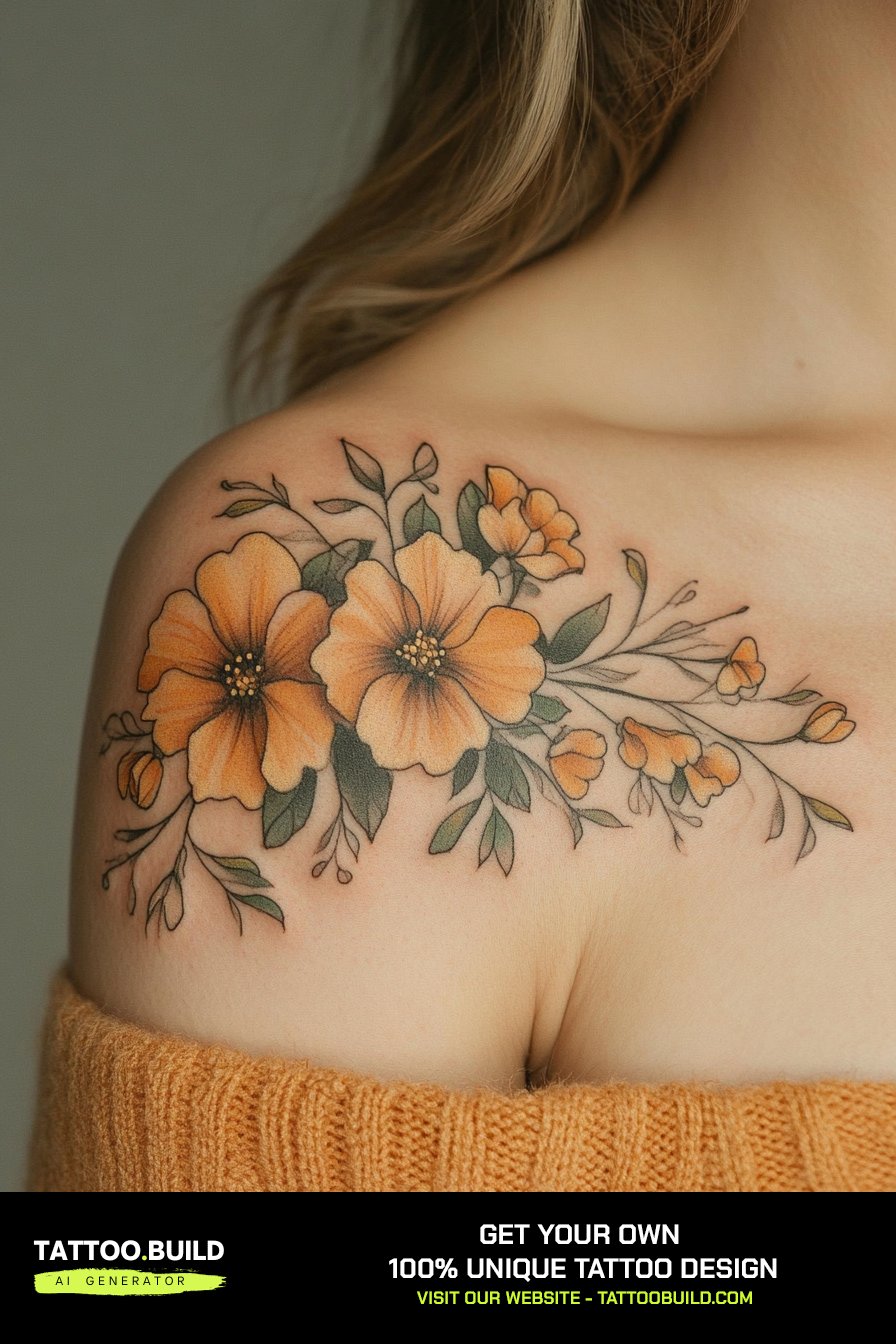
I have watched the shoulder quietly become the most requested spot for floral work in almost every studio I have walked into over the past few years, and after sitting through a lot of these sessions I understand why. The shoulder gives a floral tattoo something no other placement quite does: a broad, flat, slow-moving panel of skin that lets petals sit exactly the way the artist drew them.
Flowers distort on a forearm. They stretch on a thigh. On the shoulder they mostly stay put.
That stability is why a floral shoulder tattoo can carry both a hand-sized cluster and a full wrapping half sleeve, and why it works for a first tattoo as easily as a tenth. If you are starting small, the smaller shoulder designs in this same family are a sensible entry point.
Below are 48 designs pulled from real healed and fresh work, grouped by style rather than thrown into one long scroll, along with what I have learned about which of them actually hold up.
Which Floral Shoulder Style Is Right for You?
Style choice matters more than flower choice. A rose in fine line and a rose in bold traditional are two completely different tattoos to live with.
| Style | Typical Session | Ages Best When | Touch-Up Outlook |
|---|---|---|---|
| Fine line botanical | 2-4 hours | Lines are kept apart and out of direct sun | Most likely of any style to need one |
| Traditional / neo-traditional | 3-6 hours | Outlines stay bold and colour stays saturated | Rarely needed early |
| Black and grey realism | 4-8 hours, often split | Contrast is strong rather than uniformly mid-grey | Occasional, usually in the lightest areas |
| Watercolor | 3-5 hours | A line structure sits under the colour | Expect one within a few years |
| Wrapping half sleeve | Multiple sittings | The whole layout is designed before session one | Handled during later sittings |
Why the Shoulder Suits Floral Work So Well
The deltoid is thick, well-padded muscle with skin that does not fold much. That combination is unusually kind to detailed line work.
Compare it to the inner elbow or the ribs, where skin bunches and moves constantly, and the difference in how a healed flower looks is obvious.
Pain is the other reason people land here. In my experience the shoulder cap sits in the gentler half of the body, though the closer a design creeps toward the collarbone or the armpit the sharper it gets – the tattoo pain chart breaks that down properly.
The shoulder is also one of the easiest large placements to hide. A standard t-shirt sleeve covers most cap designs, which matters more than people expect for work.
The one genuine drawback is sun. Shoulders catch a lot of it, and UV exposure is the single biggest reason floral tattoos fade unevenly.
48 Floral Shoulder Tattoo Ideas, Grouped by Style
1. Fine-Line Botanical Sprays
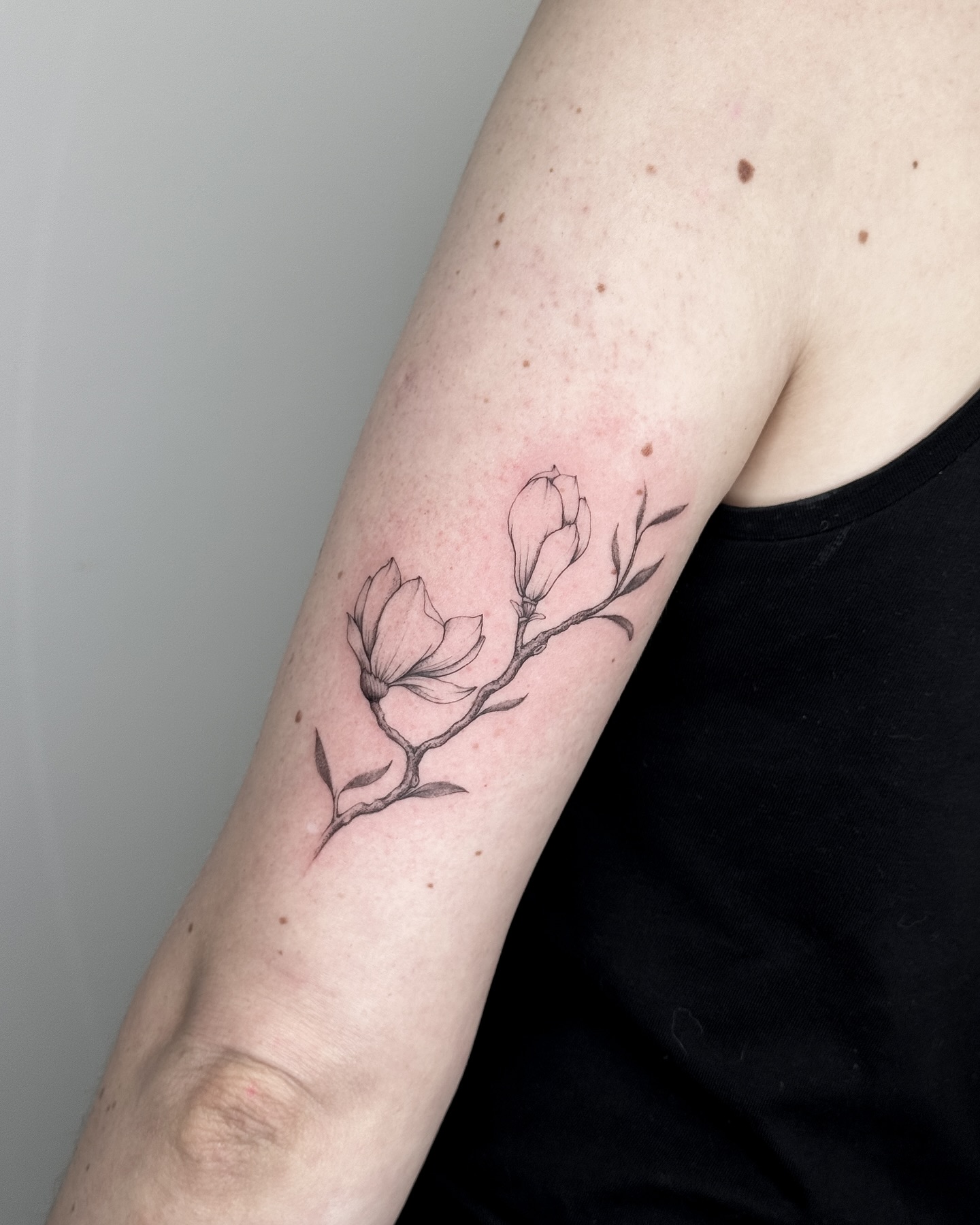
Fine line is where most people start, and it is the style I get asked about most often. Single-needle stems, small open petals, a lot of bare skin left alone.
The appeal is that it reads as jewellery rather than as a tattoo, and it sits comfortably under a strappy top without demanding attention.
The honest caveat is longevity. Very thin lines placed close together can soften and blur over a decade, and I have seen enough healed fine-line pieces to say that spacing matters more than needle size.
Ask your artist to leave visible gaps between stems rather than packing them. A design that looks slightly too sparse on paper usually looks right after a few years.
2. Bold Traditional and Neo-Traditional Roses
Traditional florals are the opposite bet: heavy outlines, limited palette, no fine detail to lose.
Every artist I have asked about longevity gives some version of the same answer – a bold outline is what keeps a tattoo readable after twenty years.
Neo-traditional pushes the same principles further with richer colour and more decorative framing, which suits the shoulder because there is room for the extra ornament. If roses are the draw, the wider rose tattoo collection shows how differently they translate across placements.
This is the style I recommend when someone tells me they never want to think about their tattoo again.
3. Peonies and Full-Bloom Statement Pieces
Peonies have quietly overtaken roses in a lot of studios, and on a shoulder the reason is geometric. A peony is a round, layered mass, and so is the deltoid.
One oversized bloom sitting on the cap of the shoulder tends to read better than four medium flowers competing for the same space.
Layered petals also give a shader somewhere to build depth without adding outlines, which is why so much of the strongest peony work is black and grey.
When I tested this idea against my own saved references, nearly all the pieces I had bookmarked were built around a single dominant bloom with smaller filler around it.
4. Wildflower and Birth-Flower Clusters
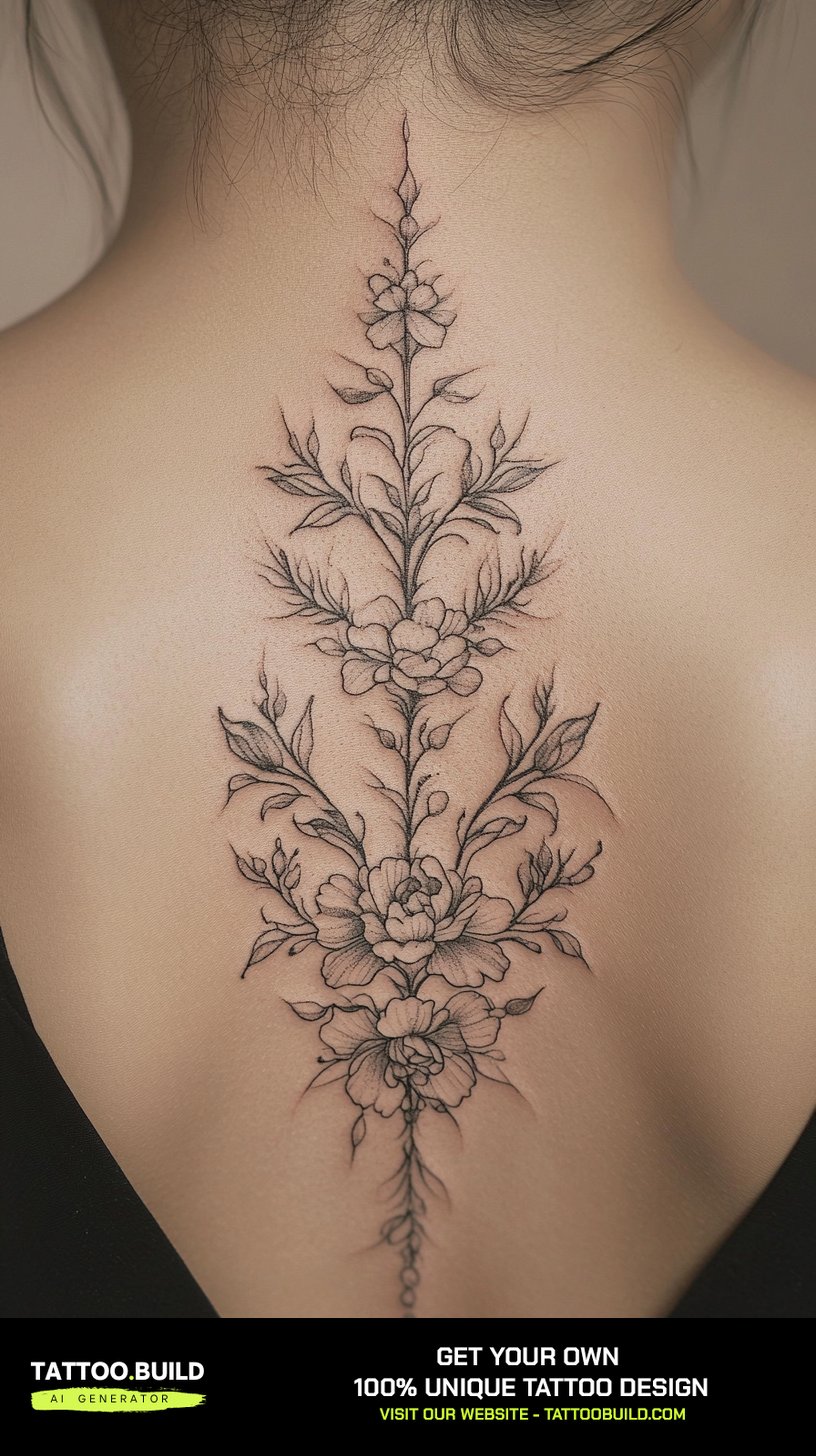
A wildflower cluster is a loose gathering of stems – daisies, lavender, poppies, cosmos – rather than one designed arrangement.
Its practical advantage is modularity. You can add a stem later for a new person or a new year without redrawing anything.
Birth flowers are the most common version of this, and they turn a decorative piece into a personal one. The broader wildflower tattoo ideas guide covers which flowers actually tattoo well, because some do not.
Small, tightly detailed flowers like baby’s breath tend to lose definition faster than larger simple shapes. Worth knowing before you commit to a bouquet of them.
5. Black and Grey Realism
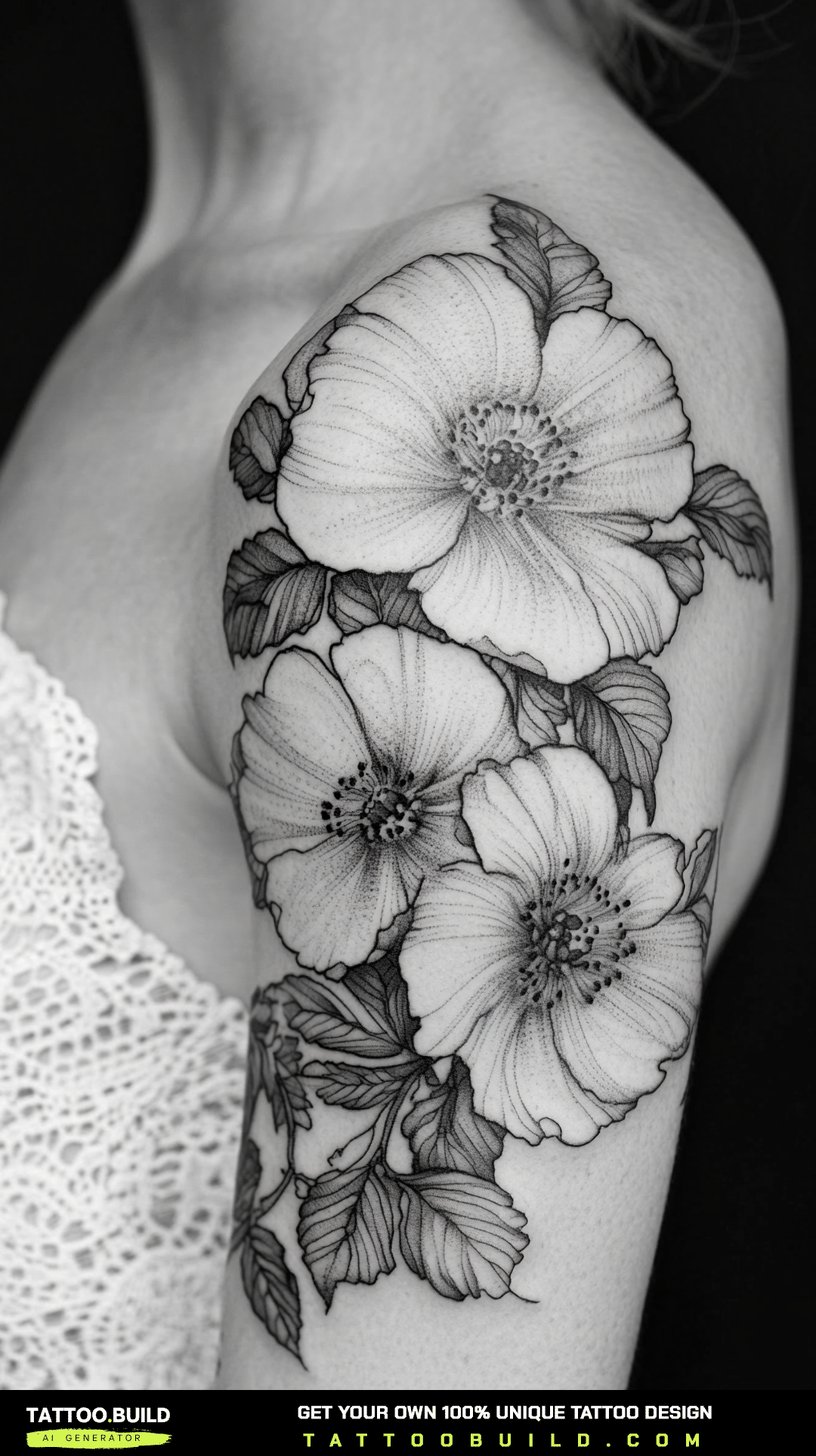
Realism on a shoulder is ambitious but well supported by the placement, because the flat surface means the artist is not fighting curvature while building petals.
The pieces that hold up are the ones with real contrast – genuine blacks next to genuine light areas – rather than an even field of mid-grey.
In my experience mid-grey is what fades first and what makes a realism piece look muddy at five years. Good artists know this and build accordingly.
Expect this to take multiple sittings. A full shoulder realism piece running four to eight hours is normal, and splitting it is usually the more comfortable choice.
6. Watercolor and Soft-Colour Florals
Watercolor florals mimic paint – colour bleeding past edges, splashes behind the blooms, soft gradients instead of flat fills.
They photograph beautifully. They also age the least predictably of anything in this list, which is why most experienced artists build a light line structure underneath the colour rather than going pure wash. The watercolor tattoo guide shows both approaches side by side.
Assume you will want a touch-up sooner with this style than with any other here. That is not a reason to avoid it, just something to budget for.
Soft-colour work also asks more of your sun discipline than black and grey does.
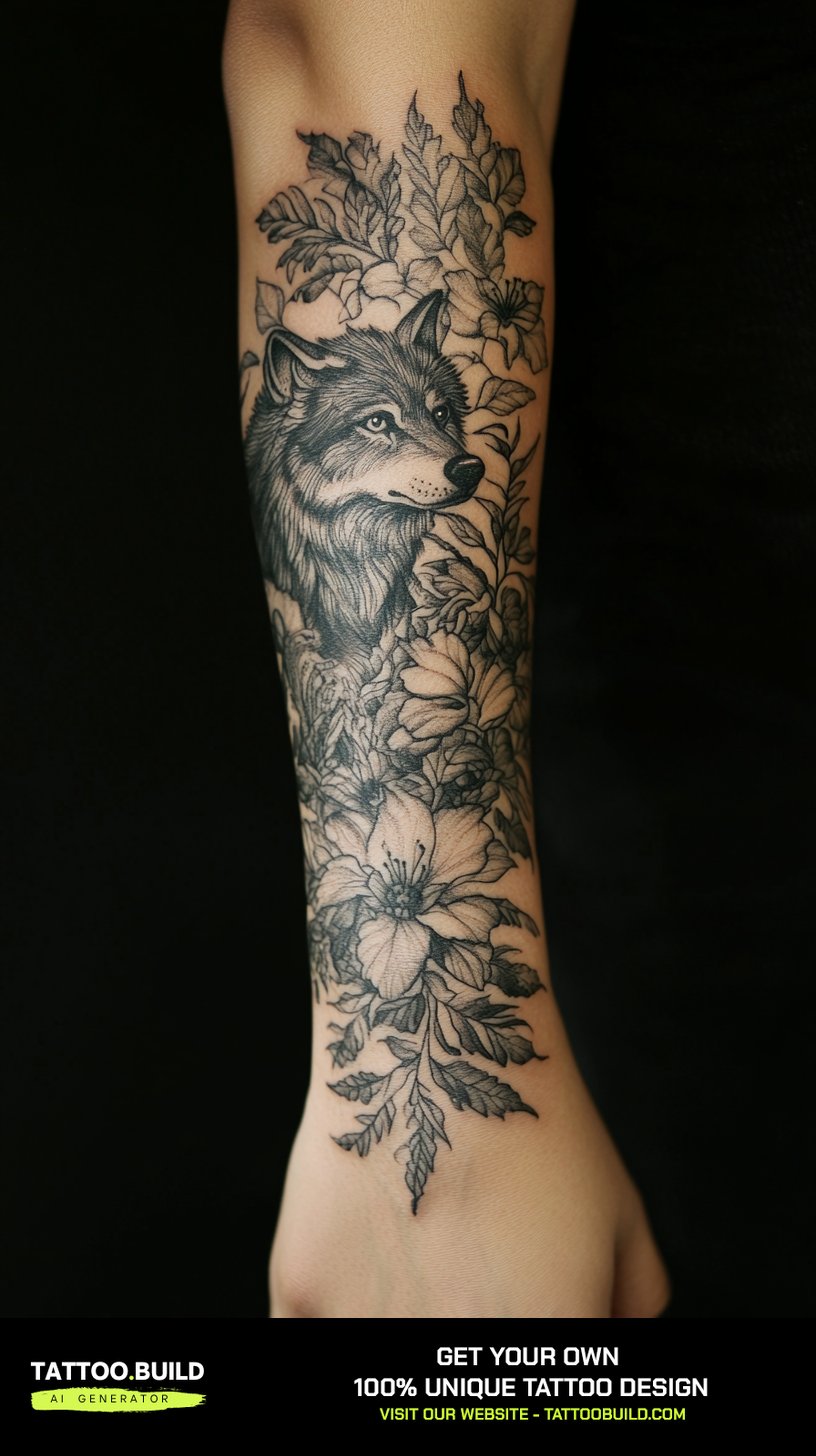
7. Florals That Wrap Into a Half Sleeve
A lot of shoulder pieces are really the first chapter of a sleeve, whether or not the person admits that at the time.
If there is any chance you will extend it, say so at the consultation. The shoulder is the transition point where a sleeve either flows or visibly stops, and retrofitting a standalone design into a floral half sleeve almost always means reworking it.
The strongest wrapping pieces I have seen were mapped out in full first, then tattooed in sections over months.
It costs nothing to plan for expansion and a great deal to fix its absence.
Placement Variations Worth Considering
Style is only half the decision. Where exactly on the shoulder the design sits changes how it reads and how visible it is.
The Shoulder Cap
Everything sits on the deltoid, inside the line a short sleeve would draw. The most coverable option, and usually the least painful.
The Shoulder Blade
Moving the design behind the shoulder gives more flat canvas and near-total coverability. If that appeals, the shoulder blade designs collection is the better starting point.
Shoulder to Collarbone
Stems reaching over the top toward the collarbone make a piece far more visible day to day, and noticeably sharper to sit through as it crosses bone.
The Full Wrap
Front, top and back, so the design changes depending on the angle you are seen from. The most demanding to design and the most rewarding when done well.
Caring for a Fresh Floral Shoulder Tattoo
Follow the aftercare your artist gives you over anything you read online, including this. They know what ink, needle configuration and wrap they used.
That said, the general shape is consistent: keep it clean, keep it lightly moisturised, do not pick, and do not soak it. No baths, pools or hot tubs until it has fully closed over.
Shoulders create one specific problem – bra straps, backpack straps and bag straps all cross exactly where the tattoo sits. Plan a couple of weeks of strap-free clothing rather than discovering this on day two.
Once healed, sunscreen is the whole game for keeping colour. The American Academy of Dermatology’s guidance on caring for tattooed skin is worth reading in full, and the FDA’s tattoo fact sheet covers ink reactions and infection risk honestly.
If you develop spreading redness, heat, swelling that worsens after day three, pus or a fever, contact a doctor rather than your artist. That is a medical question, not a tattooing one, and it is not something to wait out.
Common Mistakes and Still Not Sure?
The most frequent mistake I see is choosing a design at a size that flatters it on a screen rather than on a body. Detail that reads at phone-screen scale often disappears at real scale.
The second is picking an artist by price rather than by portfolio. Floral work is a specialism, and an artist with fifty healed florals in their book is a different proposition from one with fifty tattoos.
The third is not asking to see healed photographs. Fresh work always looks good. Healed work is the only honest evidence.
Still weighing it up? It often helps to compare the shoulder against a floral back piece before you book anything, since the two suit very different lifestyles.
Frequently Asked Questions
How much does a floral shoulder tattoo usually cost?
It depends almost entirely on size, style and your artist’s hourly rate, which varies enormously by city. A small fine-line spray might be a single short session, while a full black and grey shoulder piece can run four to eight hours across one or two sittings. The most reliable way to get a real number is to send reference images to two or three studios and ask for an estimate. Beware of quotes that come in far below everyone else.
Does a shoulder tattoo hurt more than a forearm one?
For most people the shoulder cap is comparable to or slightly gentler than the outer forearm, because there is more muscle padding and less bone underneath. Pain rises noticeably as the design moves toward the collarbone, the armpit or over the shoulder blade’s bony ridge. Everyone’s tolerance is different, so treat any pain chart as a rough guide rather than a promise. Eating properly beforehand and staying hydrated genuinely helps.
How long does a floral shoulder tattoo take to heal?
The surface usually looks settled within two to three weeks, with peeling and flaking through the first ten days or so. The deeper layers typically take somewhere around two to three months to finish healing, which is why colour can look slightly dull before it brightens. Avoid judging the final result until that period has passed. Follow your artist’s specific instructions throughout, and see a doctor if anything looks infected.
Will a fine-line floral shoulder tattoo blur over time?
Some softening is normal for any tattoo, and fine line shows it earliest because there is less ink to lose. Lines placed very close together are the ones most likely to merge visually as the years pass. Good spacing, a competent artist and consistent sunscreen are the three things most within your control. A touch-up after several years is common and not a sign anything went wrong.
Can I add to a floral shoulder tattoo later?
Usually yes, and floral designs are among the easiest to extend because stems and leaves give a natural way to grow outward. It is far simpler if you mention the possibility at the original consultation so the artist leaves sensible edges. Retrofitting a tightly framed standalone design into a larger piece often means reworking parts of it. Going back to the original artist, where possible, keeps the style consistent.
Quick Summary
- The shoulder’s flat, well-padded surface holds floral detail better than most placements.
- Fine line reads as jewellery but needs generous spacing and will likely want a touch-up.
- Bold traditional and neo-traditional florals are the most reliable long-term choice.
- Peonies suit the shoulder because a round bloom matches a round muscle.
- Wildflower and birth-flower clusters are the easiest designs to add to later.
- Black and grey realism needs real contrast, not an even field of mid-grey.
- Decide about a future half sleeve before session one, not after.
- Sunscreen after healing is the single biggest factor in how the piece looks at ten years.