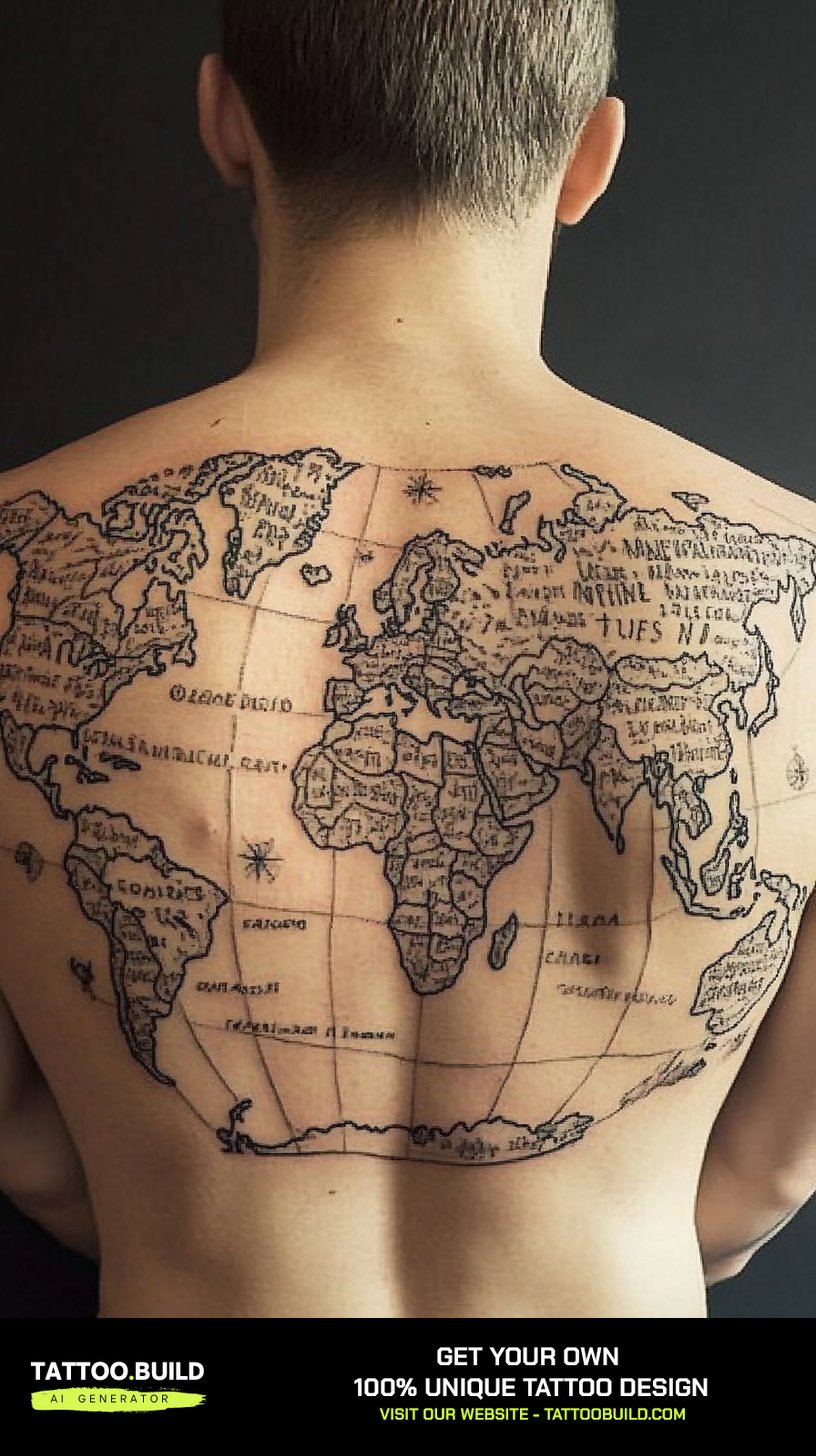
A map tattoo is one of the few designs where the meaning is baked into the shape itself. You are not wearing a symbol of a place — you are wearing the place.
I have watched this style change a lot over the last few years. The heavy, over-detailed street grids that were everywhere around 2018 have mostly given way to cleaner coastlines, contour lines and single-line outlines that actually survive a decade on skin.
The problem is that maps are made of tiny lines, and skin is not paper. Every artist I have asked about this gives roughly the same warning: the detail you love on your phone screen is the detail that closes up first.
So this guide is split between the ideas worth stealing and the practical decisions — scale, placement, how much detail is realistic — that decide whether the piece still reads as a map in ten years. If you are exploring the wider category, our travel tattoo ideas guide covers the neighbouring territory.
Which Map Tattoo Style Is Right for You?
The style you choose matters more than the location you pick, because it decides how much of the design is still legible after years of healing and sun.
| Style | Smallest size that works | Ages like | Best for |
|---|---|---|---|
| Fine line street map | 4–5 in / 10–13 cm | Softens noticeably; lines can merge | One neighbourhood, not a whole city |
| Topographic contours | 3 in / 8 cm | Very well — spaced parallel lines | Mountains, islands, lakes |
| Solid blackwork continent | 2 in / 5 cm | Best of the group | Bold, low-maintenance pieces |
| Vintage nautical chart | 6 in / 15 cm | Depends heavily on the artist | Thigh, back, upper arm |
| Coordinates only | 1.5 in / 4 cm | Well, if the font is not hairline | Discreet, first tattoos |
| Map inside a shape | 3 in / 8 cm | Good — the outline holds it together | Hearts, compass roses, state outlines |
What Actually Makes a Map Tattoo Work
Maps are dense by design. A cartographer can put a hundred lines in a square inch because ink on paper does not spread — tattoo ink does.
Over years, ink migrates very slightly into the surrounding dermis. Lines that sit close together gradually close the gap between them, which is why a detailed city grid can turn into a grey patch while a coastline stays sharp.
The practical fix is subtraction. When I have seen these pieces work, the artist has usually thrown away 60–70% of the reference: no minor streets, no labels, no compass grid — just the water, the main arteries and one or two anchors.
A map tattoo that reads from three feet away will read from three feet away forever. One that only reads at arm’s length is borrowing against its own future.
The other half of the equation is placement, and specifically how much the skin there moves and stretches. I will come back to that below, because it is where most of the regret in this style comes from.
Map Tattoo Ideas Worth Considering
1. The Hometown Street Map
This is the most requested version and the one most likely to go wrong. People bring in a screenshot of an entire city and want it at four inches.
The version that works picks a radius of a few blocks — the street you grew up on, the intersection where something happened — and keeps maybe eight roads total.
Crop hard and go bigger than feels necessary. A single neighbourhood at five inches is a tattoo; a whole city at five inches is a smudge waiting to happen.
2. Topographic Contour Lines
Contour maps are, in my opinion, the most underrated option in this whole category. They are made of evenly spaced parallel lines, which is exactly the structure that ages well.
They also read as abstract to anyone who does not know the location, which suits people who want something meaningful without explaining it at every dinner party.
Peaks, islands, lake basins and river valleys all translate beautifully. If you like the shape language, our mountain tattoo ideas guide shows how the same terrain reads in other styles.
3. The Solid World Map
Continents filled in solid black, no borders, no latitude grid. It is the most durable version of a map tattoo and the easiest to place.
A common variation is to fill only the countries you have visited and leave the rest as outline, though I would be honest with yourself about whether you will want to add to it later.
Adding to solid blackwork is harder than it sounds. If the plan is to keep filling it in, ask the artist to design it that way from the first session rather than improvising in three years.
4. Coordinates Paired With a Minimal Outline
A small coastline or island shape with the latitude and longitude underneath gives you the precision of a location without the visual noise of a full map.
Two things I would insist on: decide the format in advance (decimal degrees versus degrees-minutes-seconds look completely different), and avoid the thinnest available font.
Small numbers are the first thing to blur. Our full coordinate tattoo ideas guide goes deeper on font choice and layout.
5. Vintage Nautical Charts
Old sea charts bring rhumb lines, compass roses, sounding marks and hand-lettered coastlines. Done well, it is the most striking version of this idea.
Done badly, it is also the fastest to fall apart, because the charm lives entirely in fine detail.
This is a large-format piece — thigh, back, or a full upper arm — and it is worth waiting for an artist whose healed portfolio shows this kind of linework, not just fresh photos.
6. A Map Inside a Shape
Containing the map inside a heart, a circle, a compass rose or a state outline solves two problems at once: it gives the design a clean edge, and it lets you crop the map without it looking cropped.
The frame also carries the piece visually as the interior detail softens with age, which is a genuinely useful insurance policy.
Circles are the most forgiving frame. Hearts read as sentimental, which some people want and others very much do not.
7. Star Maps and Celestial Charts
A star map is a map of the sky at a specific date and place — same logic as a ground map, different plane.
These work best when the artist edits down to one or two recognisable constellations rather than reproducing every dot in the generated chart.
Tiny stars scattered across a large area tend to look accidental once healed. Grouped, connected linework holds up much better.
8. Matching and Split Maps
Two people, one location — or one map split across two pieces of skin that only completes when the arms are side by side.
The split version is charming in photos and slightly awkward in real life, since neither half stands on its own. I would suggest each half being a complete design that happens to line up.
Getting them done in the same session, by the same artist, is the only reliable way to keep the line weight consistent.
Where to Put a Map Tattoo
Forearm
The default choice, and a good one. The skin is relatively flat, holds line detail well, and you get to look at it.
The constraint is width — you have roughly three to four inches to play with, so long thin shapes such as coastlines and mountain ranges fit better than square city blocks.
Thigh and Calf
If you want a detailed map, this is where it should go. The thigh gives you the largest flat canvas on the body and it is protected from sun most of the year.
It is also, in my experience, the placement people are least likely to regret when the piece turns out bigger than planned.
Back and Spine
A spine placement suits vertical subjects: a river, a coastline, a mountain range, a constellation running down the centre line.
Be aware that the spine is one of the more uncomfortable areas for most people, and long sessions there are usually split in two.
Places I Would Think Twice About
Fingers, the side of the wrist, the tops of the feet and the inner elbow all move, rub or shed skin faster than average, and fine map linework there tends to need touching up.
Ribs are the specific trap for this style — the skin stretches with breathing, and a rigid grid drawn across it can distort in a way an organic design would not.
Alternatives and Variations
Compass Instead of Cartography
If what you actually want is the idea of direction rather than a specific place, a compass rose delivers it with far less fine detail to lose. The symbolism is covered properly in our compass tattoo meaning guide.
Flight Paths and Routes
A dotted arc between two points says “these two places” without drawing either of them. It is clean, it scales down well, and it is easy to extend later.
Pairing it with a small aircraft silhouette is the common route — see our airplane tattoo ideas for versions of that.
Single-Line and Minimal Versions
A coastline drawn as one continuous unbroken line is about as low-maintenance as this idea gets, and it fits places a detailed map never would.
If that is the direction you are leaning, both our minimalist tattoo ideas and fine line tattoo ideas collections are worth a scroll before you book.
Practical Tips Before and After the Session
Bring the highest-resolution source you can find rather than a phone screenshot, and bring more than one crop. Artists redraw maps rather than tracing them, and a clean source makes that redraw far better.
Ask for the stencil at your actual size and look at it on the skin before any needle touches you. If you cannot tell what it is at arm’s length in the mirror, it is too small — this is the single most useful check I know of for this style.
Budget for one touch-up at around three months. Dense linework often needs it, and most studios include the first one. Rough pricing expectations are covered in our guide to how much a small tattoo costs.
For healing, follow the aftercare your artist gives you rather than anything you read online, including this. General guidance from the American Academy of Dermatology and the US Food and Drug Administration is a reasonable baseline, but it is not a substitute for a professional.
If a healing tattoo becomes increasingly painful, hot, swollen or starts weeping after the first few days, see a doctor rather than waiting it out. Infections and ink allergies are uncommon but real, and the Mayo Clinic overview of tattoo risks explains what to watch for. Never attempt to tattoo or remove a tattoo yourself.
Common Mistakes, and What to Do If You Are Still Unsure
The mistake I see most often is scale: a map that needed six inches squeezed into three because of budget or nerves.
The second is including text — street names, city labels, dates in small type. Small lettering inside dense linework is usually the first thing to become unreadable.
The third is choosing an artist by follower count rather than by healed work. Ask specifically to see photos of fine linework a year or more after it was done.
If you are still not sure the style is for you, it is worth browsing sideways before committing. Constellation tattoo ideas and geometric tattoo designs both scratch a similar itch — precise, meaningful, line-based — with fewer of the ageing trade-offs a dense map carries.
Frequently Asked Questions
How big does a map tattoo need to be?
It depends entirely on how much detail you keep. A solid continent silhouette works at two inches, while a street map with visible roads generally needs four to five inches minimum. The reliable test is the stencil test: place it on the skin and look in a mirror from a few feet away. If the shapes merge at that distance now, they will only merge further as it heals and ages.
Do map tattoos blur over time?
All tattoos soften somewhat, and designs built from closely spaced lines show it earliest. That is a property of how ink settles in skin rather than a flaw in the design. Contour maps and solid blackwork hold up noticeably better than dense street grids. Sun exposure accelerates the process more than almost anything else, so daily sunscreen once healed genuinely matters.
Can a map tattoo be done in colour?
Yes, and watercolour washes behind a black map outline are a popular approach. Just be aware that soft colour without a black structure underneath tends to fade less predictably than linework. Most artists I have spoken to recommend keeping a solid black outline as the backbone and treating the colour as an accent. Colour also usually needs touch-ups sooner than black.
How much does a map tattoo cost?
Pricing varies enormously by region, artist demand and how much drawing time the design takes. Map tattoos tend to sit at the higher end for their size because the artist has to redraw and simplify the source rather than working from a ready-made design. Expect to pay a shop minimum for something small and coordinate-based, and to book multiple hours for a detailed chart. Always ask for a quote after the design is drawn, not before.
Can I add to a map tattoo later?
Sometimes, but it is much easier if the design was planned for it. A world map where you fill in countries over time is the classic example and works well when the outline is drawn generously from the start. Adding new elements around an existing dense piece is harder, because the new linework has to compete with settled ink. If you know you want to expand it, tell the artist in the first consultation.
Quick Summary
- Crop hard — one neighbourhood or one coastline beats a whole city every time.
- Contour maps and solid blackwork age best; dense street grids age worst.
- Go one size larger than feels necessary, especially for street maps.
- Skip small text and street labels; use coordinates instead if you need specifics.
- Thigh, forearm and back are the friendliest placements; ribs and fingers are the riskiest.
- Choose an artist on healed fine-line work, not on fresh photos.
- Budget for a touch-up at around three months and use sunscreen for life.
- Anything that looks infected during healing is a question for a doctor, not the internet.