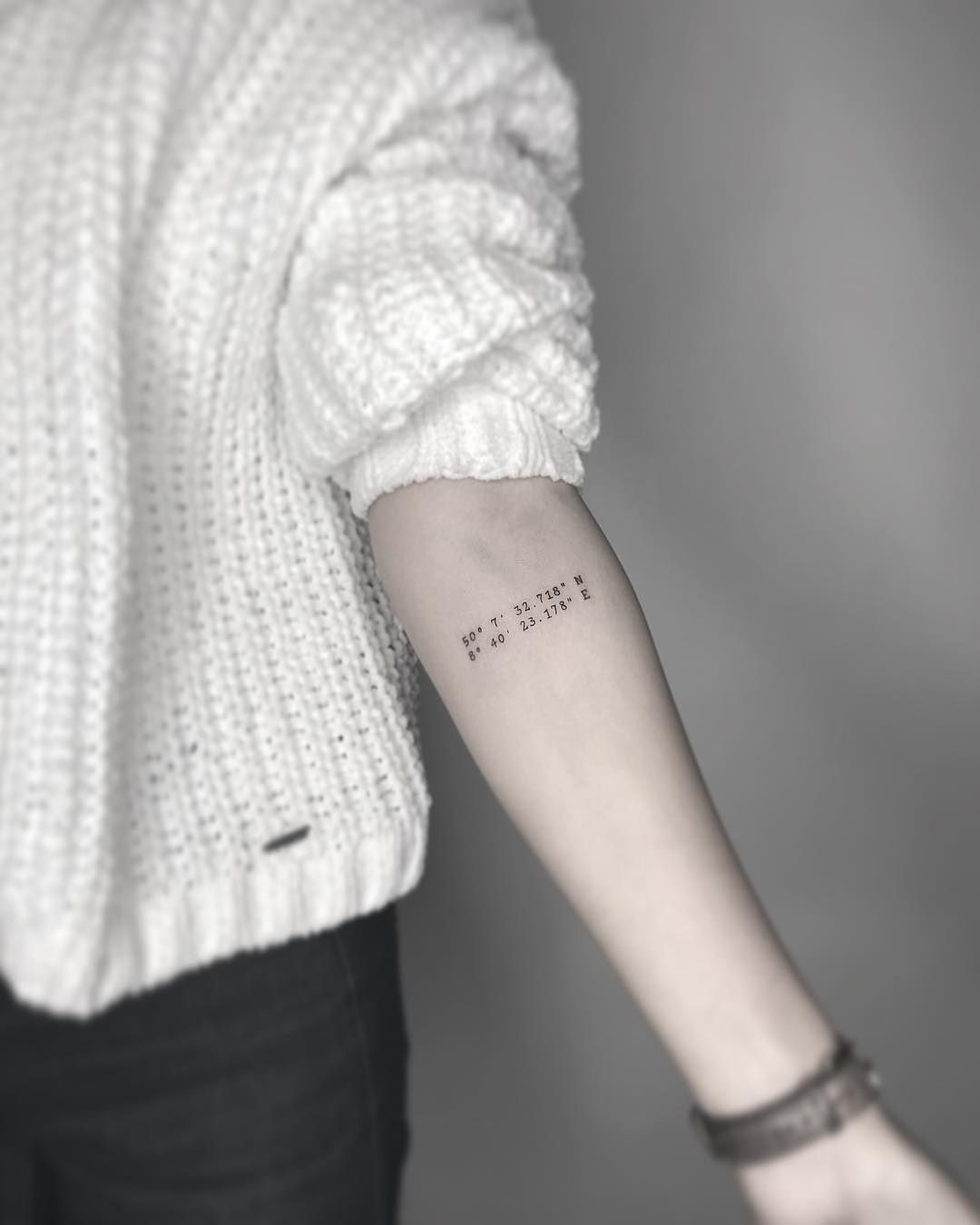
A coordinate tattoo is the most conceptually direct idea in the whole of small-tattoo design. You pick the single most important place on Earth to you, look up its latitude and longitude, and wear those numbers permanently.
To you the string means a hospital ward, a stretch of coastline, a doorway. To everyone else it is a row of digits until you decide to explain it.
I have watched people agonise for months over which symbol represents their mother, then settle a coordinate tattoo in a single afternoon. The format removes the interpretation problem entirely — a place either is the place or it is not. That is also why it overlaps so heavily with travel tattoo ideas, where the memory is already attached to a location.
Below are 21 ideas grouped by what they mark, plus the format, placement and accuracy decisions that separate a coordinate tattoo you still like in ten years from one you quietly regret.
Which Coordinate Format Is Right for You?
There are three formats artists are routinely asked for, and they are not interchangeable visually. Decide this before the stencil, not at the shop.
| Format | Looks like | Character count | Best for | Watch out for |
|---|---|---|---|---|
| Decimal degrees | 40.7128° N, 74.0060° W | Around 22 characters | Minimal, modern, single-line placements like the wrist or collarbone | A dropped decimal point moves the location by tens of kilometres |
| Degrees, minutes, seconds | 40°42’46″N 74°00’21″W | Around 26 characters | A nautical, chart-like feel; pairs well with compass and map work | Prime and double-prime marks are easy for an artist to render as apostrophes |
| Degrees and decimal minutes | 40° 42.767′ N, 74° 00.360′ W | Around 30 characters | Aviation and marine backgrounds, where this is the working format | The longest of the three — needs real estate |
| Stacked two-line | Latitude on top, longitude beneath | Halves the width | Ribs, spine, inner bicep, behind the ear | Unequal line lengths look unbalanced unless planned |
| Coordinates only, no labels | 40.7128 / -74.0060 | Shortest option | The most private version — reads as a serial number | Negative signs are easily mistaken for hyphens or dashes |
What Actually Makes a Coordinate Tattoo Work
Precision is the part most people get wrong, and it is pure arithmetic. Latitude and longitude are angles, so each decimal place you keep tightens the circle you are pointing at.
As a rule of thumb at the equator, one whole degree of latitude spans roughly 111 kilometres, so two decimal places lands you inside about a kilometre, four decimal places inside roughly ten metres, and six decimal places is street-sign precision. Most of the tattoos I have seen use four.
That matters because a coordinate with one decimal place does not mark your childhood house. It marks the general region your childhood house was in, which is a different tattoo with a different meaning.
The second thing that makes or breaks it is legibility at size. Numbers are unforgiving in a way that a leaf or a wave is not — a blurred 8 that could be a 3 is a permanent typo, whereas a slightly softened petal is just a slightly softened petal.
The last factor is the datum. Nearly every phone and mapping service reports coordinates on WGS 84, the reference frame the US National Geodetic Survey maintains, so you are almost certainly fine — but if you copied numbers off an old paper chart, they may be on an older datum and sit a few hundred metres out.
21 Coordinate Tattoo Ideas, Grouped by What They Mark
The 21 ideas below are sorted into seven groups. Most people land in one group quickly and then spend their real deliberation on format and placement.
1. Origin Coordinates: Birthplace, Hometown, Family Home and Heritage
Four of the 21 mark where you started rather than where you have been. The birthplace coordinate is the most fundamental personal geography anyone has — a hospital, a house, a town you had no say in.
The hometown coordinate is a different thing: the place that shaped you before you could consent to the shaping. People who moved a lot as children often pick this one over the birthplace, because the formative address is not the one on the certificate.
The family home coordinate points at a specific house — the one that stays home no matter where you live now. In my experience this is the idea most likely to be chosen as a pair with a sibling.
Heritage coordinates mark the country, region or village your family came from, sometimes a place you have never visited. It sits naturally alongside other family tattoo ideas, and it is worth confirming the village spelling and location with an older relative before you commit.
2. Relationship Coordinates: Where You Met, Where You Married, Matching Sets
Three ideas here. The first marks where you met the person who mattered most — a bar, a lecture hall, a hostel dorm, a street corner.
The second is the wedding location: the venue, the church, the beach, the courthouse steps. Every artist I have asked says this is the single most requested coordinate, and it is the one most often done as a matching pair.
The third is the matching set itself, and it has two versions. Both partners wear the same coordinate, or each partner wears the other’s birthplace — which is quietly the more interesting option, because each person carries the other’s origin rather than a shared event.
If you are doing a matching version, agree on format, font and placement in advance. Two people who each improvised at their own appointment end up with two tattoos that do not visually match. Browse matching tattoo ideas for couples before you book if you want a reference point.
3. Arrival and Achievement Coordinates
The coordinates of the hospital where your child was born is, for most parents I have spoken to, the strongest candidate on this entire list. Multiple children means multiple coordinate sets, which is worth planning as a layout before the first one goes on.
Achievement coordinates mark where something was won or finished: the campus where you graduated, the finish line, the venue, the office where the company got signed.
There is a real risk here that does not apply to the origin group: achievements accumulate, and the one that felt career-defining at 24 can feel modest at 40. Birthplaces do not change rank. Accomplishments do.
My honest advice is to let an achievement coordinate sit as an idea for a full year before booking. The ones I have seen age best belong to people who waited.
4. Turning-Point Coordinates
Three ideas cluster here: the place where something changed, the place that inspired the change, and the place where you recognised who you actually were.
The first is the geography of a decision — where you took the call, read the letter, or finally said the thing out loud. It is often somewhere entirely mundane, which is part of why it works.
The second is usually a travel destination. You went somewhere, and you came home different. The coordinate marks the trigger rather than the outcome.
The third is the hardest to explain to other people and the easiest to justify to yourself: the exact spot where you stopped guessing about your own identity. Nobody reading the numbers will ever get there without being told.
5. Coordinates of Peace and Return
Three more: the place you feel most yourself, the natural feature you return to, and the city you love most.
The peace coordinate points at wherever restoration happens — a cabin, a lake, a specific bench. It is the idea people describe most vividly and pin down least precisely, so spend extra time on the map before you settle the digits.
The natural-feature version narrows it further: not the mountain range but that summit, not the coast but that stretch of beach. Satellite view is your friend here.
The favourite-city coordinate is the broadest of the three. Cities are large, so a two-decimal-place coordinate genuinely does represent the city rather than any building in it — which for once is the point.
6. Memorial Coordinates
Three of the 21 mark loss: where someone is buried or memorialised, where you last saw them, and where you recovered from something that nearly took you.
A grave coordinate is precise and almost entirely private. The numbers mean nothing to a stranger but mark the exact point on Earth where a specific person permanently is.
The last-time coordinate is a quieter variant — an airport gate, a driveway, a hospital entrance. It carries the weight of a final ordinary moment rather than a ceremony.
Memorial coordinates are also the ones I would most strongly encourage you not to rush. Grief changes shape over the first couple of years, and so does what you want written on you. If you want to see how other people have handled the same problem, the broader memorial tattoo ideas collection is a better starting point than a single number.
7. Composition Coordinates: Current Home, Larger Pieces, Two Sets
The final three are as much about layout as meaning. A current-home coordinate is a statement about the present — this is the place I chose, as opposed to the one I inherited.
Coordinates absorbed into a larger composition are extremely common: numbers inside a compass rose, along a banner under an anchor, or set across a globe or map outline. The coordinate stops being the tattoo and becomes the detail that makes the tattoo specific.
Two coordinate sets on one piece is the last idea. Birth and now. Origin and destination. Two homes that between them hold everything that matters.
Two sets roughly doubles the character count, so this is the version that most often ends up on the ribs, the spine or the inner bicep rather than the wrist.
Alternatives and Variations on the Plain Coordinate
If a bare string of numbers feels either too cold or too obvious, these five variations solve the same problem differently.
Roman Numeral Dates Instead of Places
A date encodes when rather than where, and it compresses into far fewer characters. If your memory is anchored to a day rather than a location, roman numeral tattoo ideas cover the same instinct with a different alphabet.
A Map Contour or Coastline Outline
The outline of a lake, an island or a city’s street grid is instantly recognisable to anyone who knows the place and meaningless to anyone who does not — the same privacy trade as coordinates, but visual. Plenty of map tattoo ideas combine the outline with the coordinates beneath it.
A Compass Rose Carrying the Numbers
A compass gives the numbers a visual anchor and turns a text tattoo into a designed piece. It is the most common host composition by a wide margin; compass tattoo designs will show you how much the rose style changes the feel.
Elevation Alongside Latitude and Longitude
Adding altitude in metres or feet turns two dimensions into three. It is a genuinely uncommon choice and it suits summits, dive sites and anywhere the height was the point.
What3words and Plus Codes
Three-word addresses and Google’s Plus Codes both encode a small square of the planet in a much shorter string. They are readable and they fit well, but they depend on a private company’s system continuing to exist — latitude and longitude do not.
Getting the Details Right Before You Sit Down
Verify the coordinates yourself from two independent sources before the appointment. Drop a pin, read the numbers, then reverse the process — paste the numbers back into a map and confirm the pin lands where you expect. The NOAA explainer on latitude and longitude is a good five-minute refresher if the format still feels slippery.
Then check the stencil character by character on your skin, out loud, before any needle touches you. I have never regretted the extra two minutes. A misplaced minus sign is the single most common coordinate tattoo failure and it is entirely preventable at this stage.
Choose a font with unambiguous digits — one where 1 and 7, 0 and 8, and 3 and 8 stay distinct as the lines soften with age. Hairline lettering looks beautiful on day one and can thicken noticeably over years, so if you want it very small, look at how experienced artists handle fine-line tattoo work before choosing weight and size.
On aftercare: follow the instructions your artist gives you, keep it clean and out of the sun, and do not pick. Tattoos carry real risks including infection and allergic reaction — the US FDA’s consumer guidance on tattoo safety is worth reading beforehand. If you develop spreading redness, swelling, heat, pus or a fever, see a doctor rather than asking the internet. This article is design guidance, not medical advice.
Still Not Sure? The Mistakes Worth Avoiding
The mistake I see most often is insufficient precision — a coordinate rounded so hard it points at a county rather than a doorstep. Decide how tight you want the circle to be, then keep the decimal places that deliver it.
The second is choosing a font before choosing a length. A 30-character degrees-minutes-seconds string in an ornate script will not fit a wrist at a readable size, and shrinking it to fit is how digits blur.
The third is going large when the idea is inherently small. Coordinates are text, and text at scale reads as a label rather than a tattoo — most of the best examples stay modest, which is why so many people arrive at this idea from minimalist tattoo ideas rather than from lettering.
The fourth is skipping the proof read. Numbers have no visual logic to fall back on, so an error survives the entire session unnoticed. Read them aloud from the stencil, in reverse order, against your phone.
Frequently Asked Questions
How accurate does a coordinate tattoo need to be?
It depends on what you are marking. Four decimal places in decimal-degree format narrows the location to roughly ten metres, which is enough to identify a specific building, while two decimal places covers about a kilometre and points at a neighbourhood. If the tattoo marks a house or a grave, keep four; if it marks a city, two is honest and shorter. Decide the precision first, because it determines how many characters you are asking your artist to fit.
Should I use decimal degrees or degrees, minutes and seconds?
Decimal degrees is shorter and cleaner, which makes it the practical choice for small placements like the wrist, collarbone or behind the ear. Degrees-minutes-seconds looks more like a navigational chart and sits better inside compass or map compositions. Neither is more correct — they describe the same point. Write both versions out at full size before deciding, because the length difference is more obvious on paper than on screen.
Where do coordinate tattoos usually go?
Anywhere with a straight run long enough for the string: the inner forearm, the outer forearm, the ribs, the spine, the collarbone and the inner bicep are all common. Stacking latitude above longitude halves the width and opens up shorter placements. In my experience people underestimate how much length a single-line coordinate needs, and the placement conversation usually ends with either stacking it or moving it.
Do coordinate tattoos age well?
Text ages like any other fine linework — lines thicken slightly and very small detail softens over the years. Coordinates are more sensitive to this than imagery because a blurred digit becomes genuinely ambiguous rather than just soft. Going a size up, choosing a font with open counters, and avoiding the absolute smallest possible rendering all help. Ask your artist to show you healed photographs of their lettering, not fresh ones.
Can I get matching coordinate tattoos with a partner?
Yes, and it is one of the most requested versions. The thing to settle in advance is whether you both wear the same coordinate or each wear the other’s place, and then agree on format, font, size and placement so the two pieces actually read as a pair. Booking the appointments back to back with the same artist is the simplest way to guarantee consistency.
Quick Summary
- Pick what you are marking first: origin, relationship, arrival, turning point, place of peace, memorial, or a composition idea.
- Choose your precision before your font — four decimal places lands within roughly ten metres, two within about a kilometre.
- Decimal degrees is the shortest and cleanest; degrees-minutes-seconds reads as nautical and suits compass and map pieces.
- Stack latitude above longitude when the single-line version is too wide for the placement.
- Verify the numbers from two sources, then paste them back into a map to confirm the pin lands where you expect.
- Proof the stencil digit by digit on your skin, out loud, and watch for stray minus signs.
- Choose a font with unmistakable digits and resist going smaller than the lettering can survive.
- Follow your artist’s aftercare instructions, and see a doctor — not a forum — if you see signs of infection.