A map tattoo only works when it earns its size — the smaller you go, the fewer coastlines you can keep. That single rule has decided almost every map piece I have watched go well or badly.
I have been collecting and writing about travel-themed ink for years, and map designs are the ones people ask me about most often after a big trip. They look simple in a reference photo and behave very differently under a needle.
The good news is that a map is one of the most flexible symbols in tattooing. It can be a hand-sized continent, a wrist-wrapping band of dotted routes, or a full sleeve that reads like an old atlas page — and it still says the same thing about you.
Below are the map tattoo ideas I keep coming back to, with honest notes on placement, healing and what actually stays readable in ten years. If you want the wider category first, my guide to travel tattoo ideas covers the non-map options too.
Which Map Tattoo Style Is Right for You?
Every map style trades detail for durability. This is the comparison I sketch out for people before they book anything.
| Style | Best size | Detail it holds | Ages like |
|---|---|---|---|
| Fine line outline | 7-12 cm | Continent shape only | Softens noticeably; expect a touch-up |
| Bold traditional | 10-18 cm | Simplified coasts, heavy borders | The most forgiving option |
| Dotwork / stipple | 10-20 cm | Shading and landmass texture | Well, if the dots are not crowded |
| Vintage atlas / engraving | 15 cm and up | Compass roses, borders, lettering | Good at scale, muddy when shrunk |
| Watercolour | 12 cm and up | Colour washes over an outline | Fades fastest, especially in sun |
| Full sleeve scene | Whole arm | Maps plus ships, compasses, text | Excellent when properly spaced |
If you cannot decide, the bold traditional row is the safest bet. It is the one I have never seen someone regret on legibility grounds.
What Actually Makes a Map Tattoo Readable
A map is a picture made almost entirely of thin lines that need to stay separate from each other. That is the whole design problem in one sentence.
Tattoo ink spreads slightly inside the skin over the years, so any two lines placed close together will eventually drift toward becoming one. Coastlines, island chains and internal borders are exactly the kind of detail that suffers first.
This is why the number of countries you can show is a function of size, not of the artist’s skill. Even excellent fine line tattoo specialists will tell you that a palm-sized world map cannot keep Indonesia as separate islands forever.
Placement matters almost as much. Areas that stretch and rub constantly — the inner wrist, the side of the hand, the top of the foot — hold crisp detail less reliably than the outer forearm, the upper arm or the calf.
In my experience, the map tattoos that still look sharp after several years are the ones where the artist deliberately dropped detail at the drawing stage rather than trying to cram it in.
Map Tattoo Ideas That Actually Work
These are the seven directions I see most often, with the practical notes I would give a friend.
1. Map of Africa Tattoo
A map of Africa tattoo is usually about heritage rather than travel, and that changes the design brief completely.
Because the continent has a strong, recognisable silhouette, it survives at smaller sizes than a world map does. A clean outline at hand-size still reads correctly from across a room.
The most common personalisation I see is a small heart, star or single filled country marking where someone’s family is from. Every artist I have asked prefers this to writing the country name inside the shape, because small lettering inside a filled area closes up fastest.
Cultural pattern fills — Adinkra symbols, kente-inspired geometry, wildlife silhouettes — work beautifully, but they need room. Ask for them only if you are going 12 cm or larger.
2. World Map Wrist and Bracelet Tattoo
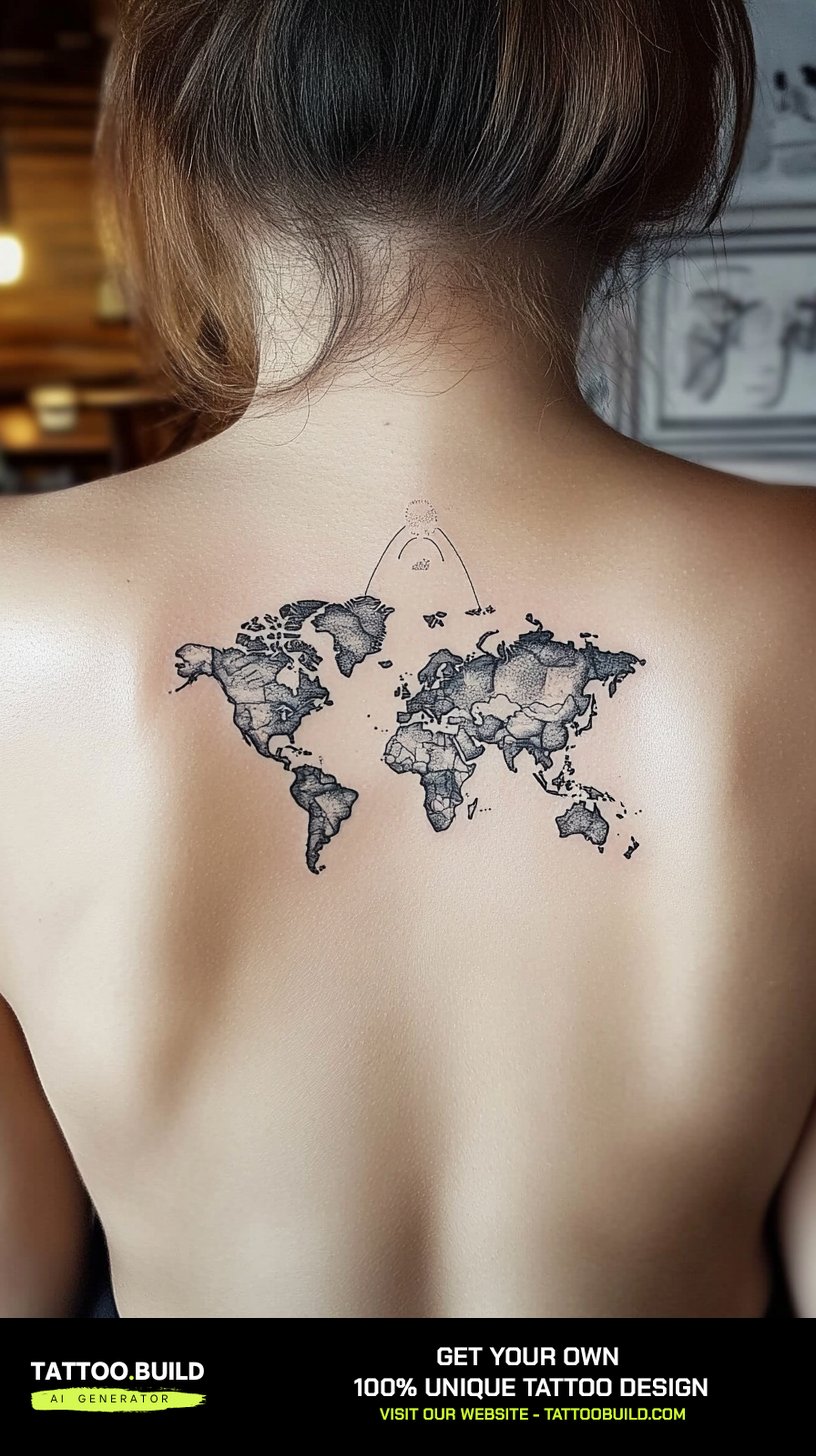
The wrist band version wraps a simplified world map or a dotted flight path all the way around the arm.
It is the most requested small map design I come across, and also the one that needs the most honest conversation beforehand. Wrist skin is thin, mobile and sun-exposed, so fine detail there fades sooner than almost anywhere else.
My advice is to keep it to landmass silhouettes and a single dotted line, with no internal borders at all. If you want specific places recorded, coordinate tattoos do that job far better at this scale.
Plan for a touch-up at the two-to-three year mark and you will be happy with a wrist map for a very long time.
3. World Map and Airplane Tattoo
Adding a plane and a dotted trail turns a static map into a story about a specific journey.
The composition trick is contrast: keep the map light and open, then make the plane the one solid, high-contrast element. If both compete for attention the piece reads as clutter.
I like this design most on the forearm and the outer bicep, where there is enough length for the dotted line to actually travel somewhere.
Some people replace the plane with a hot air balloon, a paper aeroplane or a bird for a softer feel. If the aircraft itself is the point, my airplane tattoo ideas guide goes deeper on those shapes.
4. Map Arm and Sleeve Tattoo
A map sleeve is where the idea finally gets the space it deserves, and it is my favourite version by a wide margin.
At sleeve scale you can keep genuine cartographic detail: latitude and longitude lines, a compass rose, sea monsters in the blank ocean, banner text. None of that survives on a small piece.
Expect this to be a multi-session project. Most map sleeves I have seen were built over several sittings of a few hours each, usually with outline work first and shading later.
Leave negative space deliberately. A sleeve that is dark edge to edge loses the map entirely from more than a metre away — a point I make in more detail in my sleeve tattoo ideas guide.
5. Pirate Map Tattoo
The treasure map is the most playful branch of this family, and it forgives imperfection better than any other.
Because nobody expects a pirate map to be geographically accurate, the artist can prioritise composition — torn parchment edges, a bold X, a dagger, a skull, a ship on the horizon.
These pieces suit American traditional and neo-traditional styles particularly well. Heavy black outlines and a limited palette are exactly what an aged parchment look needs.
Thighs, calves and upper arms all take this design comfortably. If the vessel is the part you love, ship tattoo ideas is the better starting point.
6. Map and Compass Tattoo
Pairing a map with a compass is the most popular combination in this whole category, and for good reason.
The compass gives the eye a focal point. A map on its own can read as flat; a compass rose sitting over it creates depth and an obvious centre.
Practically, the compass also solves a layout problem — it fills the awkward round space in an ocean where a map has nothing to show.
Meanings vary by person, but direction, purpose and finding your way home come up again and again. I unpack the symbolism properly in my guide to compass tattoo meaning.
7. Map Leg and Calf Tattoo
The calf is quietly the best canvas for a map tattoo and almost nobody suggests it first.
It offers a large, gently curved, relatively low-stretch surface that ages well, and it is easy to keep covered from the sun — which is the single biggest factor in how a tattoo holds up.
Vertical compositions work naturally here. A map running down the calf with mountains, a route line or a coastline reads better than a wide horizontal design squeezed into the same space.
Terrain-heavy maps in particular belong on the leg. If your version leans that way, the ideas in my mountain tattoo ideas guide combine with it easily.
Map Tattoo Variations Worth Considering
If the classic continent outline is not quite it, these are the adjacent ideas I suggest most often.
Topographic Contour Lines
Instead of a coastline, use the contour rings of one specific mountain, island or lake. It is abstract enough to look like pure pattern to anyone who does not know the place.
City Street Map
A few blocks of a city you love, rendered as line work. These age well because the lines are already deliberately spaced, and they are far more personal than a world map.
Constellation or Star Map
A map of the sky on a particular night rather than the ground. It carries the same commemorative weight with a completely different visual texture.
Fingerprint or Silhouette Map
A country outline filled with a fingerprint pattern, a portrait silhouette or handwriting. Striking, but it needs size — this is not a 5 cm idea.
Negative Space Map
The landmass is left as bare skin inside a solid or textured block. Bold, modern, and one of the most durable approaches on this list because there is no fine internal detail to lose.
Practical Tips and Aftercare
Bring reference material of the actual geography, not just tattoo photos. Artists are not cartographers, and a wrong coastline is a permanent mistake that is genuinely hard to fix.
Ask to see the stencil applied at full size before any needle touches you. If the smallest islands already look like a smudge on paper, they will look worse in skin.
Follow whatever aftercare instructions your artist gives you, since they know their own ink and technique. The general principles — keep it clean, keep it moisturised, do not pick — are set out well by the American Academy of Dermatology in its guide to caring for tattooed skin.
Sunscreen on a healed map tattoo is not optional if you want the thin lines to last. And if you develop swelling, spreading redness, pus or a rash days after the session, see a doctor rather than waiting it out — those can signal infection or an ink reaction, both of which the FDA notes as real risks of tattooing. Nothing here is medical advice.
Common Mistakes and Still Not Sure?
The mistake I see most is asking for every country border on a piece the size of a business card. It looks stunning as a digital drawing and unreadable after five years.
The second is choosing watercolour splashes on sun-exposed skin. Colour washes without a strong black structure underneath fade the fastest of anything in this category.
The third is rushing the placement. Sleep on the stencil position if you can — a map that sits slightly off-centre on a forearm will bother you every single day.
Still undecided? If you want something quieter, browse minimalist tattoo ideas. If you have already settled on the arm but not the design, forearm tattoo ideas will help you narrow it down.
Frequently Asked Questions
How small can a map tattoo be?
A single continent outline works down to roughly 5-7 cm because the silhouette does the work. A full world map really needs 10 cm or more before the continents stop merging into one shape. Anything smaller and you are tattooing a suggestion of a map rather than a map. In my experience the people happiest with tiny map tattoos are the ones who chose one landmass instead of all of them.
Do map tattoos age badly?
Not inherently — over-detailed ones do. Ink spreads slightly over the years, so closely spaced lines are the part that fails, not the concept. A bold, simplified map ages just as well as any other bold tattoo. Choosing fewer borders at the drawing stage is the single best thing you can do for its longevity.
Where is the best placement for a map tattoo?
The outer forearm, upper arm and calf are the most reliable, because they are relatively low-stretch and easy to keep out of the sun. The wrist and hand look great early but need touch-ups sooner. Ribs and the top of the foot are also harder on fine detail. Placement matters more for maps than for most designs, precisely because they depend on thin lines.
Can I add countries or routes later?
Usually yes, if the design was planned with that in mind. Tell your artist at the first session that you intend to extend it, and they can leave the composition open. Adding to a piece that was drawn as a closed, finished design is much harder and often means reworking the original. Marking new places with small filled dots is the easiest add-on.
How much does a map tattoo cost?
It depends entirely on size, artist and city, so any specific figure would be misleading. What I can say is that map designs take longer than they look because the linework is unforgiving and often freehand-adjusted on the body. Expect a small wrist band to be a single short session and a sleeve to be a multi-session project. Always get a quote in person after the artist has seen the placement.
Quick Summary
- Size decides detail. Choose how many countries you want visible, then size the tattoo to match — never the other way round.
- Bold beats fine for longevity. Traditional and dotwork map tattoos hold up better than delicate single-needle work.
- Africa, single-country and city maps work at smaller sizes than a full world map does.
- Wrist bands look great but fade first. Budget for a touch-up every few years.
- A compass or aircraft gives the composition a focal point and fills empty ocean space.
- Sleeves and calves are the only placements that carry genuine atlas detail well.
- Check the geography yourself. Bring accurate reference — a wrong coastline is permanent.
- Sunscreen and proper aftercare matter more here than on almost any other design.