I have spent more time than I would like to admit standing in tattoo studios, flipping through portfolios with men who know they want a sleeve and have absolutely no idea what should go in it. A sleeve is not a design you choose – it is a plan you commit to, usually across a year and several long sessions.
That single shift in thinking is what separates the sleeves that still look good a decade later from the ones that turn into a crowded patchwork of unrelated ideas.
So this guide is built the way I would talk you through it in person: the styles that actually hold up on an arm, what each one demands from your artist, and how the whole thing fits together. If you already know you want the arm covered end to end, my breakdown of full sleeve tattoos for men covers the commitment side in more depth.
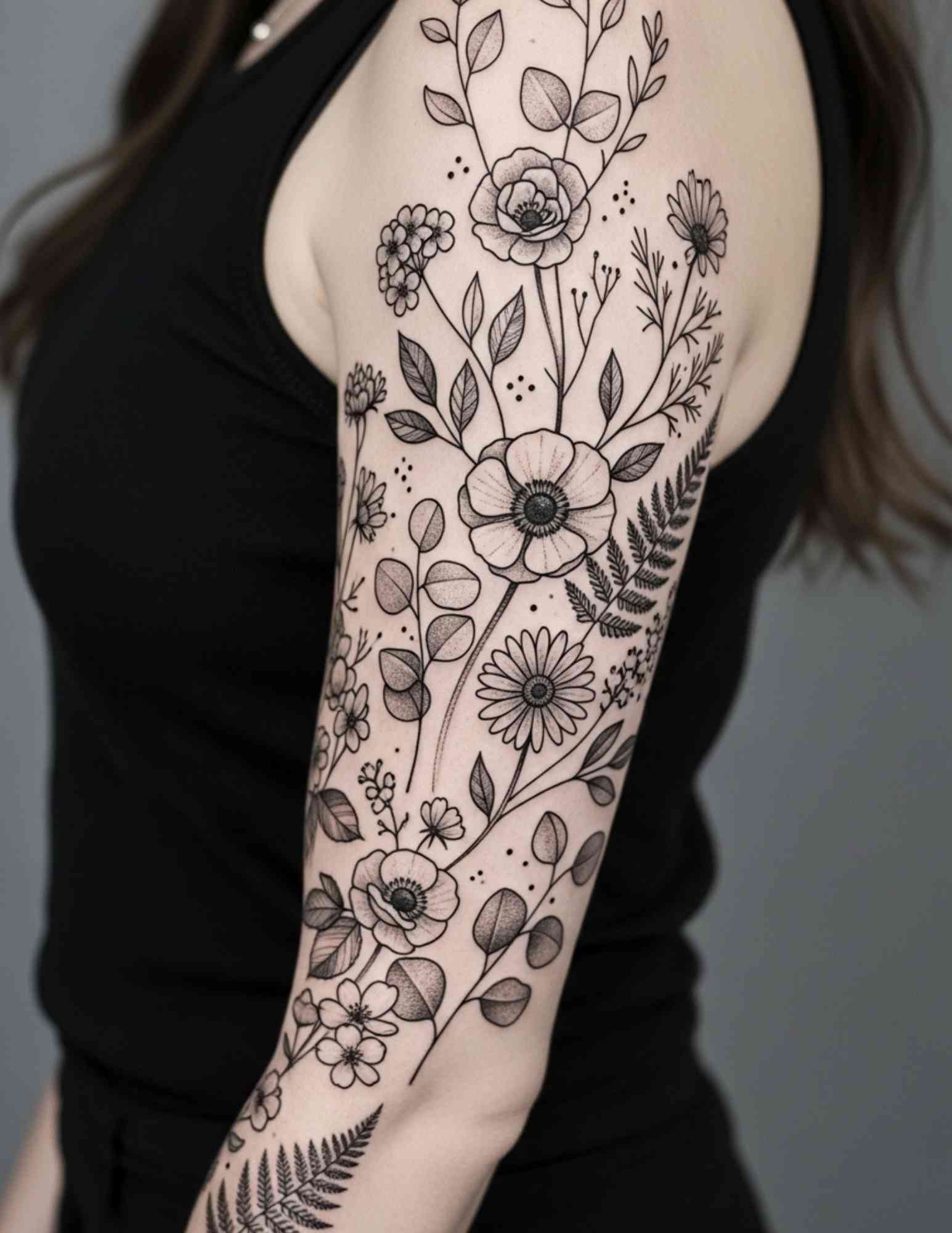
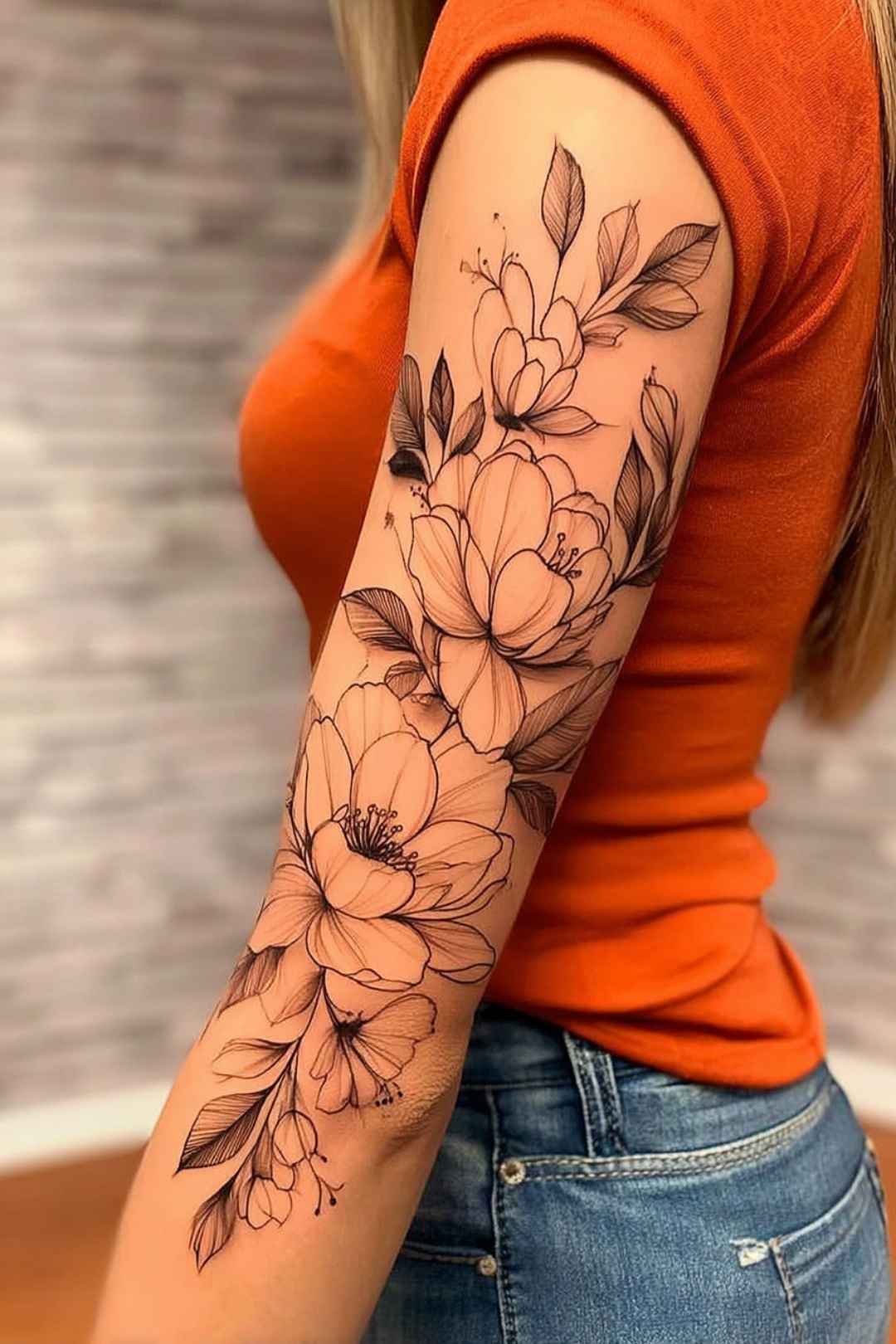
Every image below is a real sleeve. Use them the way tattooers want you to – as direction, not as something to copy line for line.
Which Sleeve Style Is Right for You?
Before the ideas, here is the honest comparison I wish someone had handed me the first time. Session counts and healing notes below are what I have consistently seen from artists I have worked with, not fixed rules.
| Style | Typical Session Load | How It Ages | Best For |
|---|---|---|---|
| Tribal / Polynesian | Moderate – solid black covers ground fast | Very well; bold black holds shape longest | Men who want impact without fine detail |
| Japanese (Irezumi) | High – background work adds hours | Excellent when the background is done properly | Anyone planning the whole arm from day one |
| Black & Grey Realism | High – shading is slow and detailed | Softest edges fade first; needs sun protection | Portraits, scenes and personal imagery |
| Biomechanical | High – built around your specific arm | Good; contrast keeps it readable | Men who want the tattoo to look structural |
| Blackwork / Geometric | Moderate to high depending on fill | Very well, but hardest to cover or lighten later | Graphic, modern, high-contrast arms |
| Mandala / Ornamental | Moderate – symmetry takes drawing time | Good; dotwork can soften over the years | Building outward from one anchor piece |
What Actually Determines How a Sleeve Turns Out
In my experience, the design matters less than three unglamorous things: the artist, the plan, and your patience.
The artist is the single biggest variable. A specialist in black and grey realism will produce a very different arm than a traditional Japanese artist, even if you hand them the same reference photo.
The plan comes second. Every artist I have asked about regret says the same thing – the arms they get called in to fix are almost always the ones that were tattooed piece by piece with no map.
Then there is budget and time. Sleeves are priced by the hour in most studios, so the number that matters is not the design, it is how many hours the design demands. I broke that down separately in how much a sleeve tattoo costs.
And your skin has a say too. Arms with scarring, heavy sun damage or existing tattoos will change what an artist can realistically build, which is a conversation to have at the consultation rather than in the chair.
Sleeve Tattoo Ideas for Men, Style by Style
These are the styles I see holding up on real arms, in rough order of how often men actually ask for them.
1. Tribal and Polynesian-Inspired Sleeves
Tribal is the style everyone assumes is dated, and then they see one done properly and change their mind.
The difference is flow. A good tribal sleeve is drawn onto your arm, not printed onto it – the bands widen at the bicep and narrow toward the wrist because that is what the muscle does.
When I tested this on myself with a stencil, the version drawn freehand on the arm sat noticeably better than the one designed flat on paper. Freehand is worth asking for.
One point of respect: Polynesian, Samoan and Maori patterns carry specific cultural meaning. Plenty of artists will happily design something in that visual language without copying sacred motifs, and that is the route I would take.
2. Japanese Irezumi Sleeves
Japanese is, in my opinion, the style best suited to the shape of an arm – because it was designed for bodies rather than paper.
The background is not filler, it is the structure. Waves, wind bars and clouds are what tie a koi at the wrist to a dragon at the shoulder and make the arm read as one piece.
Every Japanese artist I have asked says the same thing about planning: pick the main subject first, agree the background second, and never tattoo the subject in isolation and hope it connects later.
It is also the style where session count climbs fastest. The background alone can take as long as the main imagery.
3. Black and Grey Realism Sleeves
Realism is where sleeves get personal – portraits, landscapes, animals, photographs of things that actually mean something.
It is also the least forgiving style on the list. Smooth grey blending is the first thing to soften as a tattoo settles, and a portrait that is slightly off looks wrong to everyone, including strangers.
When I have compared healed realism work side by side, the pieces with strong dark anchors held up noticeably better than the ones built entirely from mid-greys.
So ask for healed photos, not fresh ones. Fresh realism always looks incredible; healed realism is the actual product.
4. Biomechanical Sleeves
Biomechanical is the style that most obviously has to be designed for your arm specifically.
The whole illusion depends on the machinery following your real anatomy. Pistons that run against the muscle line simply look like drawings sitting on skin.
In my experience the torn-skin edges are where these pieces succeed or fail – too clean and it looks like a sticker, too messy and it reads as smudging.
If you like the concept but want it lighter than a full mechanical arm, there are gentler takes in my collection of biomechanical tattoo ideas.
5. Wildlife and Nature Sleeves
Forests, mountains, wolves, bears, rivers – nature sleeves are the most requested theme I come across, and for good reason.
They scale beautifully. A tree line can compress at the wrist and open up at the shoulder without the composition breaking, which is not true of most subjects.
The mistake I see is cramming in too many animals. One strong subject with landscape around it consistently beats four competing focal points.
Leaving open skin also matters here more than in other styles. The blank areas are what make the mountains read as distance rather than clutter.
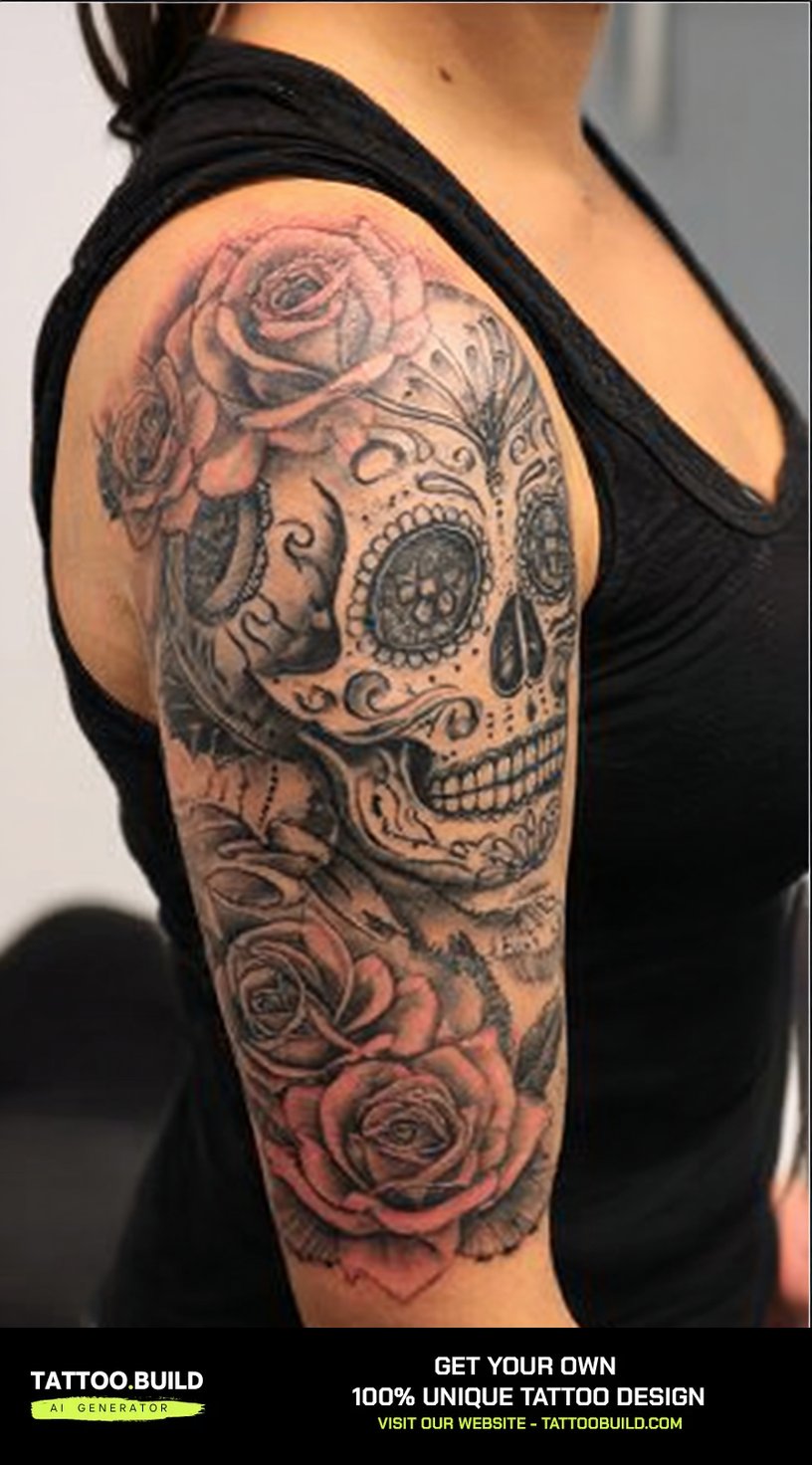
6. Skull and Floral Sleeves
Skulls have been on arms for as long as tattooing has existed in the West, and the modern version usually pairs them with flowers.
The contrast is the entire point – hard bone against soft petals, which gives an artist a natural excuse to vary texture across the arm.
Every artist I have asked prefers building a skull sleeve around two or three well-drawn skulls rather than a dozen small ones, and I agree after seeing both healed.
If the skull is the part you care about and the flowers are negotiable, there is a wider range in my guide to skull tattoo ideas for men.
7. Mythology and Fantasy Sleeves
Greek statues, Norse gods, mythical creatures – this has been the fastest-growing sleeve theme I have noticed in studio portfolios over the last few years.
Statue-style rendering is the reason. Carved marble gives an artist crisp edges and dramatic shadow, which photographs and heals better than soft skin tones.
Drapery is the quiet test of skill here. Fabric folds are difficult to fake, so if an artist’s portfolio has convincing cloth, they can probably handle the rest.
These sleeves also tend to need a strong narrative order – one figure per arm section, rather than a crowd fighting for attention.
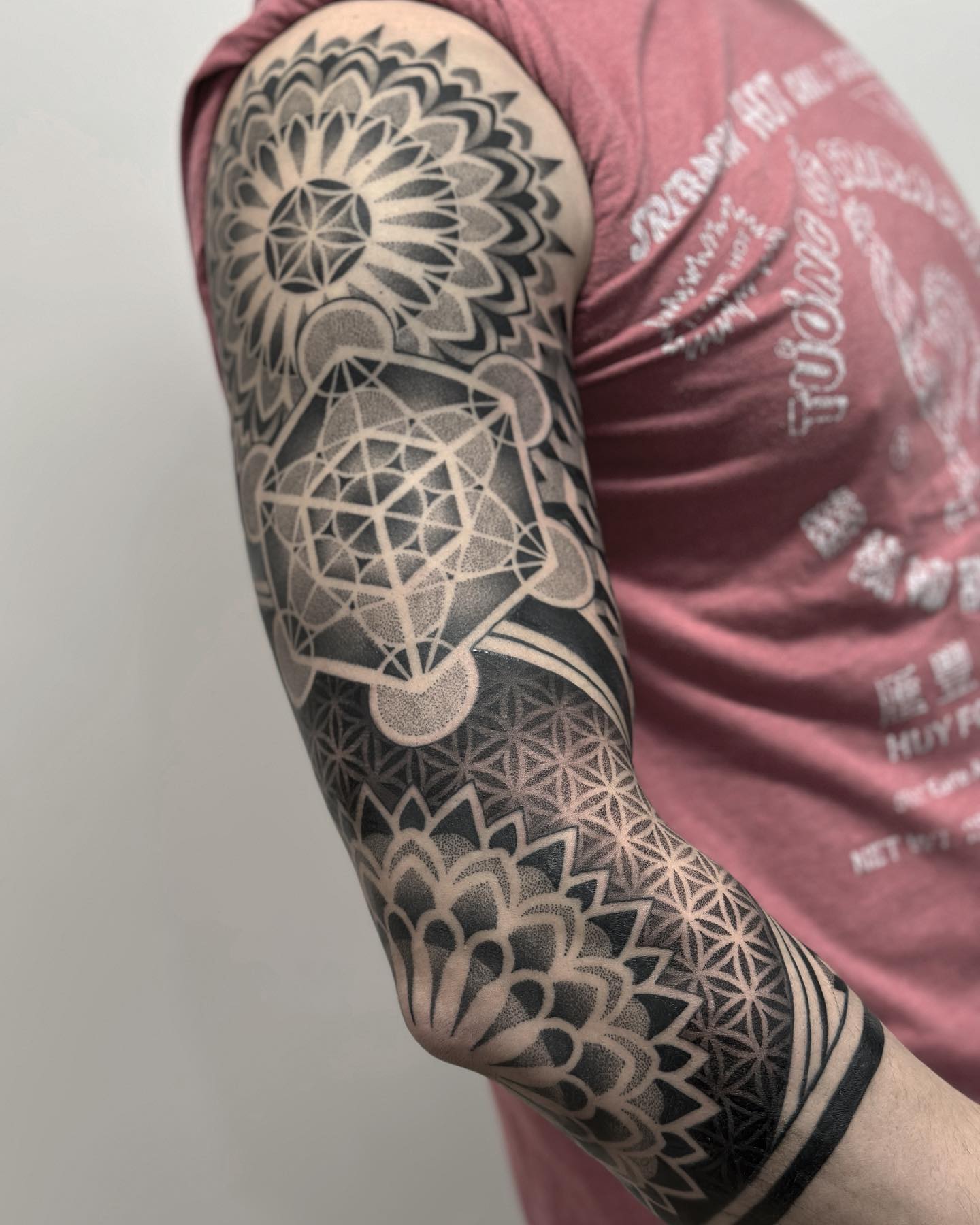
8. Blackwork, Geometric and Mandala Sleeves
Blackwork covers a wide range, from abstract brush-stroke shapes to precise geometry to ornamental mandalas.
What unites them is that they are graphic rather than illustrative – they are about shape, contrast and negative space instead of depicting a subject.
I will be straight about the trade-off: heavy solid black is the most durable choice on this page and also the hardest to cover up or lighten later. Go in knowing that. The range of what is possible is broader than most people expect, as you can see in my roundup of blackwork tattoo ideas for men.
Geometric work sits in the same family but lives or dies on precision. A line that drifts by a millimetre across a curved forearm is visible to everyone.
Mandalas are the easiest entry point of the three, because a single well-placed mandala works as a standalone piece and as the anchor for a sleeve you build later. There are more variations in my mandala tattoo ideas for men collection.
Variations Worth Considering Before You Commit
A full sleeve is not the only option, and in a lot of cases it is not the smartest first move either.
Half Sleeve
Shoulder to elbow, or elbow to wrist. It is roughly half the time and half the cost of a full sleeve, and it leaves you an obvious way to extend later. This is what I suggest to most men getting their first large piece – the options are laid out in half sleeve tattoos for men.
Quarter Sleeve
Shoulder to mid-bicep. Easy to cover with a t-shirt, quick to finish, and a genuinely useful way to find out how you handle sitting for long sessions before committing further.
Leg Sleeve
The same design logic applied to the calf and thigh. There is more flat surface to work with, though most people I have spoken to find the shin considerably less comfortable than the outer arm.
Open or Negative-Space Sleeve
Connected pieces with deliberate gaps of bare skin between them. It costs less, hurts less in total, and in my experience ages more gracefully than an arm packed wall to wall.
Looking After a Sleeve While It Heals
A sleeve is not one healing tattoo, it is several – each session restarts the process on a new section of arm.
Follow the aftercare instructions your artist gives you over anything you read online, including this page. They know what ink, needles and wrap they used. The general principles are covered in my tattoo aftercare guide, and the American Academy of Dermatology publishes straightforward guidance on caring for tattooed skin.
Sun is the long game. Once a section is fully healed, sunscreen on it is the cheapest thing you will ever do to protect the work – particularly on grey wash and soft shading. The Mayo Clinic has a clear overview of tattoo risks and skin care worth reading before your first session.
On safety, be direct with yourself: spreading redness, increasing pain after the first few days, pus, or a fever are reasons to see a doctor, not reasons to ask a tattoo forum. Allergic reactions to specific inks do happen, and the FDA keeps a plain-language page on tattoo ink safety. Nothing here is medical advice – if something looks wrong on your arm, get it looked at.
And never attempt to tattoo or remove work at home. Every artist I have asked has a story about fixing a kitchen-table tattoo, and none of those stories end cheaply.
Common Sleeve Mistakes – and What to Do If You Are Still Not Sure
The most expensive mistake is starting without a plan for the whole arm. Individual tattoos are easy to add; making six unrelated ones look intentional is not.
The second is choosing an artist by price or by availability rather than by style. A three-month wait for the right person is nothing against a tattoo you keep forever.
The third is rushing the sessions. Skin needs time between appointments, and pushing through fatigue is how detail quality drops in the last hour of a long sitting.
If you are still deciding, two things help. Get honest about how much pain you are signing up for – I mapped that out in the most painful tattoo spots – and browse widely before you commit, which is what my broader list of cool tattoo ideas for men is for.
Then sit with your shortlist for a month. If you still want it after four weeks, that is a reasonable signal. If you do not, you just saved yourself several thousand dollars.
Frequently Asked Questions
How long does a full sleeve tattoo take?
It is measured in sessions, not hours. Most full sleeves I have seen completed took several multi-hour sittings spread over months, because skin needs healing time between appointments. Detail-heavy styles like realism and traditional Japanese sit at the longer end, while bold blackwork and tribal usually cover ground faster. Your artist can give you a realistic estimate once the design is settled – before that, any number is a guess.
Should I design the whole sleeve before starting?
In my experience, yes – at least in outline. You do not need every detail finalised, but you do need an agreed theme, a placement for the main subject, and a plan for how the background connects it. Every artist I have asked says the arms they are called in to fix are the ones tattooed piece by piece with no map. Agreeing the framework first is the cheapest insurance you can buy.
Which sleeve style ages the best?
Bold, high-contrast work generally holds up longest. Solid blackwork, tribal and traditional Japanese with strong outlines tend to stay readable, while soft grey wash and fine detail soften first. That does not mean you should avoid realism – it means you should protect it with sunscreen and accept that it will need touch-ups sooner. Ask any artist for healed photos rather than fresh ones and you will see the difference immediately.
Can I mix different styles in one sleeve?
You can, but it needs a deliberate plan rather than a series of independent decisions. The mixes that work usually share one unifying element – all black and grey, or a consistent background style that carries between panels. The ones that fail are the arms where each piece was chosen on its own. If you want variety, talk to an artist who has already pulled it off and can show you healed examples.
Does a sleeve hurt more than a smaller tattoo?
Not more intensely at any given moment, but the duration is the real challenge. The outer arm is one of the more tolerable areas for most people, while the inner bicep, elbow ditch and wrist tend to be sharper. What catches people out is hour four of a session, not the first needle. Eat properly beforehand, stay hydrated, and tell your artist when you need a break – they would much rather pause than rush.
Quick Summary
- Plan the whole arm before the first needle. A framework beats a collection of separate tattoos every time.
- Choose the artist for their style, not their availability. Waiting for a specialist is the single highest-value decision here.
- Match the style to how it ages. Bold black holds longest; soft grey wash needs sun protection and touch-ups.
- Let the design follow your anatomy. Freehand or on-body stencils sit better than flat paper designs.
- Leave some open skin. Negative space is what makes a sleeve readable rather than crowded.
- Budget by hours, not by picture. Detail is what drives the total, not the subject you pick.
- Start smaller if you are unsure. A half or quarter sleeve extends cleanly into a full one later.
- Take aftercare from your artist, and medical concerns to a doctor. Spreading redness or fever is not a forum question.