I have watched people walk into a shop with a phone full of star charts and walk out with something far simpler than they planned. A constellation tattoo works because it hides a specific, personal date inside a pattern that looks like decoration to everyone else.
That is the whole appeal. Your mother’s birth sign, the night you met someone, the sky over the town you grew up in — none of it is legible to a stranger, and all of it is legible to you.
The catch is that constellations are mostly dots and thin lines, and dots and thin lines are the two things that age the fastest in skin. I have seen four-year-old star maps that still read perfectly, and two-year-old ones that have blurred into a smudge. The difference is almost never the artist’s talent — it is spacing, dot weight and placement. If you are still deciding on a wider theme, our guide to celestial tattoo ideas covers the surrounding territory.
Below are 19 directions worth considering, plus the practical part nobody tells you until you are already in the chair.
Which Constellation Tattoo Style Is Right for You?
The five approaches below cover almost every constellation tattoo I have seen. They are not equally durable, and they do not cost the same.
| Style | Typical size | How it ages | Best for |
|---|---|---|---|
| Dot-only (no lines) | 2–5 in | Good, if dots are 1mm+ and well spaced | People who want it to read as decoration, not a diagram |
| Fine line with connectors | 3–7 in | Fair — hairline connectors soften first | Anyone who wants the shape to be recognisable |
| Dotwork / stippled | 4–10 in | Very good — density hides spread | Star fields, nebula backgrounds, larger pieces |
| Geometric | 4–8 in | Fair — unforgiving of any line wobble | People who like structure and symmetry |
| Illustrative (with imagery) | 6–12 in | Excellent — solid shapes hold | Thigh, arm and back pieces with room to breathe |
If you are choosing between the first two rows, ask yourself whether you want people to recognise the constellation. That single question settles it more often than any aesthetic preference.
What Actually Makes a Constellation Tattoo Last
The International Astronomical Union recognises 88 official constellations, and most of them are, visually, a handful of unevenly spaced points. That is a design problem before it is a tattoo problem.
Small dots placed close together tend to migrate toward each other over years as ink spreads slightly in the dermis. Two dots 2mm apart can read as one blob a decade in.
My rule of thumb after years of looking at healed work: no dot smaller than about 1mm, and no two dots closer than roughly 4mm. Enlarging the whole design is usually the fix, and it usually costs nothing extra.
Placement matters just as much. Fingers, feet, the inner wrist and anywhere with heavy friction will fade faster than an outer arm or thigh. If placement is your open question, our breakdown of the most painful tattoo spots covers the same body map from the other angle.
And be honest about touch-ups. Most fine line star work benefits from one at the two-to-four-year mark. Budget for it rather than being surprised by it.
19 Constellation Tattoo Ideas Worth Considering
These are grouped roughly from most literal to most interpretive. Numbers 1 through 8 are the ones I see requested most often.
1. Your Birth Constellation
The obvious starting point, and still the most common request I hear artists field.
The advantage is that the shape carries meaning without any explanation, and if you ever tire of the astrology framing, it is still a real star pattern in the real sky.
A caution worth naming: zodiac constellations vary enormously in visual appeal. Scorpius and Leo have strong, readable shapes. Libra and Cancer are, frankly, four faint stars that do not draw well at small scale. If yours is one of the weaker ones, a lot of people end up combining the constellation with the sign glyph instead — you can see how that reads in our Scorpio sign tattoo ideas.
Every artist I have asked about this says the same thing: bring the actual star chart, not a Pinterest render, because half the versions circulating online have the stars in the wrong positions.
2. Orion’s Belt
Three stars in a near-straight line: Alnitak, Alnilam and Mintaka. It is probably the most recognisable star pattern in the northern winter sky.
That recognisability is the point. Three dots on a forearm read as intentional to anyone who has looked up, and as nothing in particular to anyone who has not.
It is also the cheapest meaningful tattoo on this list — most shops will do it as a shop minimum, which in my experience currently sits somewhere between $80 and $150 depending on the city.
When I tested placements on paper, the back of the upper arm and the inner forearm both worked. The ribs did not, because the slight curve broke the straight line.
3. Cassiopeia
Five bright stars in a W. It is circumpolar from most of the northern hemisphere, meaning it never sets — a detail a lot of people find worth carrying.
The W shape is graphically strong, which makes it one of the few constellations that survives being shrunk down.
It also pairs well with other celestial elements without getting crowded. The forearm piece below sets it between a sun and a crescent moon, which is a composition I see working repeatedly — more of that approach in our sun and moon tattoo ideas.
4. Scorpius
One of the genuinely beautiful ones. Scorpius has a long curving tail that follows the line of a forearm or a calf almost perfectly.
Antares, the red supergiant at its heart, gives you an obvious place to put a heavier star or a single spot of colour if you want one.
This is the constellation I would pick if I cared most about the design working as a design. The shape does half the work for you.
The version below uses dotted connectors rather than solid lines, which softens it and, in my experience, ages a little more gracefully than a continuous hairline.
5. Fine Line With Connecting Lines
The default look: stars joined by thin lines, the way star charts draw them.
It is the clearest way to signal “this is a constellation” rather than “these are some stars”.
The trade-off is durability. Hairline connectors are the first element to soften, and on high-friction placements they can go patchy within a few years. Ask your artist to run the connectors slightly heavier than they instinctively would — the same principle that keeps any fine line work readable over time.
6. Dot-Only, No Connectors
Drop the lines entirely and let the star positions speak.
This is my personal preference for anything on a visible placement, because it reads as intentional decoration rather than as a diagram, and it does not date the way a chart-style rendering can.
It is also the most forgiving over time — there are no thin lines to lose. Varying the star weights, as in the arm piece below, keeps it from looking like random freckles. If you like this density of mark-making, dotwork tattoo ideas is the natural next stop.
7. Ursa Major and the Big Dipper
Worth being precise here: the Big Dipper is an asterism — seven stars — sitting inside the much larger constellation Ursa Major.
Most people asking for “the Big Dipper” want those seven stars, and that is a perfectly good tattoo. But asking for the full Ursa Major gives your artist a lot more to work with compositionally.
The thigh piece below does the thing I always suggest to people set on this one: it draws the constellation and the bear it is named for, so the piece carries its own explanation.
The two pointer stars at the end of the Dipper’s bowl line up with Polaris, which is why this pattern has been a navigation tool for as long as people have been sailing.
8. A Custom Star Map by Date and Location
Rather than one constellation, this renders the whole visible sky from a specific place at a specific moment.
It is the most personal option on this list and the one most likely to go wrong. Small stars packed into a circle is exactly the density problem described earlier.
What works: pick the date, generate the chart, then have your artist select the six or eight brightest stars and drop the rest. What does not work is trying to reproduce the printout faithfully.
When I have seen these succeed, they were at least five inches across. Below that, the actual sky has more stars than your skin can hold.
Variations, Placements and Smaller Takes
Ideas 9 through 19 are less about which constellation and more about how you wear it.
9. Behind the Ear
Two to four stars tucked behind the ear, hidden by loose hair and visible when it is up.
It is a low-commitment placement in appearance but not in practice — the skin there is thin and close to bone, and most people describe it as sharp rather than long.
Keep it to a handful of stars. The area is small enough that any connector work will close up.
10. Constellation With a Moon or Planet
Adding a crescent moon gives the composition an anchor — a solid shape that holds the eye while the stars do the detail work.
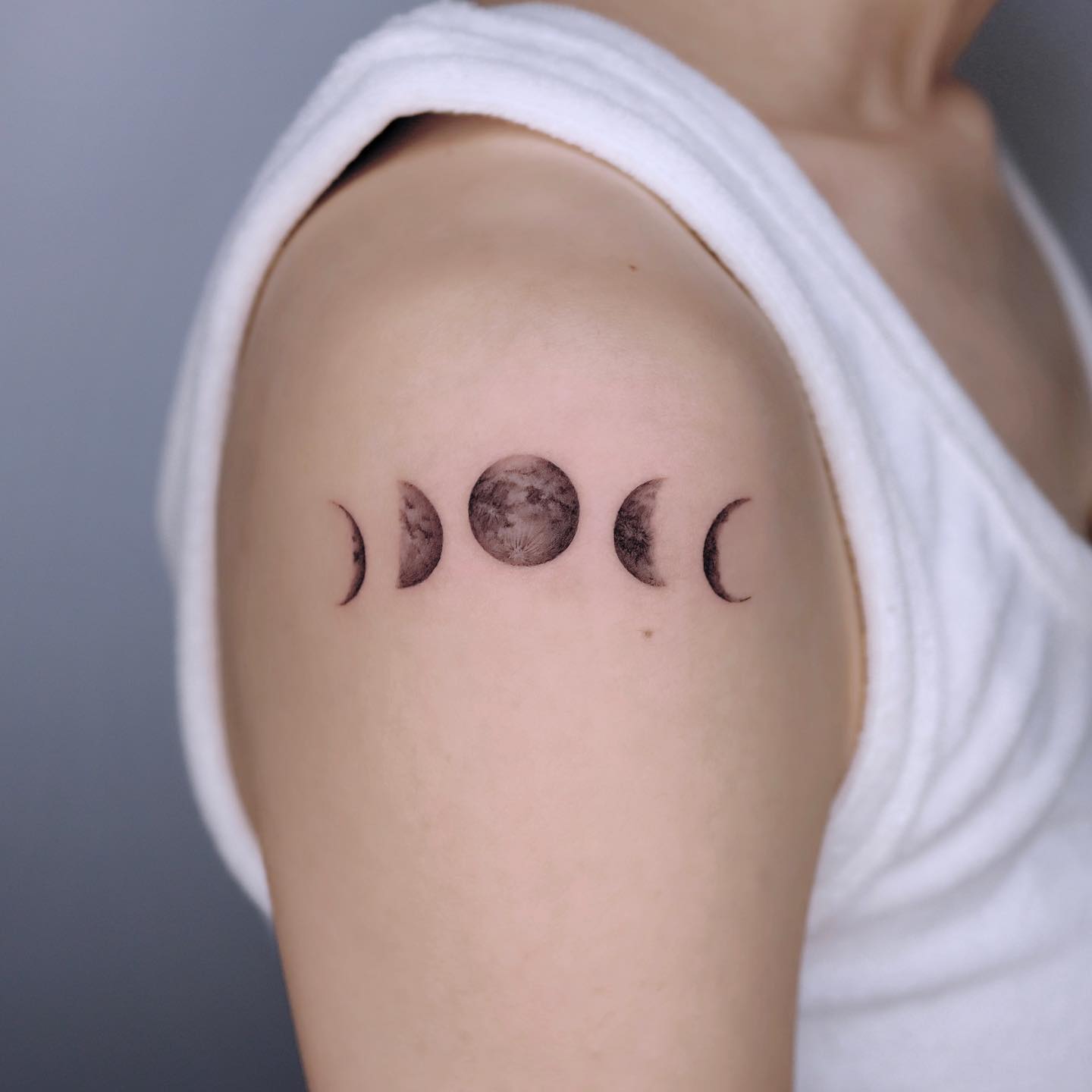
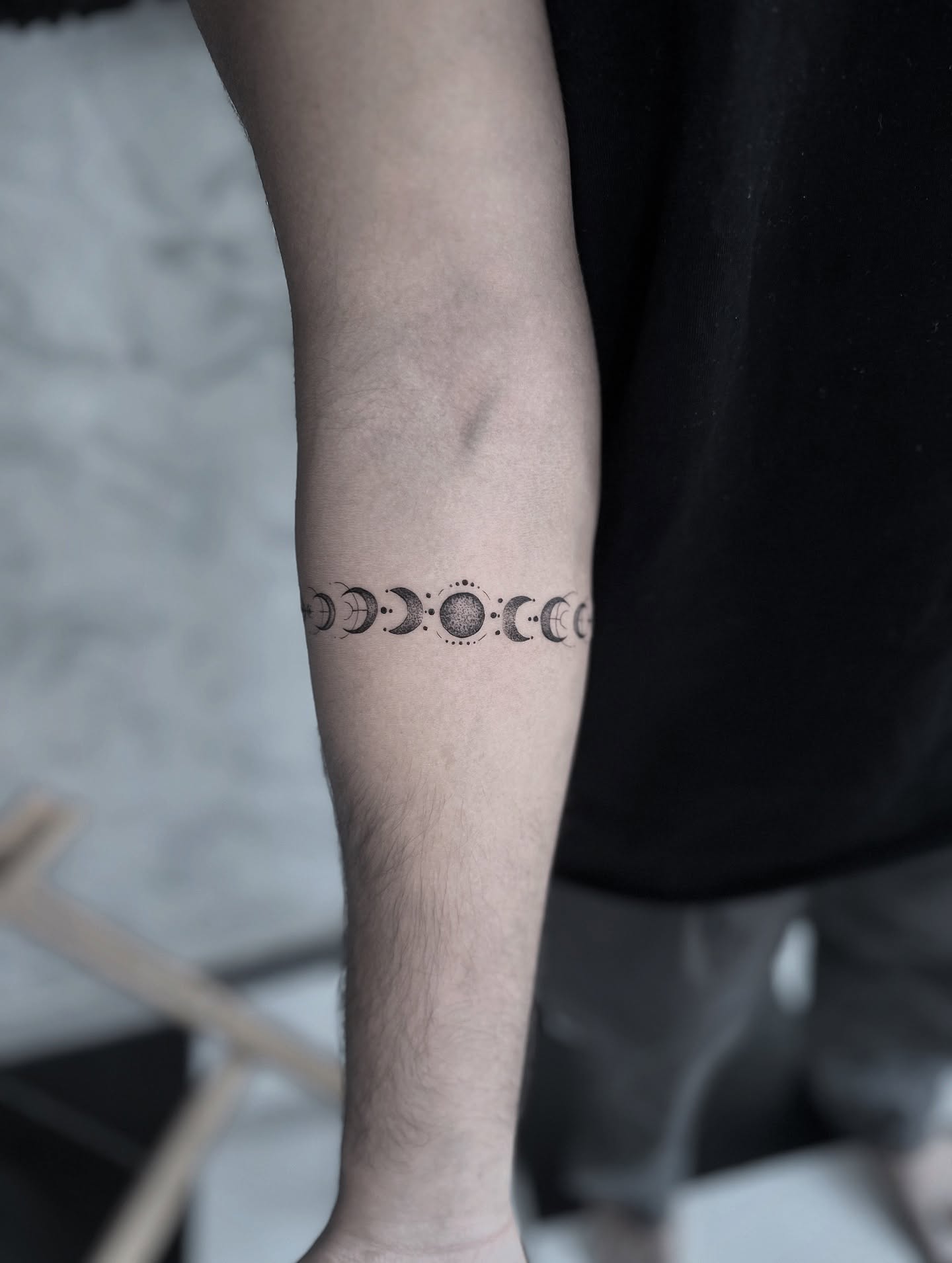
This is the single easiest way to make a small star cluster look finished rather than unfinished. Moon phase tattoos take the same idea further.
A stippled moon, as below, also ages better than an outlined one at small sizes.
11. Geometric Constellation
Stars set inside a circle, triangle or hexagon frame, sometimes with the connectors extended into a lattice.
It suits people who want structure. Be aware that geometric work is unforgiving — any wobble in a straight line is permanently visible, so this is one to book with someone whose healed geometric portfolio you have actually seen.
12. Constellation Wrist Band
A line of stars wrapping the wrist like a bracelet.
Pretty, and high-risk. Wrists get constant friction from sleeves, watches and hand washing, and this placement fades faster than almost anywhere else. Go slightly larger than feels right and expect a touch-up.
13. The Southern Cross
Crux is the smallest of the 88 recognised constellations, and its four bright stars make a compact, balanced shape.
It carries strong regional meaning across Australia, New Zealand, Brazil and the southern hemisphere generally, which is worth knowing before you wear it somewhere it will be read as a flag reference.
Purely as a shape, it fits almost anywhere — ankle, sternum, behind the arm.
14. Nebula Background With Constellation Overlay
Soft grey wash or stippled cloud behind the stars, so the constellation sits in something rather than floating on bare skin.
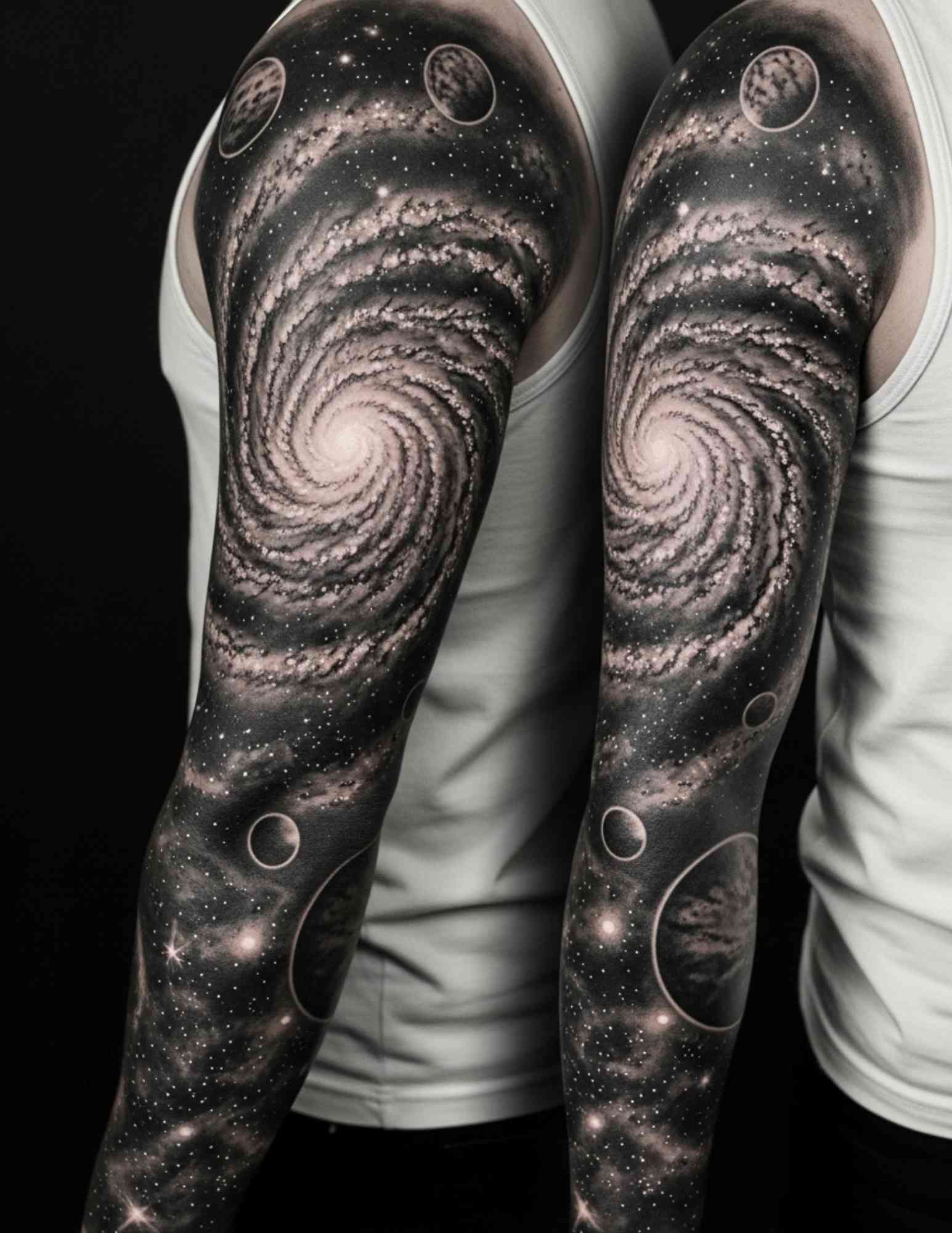
This is where a constellation tattoo starts becoming a galaxy tattoo, and it needs real size — six inches minimum in my experience, or the background muddies.
15. A Full Limb Composition
Stars scattered across an entire calf, forearm or back, sometimes with script threaded through.
The advantage of going big is that spacing stops being a constraint. You can vary star weights dramatically and let empty skin do real work.
The calf piece below is shown fresh, straight off the session — the redness around each star is normal and settles within a few days.
16. Paired Constellations
Two signs in one composition, or one constellation split across two people.
The split version needs care: each half should work alone, because you cannot assume the two halves will always be in the same room. Our matching tattoo ideas for couples covers that problem in more depth.
17. A Single Star
The minimum viable version. One star, clean line, done in ten minutes.
I have never met anyone who regretted starting here. It is an honest first tattoo, and it leaves room to build outward later.
18. Constellation With a Date
Small numerals set beneath or beside the stars.
It makes the meaning explicit, which some people want and others specifically do not. If you go this route, ask for the date in a simple sans-serif at a size you can still read at arm’s length — tiny script blurs faster than dots do.
19. Andromeda and Deep-Sky Objects
Andromeda is a constellation, but the Andromeda Galaxy inside it is a spiral roughly 2.5 million light-years away — and the spiral is what most people actually want tattooed.
It is a different design entirely: a soft lens shape rather than a dot pattern, best rendered in whipshading or dotwork. Say which one you mean when you book.
Getting the Details Right
A short checklist I would give anyone booking this, in order.
First, source a real star chart. Stellarium or any planetarium app will render the accurate sky for a given date and coordinates, and it will not silently rearrange the stars the way stylised graphics often do.
Second, print it at the size you want it on your body and tape it to your arm for a day. Almost everyone goes bigger after doing this.
Third, talk to your artist about dot weight before the stencil goes on, not after. It is a thirty-second conversation that determines whether the piece is still legible in ten years.
Fourth, follow the aftercare you are given rather than the aftercare you read online. Keep it clean, keep it out of the sun, and if anything looks infected — spreading redness, heat, pus, fever — contact your artist and see a doctor rather than waiting it out. The American Academy of Dermatology publishes plain-language guidance on tattoo care and warning signs, and it is worth reading before your appointment rather than after.
Still Not Sure? Common Mistakes to Avoid
The mistake I see most: choosing the constellation for its meaning and ignoring whether it draws well. Some do not, and no artist can fix that.
The second: going too small. A constellation is mostly negative space, and compressing it removes the only thing that makes it readable.
The third: over-decorating. Once you have added a moon, a nebula, a planet and script, the constellation stops being the subject. If you want a busier celestial piece, plan it that way from the start — space tattoo ideas is a better reference point than this article.
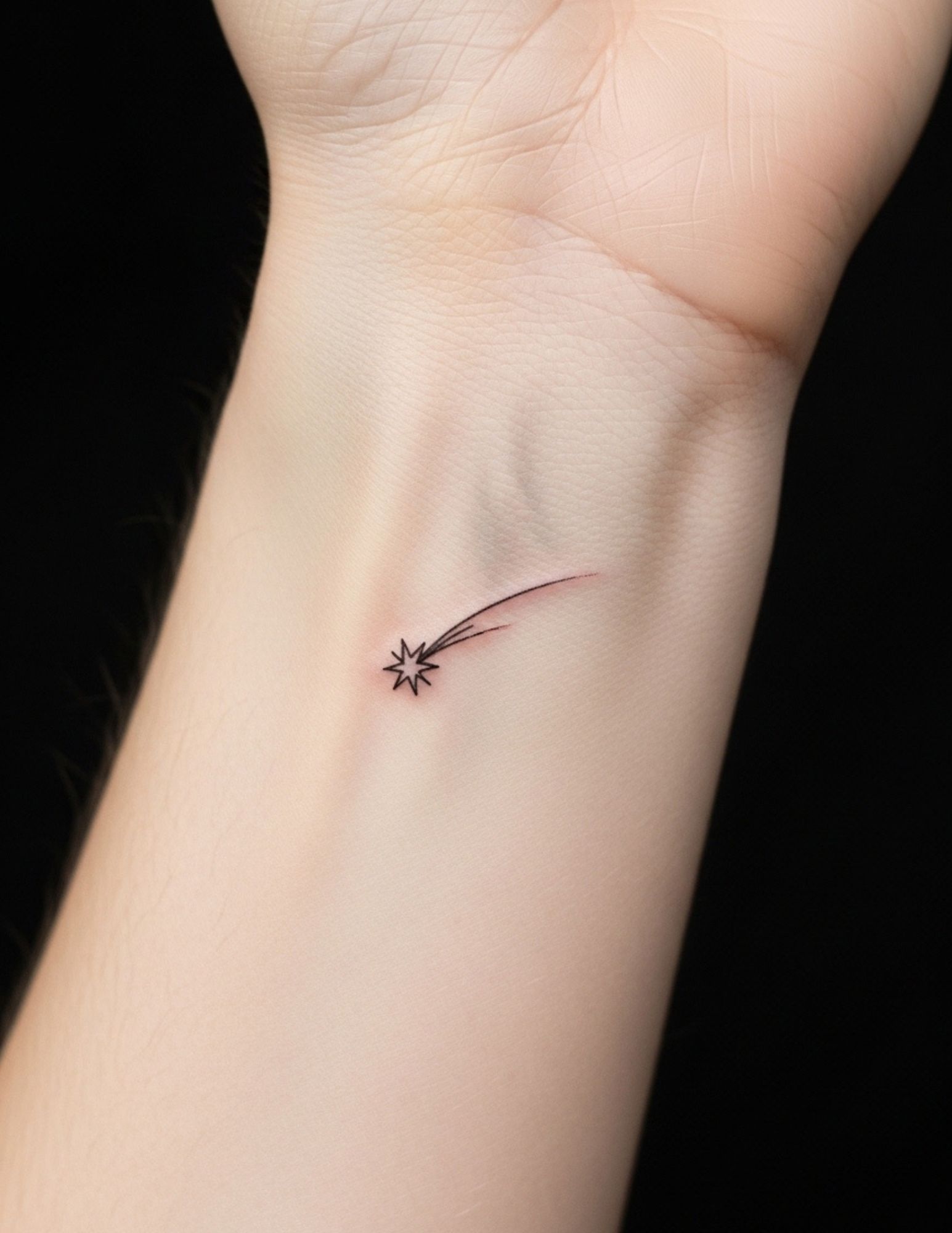
And the fourth: picking a placement for how it photographs rather than how it wears. A wrist or finger star looks perfect for a year. An upper arm or thigh star still looks right in a decade. If you want something small and low-key that will hold, shooting star tattoos on a forgiving placement is a safer bet than a delicate star map on a hand.
Frequently Asked Questions
How much does a constellation tattoo cost?
Small dot-only constellations usually land at the shop minimum, which in most North American cities currently sits somewhere between $80 and $150. A detailed custom star map with a nebula background is hourly work and can run several hundred dollars. The variables are size, detail density and how long your artist needs on the stencil, not the constellation itself. Always ask for a quote after the design is drawn rather than before.
Do constellation tattoos blur over time?
Fine dots and hairline connectors do spread slightly in the skin over years, and closely spaced dots can merge. Sizing the piece so no two dots sit closer than about 4mm dramatically reduces this. Placement matters too — high-friction areas like fingers, wrists and feet fade fastest. Most people find one touch-up somewhere in the first few years keeps the piece crisp.
Should I include the connecting lines or not?
It depends entirely on whether you want the constellation to be recognisable. Connectors make the shape legible to anyone who knows the pattern; dots alone read as abstract decoration. Connectors are also the element most likely to soften with age. In my experience people who want the meaning to be private are happier without them.
What is the least painful place for a constellation tattoo?
Outer upper arm, outer thigh and the top of the forearm are consistently described as the easier placements, because there is muscle and fat between the needle and bone. Ribs, sternum, spine, behind the ear and the inner wrist are reported as considerably sharper. Pain is individual and short-lived for a small piece — most single constellations are done in under an hour.
Can I get an accurate star map of a specific date?
Yes. Planetarium software such as Stellarium will render the exact sky for a date, time and set of coordinates, and you can export that as a reference. The important step is editing it down: keep the brightest six to eight stars and discard the rest, or the density will not survive as a tattoo. Bring both the full chart and the simplified version so your artist can see what you are working from.
Quick Summary
- Pick the constellation for how it draws, not only for what it means — Scorpius, Cassiopeia and Orion have the strongest shapes.
- Keep dots at roughly 1mm or larger and at least 4mm apart, or they will merge over time.
- Connectors make the pattern recognisable; dots alone keep the meaning private. Choose deliberately.
- Source the chart from planetarium software, not from stylised graphics that move the stars.
- Print it at full size and wear the paper for a day before committing — almost everyone sizes up.
- Favour outer arm, thigh and shoulder over wrist, hand and finger if you want it to last.
- A moon or planet gives a small cluster an anchor and makes it look finished.
- Budget for one touch-up in the first few years, and see a doctor rather than an internet thread if healing goes wrong.