I have been drawing and researching celestial tattoo work for years, and space is the one subject I keep coming back to. Space tattoos survive the trend cycle better than almost any other theme, because the subject matter is genuinely permanent — the moon will still look like that in fifty years.
The cosmos gives you an enormous range to work with: planets, nebulae, moon phases, astronauts, black holes, star maps. Each of those reads completely differently on skin.
A space tattoo also carries a particular kind of meaning. Wearing something that operates at cosmic scale is usually a statement about perspective — about knowing how small a person actually is against all of it.
Below are 20 space tattoo ideas I keep recommending, with honest notes on what each one costs you in healing, detail and long-term legibility. If you want to see how the wider category fits together, my guide to celestial tattoo ideas covers the broader theme.
Which Space Tattoo Style Is Right for You?
Style choice matters more than subject choice with space work. The same nebula can look like a NASA photograph or like a diagram, depending entirely on how it is rendered.
| Style | Best For | Minimum Size | Ages Like |
|---|---|---|---|
| Colour realism | Nebulae, planets, Earth from orbit | Palm-sized and up | Needs sun protection; colours soften over years |
| Fine line blackwork | Constellations, moon phases, solar systems | Small to medium | Lines can thicken and blur; keep gaps generous |
| Dotwork / stipple | Starfields, shading inside planets | Medium | Ages well when dots are spaced properly |
| Watercolour | Galaxy washes, aurora, atmospheric depth | Medium to large | The softest edges fade first; anchor with linework |
| Geometric | Stylised planets, orbital diagrams | Small to large | Very durable; clean shapes hold their read |
| Neo-traditional | Rockets, astronauts, retro space imagery | Medium | Excellent — bold outlines are built to last |
What Actually Makes a Space Tattoo Work
The thing most people underestimate is contrast. Space is mostly dark, and a tattoo that is dark everywhere reads as a black blob from three feet away.
Every good space piece I have seen keeps deliberate light areas — untattooed skin standing in for stars, a bright rim on a planet, a pale band through a nebula.
Scale is the second factor. A nebula packed into a two-inch square has nowhere to put its gradients, and in my experience those pieces are the ones that come back for a cover-up.
Reference quality is the third. Artists work far better from an actual astronomical image than from a Pinterest screenshot of someone else’s tattoo, and NASA’s image gallery and the ESA/Webb image archive both publish enormous free image libraries.
Finally, placement. Curved surfaces such as the shoulder cap or calf suit round subjects like planets, while long flat runs like the forearm or spine suit sequences — moon phases, planets in order, a constellation line.
20 Space Tattoo Ideas Worth Stealing
These are ordered roughly from the most involved to the most approachable, not by how good they are.
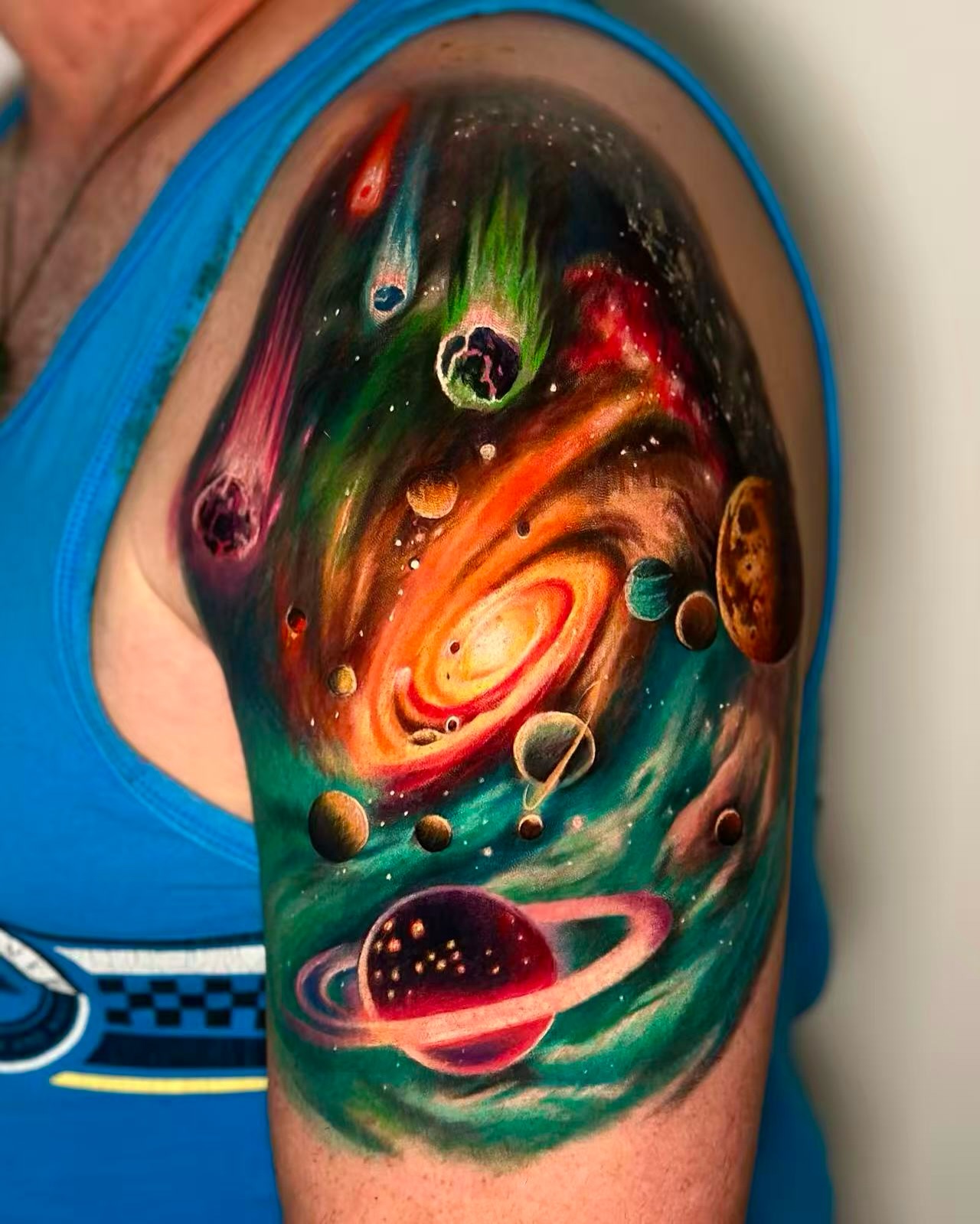
1. Colour Realism Nebula
A nebula rendered the way a telescope actually sees it: deep violet and magenta gas, pinpoint stars, no hard outline anywhere. The Pillars of Creation, the Orion Nebula and the Carina Nebula are the three references I get asked for most.
This is the most demanding idea on the list. It needs a colour realism specialist, a forearm-sized area at absolute minimum, and usually two or more sessions to build the depth properly.
2. Solar System
The eight planets running in order down the forearm or along the spine. You can do it roughly to scale, which means Jupiter dominates and Mercury is a dot, or evenly spaced, which reads cleaner as a design.
I always push clients toward evenly spaced with size hinted rather than literal. True scale looks like an error to anyone who is not an astronomer.
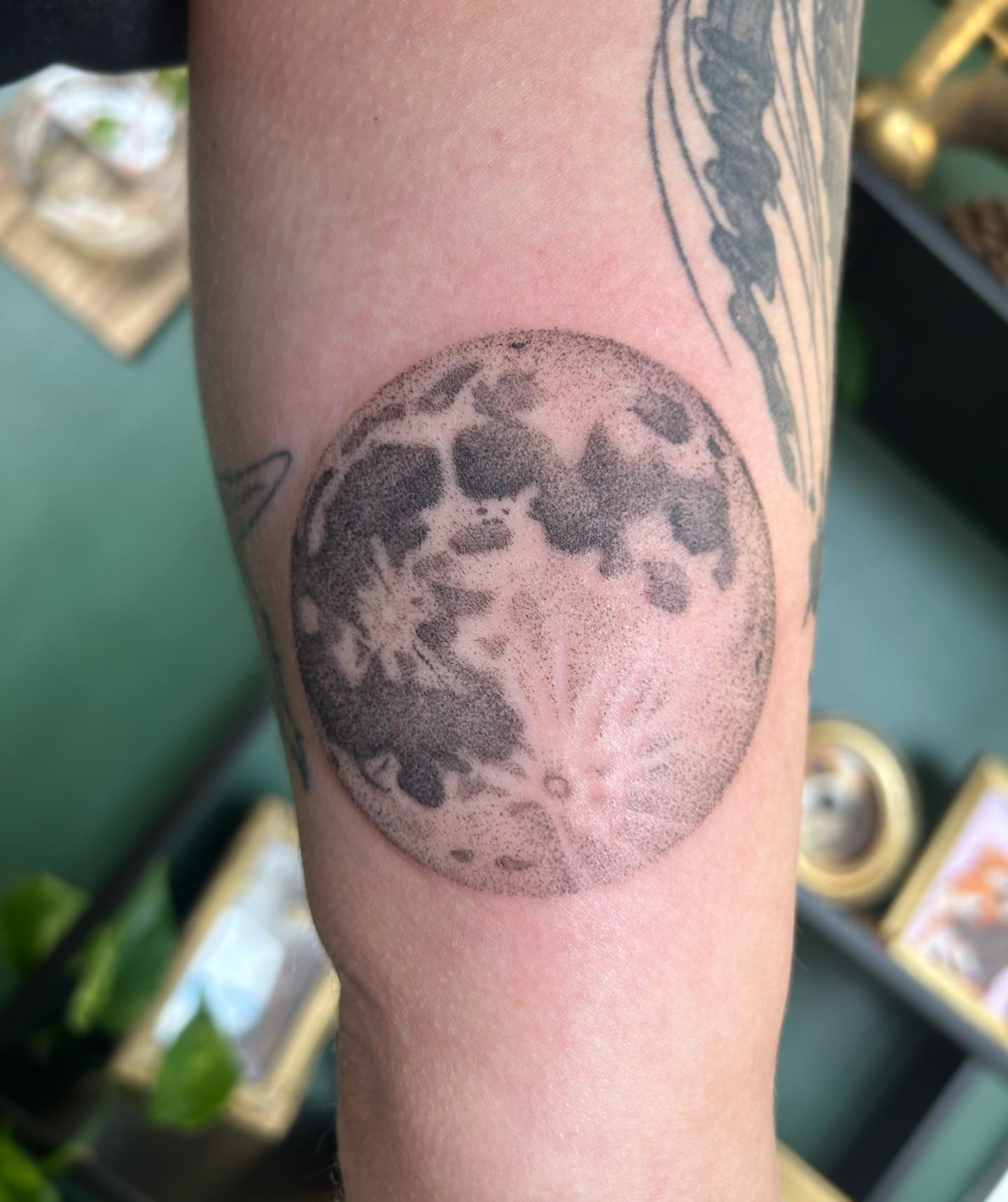
3. Moon Phases
The full lunar cycle in a horizontal row, new moon through full and back again. It is the celestial design I get asked about more than any other, and for good reason: it fits almost any placement and means whatever the wearer needs it to mean.
Keep the individual moons at least a centimetre across. Tiny crescents lose their shape as the ink settles. My moon phase tattoo guide goes deeper on spacing and placement.
4. Saturn
Saturn is the single most recognisable object in the solar system, and the rings do a lot of design work for free — they give you a natural ellipse that flows around a limb.
It works at almost any size. I have seen convincing Saturns the size of a thumbnail and full thigh pieces with Cassini-level band detail.
5. Astronaut
A suited figure drifting, tethered, or sitting on a crescent moon. The astronaut is how you put a human being into a cosmic composition without a portrait.
The visor is where these succeed or fail. A reflective visor showing a planet or a starfield is the detail worth paying for.
6. Constellation Map
A specific star pattern in fine line, dots for stars and thin connecting lines between them. This is the most personal option here, because you can use your own birth sign, the sky over a particular place, or a date that matters.
Ask your artist to vary the dot sizes by star brightness. It is a small thing that makes the difference between a real constellation and a random scatter. See more in my constellation tattoo collection.
7. Black Hole
The event horizon with its warped ring of light. Conceptually it is the heaviest subject on this list — a boundary nothing returns from.
Design-wise it is also a trap: a black hole is mostly solid black, so the accretion disc has to carry the entire piece. Insist on a bright, clearly separated ring.
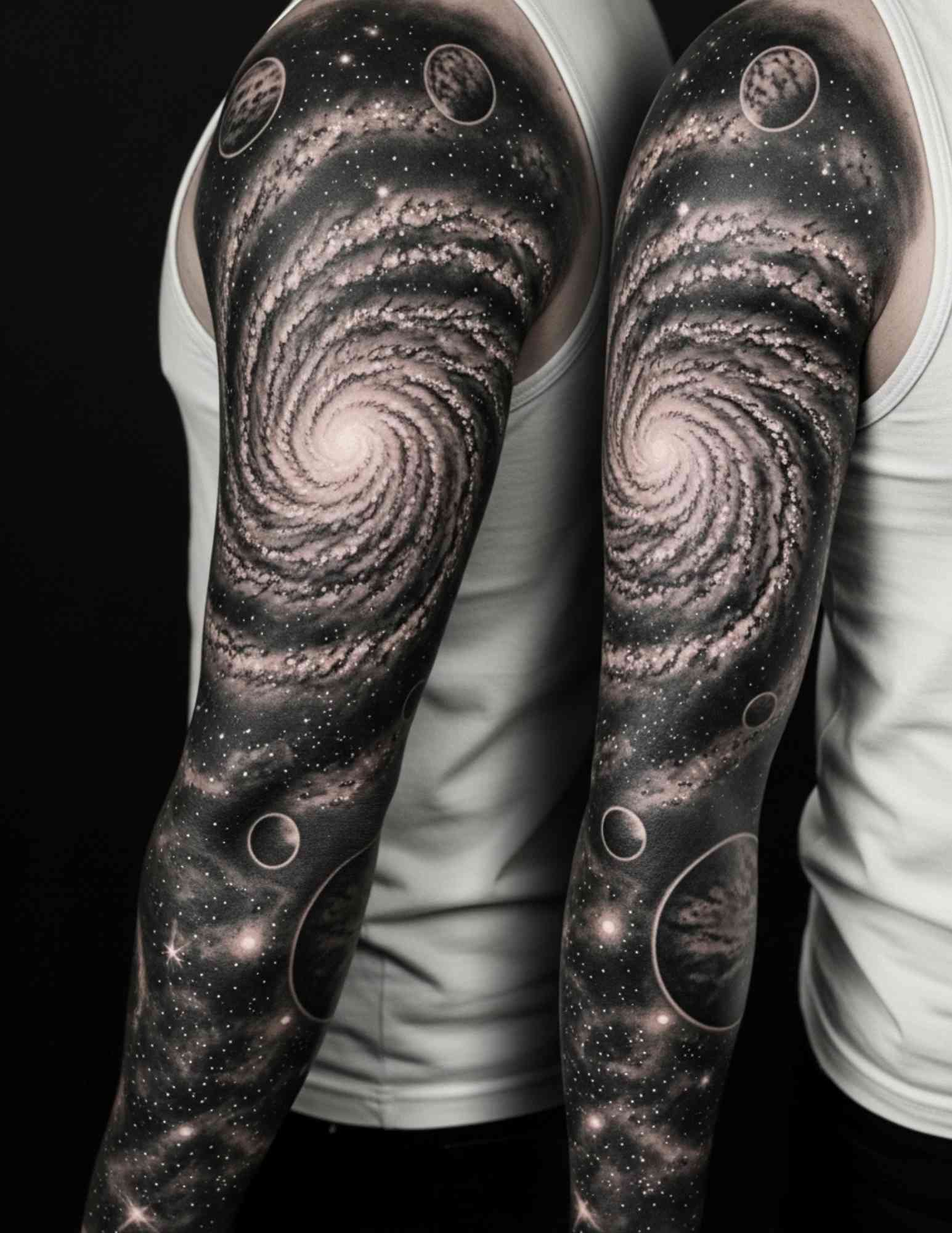
8. Galaxy Swirl
A spiral galaxy viewed face-on, arms sweeping outward. In watercolour it becomes one of the most atmospheric pieces you can wear.
Large placements suit it best — back, thigh, outer arm. At small scale the spiral arms merge into a smudge. There is a full galaxy tattoo guide if this is your direction.
9. Earth from Space
The blue marble, whole, with cloud swirls and continent edges. It is a quieter choice than a nebula and it ages better, because the shapes are simple and high-contrast.
Half-lit Earth with a terminator line across it usually reads stronger than a fully lit disc.
10. Rocket Ship
Retro fins-and-porthole rocket or an accurate Saturn V or Falcon-style launcher. The nostalgic version suits neo-traditional; the accurate version suits fine line.
Rockets are one of the few space subjects that genuinely work small, because the silhouette is unmistakable even at an inch tall.
11. Minimalist Star
A single four- or five-pointed star, sometimes just three in a loose triangle. This is the entry point for a lot of people and there is nothing lesser about it.
Simple does not mean careless. A crisp star with even points is harder to execute than it looks. My shooting star guide covers more of this territory.
12. Jupiter
Banded cloud layers and the Great Red Spot. Jupiter gives an artist something Saturn does not: horizontal texture that can be shaded with dotwork or soft colour across the whole surface.
It suits medium to large placements where those bands have room to be distinct rather than muddy.
13. Astronaut Planting Flag
The Apollo image, restaged. It carries a specific meaning — arrival, claiming, a goal reached — that a floating astronaut does not.
Some people want the flag left blank or replaced with a personal symbol, which sidesteps the politics and usually looks better anyway.
14. Cosmic Eye
An eye where the iris becomes a galaxy or nebula. It is a hybrid design and it either lands beautifully or looks like two tattoos fighting.
The version I have seen work best keeps the eye anatomically clean and puts all the chaos inside the iris.
15. Geometric Planet
A planet reduced to circles, arcs and straight lines — orbital rings, sacred-geometry framing, sharp negative space.
This is the most durable idea on the list. Clean geometry holds its read for decades where soft gradients do not, which makes it a strong choice for anyone worried about how a piece will look in twenty years.
16. Starfield
No single subject, just scattered stars of varying size across an area of skin — often used as filler between larger pieces or as a standalone soft wash across a shoulder.
Ask for genuinely random spacing. Evenly distributed dots read as a pattern, not as sky.
17. Aurora Borealis
Ribbons of green and violet light, usually over a treeline or mountain silhouette. Technically atmospheric rather than deep-space, but it belongs in the same family.
The silhouette underneath is what gives the colour somewhere to sit. Pure aurora with no anchor tends to float.
18. Space Telescope
Hubble or the James Webb Space Telescope, rendered as a technical illustration. Webb’s gold hexagonal mirror segments are a gift to a linework artist.
This one signals something specific: an interest in the actual science, not just the aesthetic.
19. The Overview Effect
A composition showing a small human figure with an enormous Earth or planet behind them. The overview effect is the well-documented shift in perspective astronauts describe after seeing Earth from orbit.
It needs room to breathe. The whole point is the size difference, and a cramped version destroys that.
20. Personal Star Map
The exact sky over a specific place and time, plotted accurately — a birth, a meeting, a loss. Free planetarium software can generate the chart for your artist.
Bring the printed chart to the consultation. In my experience the artists who do these well want the real data, not an approximation.
Variations and Ways to Combine Them
Most of the pieces I see are not a single idea from the list above. They are two or three combined.
Space plus botanical
A moon phase row growing out of a floral stem, or planets tangled in vines. The organic line softens the geometry and the combination photographs well.
Space plus animal
A wolf silhouette filled with a starfield, or a whale swimming through a nebula. The silhouette gives the cosmic texture a hard edge to live inside.
Space as a sleeve filler
Stars and small planets are one of the most flexible ways to link separate pieces into a coherent sleeve without adding another focal point.
Blackout with negative space stars
Solid black ink with stars left as untattooed skin. Striking, and genuinely permanent — blackwork is very difficult to reverse or cover, so treat it as a final decision.
Placement, Healing and Longevity Tips
Sun exposure is the main enemy of a colour space tattoo. Once healed, high-SPF sunscreen over the piece is the single most effective thing you can do to keep purples and blues from going grey.
Follow the aftercare your artist gives you rather than advice from the internet, mine included — they know what ink and technique they used. General healing guidance from the American Academy of Dermatology is a reasonable baseline.
Watch for spreading redness, heat, swelling that worsens after day three, pus or fever. Those are signs of possible infection and they need a doctor, not a forum thread. An allergic reaction to red or yellow pigment is uncommon but real, and also a medical question rather than a tattoo one.
On pain: ribs, spine, sternum and the inside of the upper arm are the placements clients complain about most for large space work, largely because these pieces take long sessions. Read up on pain management if you are planning something big.
Common Mistakes — and What to Do If You Are Still Not Sure
The most frequent mistake is cramming a large-scale subject into a small space. Nebulae, galaxies and overview-effect compositions need room, and shrinking them removes the gradients that make them work.
The second is choosing an artist by price rather than by portfolio. Space work is a specialism; a brilliant traditional artist is not automatically a good colour realism artist.
The third is skipping the reference conversation. Turning up with “a galaxy” gives your artist nothing to work with.
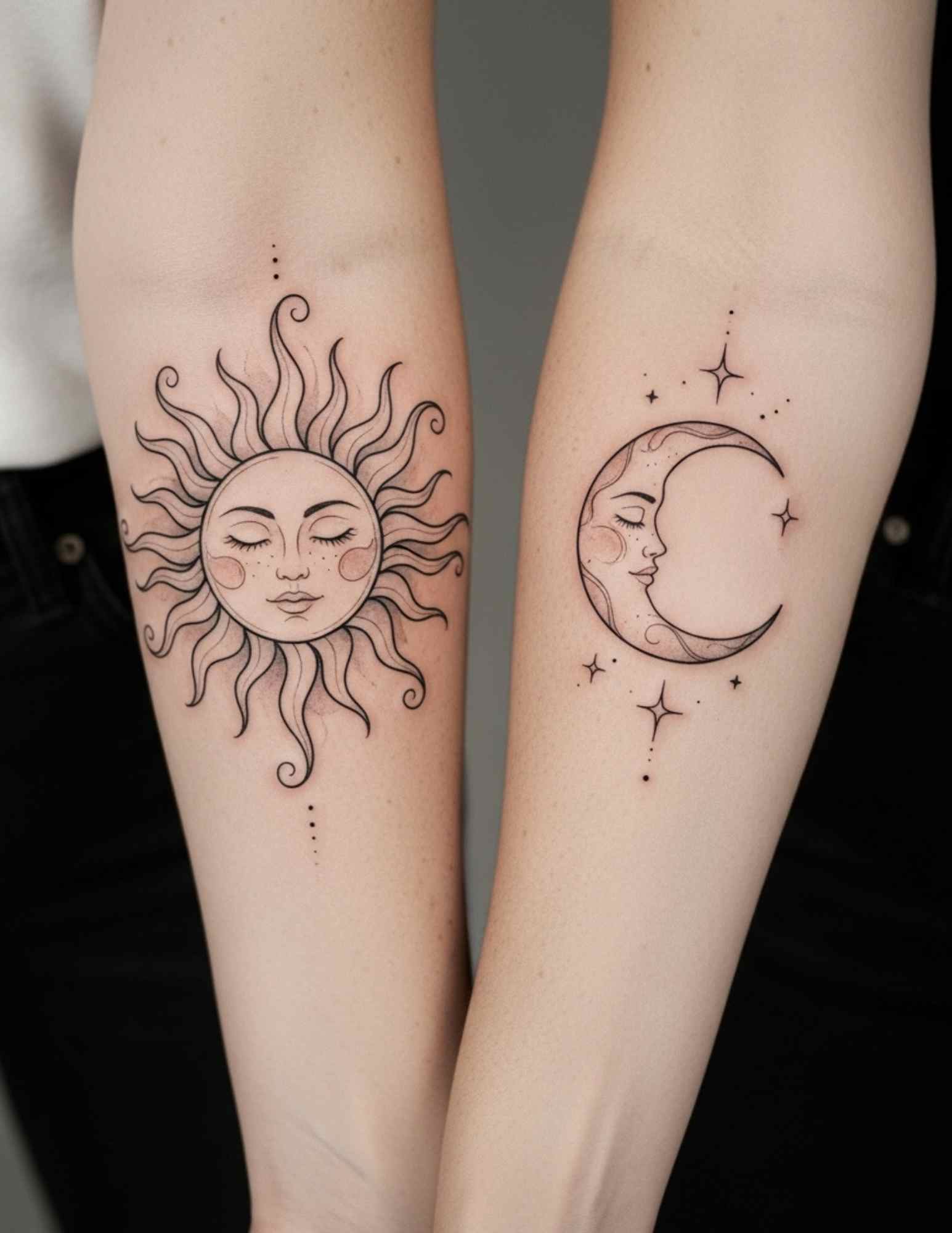
If you are still undecided, it usually helps to browse adjacent categories: sun and moon designs, dotwork tattoos, or watercolour tattoos for a softer approach. For something smaller to start with, fine line tattoo ideas is a sensible place to look.
Frequently Asked Questions
How much does a space tattoo cost?
It depends almost entirely on size and style rather than subject. A small fine line constellation or minimalist star is typically a shop-minimum piece, while a colour realism nebula covering a forearm or back is multi-session work priced by the hour. Ask for an hourly rate and an honest session estimate at consultation rather than a flat quote. Colour realism generally costs more per square inch than blackwork because it takes longer to build.
Do space tattoos age well?
Blackwork, geometric and neo-traditional space designs age very well because they rely on strong outlines and clear contrast. Colour realism and watercolour soften more over time, particularly the palest gradients, and sun exposure accelerates that. In my experience the pieces that still look sharp after a decade are the ones with deliberate dark-to-light contrast built in from the start rather than an even mid-tone wash.
What is the best placement for a galaxy or nebula tattoo?
Large flat or gently curved areas work best — the outer thigh, the back, the shoulder cap, or a full forearm panel. These subjects need surface area for their gradients to read. Avoid high-friction, high-stretch spots such as the hands, feet and inner elbow for detailed colour work, since those areas tend to lose fine detail faster.
Can a space tattoo be done in black and grey only?
Yes, and often it is the stronger choice. Black and grey handles planets, moon phases, constellations, astronauts and starfields extremely well, and it usually holds its definition longer than colour. Nebulae are the one subject where colour adds something hard to replicate, though skilled dotwork and smooth grey wash can get remarkably close.
How do I find an artist who is good at space work?
Look for healed photographs, not fresh ones, in their portfolio — healed work tells you how their gradients and fine lines actually settle. Search the specific style term alongside your city rather than just “tattoo artist”, and check whether they have done more than one piece in that style. A specialist will usually be booked further out, and waiting is almost always worth it.
Quick Summary
- Space tattoos age best when there is deliberate contrast — keep bright areas and untattooed skin as part of the design.
- Match the style to the subject: fine line for constellations and moon phases, colour realism for nebulae, geometric for stylised planets.
- Nebulae, galaxies and overview-effect compositions need real surface area; do not shrink them into a wrist piece.
- Moon phases, Saturn, constellations and minimalist stars are the most reliable small-to-medium options.
- Bring real astronomical reference — NASA and ESA publish free image libraries — rather than photos of other people’s tattoos.
- Sunscreen on the healed piece is the single most effective way to protect colour work long-term.
- Choose the artist by healed portfolio in that specific style, not by price or convenience.
- Any sign of spreading redness, heat, pus or fever after tattooing is a question for a doctor, not the internet.