I have spent a lot of time looking at dragon tattoos, and the thing that surprised me most is how badly the reputation matches the reality. The dragon is not a masculine subject — it is a subject that Western film and fantasy art spent forty years coding as masculine, and tattooing has quietly taken it back.
Walk into any decent studio and ask about dragons. In my experience the artist will start talking about flow, about how the body wraps a limb, about where the head should sit. Nobody talks about who the design is “for.”
What follows is 20 directions I keep coming back to, drawn from real work by real artists. If you want a broader starting point first, the overview of dragon designs made for women is a useful companion to this piece.
A warning worth giving up front: a dragon is rarely a small commitment. Even the compact versions ask more of an artist than most subjects, and the good ones are planned around your body rather than printed onto it.
Photo: @cody.tattoo
Eastern or Western Dragon: Which Is Right for You?
Before style, before placement, before size, there is one fork in the road. Almost everything else follows from it.
| Feature | Eastern Dragon | Western Dragon |
|---|---|---|
| Body shape | Long, serpentine, four short legs | Compact, four strong legs, large wings |
| Wings | Usually none | Central to the silhouette |
| Associated element | Water, cloud, rain | Fire |
| Traditional meaning | Wisdom, benevolence, imperial authority | Guardianship, danger, hoarded power |
| Best placements | Sleeve, spine, thigh, ribs — anything long | Back, shoulder blade, outer thigh — anything wide |
| Typical sitting time | Long, because the design usually travels | Moderate, because it stays in one panel |
| Ages best in | Black and grey with bold linework | Solid blackwork or heavy colour packing |
Neither is more “authentic” than the other. They are two different drawing problems with two different solutions. If you want background on where the two traditions diverged, Britannica’s entry on the dragon is a reasonable starting point.
What Actually Makes a Dragon Tattoo Work
The single biggest factor is flow — whether the dragon’s body follows the shape of the limb it sits on, or fights it.
A dragon drawn flat on paper and then applied to a curved arm almost always looks wrong. The body needs to bend where your body bends.
The second factor is line weight. Dragons are dense subjects, full of scales, whiskers, claws and clouds, and dense subjects blur with age if every line is drawn at the same thin weight.
Every experienced artist I have asked about longevity has said some version of the same thing: leave more space than you think you need. Skin spreads ink over decades, and detail that touches will eventually merge.
The third factor is the head. It is the part the eye finds first, so where it points and what it is doing determines whether the tattoo reads as protective, watchful, or aggressive.
20 Dragon Tattoo Ideas for Women
1. Japanese Dragon Sleeve
The full Japanese sleeve is the most traditional dragon in tattooing and the most demanding. The body travels from shoulder to wrist as a single unbroken form, with wind bars, clouds or waves filling the background so the arm never looks empty.
This is not a one-session piece. In most cases you are looking at multiple sittings across several months, and the artist will want to map the whole arm before the first needle touches skin.
What I like about it is that it is genuinely designed for a limb. If you are drawn to this route, it is worth reading up on traditional Japanese tattoo designs so you understand the background elements rather than treating them as filler.
2. Fine Line Eastern Dragon
Fine line strips the dragon down to outline. No shading, no colour packing, just the path the body takes.
It is a legitimately beautiful approach and it is also the one I would flag hardest. Fine line dragons soften faster than any other version, because there is no weight of black holding the shape together as the ink settles.
If you want one anyway — and plenty of people reasonably do — ask the artist to vary the line weight slightly rather than drawing everything at one thickness. That small change buys years of legibility.
Photo: @kohaku.tattoo
3. Watercolour Dragon
Watercolour puts loose washes of colour behind or around the linework, so the dragon looks like it is dissolving at the edges.
The version that survives is the version built on a real black outline. Washes with nothing underneath them fade into vague colour patches within a few years.
Blues and violets suit Eastern dragons because of the water association. Warm oranges and reds suit Western ones because of the fire association. That is not a rule, but it reads more coherently.
Photo: @notp.ink
4. Dragon Wrapped Around the Arm
Instead of laying the dragon flat on the outer arm, the body spirals around the limb so part of it is always out of sight.
This is my favourite structural trick in dragon tattooing. It makes the tattoo feel alive because you physically cannot see all of it at once.
It also asks more of the artist. The stencil has to be placed in sections and checked at multiple angles, which adds time to the first appointment.
Photo: @elderr_tattoo
5. Small Dragon Behind the Ear
At this size the dragon has to be simplified, not shrunk. There is a real difference: shrinking a detailed drawing gives you a smudge in five years, while simplifying gives you something that still reads.
Expect a very short session — often under an hour — and an awkward one, because the area is bony and close to the ear.
Ask for a version with no more than about a dozen distinct lines. Any artist who says that is impossible is telling you something useful about the design they had in mind.
Photo: @koryu.tattoo
6. Neo-Traditional Dragon
Neo-traditional takes the bold outlines and limited palette of American traditional and adds depth, better anatomy and richer colour.
For dragons it is a strong match, because the heavy outline gives the creature structural weight that survives decades.
It also happens to be one of the most forgiving styles to age into. Colour packed solid rather than blended holds its edges far better than gradients do.
Photo: @dragoncityink.danang
7. Dragon with Cherry Blossoms
Pairing a dragon with cherry blossom tattoos is a classic combination and it solves a practical problem: dragons create awkward empty pockets between their coils, and blossoms fill them naturally.
The symbolic pairing is also coherent. The dragon carries permanence and power; the blossom carries impermanence. Together they say something neither says alone.
Pink blossoms against black and grey linework is the version I see most, and it still looks good to me every time.
Photo: @kez.tattoo
8. Geometric Dragon
Geometric treatment rebuilds the dragon from angular shapes, repeated patterns and hard symmetry rather than organic curves.
It suits people who like the symbol but not the fantasy-art aesthetic that usually comes attached to it.
One honest caveat: geometric work punishes sloppy execution more than almost any other style, because a line that is a degree off is visible to everyone. Look hard at healed photos of the artist’s geometric work, not fresh ones.
Photo: @deos__tt
9. Feminine Western Dragon
The Western dragon drawn slender rather than bulky, with the wings carrying the silhouette and the body kept lean.
This is the version that most directly pushes back on the assumption that Western dragons have to look heavy and armoured.
The wings are the whole design here. Ask the artist to plan the wing membrane carefully, because large flat areas either need texture or need to be genuinely solid — the in-between tends to look patchy after healing.
Photo: @korolevatattoo
10. Dragon and Lotus
The dragon coils and the lotus flower designs sits at the centre of the coil. It is a composition that almost designs itself.
Both carry meanings that are widely understood across a lot of Asian traditions, though the specifics differ by culture and it is worth knowing which tradition you are drawing from.
Practically, the lotus gives the eye somewhere to rest in a design that is otherwise all movement.
Photo: @tattooer_intat
11. Dragon Eye
Rather than the whole creature, just the eye — rendered in heavy detail, with scales layered around it.
It is a fraction of the surface area of a full dragon and, in my experience, considerably more striking on the right placement.
It also ages differently. Because the whole piece is one focal point rather than a long body, there is no flow to lose. What you need to protect is the contrast around the iris.
Photo: @miacustomink
12. Dragon on the Spine
The spine is the single best placement for an Eastern dragon, because the vertebrae already give the body a centre line to follow. Chinese dragon spine tattoos are a whole category for exactly this reason.
It is also a genuinely painful placement. Bone is close to the surface along most of the spine, and sessions there tend to be shorter because people need more breaks.
If you are weighing placement rather than design, the overview of feminine spine tattoo placements covers the practical side in more depth than I can here.
Photo: @i_tats_
13. Blackwork Rib Dragon
Heavy solid black across the ribcage, with the dragon defined as much by negative space as by line.
Blackwork is the most durable thing you can put in skin. If longevity is your priority, this is the answer.
Be realistic about the sitting though. Ribs are widely considered one of the harder placements, and large areas of solid black mean a lot of passes over the same tender skin.
Photo: @loe.tattoo
14. Compact Forearm Dragon
A dragon sized to the forearm, visible in a single glance rather than requiring you to turn your arm.
This is the practical middle ground: substantial enough to hold detail, small enough to finish in one or two sessions.
It is also the placement I would suggest to anyone getting their first large-ish piece. You can see it healing, which makes aftercare much easier to stay on top of.
Photo: @lountattoo
15. Serpentine Dragon Thigh
The thigh gives you a long, relatively flat, relatively forgiving canvas — ideal for a serpentine Eastern body that needs room to travel.
It is also one of the less painful large placements for most people, though this varies a lot and the inner thigh is a different proposition from the outer.
Coverage is a real advantage here. A thigh dragon is entirely your business on any day you want it to be.
Photo: @trenched
16. Dragon Guarding a Flower
The dragon coiled protectively around a flower rather than threatening anything. Same creature, entirely different story.
This is the design choice I recommend most often when someone wants the dragon’s power without the aggression. Guardianship is arguably closer to the original Eastern reading anyway.
Peonies, roses and lotuses all work. The flower should be large enough to hold its own against the dragon, or the composition tips.
Photo: @tattooer_intat
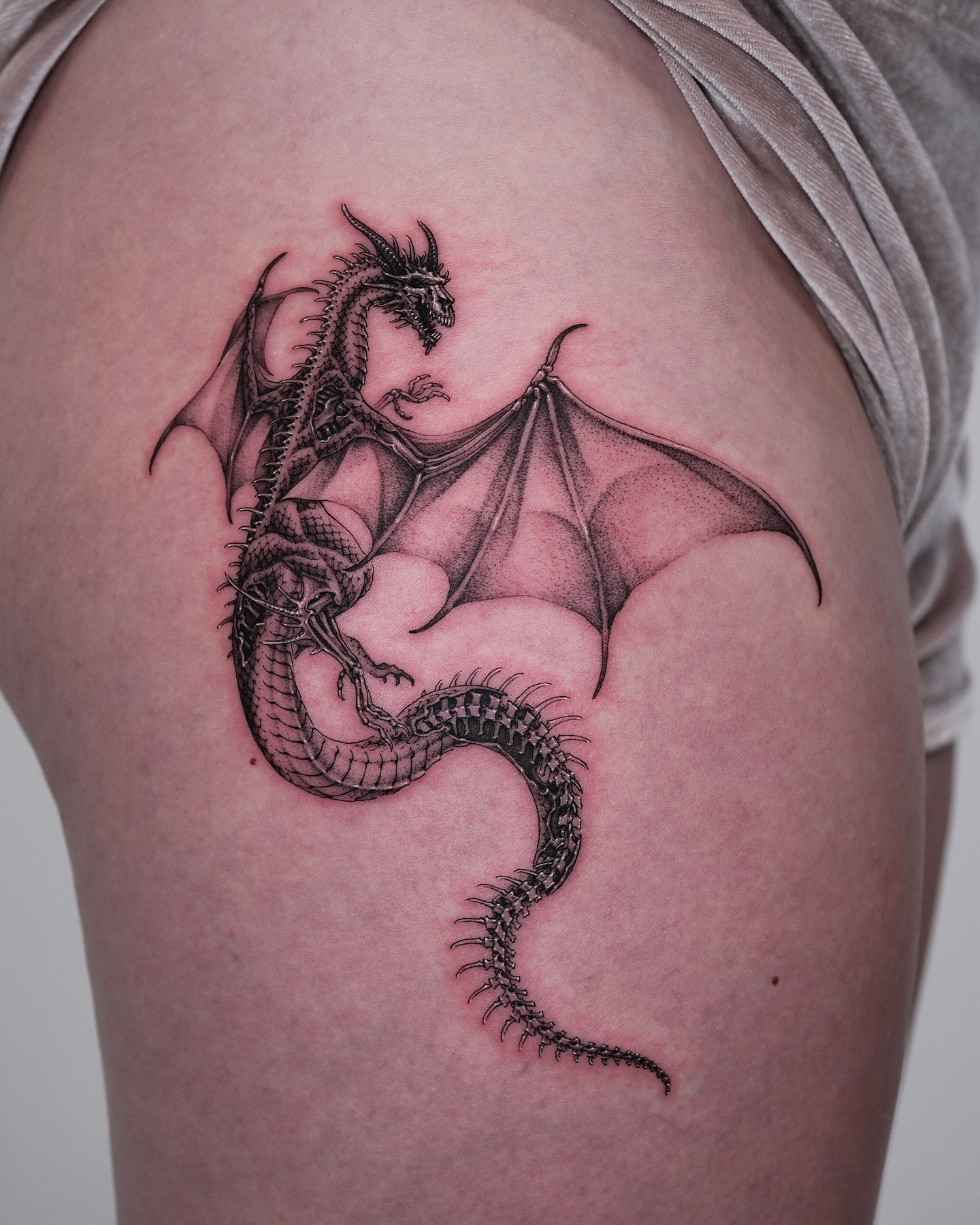
17. Skeleton Dragon
The structure without the flesh — exposed ribs, spine, skull. It sits somewhere between blackwork and dark illustrative.
It reads as memento mori more than as fantasy, which is a meaningfully different thing to wear.
Technically it is easier to age well than a scaled dragon, because bone is defined by clean separated shapes rather than by repeating texture that can merge.
Photo: @kellzmorgantattoos
18. Dragon and Phoenix Together
Dragon and phoenix tattoos for women together is one of the oldest paired motifs in East Asian design, traditionally read as balance between two complementary forces.
As a tattoo it is a large commitment, because two full creatures need real estate — usually a back piece, a full thigh, or split across two limbs.
If you split them, plan both at the same time with the same artist. Matching two designs commissioned years apart almost never works as well as people hope.
Photo: @peria_tattoo
19. Minimal Dragon Silhouette
Solid black, no interior detail, just the shape the dragon makes. It is the most under-rated version on this list.
Because there is no internal detail to blur, a silhouette looks essentially the same at thirty years as it does at thirty days.
It also scales. The same design works at two inches on a wrist or at twelve inches on a back, which is not true of most of the other entries here.
20. Ouroboros Dragon
The dragon consuming its own tail, closed into a circle. There is a deep well of meaning behind it, and the ouroboros tattoo ideas guide goes further into that than I will here.
It suits circular placements naturally: around an upper arm, around a wrist, on a shoulder cap, or as a closed piece between the shoulder blades.
Worth knowing that the ouroboros is drawn as a serpent at least as often as a dragon, so if you are researching references you will end up reading about snake tattoo symbolism too.
Photo: @bella.tattoos.570
Variations Worth Considering
Dragon Scales as an Abstract Pattern
Rather than a whole creature, just the scale texture — running up a forearm or across a shoulder as an abstract band. It keeps the association without the literal figure.
Dragon Claw or Talon
A single claw gripping the shoulder or forearm. Small, fast to execute, and surprisingly effective because the eye completes the rest of the creature on its own.
Two-Colour Dragon
Black linework with one accent colour — red for the eye, or a single colour through the mane. It gives the piece a focal point without the ageing risks of full colour.
Dragon and Tiger Pairing
Less common in Western studios than the dragon-and-phoenix pairing, but a long-standing motif in Japanese work, usually read as two balanced forces rather than as opponents.
Planning, Sitting and Aftercare
Choose the artist before the design. A dragon drawn by someone who draws dragons regularly will beat a better idea executed by someone who does not, and their portfolio will tell you which one you are dealing with.
Ask specifically for healed photos, ideally a year or more old. Fresh tattoo photos flatter everyone; healed photos show you how the artist’s line weight and saturation actually hold up.
Eat properly before a long session and bring something sugary. Large dragon pieces routinely run four hours or more, and people who skip breakfast usually regret it around hour two.
For aftercare, follow the instructions your artist gives you rather than anything you read online, including this. Studios have healing protocols they have tested on thousands of clients, and they vary by region, climate and the products available to you. If you see spreading redness, increasing pain after the first few days, or any discharge, that is a doctor’s question and not a tattoo forum’s — the American Academy of Dermatology publishes plain guidance on when tattoo problems need medical attention.
Common Mistakes and What to Do Instead
The most common mistake is bringing in a reference image from fantasy art and asking for it to be copied. Illustration and tattooing are different disciplines with different constraints, and the best artists will want to redraw it for skin.
The second is going too small for the detail requested. If you want scales, whiskers, claws and clouds, you need surface area. Something has to give, and it is better that it gives at the design stage.
The third is picking a style before picking a tradition. Decide Eastern or Western first; everything from placement to palette follows. If you are still weighing it up, comparing a gallery of Western-style dragons against a gallery of traditional Japanese tattoo designs is a useful way to see the difference in practice.
The fourth is treating the flow as the artist’s problem alone. Bring the limb, move it, and let them see how it bends before the stencil goes on.
Frequently Asked Questions
Do dragon tattoos hurt more than other designs?
Not because of the subject, but often because of the size and placement they call for. Dragons tend to live on ribs, spines and full sleeves, and those are areas most people find harder to sit through than an outer arm or a thigh. The pain comes from where the needle is, not what it is drawing. Pain tolerance also varies enormously between individuals, so treat anyone’s pain chart as a rough guide rather than a prediction.
How much does a dragon tattoo cost?
It depends almost entirely on time, and dragons take time. A small behind-the-ear design may be a single short session, while a full Japanese sleeve is usually a multi-session project spread over months. Rates vary widely by region and by artist experience, so the only reliable number is the quote your chosen artist gives you after seeing the placement. Be wary of a price that seems far below everyone else’s.
Is it disrespectful to get a Japanese-style dragon?
This is a real question and opinions genuinely differ, including among Japanese tattoo artists. The broad view I have encountered most often is that respectful engagement — learning what the elements mean, working with an artist trained in the style, and not mixing motifs arbitrarily — matters more than your background. If it concerns you, raise it directly with an artist who works in the tradition. They will have thought about it far more than any article has.
How long does a dragon sleeve take to finish?
Most full sleeves are built across several sessions rather than done in one. In my experience artists commonly work in blocks of three to six hours with healing time between them, and the total timeline is often measured in months rather than weeks. The outline usually comes first across the whole arm, then shading and any colour. Rushing it is the most reliable way to end up with a sleeve that does not flow.
Will a fine line dragon last?
It will last, but it will soften. Fine lines spread slightly as ink settles into the skin over years, and a design made entirely of thin lines has nothing heavier holding its shape. You can improve the odds considerably by asking for varied line weight, keeping the detail level honest for the size, and staying serious about sun protection. Plenty of people accept the trade-off knowingly, which is a perfectly reasonable choice.
Quick Summary
- Decide Eastern or Western first — placement, palette and proportion all follow from it.
- Match the design to the limb. A dragon that wraps and bends will always beat one applied flat.
- Bolder line weight and solid black age better than uniform fine line or blended gradients.
- Spine, ribs and full sleeves suit serpentine Eastern dragons; back and shoulder suit winged Western ones.
- Simplify rather than shrink for small placements like behind the ear.
- Ask every artist for healed photographs, not just fresh work.
- Flowers, clouds and wind bars are not filler — they solve the empty space dragons create.
- For anything involving redness, swelling or discharge past the first few days, ask a doctor rather than the internet.