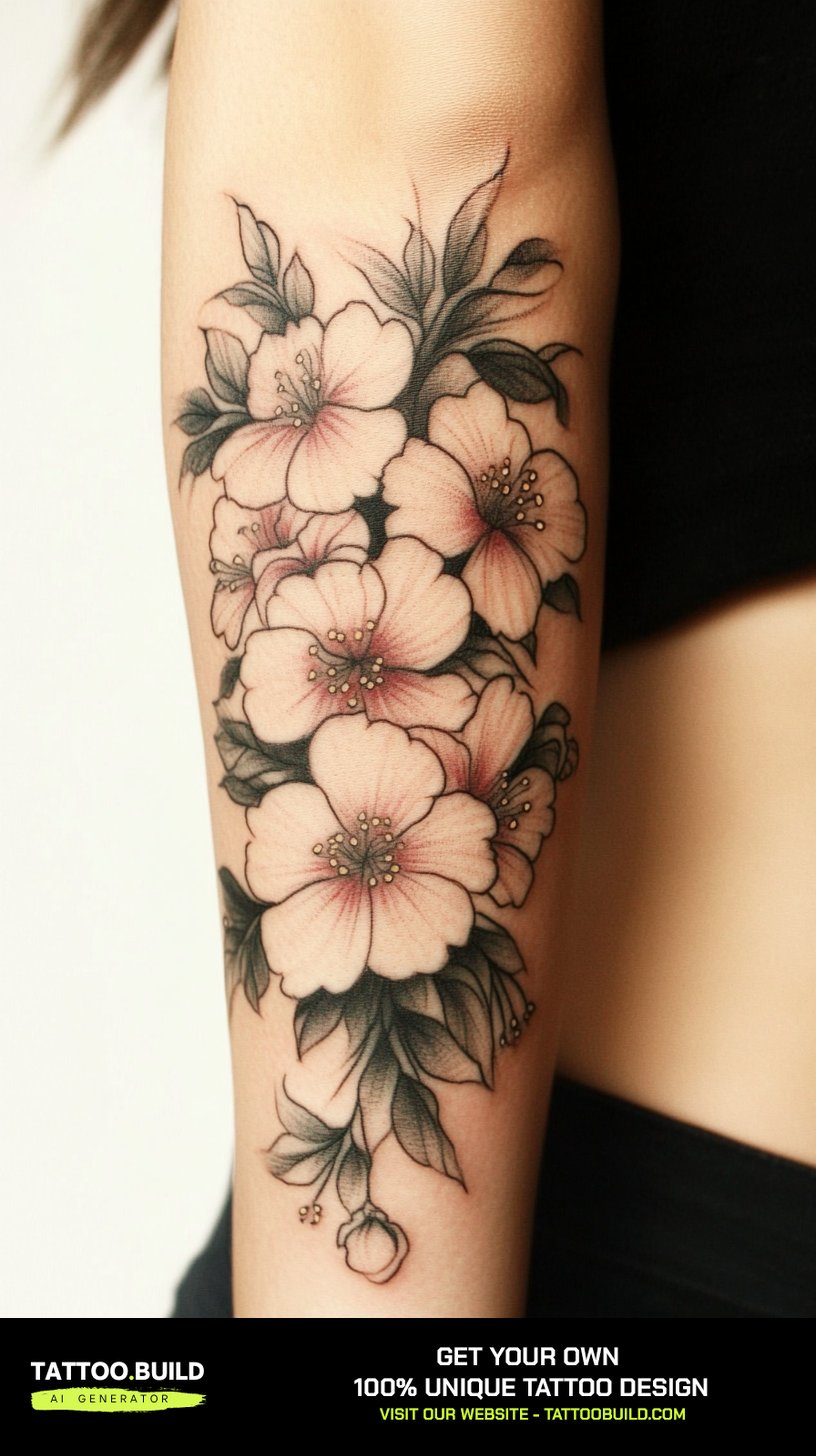
A cherry blossom tattoo works because it is honest about impermanence — the flower only looks like that for about a week a year, and the tattoo carries that meaning whether or not you explain it.
I have watched this design get requested more than almost any other floral piece, and the requests are rarely vague. People arrive knowing roughly where they want it and roughly how big.
Where they get stuck is style. A soft watercolour branch and a traditional Japanese sakura sleeve are both “cherry blossom tattoos”, and they age completely differently on skin.
This guide covers what the flower actually means, how the main styles compare, ideas by placement, and the practical parts nobody mentions until you are already in the chair. If you are leaning traditional, the wider Japanese tattoo design vocabulary is worth reading alongside this.
Which Cherry Blossom Style Is Right for You?
Every artist I have asked says the same thing: pick the style first, then the placement. The style decides how much space the design needs.
| Style | Best size | How it ages | Suits you if |
|---|---|---|---|
| Fine line / minimal | 2–5 in | Softens fastest; thin lines can blur in 5–10 years | You want something quiet and easy to hide |
| Traditional Japanese | Half sleeve and up | Best long-term hold, thanks to bold outlines | You are committing to a large, permanent piece |
| Watercolour | 4–10 in | Needs touch-ups sooner; soft edges fade first | You want a painted, illustrative look |
| Blackwork / black & grey | Any | Very stable; no pink pigment to fade | You dislike colour or have sun-exposed skin |
| Realism | 6 in and up | Holds if shading is dense, not scratchy | You want the flower to look photographic |
What the Cherry Blossom Actually Symbolises
The flower is sakura in Japanese, and the meaning attached to it is not decorative — it is specific.
Sakura bloom briefly before the petals drop, and the Japanese practice of hanami is built around going to look at them while they last.
That short window is the point. The US National Park Service, which tracks the Washington, D.C. trees each spring, notes that Yoshino cherries typically bloom for a period of several days — and that wind or rain can cut it shorter still.
The blossom stands for impermanence: beauty you notice precisely because it will not be there next month.
In samurai-era symbolism the falling petal was tied to a life lived fully and ended without regret. That reading still shows up in traditional Japanese sleeves today.
Chinese symbolism leans differently — closer to love, feminine beauty and strength. Both readings are legitimate, and in my experience most clients pick whichever one matches why they are getting the tattoo. You do not need to justify the interpretation to anybody.
A word of caution I give often: this is a design borrowed from living cultures. Getting a traditional Japanese piece from an artist who studies that tradition is a very different result than asking a generalist to copy the look.
Cherry Blossom Tattoo Ideas by Placement and Style
What follows are the designs I see requested most, with the honest trade-offs for each.
1. Simple Branch on the Wrist or Ankle
A single thin branch with three to seven blossoms. This is the entry point, and there is nothing wrong with that.
It sits well on the inner wrist, the outer ankle, or behind the ear. Expect a session of under an hour and a price closer to a shop minimum than a day rate.
The honest limitation: very fine lines on the wrist take a beating from hand washing and sun. I have seen crisp wrist pieces soften noticeably inside five years. If that bothers you, ask for slightly heavier linework than the reference photo. Our wrist tattoo ideas guide covers the placement in more depth.
Ask your artist to space the blossoms unevenly — evenly spaced flowers read as a pattern rather than a branch.
2. The Full Cherry Blossom Tree
A whole tree, trunk included, rather than a cut branch. This is the version that needs the back, the thigh or a full outer arm.
When I have seen it done small, it fails — the trunk turns into a dark smudge and the canopy loses separation. Give it space or pick a branch instead.
Done properly it is one of the strongest floral pieces there is, because the trunk gives the design a spine and the blossoms give it movement. If you are drawn to it for symbolic reasons rather than aesthetic ones, birth flower tattoos are worth comparing against.
3. Watercolour Cherry Blossoms
Soft washes of pink with no hard outline, often with a few petals drifting away from the branch.
This is the style people fall in love with on Instagram and regret least when it is done by a genuine specialist — and most when it is not.
The reason is simple. Watercolour relies on light, spread pigment, and light pigment fades faster than dense pigment. In most cases you should plan on a touch-up somewhere around year five.
Ask to see healed photos, not fresh ones. A fresh watercolour piece looks incredible on everyone; a three-year-old one tells you whether the artist knows how to build it.
4. The Cherry Blossom Sleeve
A half or full sleeve built around climbing branches, usually with a secondary element — koi, a crane, wind bars, or water.
This is a multi-session commitment. A full sleeve is realistically several sittings spread over months, with healing time between them.
The mistake I see most is collecting a sleeve piece by piece instead of designing it whole. Blossoms need negative skin between them to read as separate flowers, and you cannot retrofit that once the arm is crowded. If you are not ready for a full arm, a floral half sleeve is the safer starting point.
5. Cherry Blossoms with Japanese Kanji
Blossoms combined with characters — commonly love, strength, family, or a name.
One rule, no exceptions: have the characters verified by someone who actually reads Japanese before the needle touches skin. Font-rendered kanji from a translation site are frequently wrong, and the error is permanent.
When it is right, the contrast works well — black script against pink petals gives the design structure it would otherwise lack. Pairing with koi fish is the other classic combination in this tradition.
6. Cherry Blossom Heart
Petals arranged into a heart shape, rather than a heart outline with flowers inside it.
The arranged version ages far better. An outline plus filler tends to look dated within a decade; a shape formed from the flowers themselves does not.
It is the most common request I see for memorial and partner pieces. If that is your reason, look at heart tattoo designs before committing to the blossom version — the symbolism may land differently for you.
7. Wrist Band and Bracelet Designs
A continuous band of blossoms circling the wrist, ankle or upper arm like jewellery.
Wrapping designs are technically harder than they look. The join has to land somewhere the eye does not naturally rest, or the tattoo reads as a broken circle.
When I have tested this on my own arm placement, the cleanest result came from letting the branch taper and fade rather than meeting itself head-on. A good artist will suggest this without being asked.
8. Cherry Blossoms Along the Ribs
A branch running down the ribcage, usually vertical, often extending toward the hip.
Be straightforward with yourself about pain here. Ribs are consistently rated among the more difficult placements because the skin sits directly over bone with little padding.
It is also a slow-healing area, since it moves every time you breathe. Budget more aftercare patience than you would for an arm. Our guide to rib tattoos goes into the session-length reality.
9. Collarbone and Shoulder Blossoms
A slim branch tracing the collarbone, or blossoms falling from the shoulder across the upper chest.
The collarbone gives the design a ready-made line to follow, which is why these pieces so often look well-composed with relatively little work.
The bone is close to the surface here, so expect it to be sharper than a bicep but shorter than a rib session. Most collarbone branches are finished inside two hours.
10. Thigh and Leg Placements
The thigh is the placement I recommend most often to people who want something large but are uncertain about visibility.
It takes detail well, it is easy to cover, and it is one of the more forgiving areas for pain. It also stays out of direct sun for most of the year, which matters for pink pigment.
Calves work too, though the shin is noticeably sharper than the calf muscle. See floral thigh tattoos for scale references.
Variations Worth Considering
If the standard pink branch is not quite it, these are the directions people most often move in.
Blackwork and Black & Grey Sakura
All the symbolism, none of the fading pink. This is the version I suggest for anyone with an outdoor job or a strong preference against colour.
Blossoms with Wind and Water
Traditional Japanese work rarely floats flowers on blank skin. Wind bars or water give the branch context and make the piece feel intentional at large scale.
Falling Petals Only
No branch at all — just a scatter of petals across the shoulder, spine or forearm. Quiet, and unusually flexible about placement.
Mixed Florals
Sakura combined with peonies, roses or a birth flower. Be aware this dilutes the sakura symbolism; if the impermanence meaning is the reason you want it, keep the design single-flower.
Aftercare and Keeping the Pink
Follow the aftercare instructions your artist gives you — they know your skin and the ink they used, and their advice overrides anything written here.
The general shape of it is consistent, though: keep it clean, keep it lightly moisturised, do not pick or scratch it, and stay out of pools, baths and open water until it has closed over.
Sun is the single biggest threat to a pink tattoo. Once healed, sunscreen on the piece is the highest-value habit you can build. The FDA’s tattoos and permanent makeup fact sheet is worth reading before your appointment — it covers infection risk, allergic reactions and ink safety plainly.
If you develop spreading redness, heat, swelling that worsens after day three, pus, or a fever, contact a doctor rather than your artist. Infection and allergic reactions to pigment are uncommon but real, and they are medical problems, not tattoo problems. Nothing in this article is medical advice.
Common Mistakes — and What to Do If You Are Still Unsure
The first mistake is going too small for the style. A watercolour tree at two inches has nowhere to put its detail.
The second is bringing a single reference photo and asking for an exact copy. Most good artists would rather draw you something original in that style, and the result is almost always better.
The third is booking the pink without thinking about the next twenty years of sun exposure on that body part.
If you are still weighing it up, browse adjacent ideas before you book — cherry tattoo ideas for the fruit rather than the flower, or small tattoo ideas if you are starting small.
There is no deadline. In my experience the people happiest with their tattoos are the ones who sat with the idea for a season before booking.
Frequently Asked Questions
How much does a cherry blossom tattoo cost?
It depends almost entirely on size and your artist’s rate, so any figure here would be misleading. A small wrist branch usually falls at or near a shop’s minimum charge, while a sleeve is priced by the session or the day. The practical move is to email two or three artists whose healed work you like with your size, placement and reference, and compare quotes. Do not choose on price alone — a cheap tattoo you dislike is more expensive than a good one, once removal or cover-up enters the picture.
Does a cherry blossom tattoo hurt?
Placement matters far more than the design. Ribs, sternum, spine, ankles and the tops of the feet sit close to bone and are generally reported as sharper. Thighs, outer arms and calves have more padding and tend to be easier. Pain is also personal — sleep, food and nerves all change how a session feels, so treat any pain chart as a rough guide rather than a promise.
Will the pink fade?
Lighter pigments fade sooner than black in most cases, and pink is a light pigment. Sun exposure is the main accelerator, followed by placement on high-friction areas like hands and wrists. Daily sunscreen once the tattoo is fully healed makes a real difference. Plan on a touch-up at some point rather than treating it as a failure — it is normal maintenance, not a mistake.
Is a cherry blossom tattoo cultural appropriation?
Opinions differ, and the answer depends a lot on how you approach it. Wearing a flower that is meaningful in Japanese and Chinese culture is not inherently disrespectful, and cherry blossoms are widely celebrated outside Asia. What tends to draw criticism is treating traditional Japanese iconography as a costume, or getting kanji you cannot read. Learning what the design means and choosing an artist who understands the tradition goes a long way.
How long does a cherry blossom tattoo take?
A small wrist or ankle branch is often under an hour. A collarbone piece typically runs one to two hours, a rib branch two to four, and a thigh or back tree is usually split across multiple sessions. Sleeves are a months-long project with healing time built in between sittings. Your artist can give you a realistic estimate once they have drawn the design.
Quick Summary
- Sakura symbolises impermanence — beauty that matters because it is brief.
- Pick the style before the placement; the style decides how much space you need.
- Fine line reads quiet but softens fastest, especially on the wrist.
- Watercolour looks best fresh and needs a touch-up sooner — judge artists on healed photos.
- Traditional Japanese work holds longest thanks to bold outlines, but needs real size.
- Ribs, spine and ankles hurt more; thigh and outer arm are the forgiving options.
- Have any kanji verified by someone who reads Japanese before you book.
- Sunscreen after healing is the single best thing you can do for pink ink.