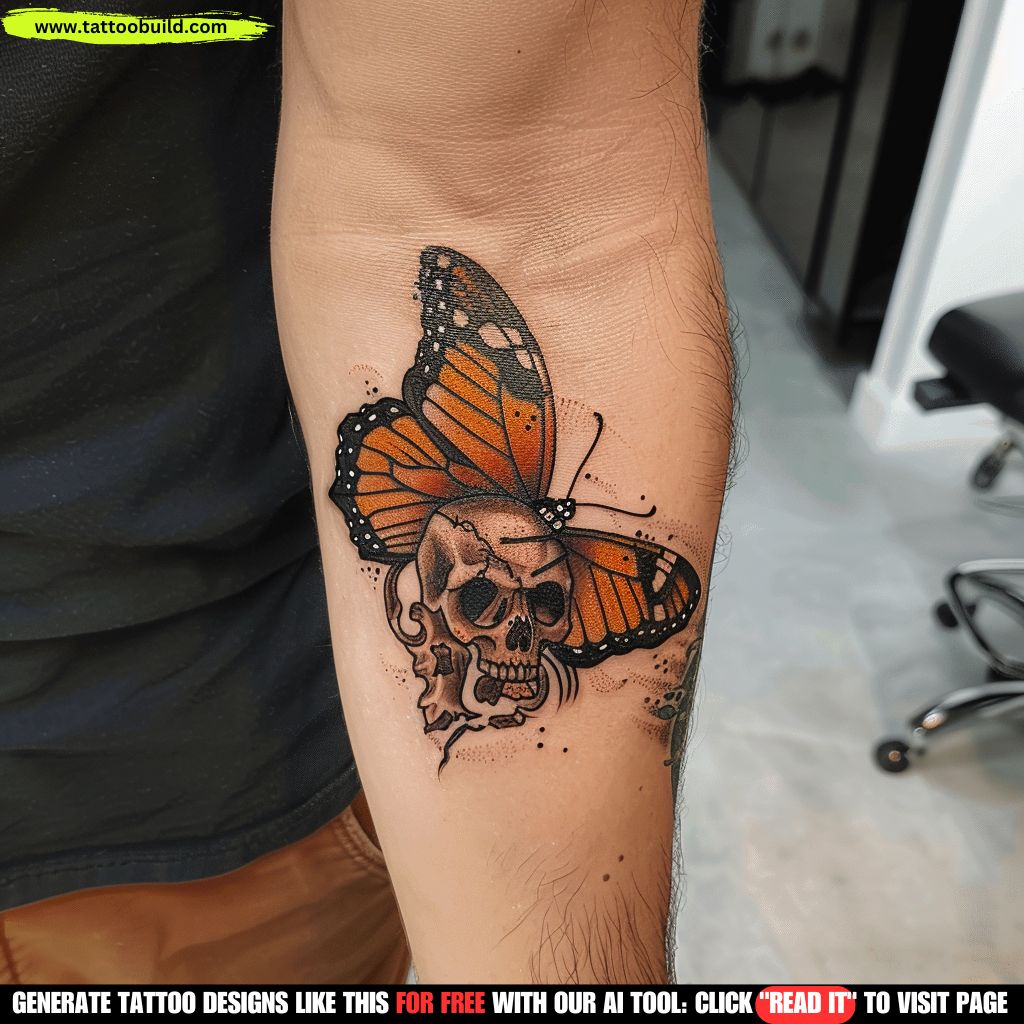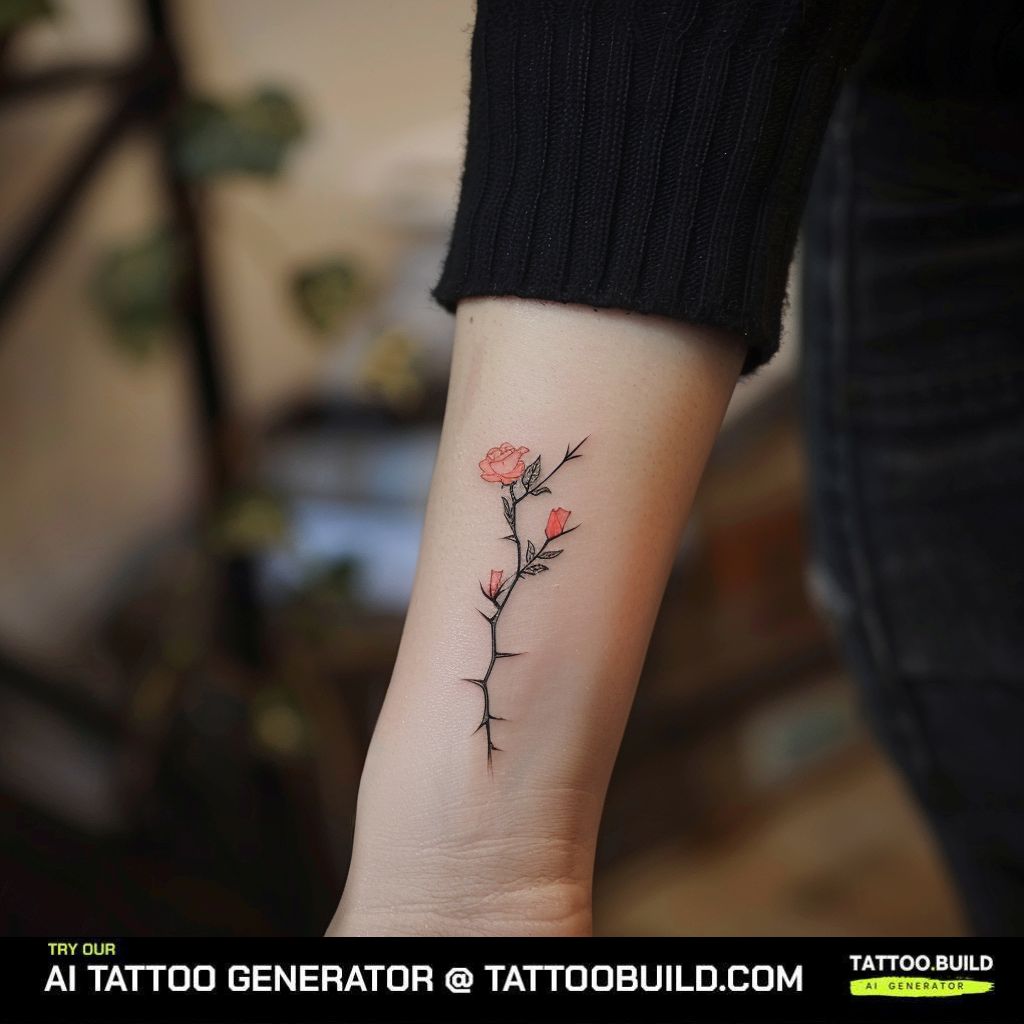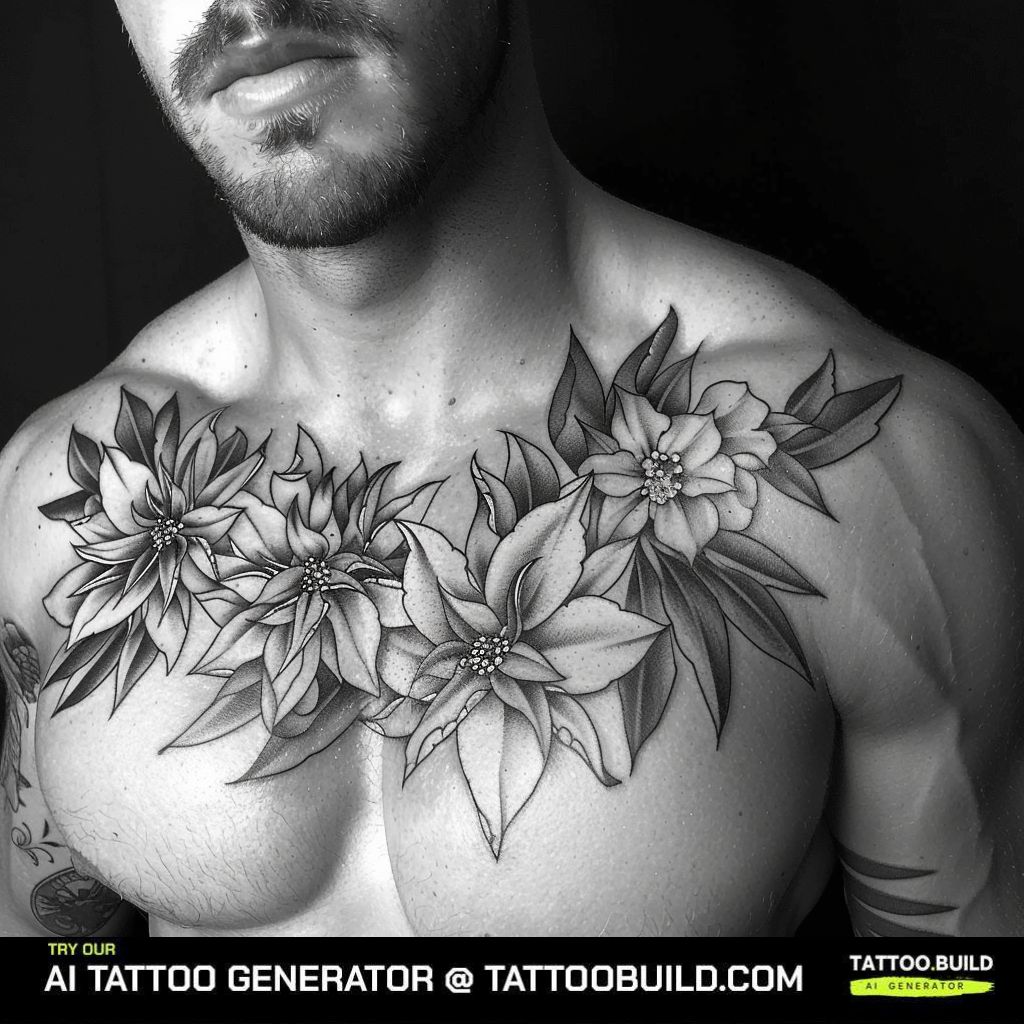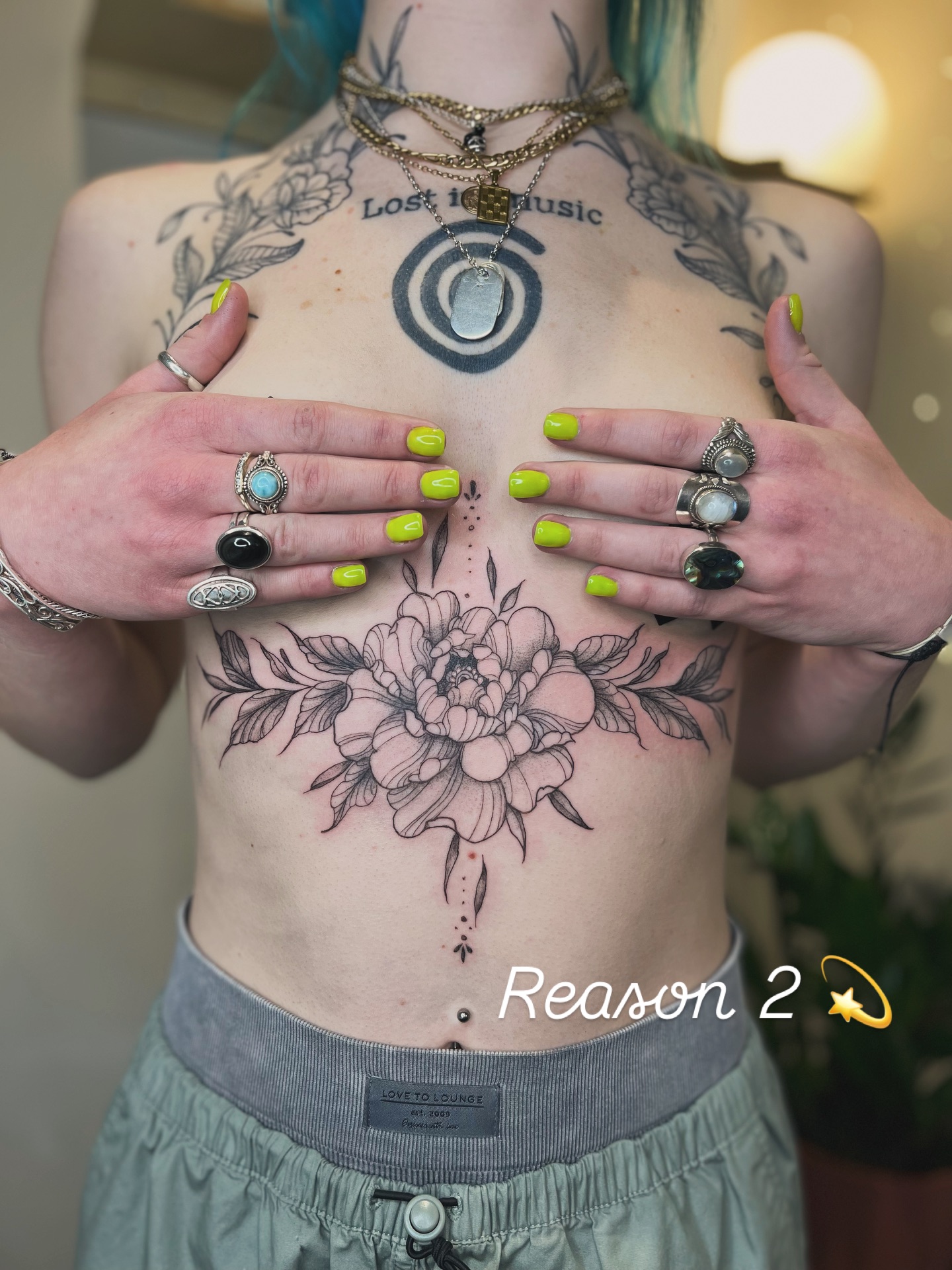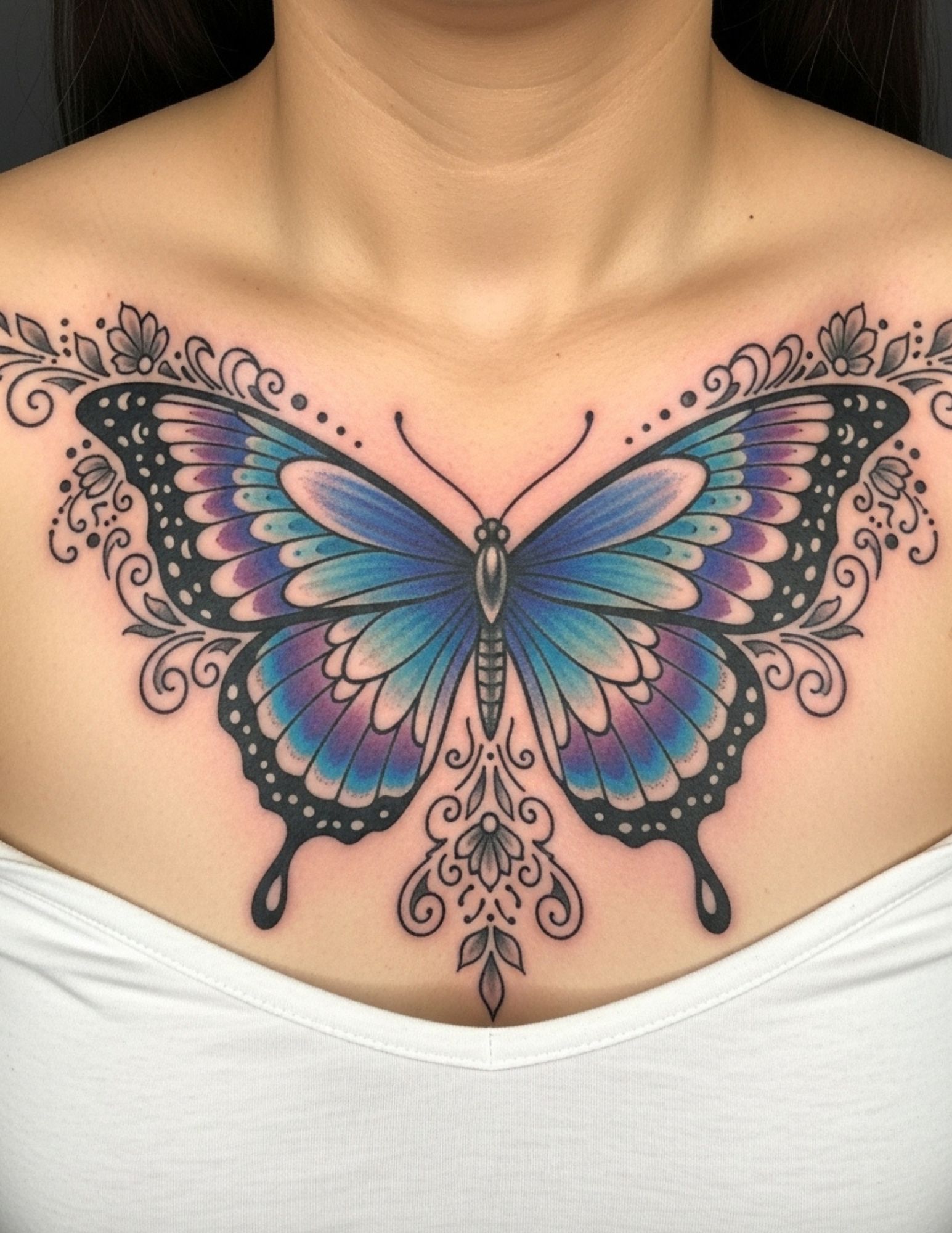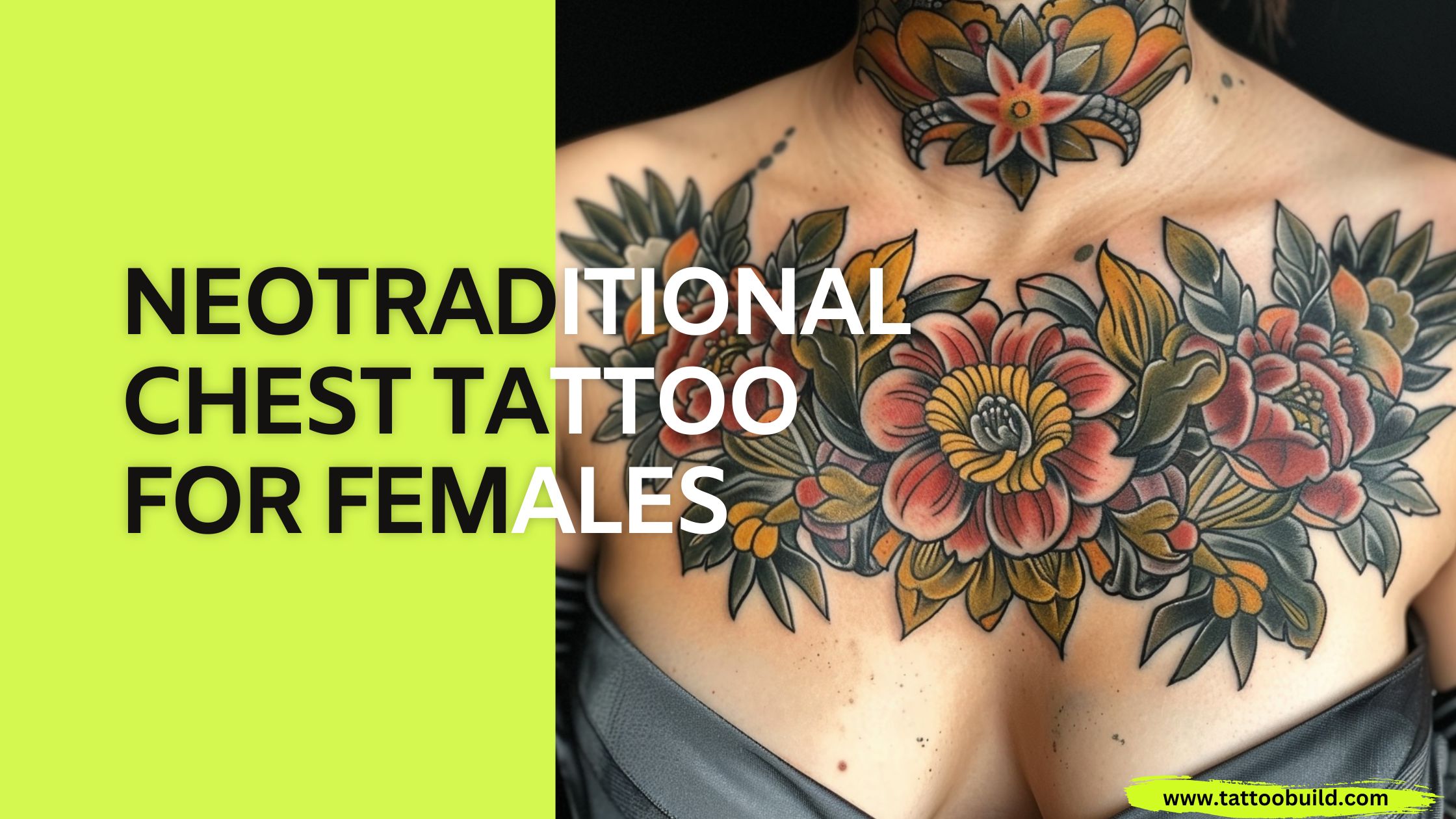
A neotraditional chest tattoo for a female client is one of the few placements where a bold traditional outline and a soft, painterly colour palette can coexist without either one winning. The chest gives an artist width, symmetry and a natural frame, and neotraditional is the style built to use all three.
I have watched this combination go from a niche request to one of the most common consultations on the books. Ten years ago the chest was mostly script and small centred pieces; now it is ornamental florals, lady heads and full nautical panels rendered in colour that actually holds.
That popularity comes with a catch. The chest is a demanding place to sit, it heals unevenly across the sternum and collarbones, and a design that looks perfect flat on paper can distort badly once it wraps a curved ribcage. It sits in the same nerve-dense neighbourhood as rib tattoos for women, and it deserves the same amount of planning.
This guide covers what neotraditional actually is, which motifs suit the chest, how to plan the layout, what the sessions realistically feel like, and the mistakes I see most often. No fluff, and no promises about pain that will not survive contact with a needle.
Which Chest Tattoo Style Is Right for You?
Before committing to neotraditional, it helps to see it next to the styles it is most often confused with. The differences below are the ones that actually change how a chest piece looks in five years.
| Style | Linework | Colour & Shading | How It Ages | Best For |
|---|---|---|---|---|
| Neotraditional | Bold outline with varied line weight inside | Full saturated colour, painterly rendering, highlights | Very well — the heavy outline holds the shape as colour softens | Florals, animals, lady heads, ornamental chest panels |
| American Traditional | Uniform heavy black outline | Limited flat palette, minimal blending | Excellent — the most forgiving style long term | Classic icons, small punchy chest pieces |
| Fine Line | Single-needle, very light | Usually black and grey, delicate | Softens fastest; often needs touch-ups on the sternum | Small, subtle sternum or collarbone work |
| Illustrative Blackwork | Bold, often with heavy fill | Black only, dot and whip shading | Strong, though solid black areas can need a refresh | Graphic, high-contrast chest panels |
| Colour Realism | No outline | Photographic blends, soft edges | Least forgiving — edges blur without an outline to hold them | Portraits, when you accept more upkeep |
If you want colour and longevity on a curved, high-movement placement, neotraditional is usually the honest middle ground. That is not marketing; it is what the outline does for you over a decade.
What Makes the Chest Such a Demanding Canvas
The chest is not one surface. It is a soft outer plane over the pectoral, a bony ridge along the collarbone, and a thin, tightly stretched strip down the sternum.
Each of those zones takes ink differently. In my experience the outer chest is the easiest area to pack colour into, while the sternum and the collarbone are where saturation is hardest to hold and where touch-ups get scheduled.
Movement matters too. The chest flexes with every breath and every arm raise, so a design drawn as a flat rectangle will fight the body. Good neotraditional chest work is drawn on the body, not on paper alone.
Pain is real here and varies enormously between people. The sternum and the area just under the collarbone are consistently reported as among the sharper spots, while the fleshier outer chest is usually more manageable.
None of this is a reason to avoid the placement. It is a reason to book a stencil session, look at the design in a mirror while standing, and give the artist room to adjust before the machine ever switches on.
Neotraditional Chest Tattoo Ideas for Women
These are the motif families that come up most in consultations, and the practical notes that go with each one.
1. Floral Panels: Roses, Peonies and Lotus
Florals are the backbone of neotraditional chest work because they bend. A rose or peony can be rotated, resized and layered to follow the collarbone without ever looking forced.
Roses remain the most requested single element I draw for this placement, and they suit the style perfectly — heavy outline, deep red core, a bright highlight on the outer petals. If you are still narrowing down a bloom, the range in these rose tattoo ideas is a useful starting point.
Peonies give you more surface area and read better at a distance, which matters on a chest piece that will mostly be seen from a few feet away. Lotus and cherry blossom work too, but they are smaller motifs and usually serve as filler around a stronger central element.
The mistake to avoid is scattering too many small blooms. Two or three large flowers with ornamental leafwork between them will always outlast a spray of a dozen tiny ones.
2. Mythical Creatures and Fantasy Figures
Mermaids, phoenixes, fae and moth-winged figures give neotraditional artists exactly what the style is built for: a stylised face, ornamental wings, and room for decorative rendering.
The phoenix in particular suits a chest layout, because the wings can spread across both pectorals and the tail can run down toward the sternum. If that direction appeals, these phoenix tattoos for women show how much the shape can vary.
When I have tattooed fairy and fae figures on the chest, the winning versions kept the face small and let the wings and drapery carry the composition. Faces at chest scale are unforgiving; wings are not.
Fantasy pieces also age well in this style because the outline does the storytelling. Even after the colour softens, the silhouette still reads.
3. Symbolic Icons: Anchors, Compasses and Keys
Symbolic icons were the original vocabulary of traditional tattooing, and neotraditional inherits them with added ornament.
A compass sits naturally at the sternum because it is radially symmetrical — it is one of the few motifs that actually benefits from being centred on a line the body already has. There is a wider range of layouts in these compass tattoo designs.
Anchors work best slightly off-centre, resting under one collarbone with rope or florals trailing away. The symbolism is well worn but genuine, and the shape is strong; anchor tattoos for females covers how the motif is being reinterpreted.
Keys, lockets and hourglasses all belong to the same family. Every artist I have asked says the same thing about them: the icon is the easy part, and the ornamental frame around it is where the piece is won or lost.
4. Wildlife Portraits: Birds, Wolves and Big Cats
Animal work on the chest gives you a natural focal point, and neotraditional handles fur and feathers better than most colour styles because it stylises rather than copies.
Birds are the most adaptable option. A swallow pair reads cleanly under the collarbones, while a single larger bird can occupy one side of the chest and leave the other for ornament.
Wolves and big cats need more real estate. In my experience a wolf head under 15 cm on the chest loses its detail within a few years, so if that is the direction, plan for scale rather than squeezing it in — these wolf tattoo ideas show the sizes that actually hold up.
Whatever the animal, ask to see the design mirrored. An animal facing the wrong way across the chest looks subtly wrong to everyone and nobody can say why.
5. Vintage Portraits and Lady Heads
The lady head is the signature neotraditional motif, and the chest is arguably its best home — it was drawn for exactly this kind of upright, centred placement.
Modern versions swap the pin-up styling for something closer to art nouveau: strong jawline, ornamental headdress, flowers worked into the hair.
Portraits of real people are a different proposition. I generally steer clients toward realism or black and grey for a likeness, because neotraditional stylisation and accurate resemblance pull against each other.
If you do want a stylised portrait, bring several reference images of the same face from different angles. One photograph is almost never enough for an artist to build a design from.
6. Nautical and Maritime Scenes
Ships, lighthouses and waves suit the chest because they are horizontal compositions, and the chest is a horizontal canvas.
A ship under full sail spanning both pectorals is one of the strongest layouts in this style, particularly when the waves are allowed to break asymmetrically rather than mirroring perfectly.
Maritime work also gives an artist a legitimate reason to use blue and teal, which are underused on chest pieces and read beautifully against warm skin tones.
One honest caveat: detailed rigging does not survive at small scale. Either commit to the size or simplify the ship before it goes on skin.
7. Ornamental Framing and Sternum Symmetry
Ornamental work — mandalas, filigree, lace and jewellery motifs — is the quiet workhorse of chest design. It fills space, links elements and follows the body better than any figurative motif.
A symmetrical ornamental panel running down the sternum with softer elements on either side is a layout I recommend constantly, because it can be built in stages across multiple sessions.
It is also the most forgiving option if you are unsure about long-term commitment to a single image. Ornament dates far more slowly than a specific character or portrait.
Neotraditional ornament differs from pure blackwork ornament in one important way: it keeps the varied line weight and often carries a colour accent, so it never reads as flat.
Variations Worth Considering
The same motif can be scoped several different ways. These are the four versions clients most often end up choosing between.
Half-Chest Versus Full-Chest
A half-chest piece sits on one side and can be finished in one or two sittings. It is the lower-commitment option and it leaves the door open to extend later.
A full chest panel is a multi-session project. Plan it as one design from the start, even if you tattoo it in pieces — stitching two separate pieces together afterwards rarely looks intentional.
Extending Into the Shoulder or Sleeve
Chest-to-shoulder is the most natural extension, and many artists will design the chest with that continuation in mind even if you never take it further.
If a sleeve is a possibility down the line, say so at the first consultation. It changes where the outer edge of the chest piece should stop. These classy shoulder tattoos for females show how the transition usually gets handled.
Muted and Desaturated Palettes
Not every neotraditional piece needs full-strength colour. A muted palette — dusty rose, sage, ochre — is increasingly common and still keeps the bold outline that defines the style.
Be aware that lighter and more desaturated pigments generally show fading sooner than deep saturated ones, so a muted piece may want a touch-up earlier. Ask your artist directly how their palette has aged on previous clients.
Sternum-Only and Underboob Placements
A sternum-only piece is a smaller commitment with an outsized visual effect, and it works particularly well with symmetrical ornamental designs.
It is also, by most accounts, the sharpest part of the whole area to sit through. Short sessions are your friend here.
Planning, Sitting and Aftercare
Choose the artist before the design. Look specifically for healed chest work in their portfolio — fresh photos tell you almost nothing about how someone’s colour settles.
Expect a full chest panel to take multiple sessions of several hours each. In my experience clients cope far better with three shorter sittings than one marathon, and the tattoo usually heals better for it.
Eat properly beforehand, wear something that opens at the front, and do not drink the night before. Alcohol thins the blood and makes colour packing measurably harder for the artist.
For healing, follow the aftercare your artist gives you rather than advice from the internet, including this article. The chest creases and sweats, so keeping it clean and unrestricted matters more here than on a forearm. Cleveland Clinic has a clear general overview of tattoo aftercare, and the FDA fact sheet on tattoos and permanent makeup covers ink safety and reactions.
If you develop spreading redness, swelling that worsens after a few days, pus, or a fever, contact a doctor rather than your artist. Allergic reactions to red pigment in particular can appear weeks or even months later, and that is a medical question, not a tattooing one — the FDA’s Think Before You Ink guidance is worth reading before you book.
Common Mistakes — and What to Do If You Are Still Not Sure
The most common mistake is choosing a design at the wrong scale. Chest pieces almost always want to be larger than clients first imagine, and shrinking a detailed neotraditional design is how it turns muddy.
The second is forcing perfect symmetry. Bodies are not symmetrical, and a design mirrored with mathematical precision often looks off once it is on skin.
The third is booking with an artist whose portfolio is strong but whose style is not actually neotraditional. A brilliant realism artist will not give you bold outlines, and asking them to is unfair to both of you.
If you are still weighing placement rather than motif, it is worth comparing against neighbouring options before committing — a feminine spine tattoo covers similar territory with a very different visibility profile.
And if the whole thing still feels too big a jump, there is no shame in starting smaller. Browsing broader collections of pretty tattoos for women is a reasonable way to find the motif first and decide on scale second.
Frequently Asked Questions
How painful is a neotraditional chest tattoo?
Pain varies a great deal between individuals, so treat any single answer with scepticism. That said, the sternum and the area directly under the collarbone are consistently described as sharper than the fleshier outer chest, where a needle has more tissue to work through. Most people find the first hour manageable and the last hour of a long session much harder, which is an argument for shorter sittings. If you are worried, book a small piece first and find out how your own body responds before committing to a full panel.
How many sessions does a full chest piece usually take?
A single-side or half-chest neotraditional piece often comes together in one or two sittings. A full chest panel with detailed colour packing is realistically a multi-session project spread over weeks or months, because each area needs to heal before it is refined. Your artist should give you an estimate at the consultation once the design is drawn, and that estimate will be more accurate than any general figure. Be sceptical of anyone who promises a large full-colour chest panel in a single day.
Will a neotraditional chest tattoo fade faster than one on my arm?
The chest is not inherently worse than the arm, but it does get significant sun exposure in summer and it creases with movement, both of which contribute to fading over time. The heavy outline that defines neotraditional is exactly what protects the design as the colour softens, which is one of the style’s real advantages here. Sunscreen on a healed tattoo is the single most effective thing you can do to slow fading. Expect that any large colour piece may want a touch-up at some point in its life.
Can neotraditional work be done in black and grey instead of colour?
Yes, and it is more common than people assume. The style is defined by its line weight, ornamental rendering and stylisation rather than by colour specifically, so a black and grey neotraditional chest piece is entirely coherent. It tends to age very predictably and suits clients who want the aesthetic without the upkeep of saturated colour. Ask to see healed examples of the artist’s black and grey work before deciding, since the shading approach differs from their colour work.
What should I bring to a neotraditional chest tattoo consultation?
Bring reference images of the style you want, not just the subject — showing an artist five neotraditional pieces you admire is far more useful than one photo of a rose. Bring any hard constraints too, such as scars, existing tattoos, or clothing you need the piece to sit under. Wear or bring a top that opens at the front so the placement can actually be assessed. Finally, come with a rough budget and be honest about it, because scale and session count follow directly from that.
Quick Summary
- Neotraditional pairs a bold traditional outline with painterly colour, which is why it holds up better on the chest than outline-free colour styles.
- The chest is three different surfaces — outer pectoral, collarbone and sternum — and each takes ink and pain differently.
- Florals, mythical figures, symbolic icons, wildlife, lady heads, nautical scenes and ornamental panels are the seven motif families that suit the placement best.
- Scale is the most common mistake; chest designs almost always need to be bigger than first imagined.
- Full chest panels are multi-session projects, and shorter sittings usually heal and feel better than marathons.
- Muted palettes are a legitimate option but may want a touch-up sooner than deeply saturated colour.
- Choose an artist by their healed chest work in this specific style, not by their portfolio overall.
- Follow your artist’s aftercare, and treat spreading redness, worsening swelling or fever as a matter for a doctor.