The chest might be the most deliberate place a woman can put a flower. It is the only major placement you choose almost entirely for yourself — the sternum and upper chest sit under most necklines, which means the piece belongs to you first and to everyone else second.
I have spent a lot of time looking at how floral work sits on the chest, and the pattern is consistent: the designs that age best are the ones that follow the body’s own lines rather than fighting them.
The sternum wants something vertical. The collarbone wants something that sweeps. The broad upper chest can carry a centrepiece that nothing else on the body can hold at the same scale. If you are still weighing placements, it is worth comparing these against floral shoulder tattoos for women, which solve a very different problem.
Below are 19 floral chest designs, grouped by how they use the space, plus the pain, healing, and cost realities I wish more people knew before they booked.
Which Chest Placement Is Right for You?
Every zone on the chest behaves differently. This is the shorthand I use when someone cannot decide.
| Zone | Best design shape | Pain (relative) | Typical session time | Visible in most tops? |
|---|---|---|---|---|
| Sternum | Narrow vertical column, mirrored or spine-like | High — thin skin over bone | 2–4 hours | Rarely |
| Clavicle | Horizontal branch or sweeping stem | High directly on the bone | 1–3 hours | Often |
| Upper chest (broad) | Centred arrangement spanning both sides | Moderate | 4–8 hours, sometimes split | Partly |
| Full chest panel | Layered composition using every zone | Moderate to high, varies by section | Multiple sessions | Partly |
| Chest into ribs | Flowing stems that spill downward | High on the ribs | Multiple sessions | Rarely |
What Makes the Chest Different From Any Other Floral Placement
Most placements are flat canvases. The chest is not — it is a curved, moving, asymmetrical surface with a bony ridge down the middle.
That changes the design before the needle ever touches skin. A stencil that looks balanced on paper can read crooked on the chest, because the two sides of the ribcage are almost never perfect mirrors of each other.
The good artists I have watched handle this by drawing the stencil freehand on the body, or by adjusting a printed stencil while the client stands upright rather than lies down. If an artist stencils your chest piece while you are flat on the bed and never checks it standing, ask them to.
The other difference is how the chest moves. Breathing, arm movement, and posture all shift this area, so a design built from rigid straight lines will look tense. Organic botanical shapes are forgiving here, which is part of why florals dominate the placement.
Clothing matters too. The chest is framed by necklines in a way no other placement is, and a design that stops awkwardly mid-collarbone can look unfinished under a crew neck. The same logic applies to a bird chest tattoo for women, where the wingspan has to make sense with what you actually wear.
19 Floral Chest Tattoo Ideas for Women
These are organised roughly from the smallest and most private to the largest and boldest.
1. Fine Line Sternum Floral
A narrow vertical column of blooms and leaves running down the breastbone, built from single-weight lines and almost no shading.
This is the design I get asked about more than any other. It works because the sternum is already a vertical line, so the tattoo reads as though the body suggested it.
The trade-off is longevity. Fine line work on the sternum is one of the harder combinations to keep crisp — thin skin over bone, plus years of sun exposure in summer tops, means many people need a touch-up sooner than they expected. If you want the same delicacy on a more forgiving surface, a fine line spine tattoo holds up slightly better.
Ask your artist to go marginally heavier on line weight than the reference photo. It looks nearly identical at three weeks and noticeably better at three years.
Photo: @raini.xo.tattoo
2. Clavicle Rose Branch
Stems, leaves, and two or three open roses tracing the collarbone from the shoulder toward the centre of the chest.
The clavicle is the closest thing the chest has to a ready-made guideline, and a branch laid along it looks almost architectural.
Every artist I have asked about this placement says the same thing: the bone itself is the sore part, and it is brief. Most clavicle branches are a single sitting of one to three hours.
One practical note — this is among the most visible chest placements. It sits above nearly every neckline, so treat it as a piece you are choosing to show.
Photo: @bidi_bidi_inks
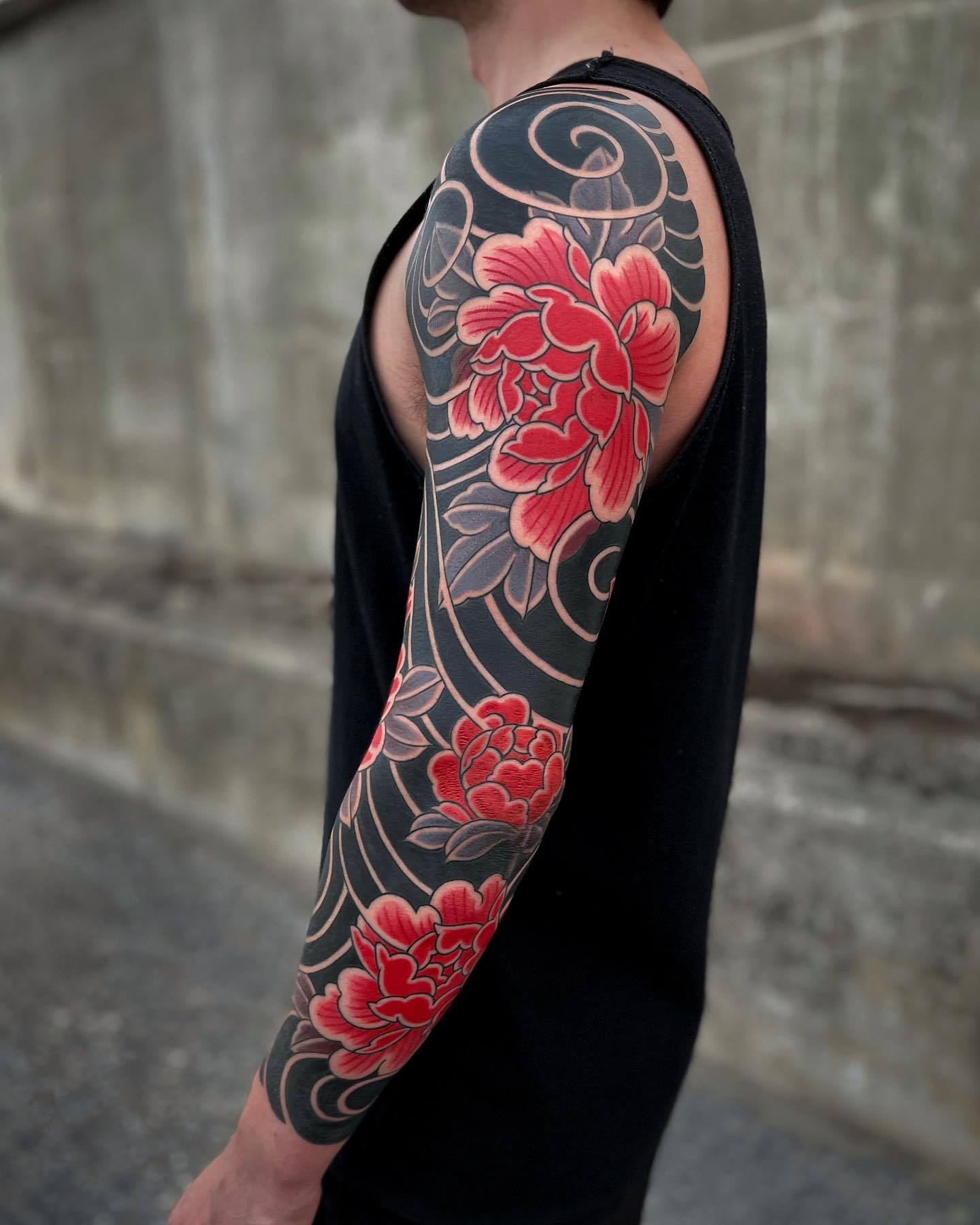
3. Full Chest Peony Arrangement
Large peonies massed at the centre with stems and foliage reaching out toward both shoulders.
Peonies are the flower I would pick for any large chest piece. The layered, ruffled petals give an artist somewhere to put shading, which is exactly what a big composition needs to avoid looking flat.
Expect this one to take multiple sessions if it is in colour. A full chest peony arrangement is a project, not an appointment.
In black and grey it is faster and, in my experience, ages more predictably — the contrast that makes peonies work does not depend on pigment holding its hue.
Photo: @fleur.tattoos
4. Wildflower Scattered Chest
Small individual wildflowers placed across the upper chest with gaps of bare skin between them, rather than one connected arrangement.
This is the most adaptable idea on the list. Because the elements are separate, you can start with three or four flowers and add more over years without the design ever looking incomplete.
It also suits people who are nervous about commitment. A first session of scattered stems is short, relatively low pain on the softer chest tissue, and tells you honestly how you feel about ink there.
The risk is drift. Without a plan for the overall silhouette, additions can turn into clutter — so agree on an outer boundary with your artist at the start, even if you only fill part of it now.
5. Magnolia Sternum Piece
Open magnolia blooms stacked down the sternum, usually in soft black and grey with a lot of smooth gradient work.
Magnolias have broad, simple petals, which makes them a good test of an artist’s shading. There is nowhere to hide a rushed gradient on a petal that size.
I find this design reads as quieter than a rose or peony of the same dimensions. The shapes are rounder and the negative space inside each bloom keeps it from feeling heavy.
If you bruise easily, book this with recovery time. The sternum often swells more than people expect for the first two or three days.
Photo: @steph.art.please
6. Symmetrical Floral Design
A mirrored composition, with matching flowers and foliage on each side of the sternum’s centre line.
Symmetry is the highest-difficulty request on the chest, and it is worth saying plainly: perfect symmetry on an asymmetrical body is not achievable.
What a skilled artist delivers is the impression of symmetry, adjusted so the piece looks balanced on you rather than measuring equal on a ruler. Ask to see healed photos of their symmetrical work before booking.
When it lands, the effect is striking — it reads as ornamental, almost like jewellery, and it frames the centre of the chest in a way no loose arrangement does.
Photo: @goodtimestattoo
7. Cherry Blossom Branch
A thin branch with clusters of small five-petal blossoms, often sweeping along the collarbone or arcing across the upper chest.
Cherry blossom suits the chest because the blooms are small and repeated, so the design can follow a curve without any single element distorting.
The traditional association is with impermanence and the brevity of beauty, which is part of why it shows up so often on placements people describe as personal.
Practically, watch the petal size. Blossoms under about a centimetre tend to lose their internal detail as they heal and blur into solid dots.
Photo: @tattooist_inkandbloom
8. Neo-Traditional Floral Chest Panel
Bold confident outlines, stylised petal shapes, and saturated colour with decorative line detail worked into the background.
This is the style I would recommend to anyone who wants their chest piece to still be legible in twenty years. Heavy outlines hold a shape long after fine internal detail has softened.
Neo-traditional also handles scale well. The stylisation means a large chest panel does not need photographic detail to feel finished, which shortens the total time under the needle.
If this is the direction you are leaning, it is worth studying dedicated neo-traditional chest tattoos for women before you commit to a specific artist, because the style varies a lot between hands.
Photo: @solemn.tattoo
9. Lotus Sternum
A single lotus centred on the sternum, petals opening symmetrically to either side.
The lotus is almost purpose-built for this placement. It is naturally radial, so it does not need to be bent to fit a vertical line — it simply sits on the centre.
Its meanings run across several traditions, generally touching on growth through difficulty and spiritual opening. If that matters to you, read about the symbolism yourself rather than taking a studio’s one-line version of it.
There are many structural variations, from geometric and ornamental to soft and realistic — lotus flower tattoo designs is a useful place to see the range side by side.
Photo: @_emilytattoo_
10. Botanical Illustration Style
Flowers drawn the way a field guide would render them: accurate species detail, visible stamens and leaf veins, often built with stippling rather than solid shading.
I love this style and I am cautious recommending it for the chest. The detail that defines it is exactly the detail that thin skin over bone tends to lose first.
It works best at a generous scale. Give a botanical illustration piece more room than feels necessary and the fine interior work survives much longer.
Bring real reference. Artists who work in this style would rather have a photograph of the actual plant than a photograph of somebody else’s tattoo of it.
Photo: @dy3tatts
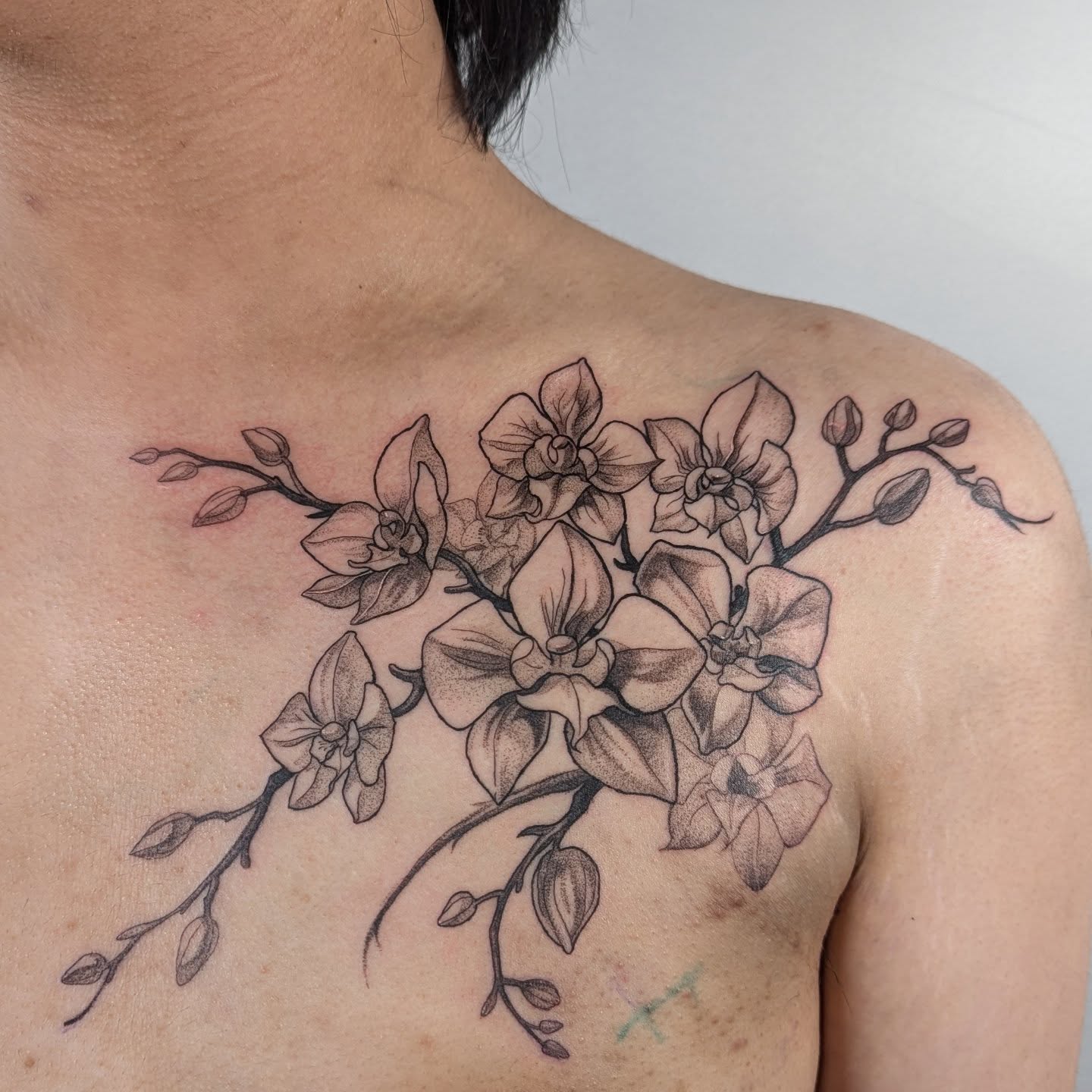
11. Orchid Arrangement
Orchid blooms on long curving stems, usually drifting diagonally across the upper chest rather than sitting square.
Orchids bring something roses and peonies do not — an irregular, slightly strange silhouette. The asymmetry of the flower itself means the composition does not have to be centred to look intentional.
This is the design I suggest when someone wants a floral chest piece that does not look like everyone else’s.
The long stems also solve a common problem: they give the artist a way to carry the eye from the chest toward the shoulder without adding more flowers.
Photo: @zthecreative
12. Watercolour Chest Garden
Loose colour washes that spill beyond the linework, imitating pigment bleeding into wet paper.
Watercolour is the most polarising style in this list, and the honest summary is that it looks extraordinary fresh and demands the most maintenance.
Soft unlined colour has nothing holding its edge, so it tends to soften faster than outlined work. Artists who do this well usually include a light structural line under the wash for exactly that reason.
If you go this route, accept sunscreen as a permanent habit and budget for a refresh every handful of years. That is the actual cost of the style.
Photo: @claire_tattoos
13. Floral Neckline Collar
A row of small flowers tracing the line a neckline would sit on, running from shoulder to shoulder across the base of the throat and upper chest.
This is the most decorative idea here — it functions less like a picture and more like a permanent necklace.
Because it follows a clothing line, it is worth trying the shape out first. Drawing it on with a skin-safe marker and wearing your normal tops for a day tells you more than any reference photo will.
It is also high visibility. A collar design is effectively impossible to cover with anything short of a turtleneck, which some people want and others discover too late.
Photo: @tattoobybubbles
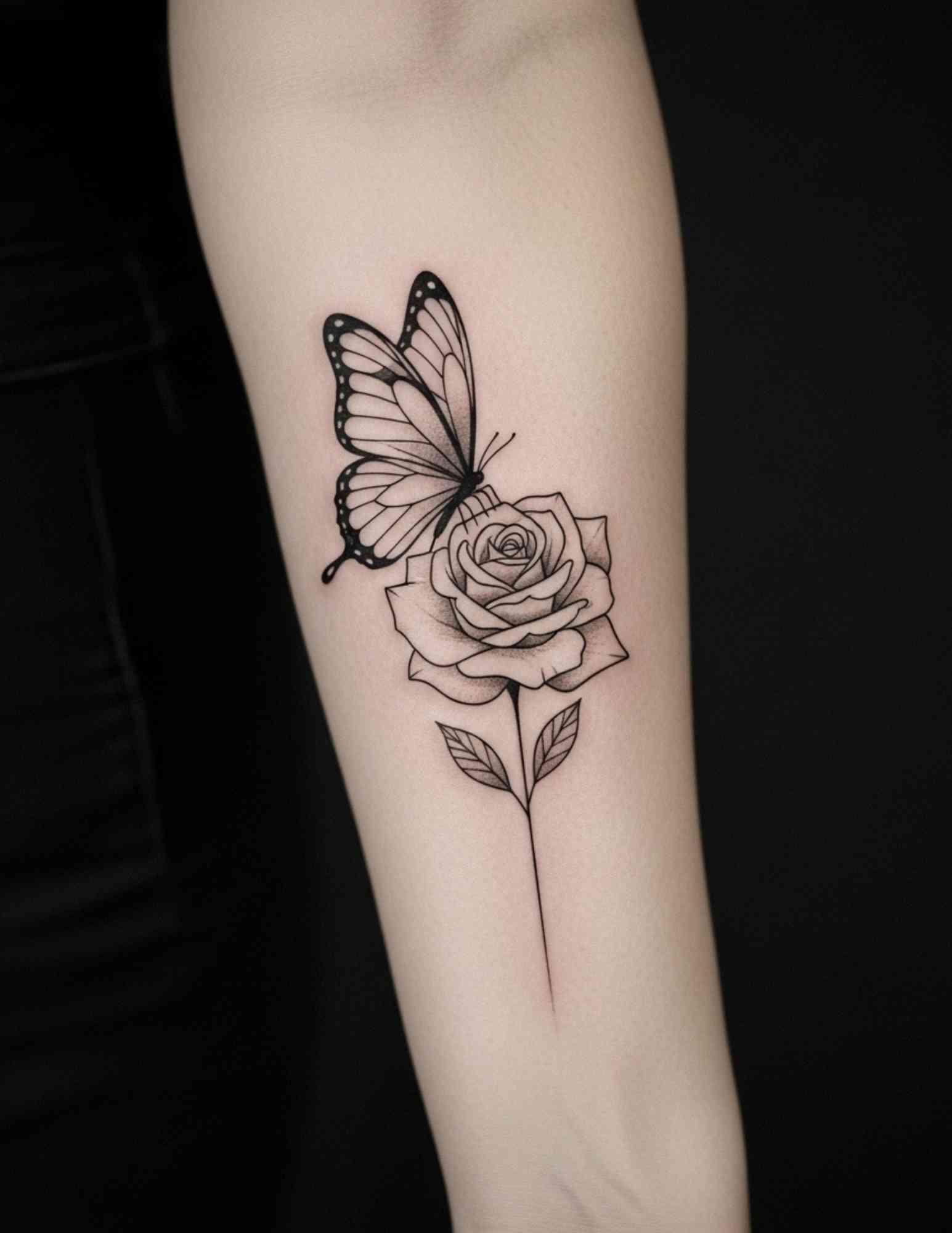
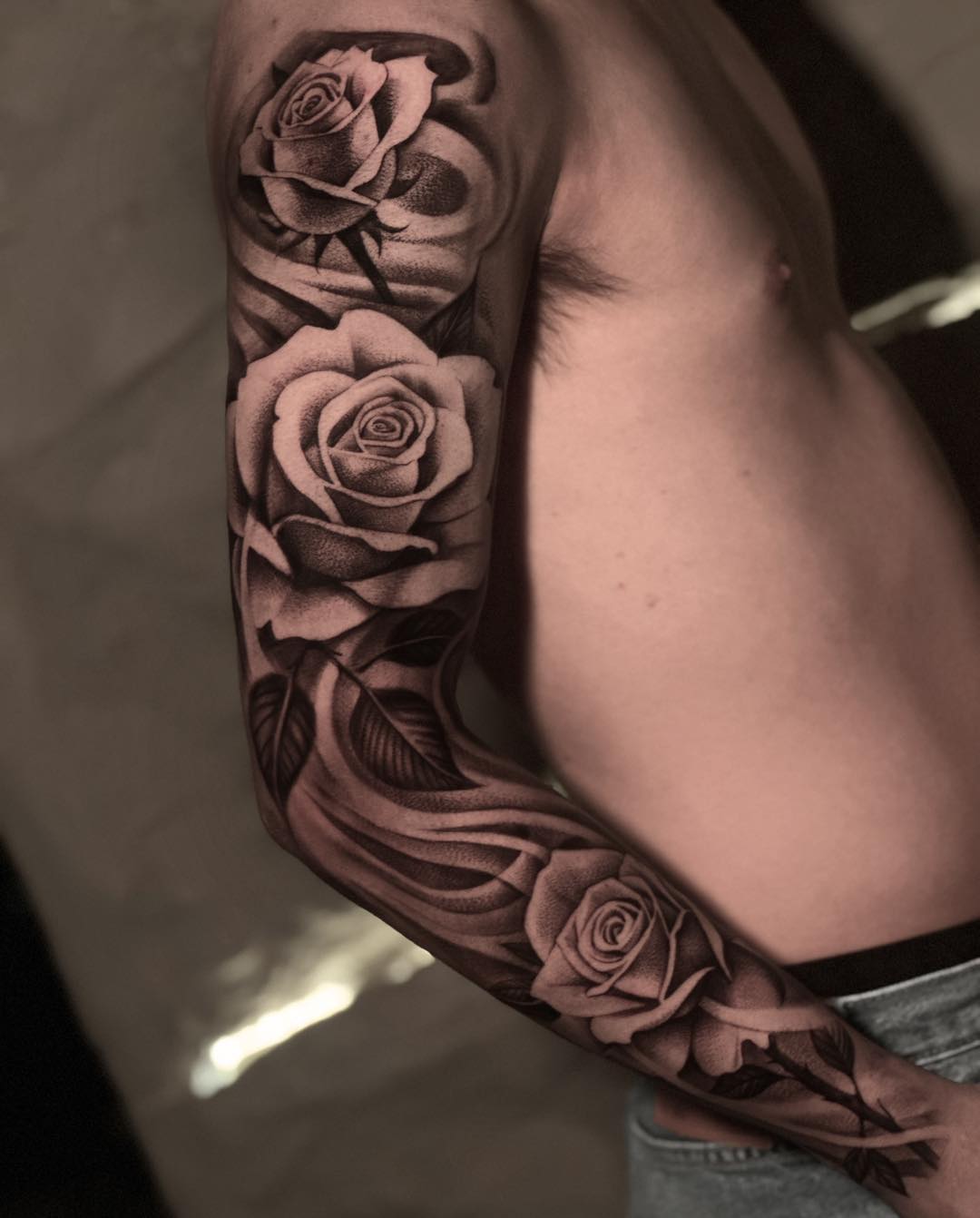
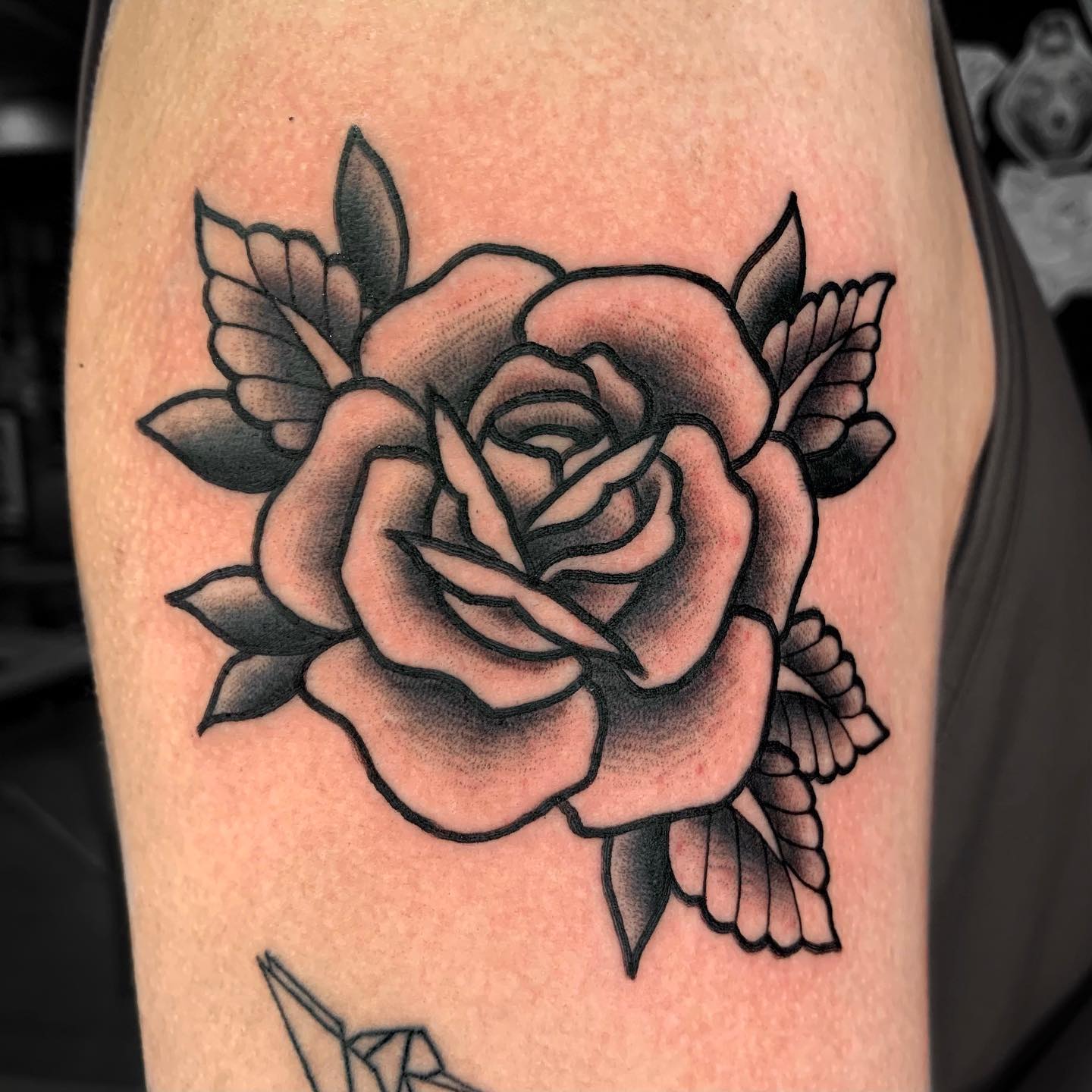
14. Single Large Rose
One rose, rendered big, placed off-centre on the upper chest rather than on the sternum.
There is a reason this never goes out of style. A single well-executed rose is the most reliable tattoo in the medium — the form is forgiving, the shading reads at any distance, and it holds together as it ages.
Off-centre placement is the detail most people miss. A lone rose dead-centre on the sternum can look like the start of an unfinished larger piece; set to one side, it looks deliberate.
If you are comparing interpretations before you book, rose tattoo ideas covers the stylistic range from traditional through to realism.
Photo: @berserk_tattoos
15. Floral Ribcage Extension
A chest composition that does not stop at the chest — stems and smaller blooms continue down over the ribs on one side.
Extending downward is the simplest way to make a chest piece feel like it belongs to a body rather than sitting on one. The flowers appear to fall naturally with gravity.
Be clear-eyed about the pain. The ribs are a genuinely difficult area for most people, and this is usually where a chest project gets split into separate sessions.
If the rib section is the part you are unsure about, reading up on rib tattoos for women first will give you a realistic picture of what that sitting involves.
16. Birth Month Flower
The flower assigned to your birth month — or to the birth months of people you love — worked into a small chest arrangement.
This is the most personal idea on the list and the one I see chosen most often for family. Several flowers grouped together can represent several people without any names or dates.
It is also a neat answer to the cluttered-over-time problem: the set is finite and defined in advance, so you know what the finished piece looks like before the first session.
Assignments vary by source and by country, so check more than one list. Birth flower tattoo ideas lays out the common versions month by month.
Photo: @notnice.ink
17. Garden Composition With Bees or Butterflies
Flowers plus a small creature — a bee mid-flight, a butterfly settled on a petal, occasionally a moth.
Adding an insect does something a purely botanical piece cannot: it implies a moment. The eye reads a relationship between the creature and the bloom, and the composition gains a small story.
Keep the creature small and keep it to one. Two or three butterflies quickly tips from narrative into decoration.
Placement matters more here than anywhere else on this list. An insect sitting in empty skin looks stranded — it needs to be touching or overlapping a flower to read correctly.
Photo: @_gwen.ink
18. Dark Floral Chest
Flowers rendered in deep blacks with dramatic shadow and very little light area — closer to gothic illustration than to a garden.
This is the strongest counterpoint to the soft, pale floral work that dominates the placement, and it suits the chest particularly well because the area can carry that much visual weight without looking overloaded.
Heavy black is also the most durable choice on this page. Dense saturated black holds its look longer than fine line or soft colour, full stop.
What it costs you is reversibility. A large area of solid black is the hardest thing to cover up later and the most stubborn to remove, so commit to the design, not just the mood.
Photo: @xen.inkz
19. Fine Line Chest and Shoulder Piece
Flowers on the upper chest with stems and foliage wrapping over the shoulder and onto the upper arm.
This is the design that looks most like clothing. Because it crosses the shoulder seam, it follows the lines a garment would, and the effect in a vest or strapless top is genuinely striking.
It is also the most involved piece here in planning terms. Chest and shoulder are different surfaces at different angles, so the composition has to be drawn on the body rather than designed flat.
Expect at least two sessions and expect the shoulder to be the easier half. The area where the chest meets the armpit is the one spot most people find worse than the sternum.
Photo: @tattooist_inkandbloom
Variations Worth Considering
If none of the 19 is quite right, these three adjustments change a floral chest piece more than swapping the flower does.
Colour Versus Black and Grey
This decision affects longevity more than style. Black and grey relies on contrast, which fades more gracefully than hue does, and it is the safer choice on sun-exposed chest skin.
Colour gives you species accuracy and warmth that grey cannot reach. If you want colour, reds and deep purples generally hold better than pale yellows and pastels.
Adding Script or a Date
Small lettering tucked between stems can work, but it is the first element to blur. Keep it short, keep the font simple, and give it breathing room rather than nesting it inside petals.
Underboob and Below-Sternum Continuation
Carrying the design below the sternum into the underbust area is increasingly common and changes the piece from a chest tattoo into a torso tattoo. It is more painful and more private, in roughly equal measure.
Pain, Healing, and Aftercare for Chest Florals
The chest is a moderately painful placement overall, with sharp spikes wherever the needle crosses bone — the sternum, the collarbone, and the ribs.
Healing here is usually straightforward, because the chest avoids the constant friction that makes hands, wrists, and ankles difficult. The one thing that consistently causes problems is clothing: bra straps, underwires, and anything tight across the sternum rub a fresh tattoo. For roughly the first two weeks, loose and soft wins.
Follow the aftercare instructions your own artist gives you, because they know what they put in your skin. General guidance from dermatologists — keep it clean, keep it moisturised, keep it out of the sun, do not pick — is summarised well by the American Academy of Dermatology.
Know the difference between normal healing and a problem. Redness, warmth, and mild swelling in the first few days are expected. Spreading redness, increasing pain after day three, pus, or fever are not — those warrant a doctor, not a forum thread. Allergic reactions to pigment are uncommon but real, and red inks are the most frequently implicated; the FDA’s guidance on tattoo safety covers what to watch for. Never attempt to treat, alter, or remove a tattoo yourself.
Sun is the long game. The upper chest catches more direct sun than almost any other tattooed area on a woman’s body, and unprotected sun exposure is the single biggest reason floral chest pieces look tired early. Daily sunscreen once healed is not optional if you care how it looks in a decade. If you have a history of skin reactions or keloid scarring, talk to a dermatologist before booking — the Mayo Clinic’s overview of tattoo risks is a reasonable starting point.
Still Not Sure? Common Mistakes to Avoid
The mistake I see most often is choosing the flower before choosing the shape. Decide whether you want something vertical, sweeping, or centred first — the species can follow.
The second is booking fine line work at a size too small for the placement. Chest skin is not forgiving of tiny interior detail, and the piece that looked perfect on Instagram was probably larger than it appeared.
The third is skipping the standing stencil check. Take the extra ten minutes.
And the fourth is not looking at adjacent placements before committing. If the privacy of the sternum is what appeals to you, a feminine spine tattoo offers the same quality of concealment with a longer vertical canvas and a very different feel.
Frequently Asked Questions
How painful is a floral chest tattoo for women?
Expect it to be moderately painful overall, with genuine spikes wherever the needle passes over bone. The sternum and the collarbone are the sharpest points, and the soft tissue of the broader upper chest is noticeably easier. Most people describe the sternum as intense but tolerable in stretches rather than unbearable. Pain tolerance varies a lot between individuals, so treat any scale you read online as a rough guide only.
How long does a floral chest tattoo take?
A small clavicle branch or a scattered wildflower session is often one to three hours. A fine line sternum piece usually runs two to four hours. A full chest arrangement in colour is commonly split across multiple sessions, sometimes totalling eight hours or more. Your artist can give you a real estimate once they have seen the design at actual size.
Will a fine line chest tattoo fade faster than other placements?
In most cases, yes — and for two compounding reasons. Thin skin over the sternum holds fine detail less reliably than fleshier areas, and the upper chest gets heavy sun exposure. Slightly heavier line weight and consistent sunscreen both help considerably. Many people with fine line chest work plan on a touch-up at some point, and that is normal rather than a sign something went wrong.
Can a floral chest tattoo be hidden for work?
It depends entirely on which zone you choose. Sternum and below-sternum work sits under almost every neckline, and chest-into-rib designs are effectively invisible in normal clothing. Clavicle pieces and neckline collars are the opposite — they show above most tops. If concealment matters, draw the shape on with a marker and wear your actual work clothes for a day before you book.
What flower works best for a large chest piece?
Peonies and roses are the most reliable at scale, because their layered petals give an artist somewhere to build shading and their silhouettes stay readable from across a room. Magnolias work well if you want something softer. Very small repeated flowers like cherry blossom can fill a large area, but they carry less visual weight than one big bloom. Bring reference photos of healed tattoos, not just fresh ones, when you discuss it.
Quick Summary
- Pick the shape before the flower. Sternum wants vertical, clavicle wants sweeping, upper chest wants centred.
- Peonies, roses, and magnolias are the most reliable blooms at large scale; cherry blossom and wildflowers suit scattered or curved layouts.
- Fine line work is the most requested and the least durable on the chest — go slightly heavier on line weight than your reference.
- Neo-traditional and dense black and grey age the best; watercolour looks the best fresh and needs the most upkeep.
- True symmetry is not achievable on an asymmetrical ribcage — ask for balance, and check the stencil standing up.
- Pain peaks over bone at the sternum, collarbone, and ribs; the broader chest is comparatively easy.
- Avoid tight bra straps and underwires for about the first two weeks, and make daily sunscreen permanent once healed.
- Watch for spreading redness, worsening pain after day three, pus, or fever, and see a doctor if they appear.