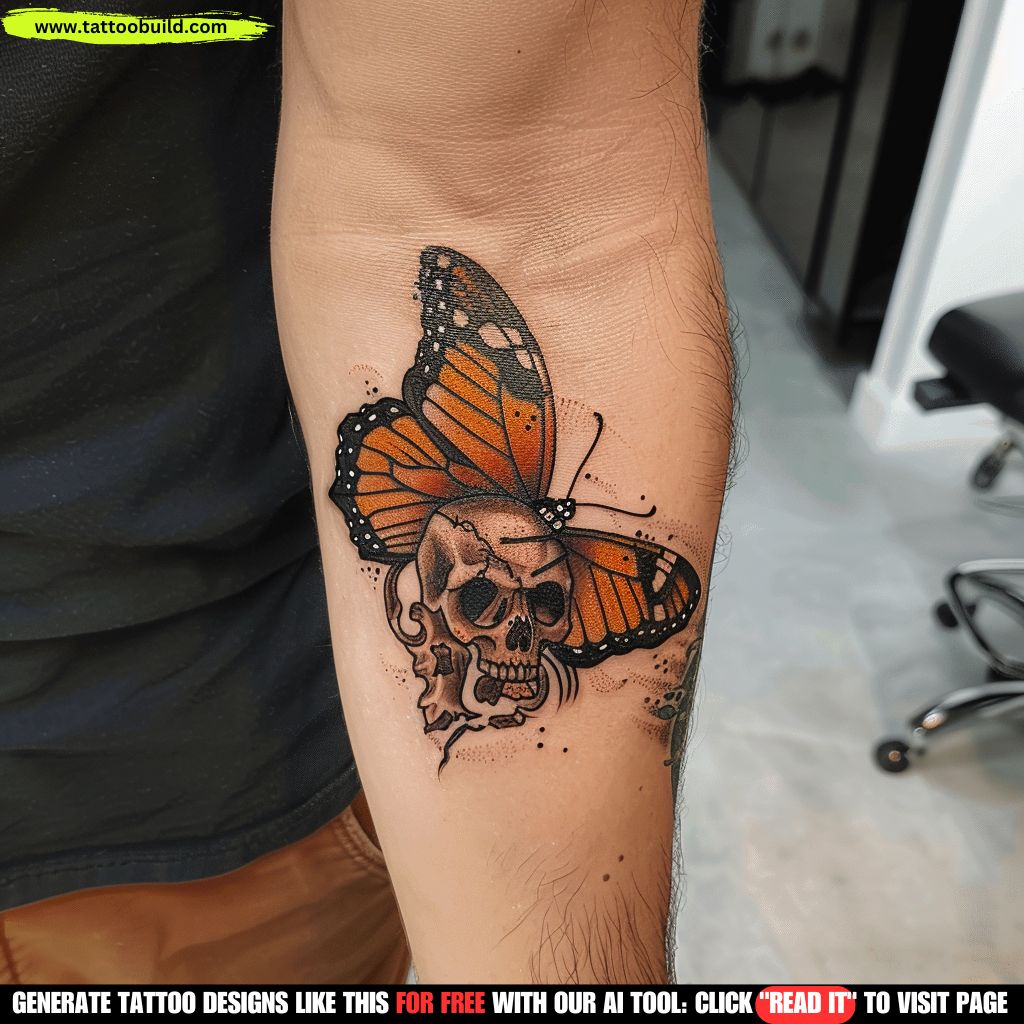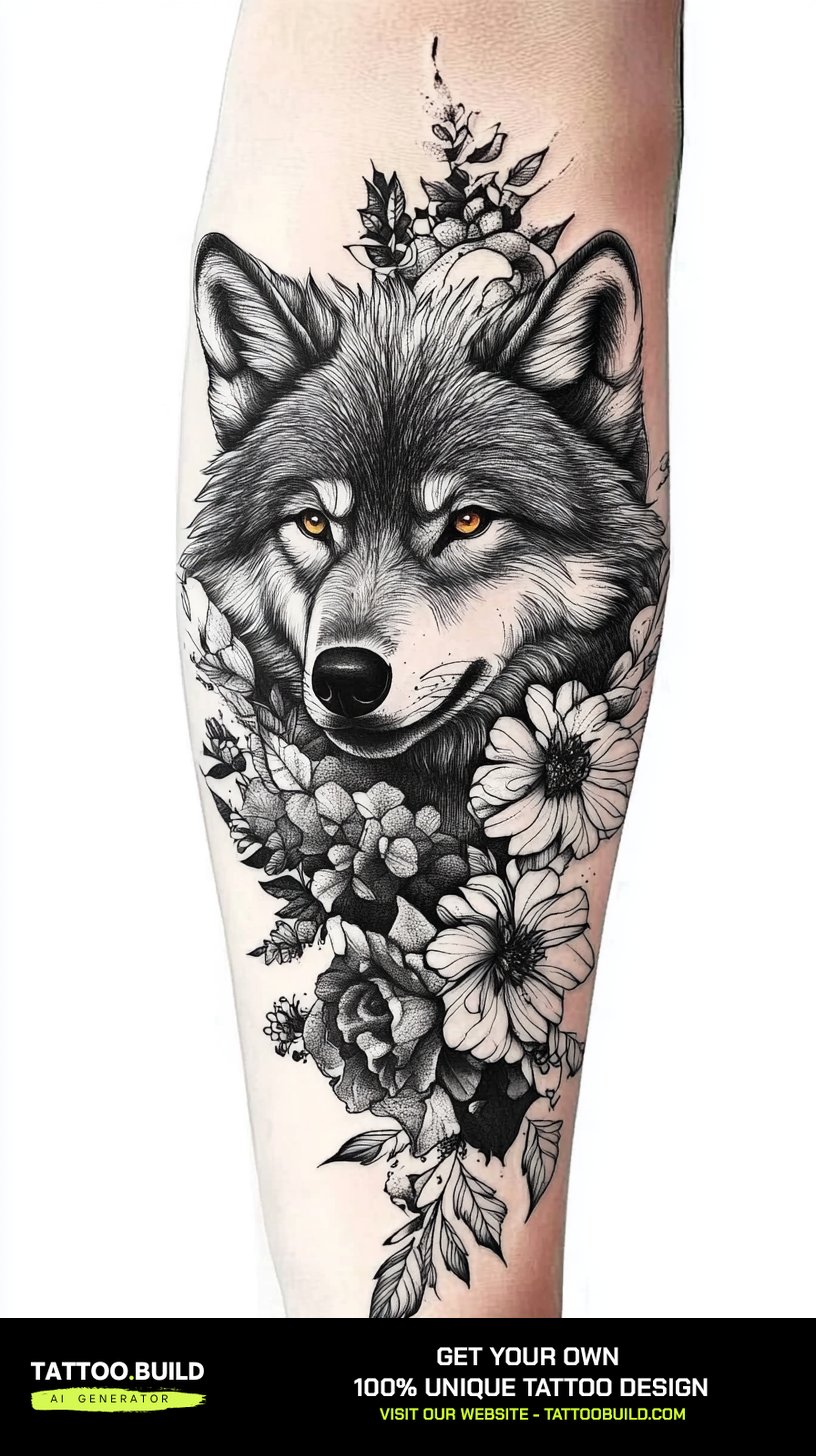
A wolf tattoo lives or dies on the eyes. I have looked at hundreds of them over the years, and the ones that stop me are never the most detailed — they are the ones where the artist got the gaze right.
The wolf is one of the most requested animals in any studio, which is exactly the problem. Ask for “a wolf” and you will get the same howling silhouette that half the internet already wears.
This guide is the version I wish I had before my first consultation: how the main styles actually age on skin, which placements suit which compositions, and the questions worth asking your artist before the stencil goes on. If you want to compare finished pieces side by side first, our gallery of awesome wolf tattoo ideas is a good place to start.
Everything below comes from looking closely at real healed work and from conversations with artists who tattoo animals week in, week out — not from theory.
Which Wolf Tattoo Style Is Right for You?
Style is the first real decision, and it constrains everything after it — size, placement, budget and how the piece will look in a decade.
| Style | Best size | Ages well? | Suits you if… |
|---|---|---|---|
| Black & grey realism | Medium to large | Very well when shading is bold | You want the animal to read as a real wolf |
| Fine line | Small | Softens fastest — expect blur | You want something quiet and delicate |
| Blackwork & ornamental | Medium to large | Excellent — solid black holds | You like graphic, high-contrast work |
| Negative space / forest | Small to medium | Good if gaps are generous | You want scenery, not a portrait |
| Colour & watercolour | Large | Needs touch-ups over time | You want a bold statement piece |
| Floral wolf | Medium to large | Good with clear separation | You want softness alongside the animal |
If two rows appeal equally, take both to your consultation. A good artist will tell you which one your body part and skin tone will actually carry.
What Makes a Wolf Tattoo Read Well
Wolves are hard to draw. The skull is narrower than a dog’s, the muzzle longer, and the ears sit higher and more upright than most reference photos suggest.
When a wolf tattoo goes wrong, it usually goes wrong in one of two places: the muzzle reads as a husky, or the eyes end up flat and lifeless.
Contrast does more work than detail. Every artist I have asked about animal portraits says the same thing — they push the darks harder than looks right on day one, because the piece lightens as it settles.
Fur is the other trap. Drawn as thousands of tiny strokes it turns to grey mush within a few years; drawn as clumps and shapes with real light and shadow, it keeps its form.
Ask any artist you are considering for healed photos of their animal work, taken at least a year after the session. Fresh photos flatter everyone.
Wolf Tattoo Ideas by Style
These are the six directions I keep coming back to, with what each one actually demands from you and your artist.
Black and Grey Realism
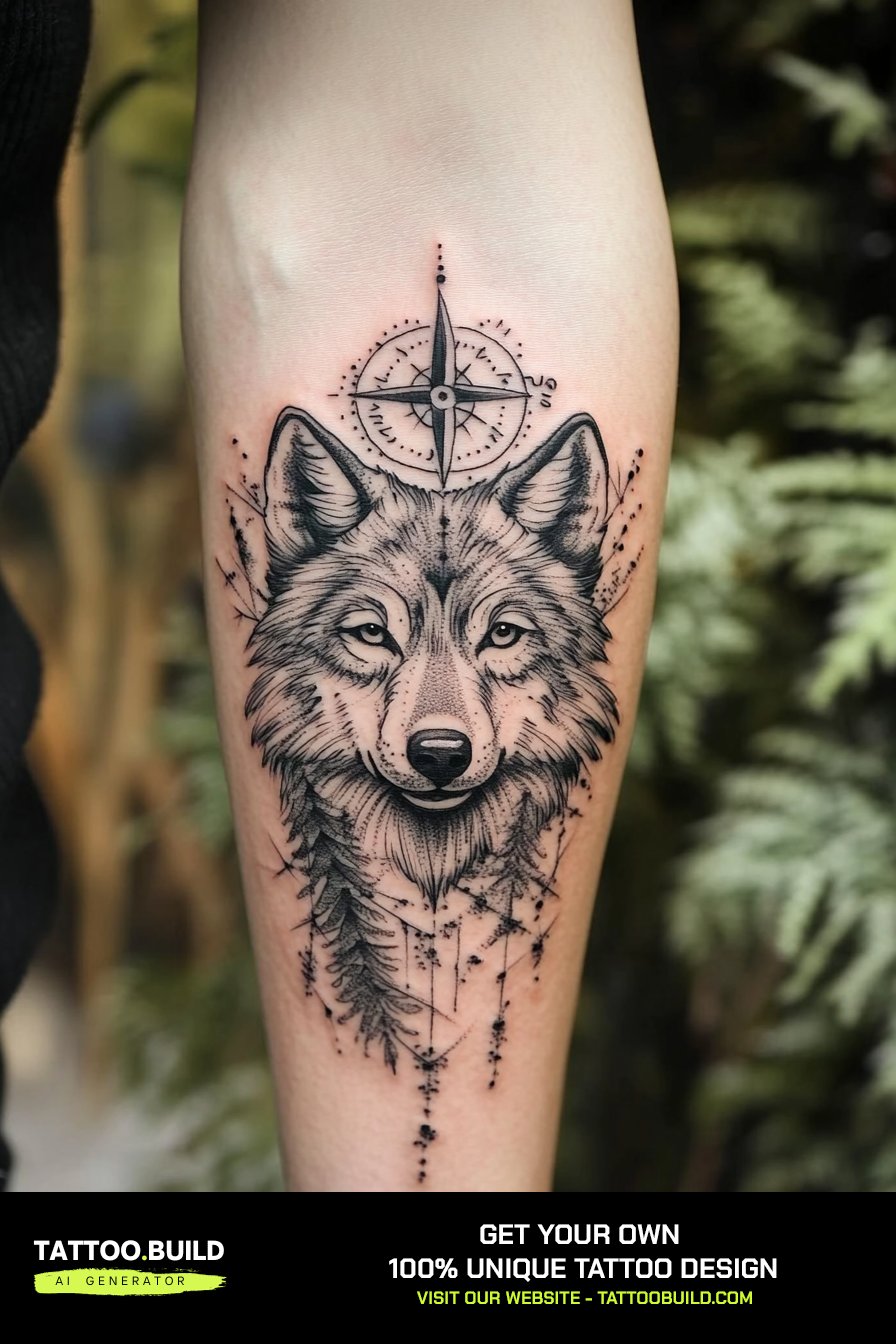
This is the classic, and for good reason. A well-shaded wolf portrait in black and grey has depth that colour rarely matches on skin.
Realism needs room. In my experience anything under about a palm’s width forces the artist to compress the eyes and muzzle until the character drains out of it.
Expect multiple sessions for a large piece, and expect the artist to want a break between them so the skin can recover. Rushing shading into swollen skin is how work heals patchy.
Bring more than one reference photo. One for the pose, one for the expression, one for the fur texture — artists work far better from three good references than from a single screenshot.
Fine Line and Minimal Wolves
Fine line wolves are the quiet option — a small standing or sitting animal, a single needle grouping, no heavy black anywhere.
They suit the inner forearm, the calf and the ribs, and they usually sit within a couple of hours of chair time.
Be honest with yourself about the trade-off. Fine line work spreads as it ages, and lines placed close together will eventually merge, so leave real gaps between the wolf and any botanicals beside it.
I would take a slightly larger fine line wolf over a tiny one every time. The extra centimetre buys years of legibility. Our guide to minimalist tattoo ideas goes deeper on that trade-off.
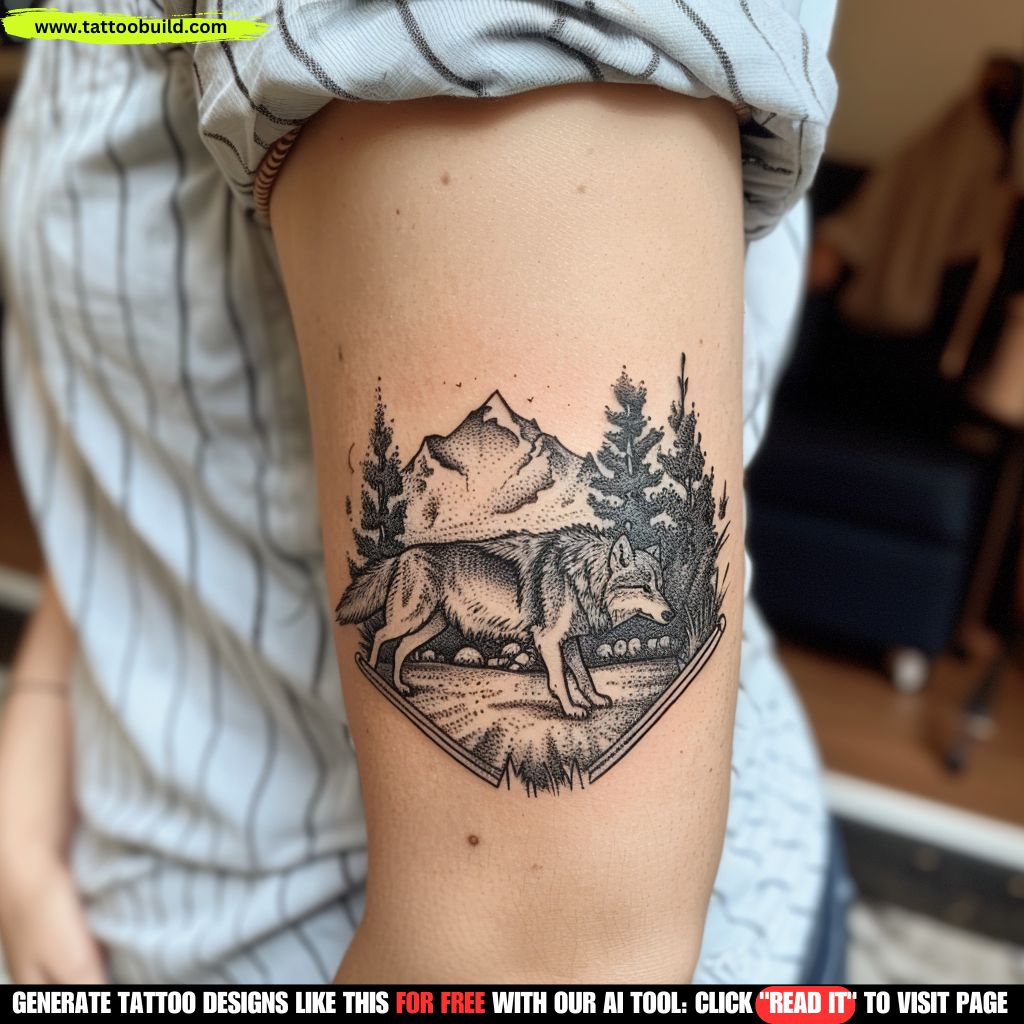
Forest and Negative Space Wolves
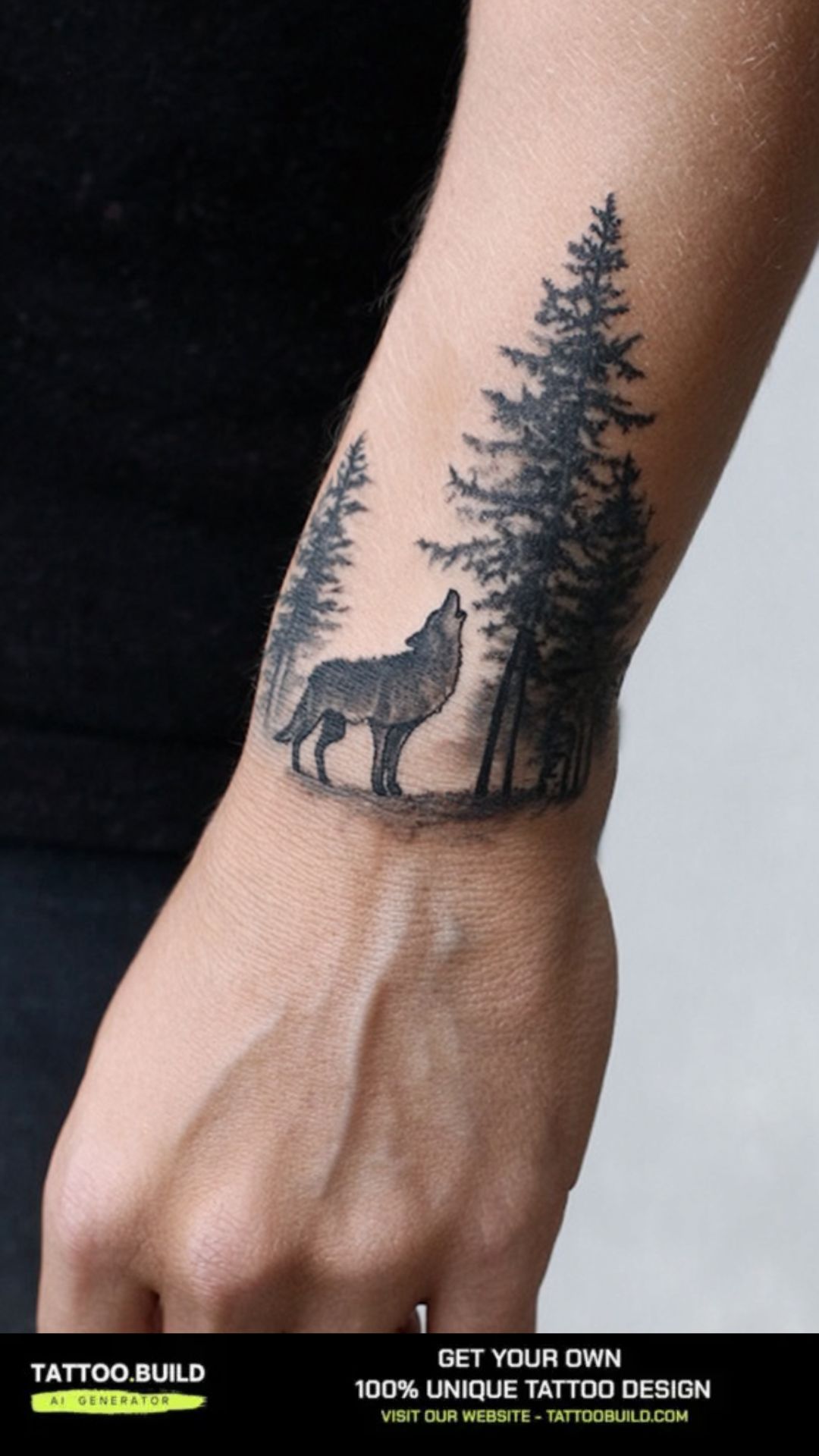
Instead of a portrait, you get a scene: a pine treeline, mist, and a wolf silhouette either walking through it or held inside the shape of the trees.
These read beautifully at small sizes because the eye takes in the silhouette first and the detail second.
The gaps are the design. When I have seen these age badly it is because the trees were packed too tightly and the whole band collapsed into one dark smear.
Ask for the treeline to be broken up, with sky showing through. It looks sparse on the stencil and correct on healed skin.
Wolf designs and the prompts behind them
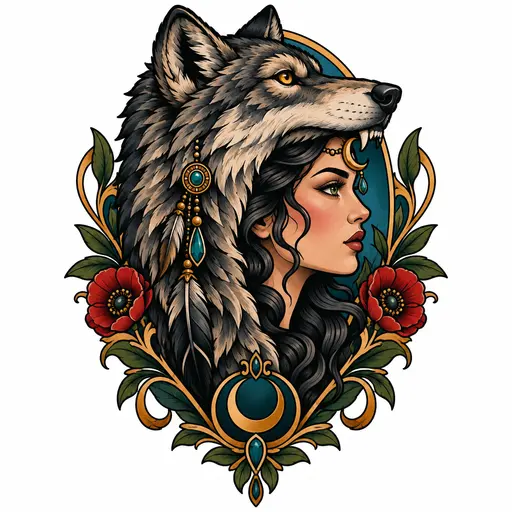
A woman's profile wearing a wolf-head headdress, a jewelled crescent moon on her brow
Use this idea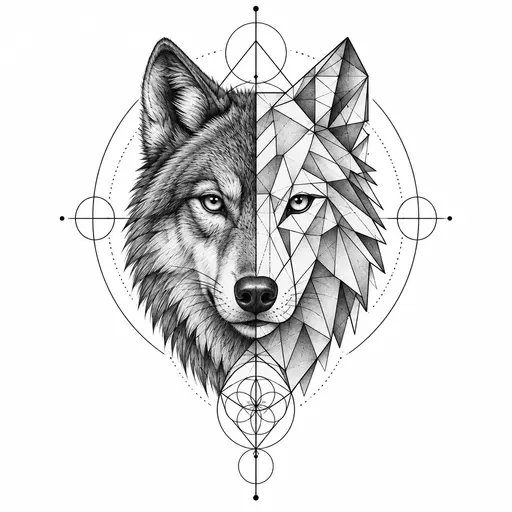
A wolf's head built from triangles and fine linework, one half realistic and the other pure geometry
Use this idea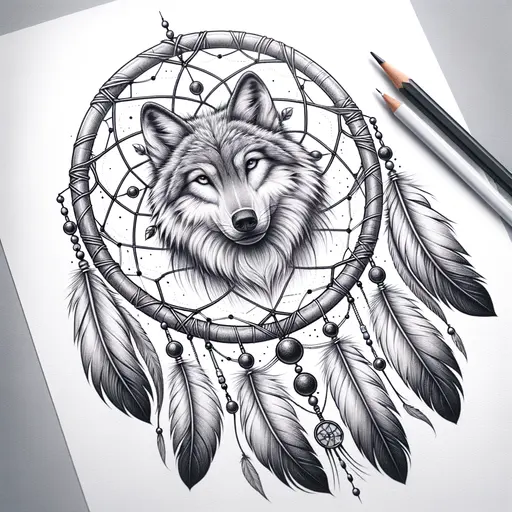
Dream catcher with wolf inside
Use this idea
Blackwork and Ornamental Wolves
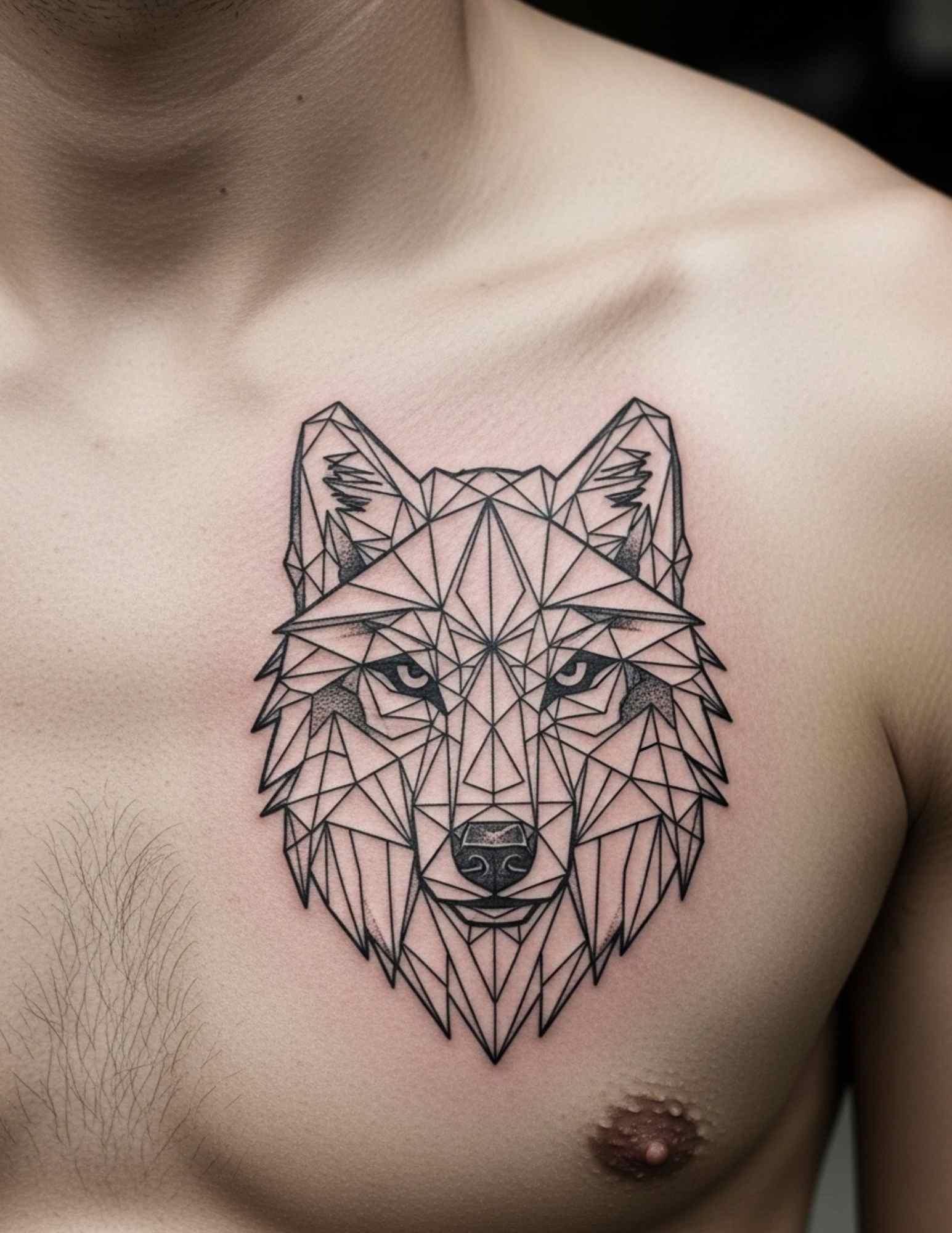
Heavy black, geometry and pattern instead of soft shading. Often paired with Nordic knotwork, mandala bands or dotwork texture.
Of every style here, this is the one I would bet on longest. Solid black holds its edge for decades in a way that delicate grey wash does not.
It also wraps limbs well, which makes it a natural choice for forearm bands and half sleeves where the design has to work from several angles.
The catch is commitment — large areas of black are difficult to cover later and slow to lighten if you ever want it removed. If the graphic approach appeals, our roundups of blackwork tattoo ideas and dotwork tattoo ideas are worth a browse.
Colour and Watercolour Wolves
Colour is the loudest option and the highest maintenance one. Splash backgrounds, split faces and saturated blues are common.
Two things matter here. First, colour generally sits differently on different skin tones, so ask your artist which palette will actually stay vivid on yours.
Second, watercolour styles usually need a black or grey structure underneath to survive. Pure washes with no anchoring linework tend to fade into vagueness.
Plan for touch-ups and treat sun exposure seriously — sunscreen on a healed colour piece is not optional if you want it to keep its punch.
Floral Wolf Tattoos
Pairing the wolf with peonies, dahlias or wildflowers is currently one of the most requested combinations, and it is more than decoration.
The flowers give the composition a base and a natural place to fade out, which solves the awkward problem of where a floating animal head should end.
Keep a value gap between the wolf and the flowers. When both are shaded to the same mid-grey, the eye cannot separate them and the piece turns into texture.
A single accent bloom in colour against an otherwise black and grey piece is a restrained way to add warmth without committing to a full colour tattoo.
Wolf Tattoo Meanings and Variations
Meaning is personal, but a few threads come up again and again — and knowing them helps you brief an artist properly.
Family and Loyalty
The “lone wolf” image is the popular one, but it is not how wolves actually live. A wild pack is normally a family unit — a breeding pair and their offspring from the last few years, as the International Wolf Center explains.
That makes a wolf a genuinely good symbol for family loyalty, and it is why pack tattoos — two or three wolves, or one wolf per family member — have become a common request.
The Wolf and the Moon
The howling-at-the-moon image is a cultural invention rather than a behaviour — wolves howl to locate each other, not at the moon specifically. That does not make it a bad tattoo, but it is worth knowing.
Composition-wise, a moon behind the head gives you a clean circular frame, which is one of the easiest ways to make an animal portrait feel finished. If the lunar side interests you more than the animal, see our moon phase tattoo ideas.
Norse and Mythological Wolves
Fenrir, the bound wolf destined to break loose at Ragnarök, and Geri and Freki, the two wolves who accompany Odin, are the most common Norse references people bring in.
Roman mythology offers the she-wolf who raised Romulus and Remus — a nurturing rather than a fearsome wolf, and a nice counterweight if the snarling versions feel wrong to you. Our Norse mythology tattoo ideas cover the wider visual language.
Wolves Paired With Objects
Daggers, compasses, arrows and skulls all get paired with wolves, and each shifts the reading of the piece considerably.
The dagger version in particular carries its own tradition and is worth understanding before you commit — we unpack it in wolf dagger tattoo meaning.
A Note on Cultural Imagery
Wolves carry real significance in a number of Indigenous cultures, and specific clan or ceremonial designs are not free-for-all reference material.
If a design belongs to a living tradition that is not yours, ask before you borrow it. Drawing on the animal itself is open to anyone; copying a specific cultural motif is a different conversation.
Placement, Sizing and Getting It to Heal Well
The forearm is the most popular placement I see for wolves, and it works because the shape of a wolf’s head fits a vertical panel almost perfectly.
The thigh is the underrated one. It gives you the most uninterrupted canvas on the body, it is one of the less painful areas for most people, and it stays out of the sun by default — which matters more for long-term appearance than most people expect.
Chest and back suit large, symmetrical compositions; ribs and feet will test your pain tolerance and are harder places to heal cleanly.
Have the stencil placed and then walk around with it. Look at it in a mirror, sit down, bend your arm. Every artist I have watched expects this, and it is the last cheap moment to change your mind.
On healing: the surface usually closes over in roughly two to three weeks, while the deeper skin keeps settling for a couple of months. Follow the specific aftercare your artist gives you — it overrides anything you read online, including this page.
Watch for spreading redness, swelling that worsens after the first few days, heat, pus or fever. Those are signs to contact a doctor rather than to wait it out; the American Academy of Dermatology has straightforward guidance on caring for tattooed skin. Nothing here is medical advice.
And the obvious one that still needs saying: get tattooed by a licensed professional in a studio. Home kits and amateur removal attempts cause the scarring and infections that no artist can fix afterwards.
Common Mistakes — and What to Do If You Are Still Not Sure
The most frequent mistake is going too small for the style. A realistic portrait squeezed onto a wrist has nowhere to put its shadows.
The second is picking an artist by price rather than by portfolio. Animal realism is a specialism, and a brilliant traditional artist is not automatically the right person for it.
The third is bringing someone else’s tattoo as the reference. Good artists will redraw it rather than copy it, and the result will be better — but expect that conversation.
If you are still undecided, look at more finished work before you book. Our galleries of wolf tattoo design ideas and geometric wolf tattoo ideas show the same animal handled in very different ways.
And if the wolf is destined to become part of a bigger piece later, plan for that now — our geometric sleeve tattoo ideas show how a single animal can anchor a full sleeve.
Frequently Asked Questions
How much does a wolf tattoo cost?
It depends far more on time than on subject, so the honest answer is that a small fine line wolf is usually a single short sitting while a detailed forearm or thigh portrait is several hours or several sessions. Most studios charge either an hourly rate or a flat day rate, and both vary widely by city and by artist demand. Ask for a written quote at consultation rather than over direct message. Any artist worth booking will happily give you one.
How long does a wolf tattoo take?
A small minimal wolf typically fits into one or two hours. A medium black and grey portrait on the forearm is commonly a half-day sitting, and a large thigh or back piece is usually split across multiple sessions with healing time between them. Detailed shading takes longer than it looks because the artist is building tone in layers. Booking a longer slot than you think you need is better than being rushed.
Where does a wolf tattoo hurt the least?
Pain is individual, but most people report the outer thigh, the outer upper arm and the calf as among the more manageable areas. Ribs, sternum, feet, hands and the inner arm tend to be reported as sharper. Long shading passes over one spot are often what people find hardest, not the outline. Tell your artist if you need a break — they would far rather pause than have you tense up for an hour.
Do wolf tattoos age well?
Blackwork and bold black and grey wolves generally hold up best over decades, because strong contrast survives the natural softening of lines under the skin. Fine line and heavily textured fur work tend to blur soonest, especially at small sizes. Sun exposure is the single biggest controllable factor, so sunscreen on healed work genuinely helps. Occasional touch-ups are normal rather than a sign something went wrong.
What does a wolf tattoo symbolise?
Most commonly loyalty, family, independence, instinct and resilience — often several at once. Because wild wolf packs are family groups rather than gangs of loners, the family reading is arguably the more accurate one, even though the lone wolf image is more popular. Norse, Roman and various Indigenous traditions each add their own layers of meaning. In the end the meaning that matters is the one you can explain in your own words.
Quick Summary
- Pick the style first — it decides your size, placement and budget.
- Black and grey realism needs space; anything smaller than a palm loses the face.
- Fine line wolves are beautiful but spread with age, so leave real gaps.
- Blackwork and ornamental designs age best but are hardest to cover later.
- Negative space forest pieces depend on the gaps, not the detail.
- Colour and watercolour need a dark structure underneath and ongoing sun protection.
- Forearm and thigh are the two placements that suit a wolf’s shape best.
- Choose the artist by healed animal work in their portfolio, not by price.