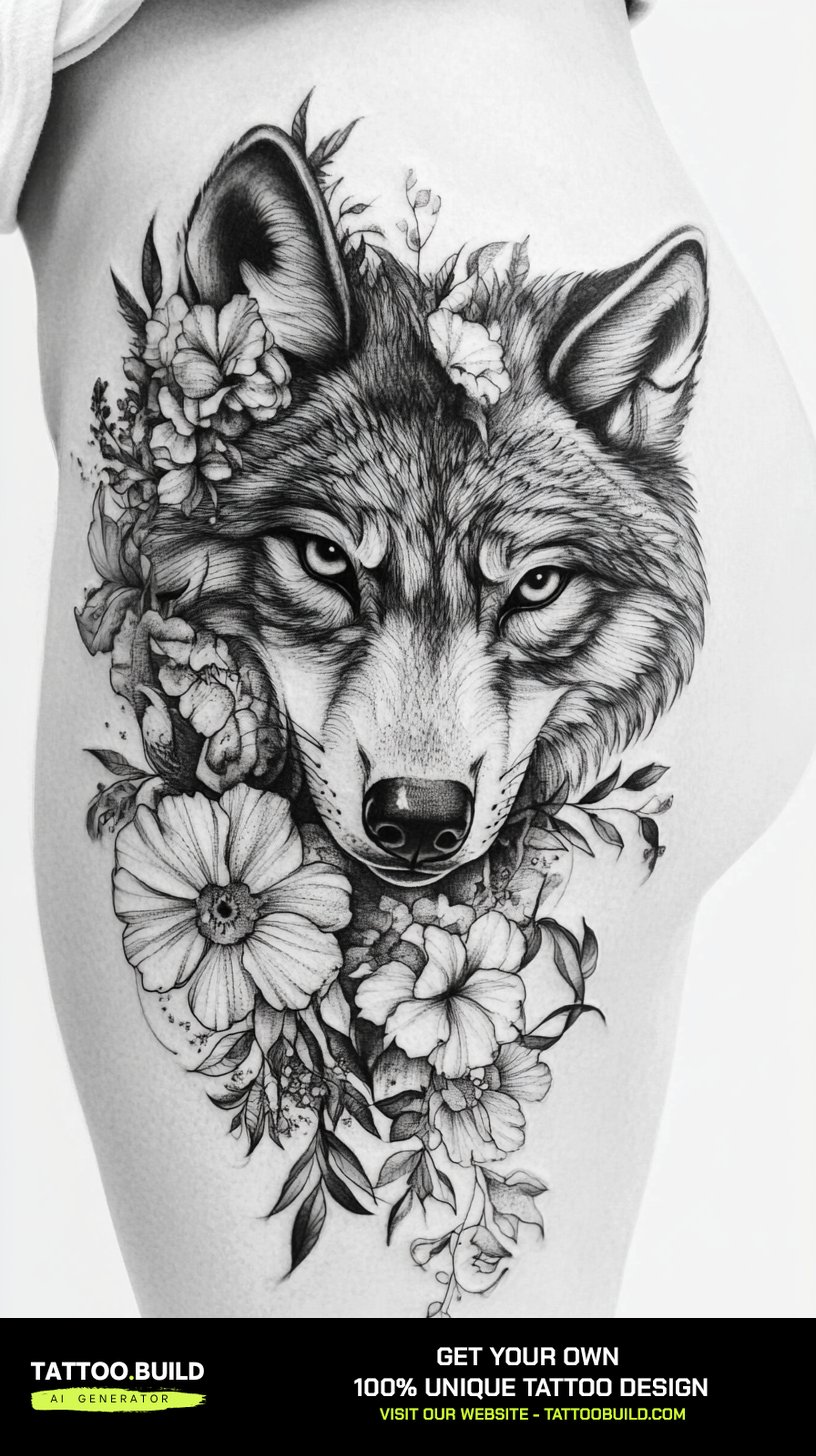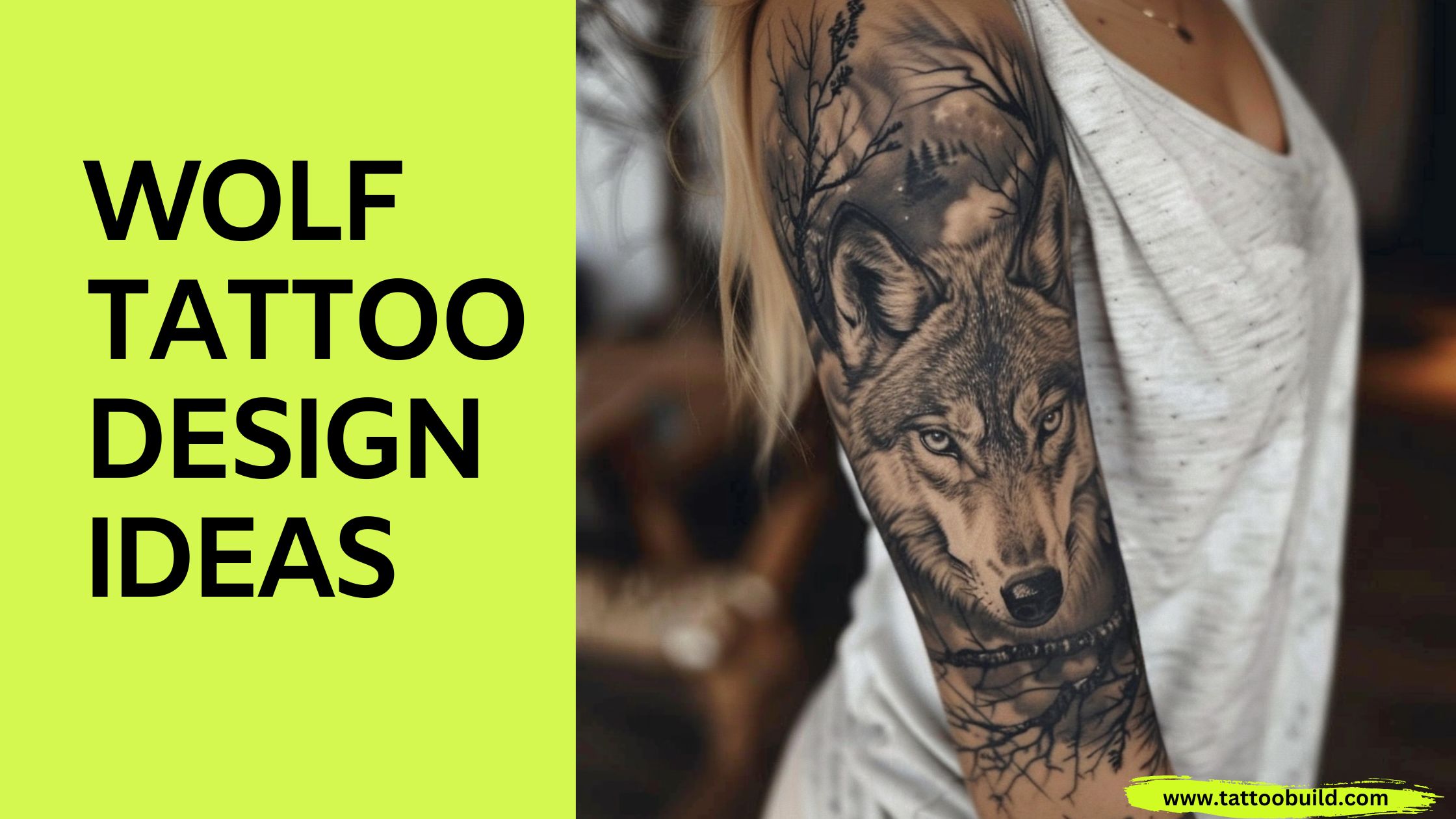
A wolf is one of the few subjects that works at almost any size, in almost any style, on almost any part of the body — and that is exactly why so many of them end up looking generic. The difference between a wolf tattoo you still like in ten years and one you quietly cover is almost never the idea; it is the amount of detail the design tries to hold.
I have spent a long time looking at this category, and the pattern is consistent. The pieces that age badly are the ones crammed with individually rendered hairs, tiny background elements and thin internal lines on a small canvas.
The ones that still read cleanly years later committed to a few strong shapes early and let the artist’s shading carry everything else. If you are still narrowing down the overall direction, the broader wolf tattoo ideas roundup is a useful place to browse before you settle on a style.
What follows is a walk through the wolf tattoo design ideas that actually hold up — what each style demands from your artist, where it sits best on the body, and the specific mistakes that cause regret.
Which Wolf Tattoo Style Is Right for You?
Style choice drives cost, session length and how the piece ages far more than subject matter does. This is the honest version of that trade-off.
| Style | Smallest size that works | Best placement | How it ages | Touch-up demand |
|---|---|---|---|---|
| Black & grey realism | Roughly palm-sized and up | Outer arm, back, thigh | Softens gradually; stays readable if shapes were strong | Low to moderate |
| Geometric / linework | Small, but not tiny | Forearm, calf, shoulder | Lines thicken over time; spacing matters most | Low |
| Tribal / blackwork | Medium | Shoulder, chest, upper arm | Among the most durable options | Very low |
| Watercolor | Medium | Upper arm, shoulder blade, thigh | Colour fades fastest; needs a black anchor | High |
| Fine-line / minimalist | Small | Inner forearm, ankle, ribs | Blurs if lines were placed too close together | Moderate |
| Full-colour illustrative | Medium to large | Outer arm, back, calf | Holds well with saturated, bold colour | Moderate |
If you are torn between two rows, pick the one that needs the least detail. That single rule has saved more wolf tattoos than any other piece of advice I know.
What a Wolf Tattoo Actually Means
Wolves carry a heavier symbolic load than most animal tattoos, and a lot of what gets repeated about them is folklore rather than biology.
The most common reading is loyalty — the idea that a wolf belongs to something larger than itself. That connects the design to a wider family of tattoos that symbolise loyalty, and it is the meaning most people bring to me when they describe a pack piece.
The second reading is independence: the lone wolf, self-sufficient and apart. Both meanings are legitimate, and they can sit in the same tattoo without contradiction.
Worth knowing, though: the “alpha wolf” framing that underpins so many lone-wolf designs is largely a misreading of captive-wolf behaviour. The researcher L. David Mech, who popularised the term decades ago, later argued against it — wild packs are usually family groups led by the breeding parents, as the International Wolf Center explains.
None of that makes your tattoo less meaningful. But if the dominance idea is the whole reason you want the piece, it is worth knowing the story is closer to family than hierarchy — and many people find that reading better anyway.
Wolf Tattoo Design Ideas That Hold Up Over Time
These are the eight directions I see succeed most consistently, with what each one actually asks of you.
Realistic Wolf Portraits
A realistic wolf is the most requested version of this tattoo and the one most often executed badly.
The failure is predictable: the artist tries to draw fur as individual hairs. Real fur in a tattoo comes from shading in clumps and directional gradients, with only a handful of stray hairs picked out at the silhouette edge.
When I compare portraits that healed well against ones that muddied, the well-aged pieces almost always used fewer, larger value shifts. In practice that means booking someone whose healed black-and-grey work you have actually seen — not just fresh photos taken an hour after the needle came out.
Size honestly: below roughly palm-sized, a realistic portrait starts fighting itself. Outer arm, back and thigh give you the flat, low-movement surface this style needs.
Geometric Wolf Tattoos
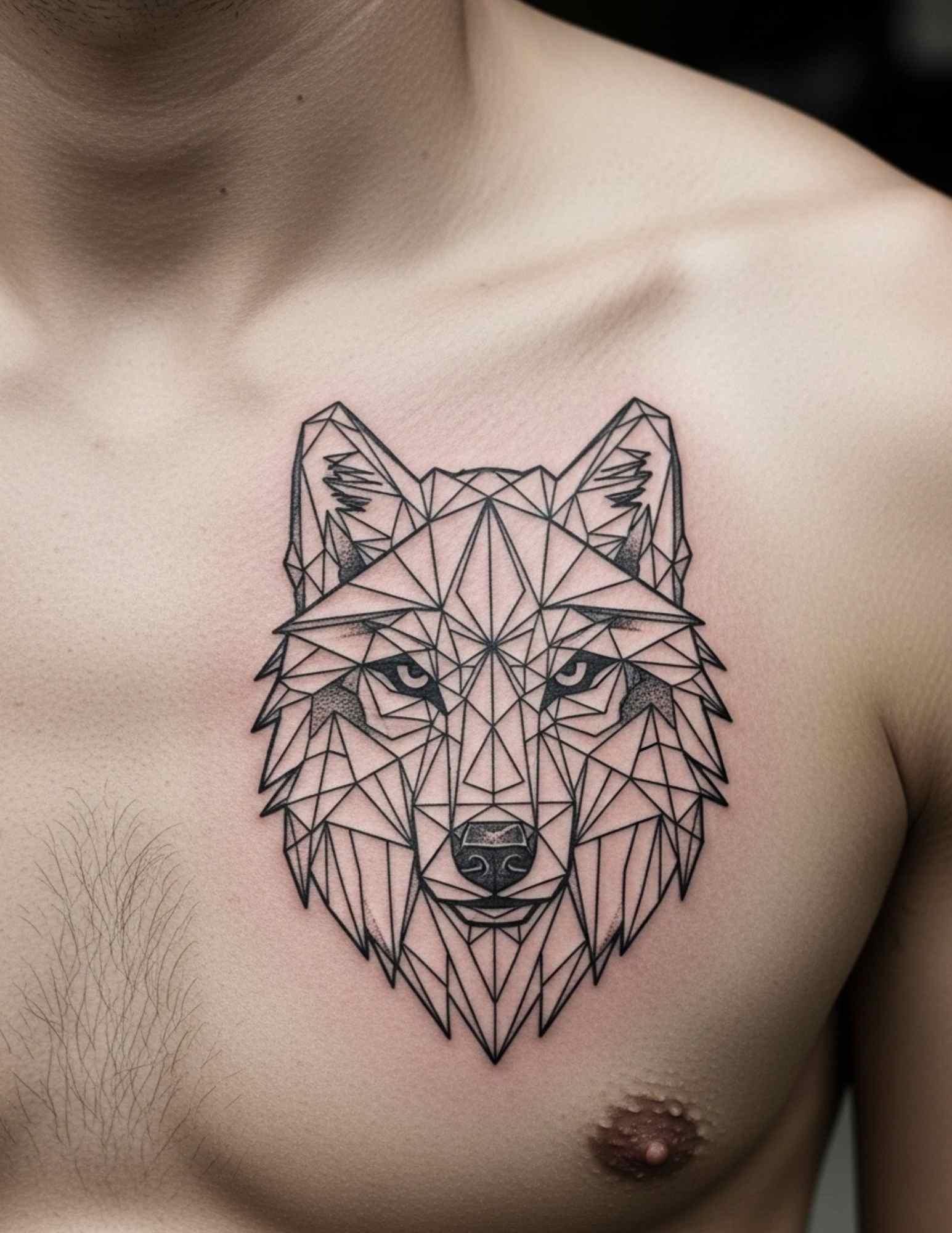
Geometric wolves replace shading with structure — triangles, mandala frames, deliberate negative space.
The appeal is practical as much as aesthetic. Clean linework at a sensible weight is one of the more forgiving things you can put in skin, because there is no delicate gradient to soften.
The one thing that ruins them is line spacing. Lines placed too close together will eventually spread into each other, and a crisp geometric wolf becomes a grey smudge. Every artist I have asked about this gives the same answer: leave more gap than looks right on paper.
If this is the direction you are leaning, the dedicated geometric wolf tattoo ideas collection shows how much variation is possible within the style.
Tribal and Neo-Tribal Wolves
Tribal wolves are built from bold black shapes, solid fill and the skin showing through as negative space.
This is, by some distance, the most durable option on the list. Heavy black holds its edge for decades in a way that fine grey washes simply do not.
Two cautions. First, tribal draws on specific cultural traditions — Polynesian, Haida, Norse — and lifting motifs without understanding them is worth thinking about before you commit. A neo-tribal design that borrows the visual language without claiming the heritage is usually the cleaner choice.
Second, large solid black areas are harder to remove or cover later. That is a real trade-off for the durability. Browsing general tribal tattoo ideas first will help you separate the styles.
Watercolor Wolf Tattoos
Watercolor wolves pair a grounded animal with loose, unbounded colour behind it.
They photograph beautifully. They also fade fastest of anything here, because the technique deliberately avoids the heavy black outline that normally holds pigment in place.
The version that survives keeps a genuine black-and-grey wolf at the centre and treats the colour as a background layer. Pure colour with no dark anchor is the version that looks washed out after a few summers.
Plan for touch-ups and keep it out of direct sun. The wider watercolor tattoo ideas guide covers the technique in more depth if you want to compare approaches.
Wolf designs and the prompts behind them
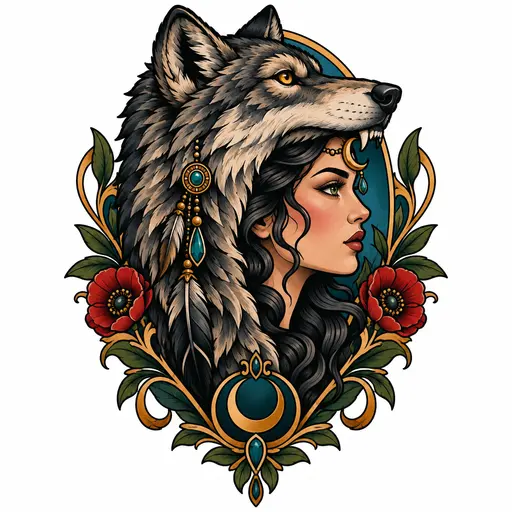
A woman's profile wearing a wolf-head headdress, a jewelled crescent moon on her brow
Use this idea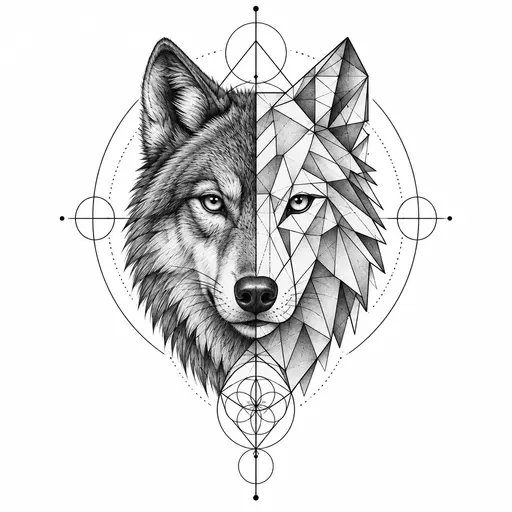
A wolf's head built from triangles and fine linework, one half realistic and the other pure geometry
Use this idea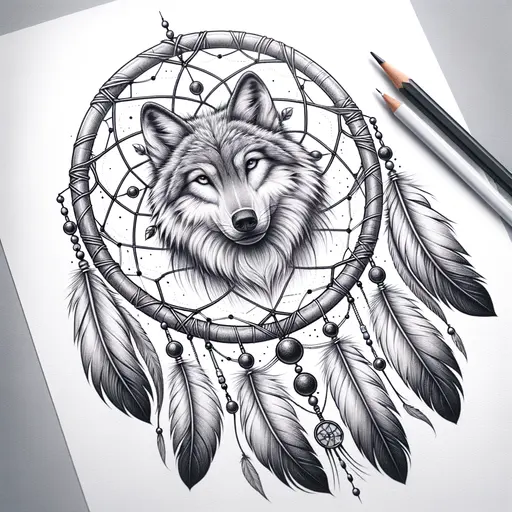
Dream catcher with wolf inside
Use this idea
Lone Wolf Tattoos
A single wolf, usually standing or walking, often with a lowered head.
This is the most personal version of the design and the easiest to get right, because there is only one subject competing for attention.
In my experience the forearm is the best home for it — the vertical run of the arm matches the animal’s proportions, and you see it constantly, which matters more than people expect for a tattoo carrying personal meaning.
Keep the background minimal. A lone wolf with a busy scene behind it stops being a lone wolf.
Wolf Pack Tattoos
Packs are the natural choice for family, siblings or chosen-family meaning.
The compositional problem is depth. Three wolves at the same scale, same darkness and same distance from the viewer read as one shape, not three animals.
Ask your artist to stage them — one in sharp foreground focus, the others lighter and softer behind. That single adjustment is the difference between a pack and a blob.
Packs need room. Back, ribs, thigh or a full outer-arm panel; a pack squeezed onto a wrist will not survive the first decade.
Wolf and Moon Tattoos
The howling wolf against a full moon is the most recognisable composition in the category, and it is popular for a structural reason: the circle of the moon gives the design a natural frame.
That frame is genuinely useful. It contains the piece, it works on round surfaces like the shoulder, and it gives the eye somewhere to rest.
The variation I like most swaps the full moon for a crescent or a phase sequence, which reads as less literal while keeping the same silhouette advantage. The moon tattoo ideas roundup has plenty of options for that half of the design.
One biological footnote worth having: wolves do not howl at the moon. Howling is long-distance communication between pack members, as the National Park Service describes. The image is still a good image — just not a documentary one.
Wolf Eye Tattoos
A tight crop on the eyes, sometimes just one, usually in high-contrast black and grey.
This is the highest-risk design here despite often being the smallest, because everything rests on a narrow band of shading. There is nowhere for a mistake to hide.
When I have seen these work, the artist had a deep black-and-grey realism portfolio and the piece was larger than the client originally wanted. When I have seen them fail, it was a small eye done by a generalist.
If you want this design, it is worth waiting for the right artist rather than taking the next available slot.
Variations and Related Motifs to Consider
If none of the eight core directions fits, these hybrids often solve the problem.
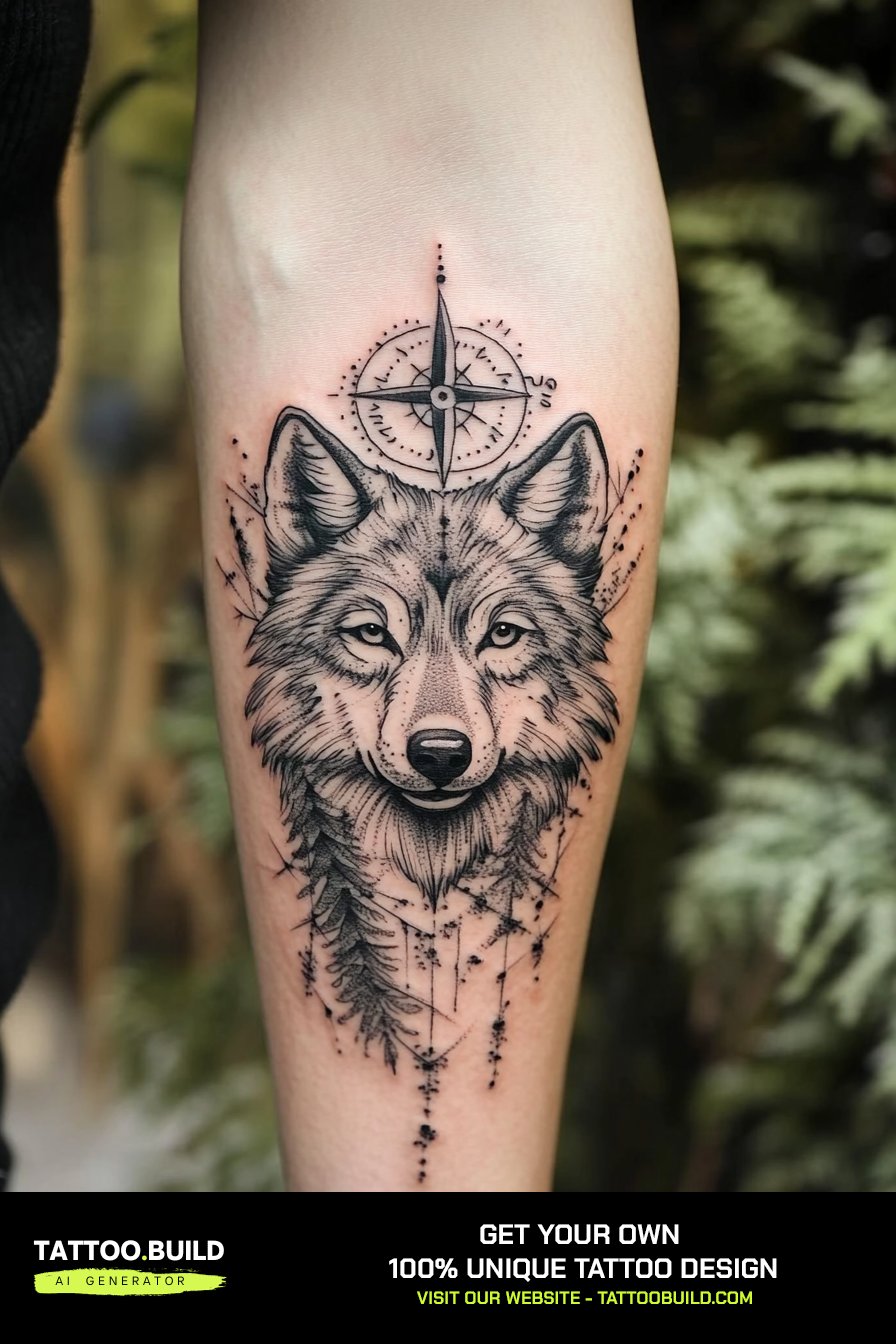
Wolf and Compass
Pairing a wolf with a compass rose shifts the meaning from loyalty toward direction and self-navigation.
It also solves a composition problem: the compass gives a circular anchor beneath or behind the animal, which stops the design drifting on a long limb. The wolf and compass tattoo designs collection shows how the two elements are usually balanced.
Wolf and Dagger
A sharper, more confrontational reading — protection, sacrifice, a threat met head-on.
The dagger adds a strong vertical line, which makes this a natural fit for the forearm or the outside of the calf. There is more on the symbolism in the wolf and dagger tattoo meaning guide.
Minimalist and Fine-Line Wolves
A wolf reduced to a single continuous contour, or a small geometric silhouette.
These age better than almost anything else for one boring reason: there is nothing in them to blur. A design with six lines cannot lose detail it never had.
The trap is placing those few lines too close together, or going so small that a millimetre of natural spread closes the gaps. Ankles, inner forearms and behind the ear all work, provided the design is drawn for that scale rather than shrunk down to fit it.
Nature-Framed Wolves
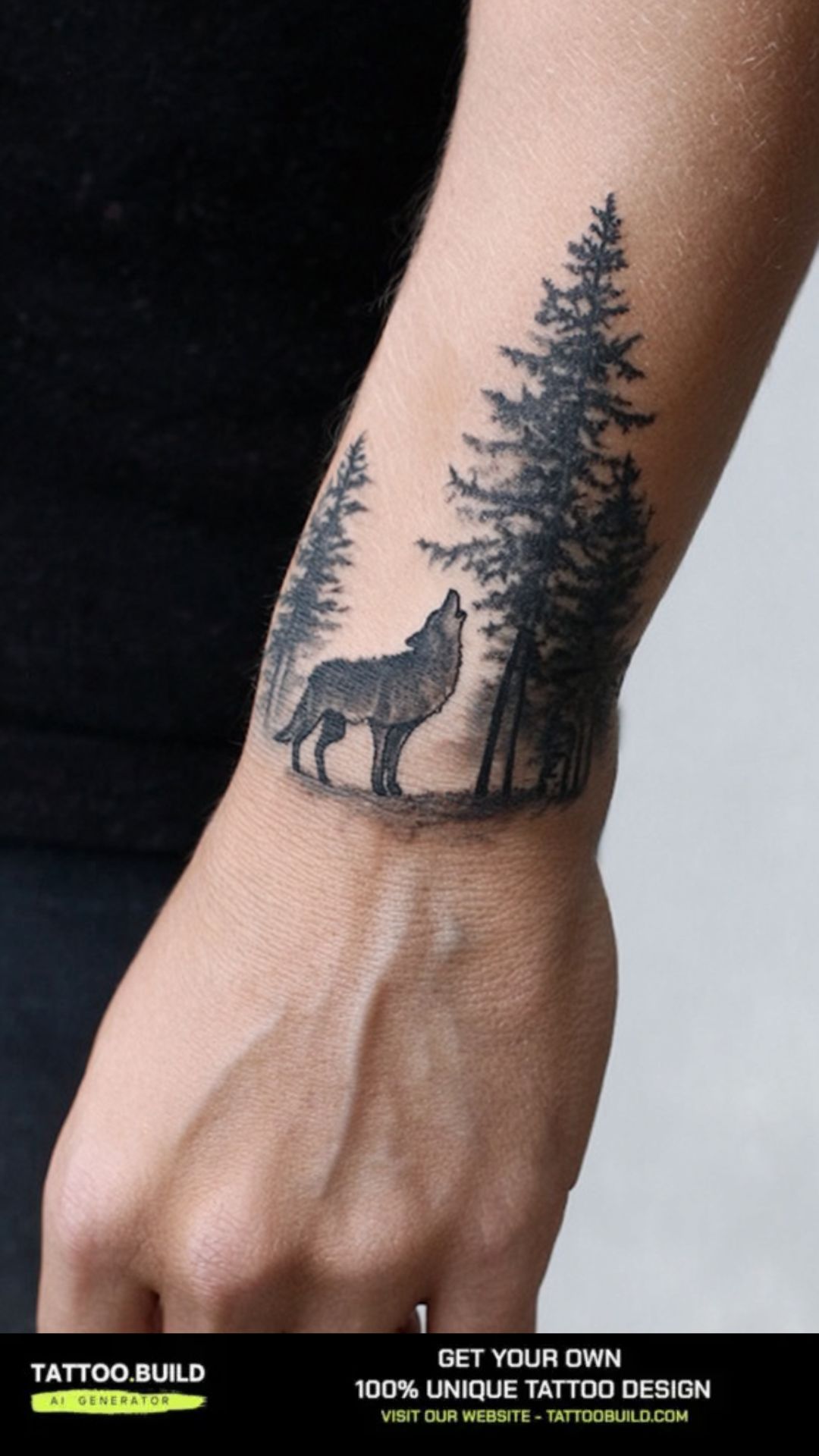
Pines, mountains, mist or a treeline give the animal a place to stand and turn a portrait into a scene.
The rule I would hold to: the background should be lighter and softer than the wolf, always. The moment the forest competes with the animal for contrast, the design loses its subject.
These need real estate. A back piece, a full outer arm or a thigh panel gives the scene room; a compressed version just becomes texture.
Placement, Sizing, and Healing Without Regret
Placement is not just aesthetic — it changes how long the tattoo stays sharp.
Flat, low-friction, low-sun areas hold detail longest: outer arm, back, thigh, calf. High-friction and high-exposure areas — hands, feet, inner wrist — break down detail faster, which matters a great deal for a subject as detail-dependent as a wolf.
On sizing, the guidance I give every time is to add roughly a third to whatever size you first pictured. Nobody I have spoken to regrets going slightly larger; plenty regret cramming a portrait into a space that could not hold it.
Healing is where good work gets undone. Keep it clean, keep it moisturised, and keep it out of the sun — the tattoo aftercare guidance from the American Academy of Dermatology is a solid, non-commercial baseline, and our own tattoo aftercare walkthrough covers the day-by-day version.
If a healing tattoo becomes increasingly painful, hot, swollen or starts weeping after the first few days, that is not part of normal healing. Contact your artist and see a doctor — this article is design guidance, not medical advice, and infections and pigment allergies both need proper care.
Common Mistakes and How to Avoid Them
Four things account for most of the wolf tattoos people end up unhappy with.
Too much detail in too little space. This is the dominant failure. Skin spreads ink slightly over the years, and anything finer than that spread disappears into it.
Choosing an artist by price or availability rather than by style. A brilliant traditional artist is not automatically a brilliant black-and-grey realism artist. Look for healed photos in the exact style you want.
Copying a reference image exactly. A wolf drawn for a flat screen rarely maps cleanly onto a curved limb; a good artist will redraw it for your body, and you should want them to.
Rushing the design stage. Sitting with a drawing for a week costs nothing and catches most regrets. If you are still gathering references, the awesome wolf tattoo ideas gallery is worth a slow scroll before you book.
Frequently Asked Questions
What does a wolf tattoo symbolize?
Most people choose a wolf for loyalty, family or independence, and all three readings are widely recognised. A pack composition leans toward belonging and kinship; a single animal leans toward self-reliance. Some wearers also connect it to protection or to a specific cultural tradition. The meaning that matters most is the one you bring to it, since nobody looking at the tattoo gets the explanation.
Where is the best place to get a wolf tattoo?
The outer arm, back, thigh and calf are the strongest choices for detailed designs, because they are relatively flat, move less and get less sun. Small or minimalist wolves work well on the inner forearm, ankle or behind the ear. Hands, feet and inner wrists tend to break down fine detail faster. Your artist should pick placement partly based on how the design’s shape fits the body’s natural curves.
Do wolf tattoos hurt more than other tattoos?
Not because of the subject — pain depends on placement and session length, not on what is being drawn. Areas over bone or with thin skin, such as the ribs, sternum, ankles and inner arm, are generally reported as more painful than fleshier areas like the outer arm or thigh. Because detailed wolf portraits take longer, the total discomfort can be higher simply from time in the chair. Splitting a large piece across sessions usually makes it much easier.
How much does a wolf tattoo cost?
Pricing varies enormously by region, artist experience and studio, so any specific figure would be misleading. Most artists charge either an hourly rate or a flat price per piece, and detailed realism takes substantially more hours than linework or minimalist designs. The practical approach is to send your reference and placement to two or three studios and compare quotes. Expect a deposit, and expect the best artists to have a waiting list.
Are wolf tattoos only for men?
No — that association is a marketing habit rather than anything real. Fine-line, watercolor, floral-framed and minimalist wolves are extremely common across all genders. The style, scale and placement shape how a wolf tattoo reads far more than the subject does. Pick the version that matches how you want to look, not what a search result thinks the category is for.
Quick Summary
- Choose the style before the pose — it drives cost, session length and how the piece ages.
- Less detail almost always ages better; when torn between two designs, take the simpler one.
- Realistic portraits need real size, a flat surface and an artist with healed black-and-grey work in their portfolio.
- Tribal and blackwork are the most durable options; watercolor is the least, and needs a black anchor plus touch-ups.
- Pack designs only work when the wolves are staged at different depths and contrast levels.
- Add about a third to your first size estimate — almost nobody regrets going slightly larger.
- Keep the tattoo clean, moisturised and out of the sun while healing; see a doctor if pain, heat or swelling increases after the first few days.
- Sit with the drawing for a week before committing. It costs nothing and prevents most regret.