The wolf and compass pairing is one of the few tattoo combinations that still makes sense years after you get it. A wolf stands for who you are; a compass stands for where you are headed – and together they read as a single sentence about staying yourself while you find your way.
I have watched this design go through three or four fashion cycles now, and it keeps coming back because the meaning does not depend on a trend. It depends on you.
What follows is everything I have learned from looking at hundreds of these pieces, talking to artists about which versions heal well, and watching which ones still look sharp after five or ten years. If you are still deciding on the animal half, it is worth browsing broader wolf tattoo ideas first to see which wolf expression actually feels like you.
Below you will find style comparisons, real design breakdowns, placement advice, and honest notes on what tends to go wrong.
Which Wolf and Compass Style Is Right for You?
Style matters more than subject matter here. The same wolf and compass concept looks completely different depending on the technique your artist uses, and each one ages differently.
| Style | Best Size | Typical Sitting | How It Ages | Best For |
|---|---|---|---|---|
| Black & grey realism | 6 inches or larger | 4-8 hours, often two sessions | Softens gradually; needs solid contrast to hold | Upper arm, thigh, back |
| Geometric / linework | 4-8 inches | 2-5 hours | Very well if lines are not crowded | Forearm, calf, chest |
| Dotwork / stippled | 5 inches or larger | 3-6 hours | Lightens over time; dots can merge if packed tight | Forearm, shoulder |
| Fine line / minimalist | 2-4 inches | 1-2 hours | Most likely to need a touch-up within a few years | Inner forearm, wrist, ribs |
| Traditional / bold line | 4-7 inches | 2-4 hours | Best long-term readability of any style here | Outer arm, calf, shoulder |
| Neo-traditional colour | 5-9 inches | 4-7 hours | Colour fades unevenly; sun exposure is the main factor | Thigh, upper arm, back |
If you are torn, the honest advice from most artists I have asked is the same: pick the style you would still want if the meaning stopped mattering, because the style is what you look at every day.
What the Wolf and Compass Actually Symbolize Together
Wolves carry a long and genuinely mixed reputation. Across folklore and mythology worldwide they appear as guardians, outcasts, mothers, and threats – sometimes all within the same culture.
That range is exactly why the wolf works so well in tattooing. It can mean loyalty and family, or independence and solitude, depending entirely on how you pose it.
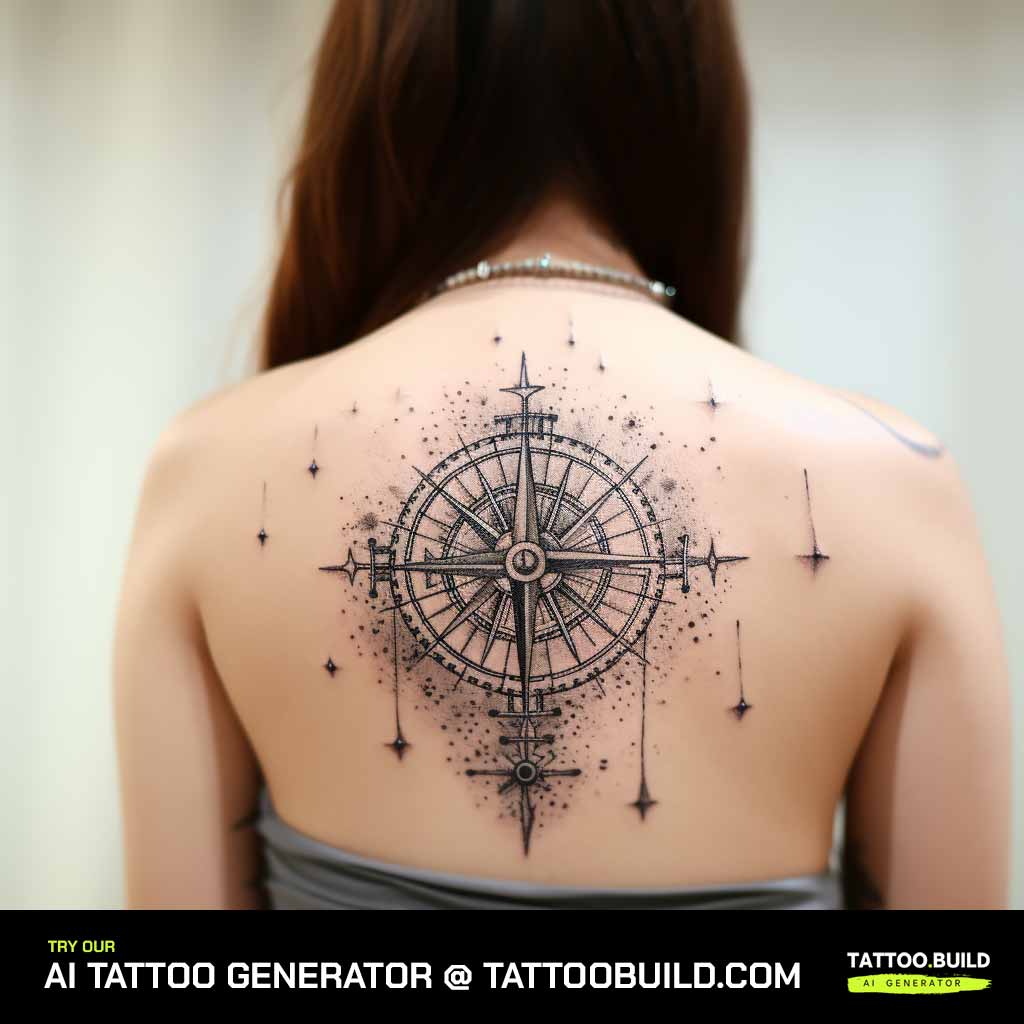
The compass is more literal. The compass rose has been used on maps and charts for centuries as a way of fixing direction, and that meaning has stayed remarkably stable in tattoo work: finding your way, coming home, not losing yourself.
Put them together and you get a tension worth wearing. The wolf is instinct; the compass is intention. Most people who wear this design are somewhere between the two.
In my experience the pieces that land hardest are the ones where the wearer picked a side. A wolf dominating the composition reads as instinct-first. A compass dominating it reads as someone who has consciously chosen a direction. Splitting them 50/50 is the safe option, but it is also the least specific one. If you want to go deeper on the second half of the symbolism, the guide to compass tattoo meaning covers the variations in detail.
Wolf and Compass Tattoo Designs Worth Considering
These are the arrangements I see working again and again, grouped by what actually differentiates them rather than by vague style labels.
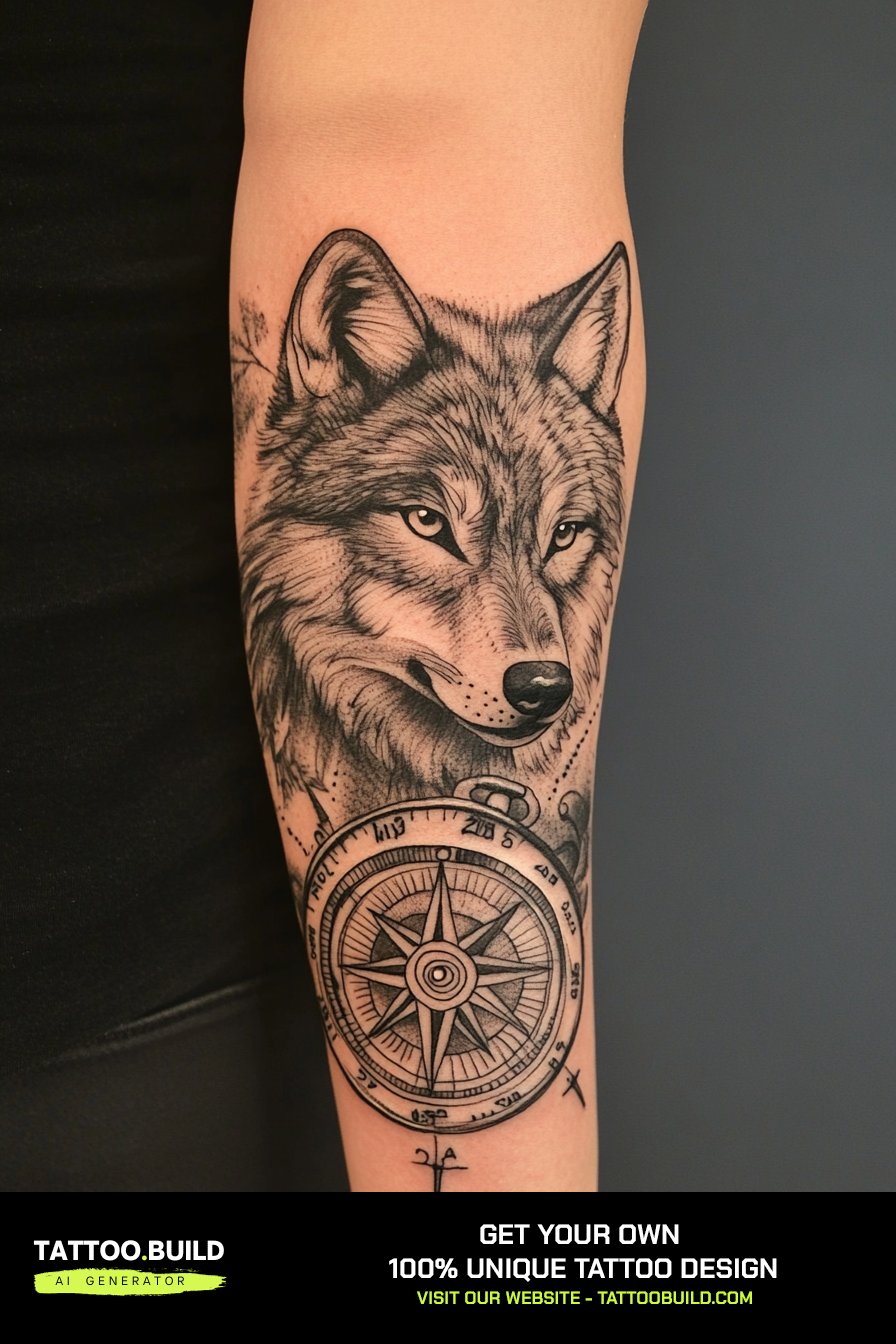
1. Wolf Head Inside the Compass Rose
This is the default version, and there is a reason it stays popular: the circular compass frame gives the wolf portrait a natural border, which solves the hardest compositional problem in one move.
The frame also stops the design from spreading. When I have seen this go wrong, it is almost always because the wolf was drawn too large for the circle and the compass points got squeezed into decoration.
Ask your artist to draw the compass first and fit the wolf to it, not the other way round. The proportion that tends to work is a wolf occupying roughly the inner two-thirds of the dial, leaving the points clean.
This layout suits round placements best – outer shoulder, upper arm, the flat of the chest, or the front of the thigh.
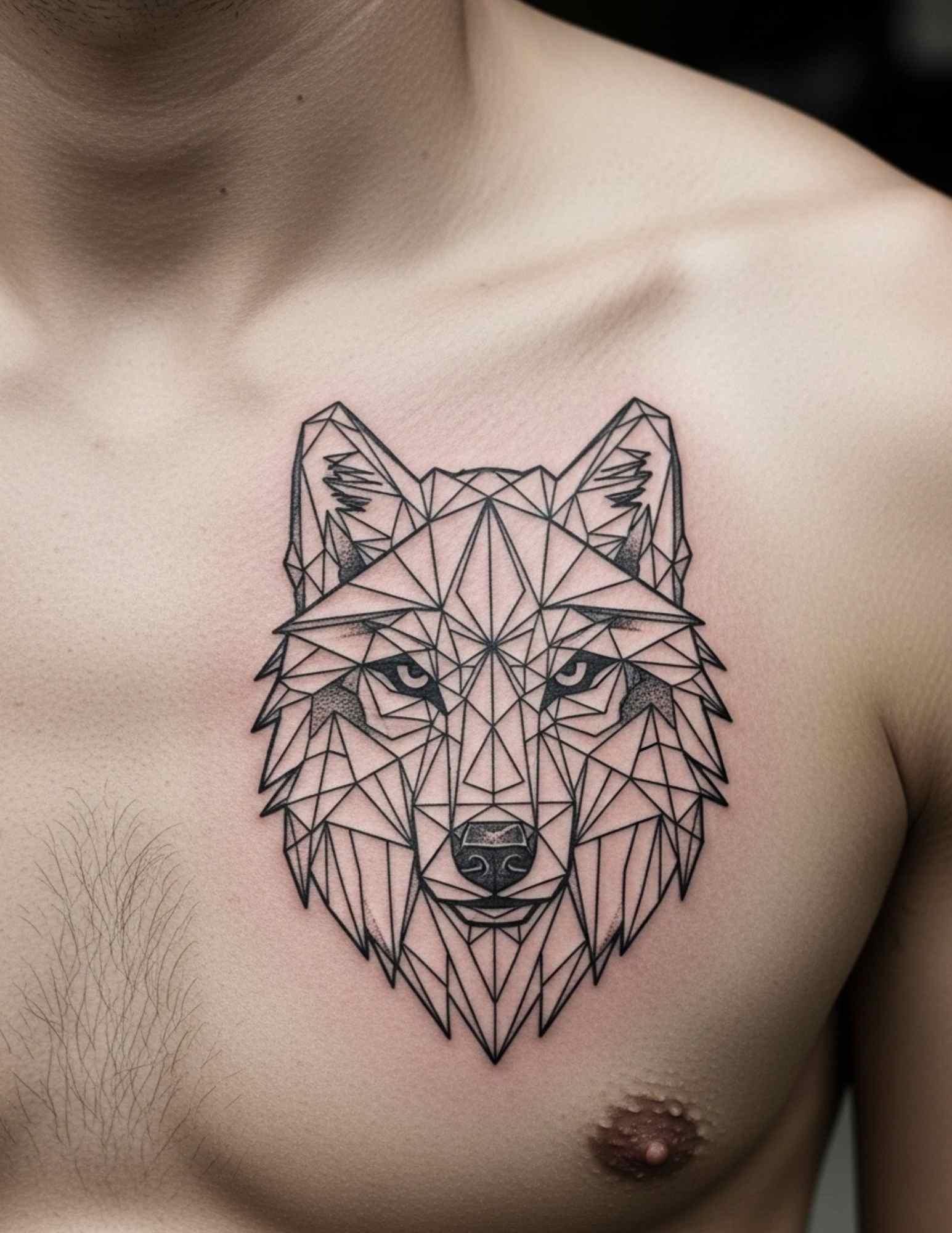
2. Geometric Wolf and Compass
Geometric versions break the wolf into angular planes that visually rhyme with the compass points, so the two halves feel designed together rather than glued together.
The strength of this style is longevity. Clean straight lines with breathing room between them hold their shape better over a decade than dense shading does.
The weakness is that geometry is unforgiving. A wobble in a straight line is obvious in a way that a wobble in fur texture never is, so this is a style where the artist matters more than the design.
Every artist I have asked about this style says the same thing: bring reference, then let them redraw it to fit your anatomy. Straight lines wrapping a curved limb need adjusting on the stencil. There is a whole gallery of geometric wolf tattoos worth studying before you commit.
3. Black and Grey Realism
Realistic wolf portraits paired with a detailed brass compass produce the most dramatic version of this idea – and the most demanding one.
Realism needs size. A photorealistic wolf eye squeezed into three inches will blur within a few years because the tonal steps are simply too small to survive skin healing.
When I tested this reasoning against artists who specialise in black and grey, the number that kept coming up was six inches minimum for a portrait, and larger if the compass is going to carry real detail too.
Budget for two sessions. Most realism pieces at this scale are outlined and blocked in on day one, then refined once the skin has settled.
4. Fine Line and Minimalist Versions
The minimalist take strips the design to a single continuous outline of a wolf and a simple four-point compass, often no larger than a business card.
These are the most wearable option if you work somewhere conservative or you simply want something quiet. They also hurt the least and cost the least.
The honest trade-off: fine line work is the most likely of any style here to need a touch-up. Thin lines have less pigment in them, so any that sit slightly too shallow will fade sooner.
I would still get one – just go in expecting a possible refresh rather than feeling let down by it. If small is the direction you are leaning, the minimalist tattoo ideas collection is a good sanity check on scale.
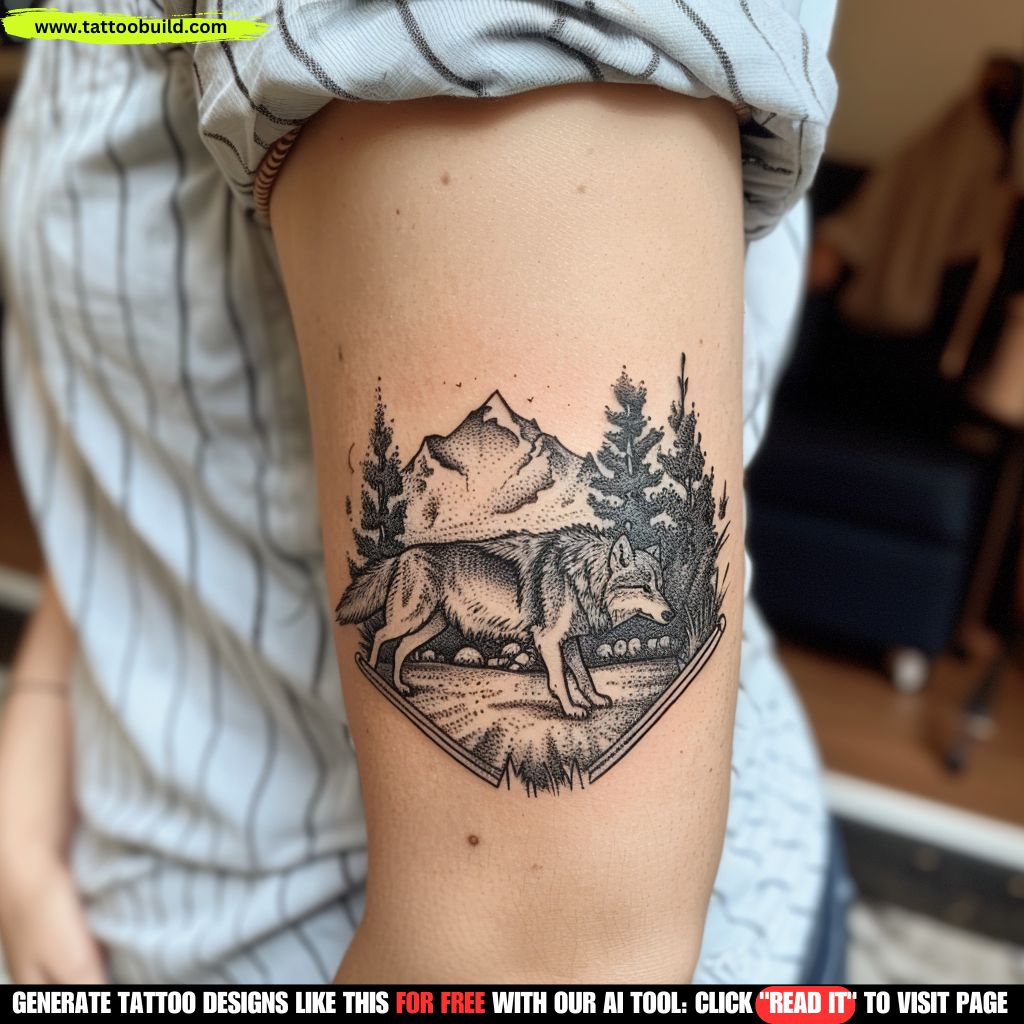
5. Wolf, Compass and Landscape Scenes
Adding mountains, pines, or a treeline behind the compass turns the tattoo from a symbol into a scene, and it is the version people seem to bond with most.
The reason is specificity. A generic compass means “direction”; a compass over a skyline that looks like the range you grew up beside means something only you can explain.
Composition-wise, keep the landscape as background value only. The moment the mountains get the same contrast as the wolf, the eye has nowhere to rest and the piece reads as busy.
This version scales upward beautifully, which is why it so often becomes the centrepiece of a larger sleeve. Pairing it with mountain tattoo ideas is the usual next step.
6. Nordic and Viking-Influenced Designs
Norse-flavoured versions swap the nautical compass rose for a vegvisir-style stave and give the wolf a heavier, more graphic treatment.
Worth knowing before you commit: the vegvisir comes from a nineteenth-century Icelandic manuscript, not the Viking Age itself. It is a genuinely old symbol, just not as old as it is usually sold as being.
That does not make it a bad choice. It just means you should wear it because you like what it stands for, not because of a history that will not hold up if someone asks.
Bold weight suits this style. Thin, delicate linework fights the visual language it is borrowing from. If this direction appeals, the wider set of Norse mythology tattoo ideas will show you how the motifs are usually combined.
7. Dotwork and Heavy Blackwork
Dotwork builds tone out of thousands of individual points, which gives the compass dial a soft, engraved quality that solid shading cannot match.
It is slow work. Expect a longer sitting than a shaded piece of the same size, and expect your artist to quote accordingly.
The main risk is density. Dots packed too tightly can blur into a flat grey patch over the years, so the good artists deliberately leave more space than looks right when it is fresh.
Trust that instinct if your artist raises it – the piece is being drawn for how it will look in ten years, not for the photo on day one. See how the technique behaves across subjects in this dotwork tattoo roundup.
Placement Options and Design Variations
Where the tattoo goes changes the design more than most people expect, because the shape of the space dictates the shape of the composition.
Forearm – The Most Common Choice
The inner and outer forearm both suit a vertical stack: compass below, wolf above, or the reverse. The space is roughly rectangular, so circular designs need a little stretching to fill it.
Forearms also heal quickly and are easy to keep clean, which makes them a sensible first placement. Browse forearm tattoo ideas for a sense of how much detail fits comfortably.
Upper Arm and Shoulder
The rounded shoulder cap is the natural home for a circular compass composition – the frame and the muscle curve reinforce each other.
It is also one of the less painful areas for most people, and it stays covered under a t-shirt, which matters more to some readers than they admit at the consultation.
Back and Chest
Large flat areas let realism and landscape versions breathe. A back piece can carry a full mountain range without the compass losing its focus.
The trade-off is obvious: you will rarely see it yourself, and healing a back piece alone is genuinely awkward.
As Part of a Sleeve
A wolf and compass works well as the anchor image of a sleeve, with filler like forest, smoke, or clouds connecting it to the rest.
If a sleeve is where this is heading, plan the whole layout before the first session rather than adding pieces one at a time. Retro-fitting a sleeve around an existing tattoo is the most common regret I hear about. The half sleeve tattoo gallery is a useful planning reference.
Practical Tips and Aftercare
The design decisions are the fun part; the healing is what determines whether it still looks good in five years.
Follow the aftercare instructions your artist gives you over anything you read online, including this article – they know what ink and technique they used on your skin. In general that means keeping the area clean, moisturised, out of the sun, and out of pools, lakes, and baths until it has fully closed.
Watch for the difference between normal healing and a problem. Redness, mild swelling, and flaking in the first week are expected. Spreading redness, heat, pus, or a fever are not, and they are reasons to contact a doctor rather than wait it out. The American Academy of Dermatology publishes plain-language guidance on caring for tattooed skin that is worth reading before your appointment, not after.
One practical point that gets overlooked: book your session when you have a few quiet days afterwards. A fresh forearm piece and a week of heavy manual work do not mix, and rushing the healing is the easiest way to lose line quality you paid for.
Still Not Sure? Common Mistakes to Avoid
Almost every disappointing wolf and compass tattoo I have seen failed for one of a handful of reasons, and none of them were about talent.
Going too small for the detail. This is the big one. A design that looks crisp on a screen at 1,000 pixels wide is being reproduced at two inches on skin that moves – detail has to be removed, and if it is not, it turns to mush.
Bringing a finished drawing and refusing to let the artist change it. Reference is helpful; a locked design is not. Artists adjust for anatomy, and that adjustment is most of what you are paying for.
Choosing an artist by price rather than by portfolio. Look specifically for healed photos in the style you want – fresh work flatters everyone. A specialist in linework tattoos and a specialist in realism are not interchangeable.
And the quiet one: rushing the decision. If you have wanted this design for more than a few months, that is a good sign. If you thought of it last weekend, another month of thinking costs nothing.
Frequently Asked Questions
What does a wolf and compass tattoo mean?
Broadly, it combines the wolf’s associations – loyalty, family, instinct, independence – with the compass’s association with direction and finding your way. Most wearers read it as staying true to who they are while navigating a change in life. The specific meaning is genuinely personal, and two people with near-identical designs often explain them completely differently. There is no fixed or traditional definition you have to follow.
How much does a wolf and compass tattoo cost?
It depends far more on your artist’s hourly rate and your city than on the design itself, so any figure quoted online is close to meaningless. A small fine line version might be a single short sitting; a detailed realism piece can run to two full days of work. The reliable approach is to email two or three local artists with your reference, your rough size, and your placement, and compare their quotes. Most will give you a range without charging for the consultation.
How big does the tattoo need to be?
For a simple linework or minimalist version, three to four inches is usually enough. For realism, most artists I have asked put the practical minimum around six inches for the wolf alone, because smaller than that the tonal detail closes up as it heals. If your artist tells you your design needs to be bigger than you planned, that advice is almost always worth taking. Shrinking a detailed design is the single most common cause of disappointment with this subject.
Does a wolf and compass tattoo suit women as well as men?
Yes, and the idea that it is a masculine design is mostly a leftover from how it used to be marketed. The style choice does far more work than the subject: a fine line wolf with a delicate compass rose reads very differently from a heavy blackwork version. Placement shifts it too – a spine, ribcage, or inner forearm piece has a completely different feel from an outer bicep. Pick the treatment you like and ignore the category.
How long does a wolf and compass tattoo take to heal?
The surface usually closes within two to three weeks, but the deeper layers keep settling for a couple of months, which is why a tattoo can look slightly cloudy before it sharpens up again. Avoid judging the final result until at least the six-week mark. Sun exposure during that window is the fastest way to damage a new piece, so keep it covered. If anything looks or feels wrong rather than simply itchy, ask your artist or a doctor rather than guessing.
Quick Summary
- The wolf carries identity and instinct; the compass carries direction – together they read as one idea, not two.
- Choose your style before your design. Style is what you look at daily and what determines how the piece ages.
- Realism needs roughly six inches or more; fine line works small but is the most likely to need a touch-up.
- Geometric and bold-line versions hold up best over a decade because they leave space between the lines.
- Adding a landscape makes the tattoo specific to you, but keep it lower in contrast than the wolf.
- Circular compositions suit shoulders and thighs; vertical stacks suit forearms and calves.
- Going too small for the level of detail is the most common regret with this subject.
- Follow your artist’s aftercare instructions, and treat spreading redness, heat, or fever as a reason to see a doctor.