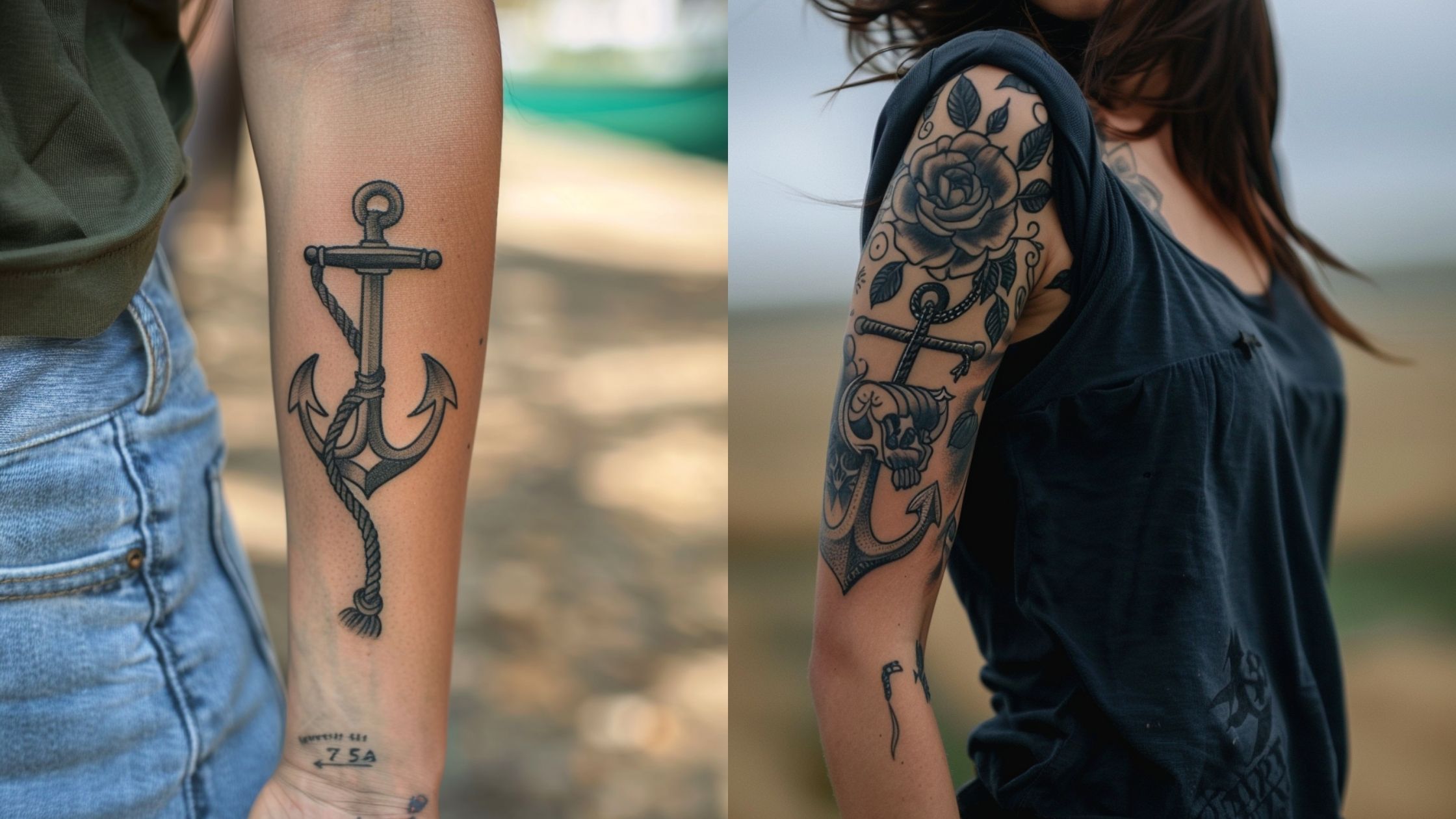
An anchor is one of the few tattoo symbols that has never really gone out of fashion, and after years of looking at these designs I think I know why. An anchor works because it says something specific – hold steady – without needing a single word of explanation.
I have watched women walk into studios asking for something small and meaningful and walk out with an anchor more often than almost any other motif. It is legible at two inches and it is still interesting at twelve.
This guide collects the anchor tattoo ideas for females that I keep coming back to, grouped by style rather than by size, so you can find the version that fits your body and your reasons. If you want the symbolism unpacked properly first, our piece on what an anchor tattoo symbolizes goes deeper than I will here.
Everything below is my own read from studio visits and conversations with artists. Prices, healing and placement advice vary by person – treat this as a starting point, not a rulebook.
Which Anchor Tattoo Style Is Right for You?
Style choice matters more than size. A fine-line anchor and a realistic anchor age completely differently, even on the same arm.
| Style | Best Size | Typical Sitting | How It Ages | Suits You If |
|---|---|---|---|---|
| Minimalist / fine line | 1-3 inches | 30-60 minutes | Lines soften; may need a touch-up in a few years | You want something discreet and quick |
| Solid black silhouette | 2-5 inches | 1-2 hours | Excellent – the most forgiving option | You want it to still look sharp in twenty years |
| Traditional / old school | 3-6 inches | 2-3 hours | Very well – bold lines were designed for it | You like the sailor heritage of the symbol |
| Watercolour | 3-6 inches | 2-4 hours | Softest edges of any style; needs sun care | You want colour and movement over precision |
| Black and grey realism | 5 inches and up | 4+ hours, often multiple sessions | Good if contrast is strong; grey wash can flatten | You want a centrepiece, not an accent |
| Anchor with florals | 4-8 inches | 3-5 hours | Depends on linework weight | You want the symbol softened rather than stark |
Why the Anchor Still Means Something
The anchor is old iconography. It shows up in early Christian art as a symbol of hope long before it was ever a sailor’s tattoo, which is part of why it carries weight for people who have no connection to the sea at all.
In maritime tattoo tradition it marked experience – crossing an ocean, surviving a crossing, having somewhere to come back to.
Most of the women I have spoken with are using it in that second sense. It marks a person, a place or a period they held on through.
That flexibility is the symbol’s real strength. It reads as steady and grounded to a stranger, and it can mean something far more specific to you without being obvious about it.
It also sits comfortably in a wider nautical family. If the anchor itself feels too literal, browsing ocean tattoo ideas often turns up a gentler way into the same theme.
Anchor Tattoo Ideas for Females, by Style
The designs below are grouped the way I would actually shortlist them with a client – by what the tattoo is doing, not just what it looks like.
1. Celestial Anchors With Planets and Stars
This is the pairing I have seen grow fastest over the past few years, and it makes sense. An anchor holds you down; planets and orbits pull outward.
The tension between the two is the design. Artists usually keep the anchor solid and the celestial elements thin, so the eye knows where to land first.
It works well on the forearm and outer bicep, where there is a long vertical run for orbit lines. Ask your artist to keep the planets at least a few millimetres apart – fine lines that sit too close tend to blur together as they heal.
If you like the symbolism of navigation more than the anchor itself, our guide to compass tattoo meanings covers the closest alternative.
2. Minimalist and Silhouette Anchors
If you only take one piece of advice from this article, take this one: a simple, solid anchor is the safest tattoo on this entire page.
Every artist I have asked about longevity says the same thing – bold shapes and clean negative space outlast fine detail, every time.
Minimalist versions sit well on the wrist, ankle, behind the ear and along the ribs. They heal fast and they are easy to cover for work.
The trade-off is that there is nowhere to hide a shaky line. A small anchor is a test of the artist, not of the design. Look specifically at healed photos of their small work, not fresh ones.
For more designs in this register, we have a whole collection of small meaningful tattoos for women.
3. Anchors With Flowers and Watercolour
Wrapping florals through an anchor is the most common way women soften the symbol without losing it.
Roses are traditional. Peonies, wildflowers and forget-me-nots show up constantly in modern versions, and the last of those carries its own memorial meaning for a lot of people.
Watercolour takes it further – loose washes of blue and pink that spill past the linework on purpose.
I will be honest about the limitation here. Watercolour without a strong black structure underneath tends to lose definition fastest of any style, and it is the least forgiving of sun exposure. If you want colour, insist on a solid black skeleton beneath it.
4. Back and Spine Anchors
A vertical anchor down the spine is one of the most elegant placements available, because the shape and the body agree with each other.
The upper back gives an artist room to work at a size where detail actually survives, and it is completely coverable.
Spine work is genuinely uncomfortable for most people – thin skin directly over bone. Plan for a shorter session than you think you can handle.
5. Thigh Anchors
Thigh placement is my quiet favourite for larger anchors. There is space, the skin takes detail well, and it fades more slowly than sun-exposed areas.
It also means you can go decorative – rope, chain, florals filling the negative space – without the piece feeling crowded.
Sitting for a thigh piece is usually easier than an ankle or rib piece of the same size. If it is your first larger tattoo, this is a forgiving place to start.
There is more on placement and composition in our guide to thigh tattoos for women.
6. Realistic Black and Grey Anchors
Realism turns the anchor into an object rather than a symbol – rusted metal, weathered rope, real weight.
These need size. Below about five inches the shading collapses into a grey smudge as it settles, which is the single most common disappointment I hear about with realism.
The pieces that hold up are the ones with genuinely dark shadows. Grey-on-grey looks beautiful in the chair and vanishes over a decade.
Expect multiple sessions and expect to book a specialist. Realism is the one style where the artist matters more than the design.
7. Anchors With Skulls and Sleeve Work
Skull and anchor is old-school iconography that has been reclaimed hard by women in the last decade, and at sleeve scale it looks bold rather than grim.
The trick with sleeve work is cohesion. Separate elements only read as one tattoo when the shading language is consistent across all of them.
If you are building toward a sleeve, tell your artist at the first session – background and flow are much harder to retrofit around finished pieces.
8. Anchors With Ships, Planes and Travel Motifs
Anchor plus ship is the fullest version of the story: the thing that moves and the thing that holds.
The plane variation has become its own category – usually marking two homes, two countries, or two people in different places.
Rigging and fine ship detail is demanding work. Ask to see healed photographs specifically, because fresh rigging looks crisp on everyone.
For more in this direction, see our ship tattoo ideas and, if you want the coastal-landmark version, lighthouse tattoo ideas for women.
9. Underwater Anchors With Bubbles
Bubbles are the cheapest trick in nautical tattooing and one of the most effective – they imply water without you having to commit to drawing waves.
A rising trail of dots also gives the composition a natural line, which helps a small anchor sit properly on a curved limb.
Dot-work bubbles keep the whole piece light, which is useful if you want nautical without anything heavy.
Alternatives and Variations Worth Considering
If you love the meaning but the anchor shape itself is not clicking, these carry similar weight.
The Compass
Where the anchor says hold steady, the compass says find your way. It is the most common substitution I see, and it suits circular placements like the shoulder or inner forearm better than an anchor does.
The Lighthouse
A lighthouse carries guidance and safety rather than stillness. It also gives an artist a vertical subject with built-in contrast.
The Ship’s Wheel
Control and direction, in a shape that fills a circle cleanly. Often paired with an anchor rather than replacing it.
The Anchor Paired With an Animal
Swallows, sharks and sea turtles all pair naturally with anchors and shift the meaning. The shark and anchor combination in particular has its own distinct symbolism.
Aftercare and Practical Advice
Follow the aftercare instructions your artist gives you over anything you read online, including this article – they know what they used on your skin.
In general terms, a new tattoo is an open wound. Keep it clean, keep it moisturised rather than soaked, and do not pick at flaking skin no matter how much it itches. The American Academy of Dermatology has clear guidance on caring for tattooed skin that is worth reading before your appointment.
Sun is the single biggest factor in how your anchor looks in ten years. Once it is fully healed, sunscreen on it whenever it is exposed – this matters most for watercolour and fine-line work.
Redness and soreness for a few days is normal. Spreading redness, heat, pus, fever or a rash that appears weeks or months later is not – see a doctor rather than waiting it out. Reactions to tattoo ink are uncommon but real, and the FDA maintains a fact sheet on tattoos and permanent makeup covering the known risks. Never attempt to tattoo or remove a tattoo yourself.
Still Not Sure? Common Mistakes to Avoid
The mistake I see most often is choosing the size before choosing the style. A realistic anchor at two inches will not work, no matter how good the artist is.
The second is picking a placement for how it photographs rather than how it lives. Hands, feet and inner fingers fade fastest and need the most touch-ups.
The third is bringing a reference image and expecting an exact copy. Good artists will adapt a design to your body, and that adaptation is usually what makes it look right on you.
If you are still weighing placement, our roundup of forearm tattoo ideas for females is a useful comparison point, and it is worth reading what dermatologists say about skin reactions before you commit.
Frequently Asked Questions
What does an anchor tattoo mean for a woman?
For most women I have spoken with, an anchor stands for stability, resilience and the person or place that keeps them grounded. It carries an older meaning too – hope, in early Christian symbolism, and sea experience in sailor tradition. The meaning is genuinely personal, which is part of the appeal. Nobody reading it on your arm learns anything you did not choose to tell them.
Where is the best place for a female anchor tattoo?
It depends on the size and style you want. Small minimalist anchors work beautifully on the wrist, ankle, ribs or behind the ear, while larger detailed pieces need the thigh, forearm, upper back or shoulder. Spine placement suits the anchor’s vertical shape but is one of the more uncomfortable spots. Avoid hands and feet if you want to minimise touch-ups.
How much does an anchor tattoo cost?
Prices vary enormously by country, city and artist reputation, so any figure I gave you would be misleading. What is consistent is the structure – most studios have a shop minimum for small work and charge by the hour or by the piece above that. Get a quote in person, and be wary of anyone dramatically cheaper than everyone else in your area.
Do anchor tattoos hurt?
The design does not determine the pain – the placement does. Fleshy areas like the outer thigh and upper arm are generally the most tolerable, while ribs, spine, ankle and anywhere directly over bone are noticeably sharper. Most people describe a small anchor as very manageable. If you are anxious about it, book a short first session rather than a full sleeve.
Will a fine-line anchor tattoo last?
It will last, but it will change more than a bold one. Fine lines soften and spread slightly as they settle into the skin, so a delicate anchor typically looks a little thicker after a few years and may want a touch-up eventually. Keeping it out of the sun makes the biggest difference. If permanence with no fuss is your priority, a solid silhouette is the better bet.
Quick Summary
- The anchor reads as stability and resilience to everyone, and can mean something far more specific to you.
- Choose the style before the size – realism needs five inches or more, minimalism does not.
- Solid black silhouettes age better than any other option on this list.
- Florals and celestial elements are the two most popular ways to soften the symbol.
- Thigh, upper back and forearm give the best balance of space, comfort and longevity.
- Watercolour needs a strong black structure underneath and diligent sun protection.
- Ask every artist for healed photos, not fresh ones – especially for fine linework.
- Follow your artist’s aftercare, and see a doctor for any spreading redness, pus or fever.