A tattoo that means strength and courage works because of what it costs you to sit for it, not because of the symbol you pick.
I have watched people walk into a shop with a screenshot of a lion and walk out three hours later with something that finally looks like the year they survived.
The symbol is only the vocabulary. The meaning comes from the story you attach to it, and from the fact that you chose to carry it somewhere you will see it every day.
Below are fifteen designs I keep coming back to, plus the honest trade-offs on style, placement and healing that most idea lists skip. If you want a broader pool of fighting imagery first, the warrior tattoo ideas guide covers a lot of adjacent ground.
Which Strength Symbol Is Right for You?
Most people arrive knowing the feeling they want and not the animal. This table is how I usually narrow it down in the first ten minutes of a consultation.
| Symbol | The kind of strength it says | Best size & placement | Ages well as |
|---|---|---|---|
| Lion | Authority, protecting people who depend on you | Palm-sized or larger; outer arm, chest, thigh | Bold black and grey with real shadow |
| Wolf | Loyalty, instinct, strength drawn from a pack | Medium to large; forearm, calf, shoulder | Blackwork or heavy black and grey |
| Phoenix | Coming back after something burned down | Large; back, ribs, full forearm panel | Traditional or neo-traditional colour |
| Koi | Endurance, swimming against the current | Large; thigh, back, half sleeve | Japanese style with background |
| Mountain | Quiet resilience, something you climbed | Small to medium; forearm, chest, spine | Simple linework with a little fill |
| Arrow | Pulled back before you move forward | Small; inner forearm, ribs, ankle | Clean single-needle or bold line |
| Shield or Spartan helmet | Discipline, defence, holding a line | Medium to large; chest, outer arm, calf | Heavy black with strong contrast |
| Tree of life | Roots, family, strength that grew slowly | Medium; back, shoulder blade, inner arm | Bolder branches than you think you need |
Why Strength and Courage Tattoos Resonate
Strength imagery is old, and that is exactly why it still lands. Lions, wolves and phoenixes were shorthand for the same ideas long before anybody put them under a needle.
What has changed is the reason people get them. In my experience, very few clients want to look intimidating. Most want a reminder of something they already got through.
That shift matters when you design. A symbol chosen as a trophy for the past reads differently than one chosen as a threat, and a good artist will draw it differently too.
There is also a plain physical fact underneath all of it. Sitting still while somebody puts a needle in your skin for three hours is a small, controlled rehearsal of tolerating discomfort on purpose.
The best strength tattoos are specific. A generic lion is decoration. A lion with your grandfather’s birth year worked into the mane is a story, and nobody can copy it.
15 Tattoo Designs That Mean Strength and Courage
Each of these carries a slightly different flavour of strength. Read them for the difference, not the picture.
1. Skull Tattoo
The skull is the oldest courage symbol there is, and it is almost always misread as aggression.
What it actually says is that you have looked at your own mortality and kept going. Traditional shops have used it as a memento mori for over a century.
I like it best in heavy blackwork, where the shadow does the work and the linework stays open enough to still read in fifteen years. Fine detail inside the eye sockets is the first thing to blur as the tattoo settles.
If you want it softer, pair it with something living: a flower through the jaw, a moth on the crown. The contrast is what stops it looking like a biker patch.
2. Tiger Tattoo
A tiger is raw nerve rather than authority. It is the animal you use when the strength you are marking was loud and a bit reckless.
In Japanese work the tiger traditionally guards against bad luck and disease, and it is usually drawn mid-movement rather than posed.
Stripes are the whole design. Every artist I have asked says the same thing: a tiger fails when the stripes are treated as decoration instead of as the thing that describes the muscle underneath.
It wants space. On anything smaller than a hand span the face collapses into a cat, and there is no rescuing it later.
3. Arrow Tattoo
An arrow only travels after it has been pulled backwards. That is the entire meaning, and it is why it suits people marking a setback rather than a victory.
It is also the most forgiving design on this list for a first tattoo: small, fast, linear, and it sits comfortably almost anywhere.
Two arrows crossed traditionally read as friendship or alliance, and a bundle reads as strength in numbers. Worth knowing before you pick a count at random.
If you want it minimal, fine-line tattooing covers the single-needle approach, though be aware very thin lines usually need a touch-up sooner than bold ones.
4. Koi Fish Tattoo
The koi swims upstream. In the Japanese legend it climbs the waterfall at the Dragon Gate and is turned into a dragon for the effort.
That makes it the clearest endurance symbol in tattooing: not a single brave moment, but years of pushing against something.
Direction carries meaning in traditional Japanese work, with an upstream fish usually read as a struggle still in progress and a downstream fish as one already won. Artists vary on this, so say what you mean out loud.
Koi want water around them. A fish floating on bare skin looks unfinished, which is why koi fish tattoo designs almost always include waves or wind bars.
5. Dragon Tattoo
Dragons split by culture, and the split matters. Eastern dragons are usually protective and associated with water and wisdom; Western ones are usually the thing being fought.
Pick deliberately. I have seen people ask for a Chinese dragon meaning and get a European wyvern because nobody asked the question at the consult.
Dragons are a commitment of space. The body needs room to coil, and squeezing one onto a small panel is the most common way the design gets ruined.
They wrap limbs beautifully, which is why so many start as a forearm piece and end up as a sleeve within two years.
6. Lion Tattoo
The lion is strength as responsibility. It is the design people choose when what they endured was on behalf of somebody else.
The mane is where these live or die. Done well it carries all the contrast; done flat it turns into a texture blob within a few years.
A lioness reads differently and is chosen less often than it deserves, usually for protective or maternal strength rather than authority.
Look through a range of lion tattoo ideas before you commit to a pose, because a front-facing portrait and a roaring profile send genuinely different messages.
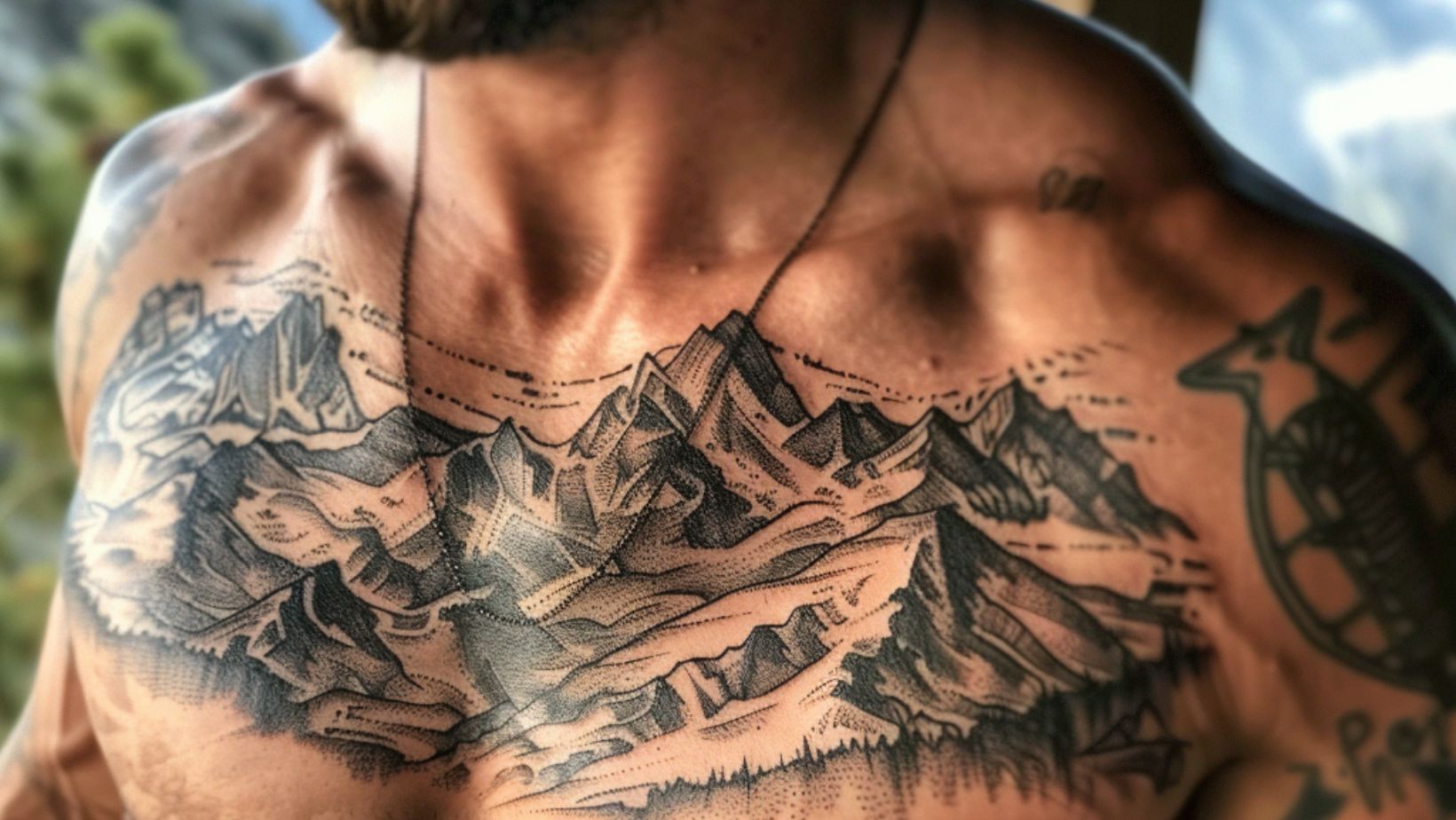
7. Mountain Tattoo
Mountains are the quietest symbol here, and often the most honest one.
There is no animal aggression in a ridgeline. It simply says something was hard and you went up it anyway.
They also personalise easily. An accurate profile of a specific peak, or an elevation line from a hike that mattered, turns a common design into yours alone.
I would push back gently on the very fine linework versions. Thin parallel lines close together are the classic setup for lines blurring into one another over time, so ask your artist to open the spacing.
8. Shield Tattoo
A shield is defensive strength. It is for protecting rather than attacking, which makes it a good fit for people in caretaking work.
Heraldic shields let you load in real meaning without a word of text: a family crest, an animal, a date split across the quarters.
Norse and Celtic round shields carry their own history and pair naturally with knotwork, though check the specific symbol rather than trusting a Pinterest caption.
Keep the outline heavy. A shield with a weak border stops reading as an object and starts reading as a smudge shaped like a leaf.
9. Spartan Helmet Tattoo
The Corinthian helmet is discipline more than violence. It is popular with military and first-responder clients for exactly that reason.
Its advantage is graphic: the silhouette is instantly recognisable even at small sizes and even in solid black.
Its disadvantage is that it is everywhere. If you want it to feel personal, change the crest, the damage, or the angle rather than copying a stock design.
Plumes are where people overreach. A crest rendered in ten shades of grey looks incredible on paper and muddy on skin after a few years.
10. Wolf Tattoo
Wolves mean strength that is social. A lone wolf is the popular reading, but in the actual animal the pack is the point.
That makes it a good choice for family, unit or crew meaning without needing names written anywhere.
Fur is the technical challenge. It needs directional whip shading, and an artist who mostly does script or fine line will struggle with it.
Browse wolf tattoo designs with an eye on how the fur is broken up, not on the pose. That is the tell for whether the tattoo will still read clearly later.
11. Bear Tattoo
The bear is protective strength with restraint built in. It is enormously powerful and mostly does not bother.
In several Indigenous North American traditions the bear carries meanings around healing and courage. If you are drawn to a specific cultural style, research whose it is and whether it is open to wear.
A bear track or a simple silhouette carries most of the meaning at a fraction of the size and cost, which is worth knowing if this is a first piece.
Full portraits need room for the snout and shoulder mass, otherwise the animal reads as a dog.
12. Feather Tattoo
A feather is the gentlest strength symbol on this list: freedom, lightness, surviving without hardening.
It is a common memorial choice, often with a bird breaking away from the barbs to represent someone released rather than lost.
Be careful with specific traditions here. Eagle feathers in particular hold protected ceremonial meaning in many Native American nations, and a generic feather avoids borrowing something that is not yours.
Technically it is unforgiving. The gaps between the barbs are narrow, and if they are drawn too tight they close up as the ink settles.
13. Tree of Life Tattoo
The tree of life is strength that grew slowly. Roots below, branches above, the same organism.
It appears in Norse, Celtic and several other traditions, so it carries weight without belonging to a single closed culture.
It personalises well. Number the branches for children, weave initials into the roots, or match the species to somewhere that matters to you.
My one warning, and our tree of life guide makes the same point, is that fine root systems have to be drawn bolder than feels right or they merge into a dark mass.
14. Phoenix Tattoo
The phoenix is the rebirth symbol, and it is the one people most often choose after something genuinely bad.
It is also the best cover-up shape in tattooing. Wings and flames absorb old work in a way almost nothing else does.
Colour suits it. If you have ever wanted a red or orange piece, this is the design that justifies it, though colour usually needs more protection from sun than black and grey does.
It needs scale. Look at large-format examples such as these phoenix tattoo designs and notice how few of them are small.
15. Hammer Tattoo
Mjolnir, Thor’s hammer, is strength as a working tool rather than a weapon. In Norse myth it is used to protect and to bless as much as to fight.
The knotwork versions are striking, but the symbol has been adopted by some extremist groups. Most artists are aware of this; ask about design choices that keep the meaning clearly Norse rather than coded.
A plain blacksmith’s hammer is the underrated alternative. It reads as work, craft and building something, with none of the baggage.
Geometry is everything here. The shape is symmetrical, so any wobble in the outline is visible forever.
Styles and Placements to Consider
The style you choose affects how the tattoo looks in a decade far more than the subject does.
Blackwork and Bold Line
Heavy black is the most durable choice available. Thick lines and solid fills hold their shape as skin changes, which is why century-old traditional work still reads clearly.
It suits skulls, shields, helmets and hammers especially well. If you want to see the range, blackwork tattoo designs runs from solid silhouettes to dotwork-heavy pieces.
The trade-off is honest: bold black is harder to cover or remove later, and it is less forgiving of a design you are only half sure about.
Fine-Line and Minimalist
Fine line gives you elegance and a shorter, gentler session. It suits arrows, mountains and small script well.
It also fades faster. Thin lines carry less pigment, so plan for a touch-up and keep designs open rather than dense.
I would not put a fine-line piece on a hand, foot or finger and expect it to hold. Those areas turn over skin quickly and blur the fastest.
Placement for Meaning
Inner forearm is for you; it faces you whenever your arm is down. Outer arm, chest and calf are for other people.
Ribs, sternum and spine hurt considerably more than fleshy areas, and that is worth knowing before you book a long session in one of those spots.
Think about your job too. Hands, neck and face remain a genuine problem in some workplaces, however much attitudes have shifted.
Aftercare and Choosing the Right Artist
A strength tattoo is a wound before it is a symbol, and how you treat it in the first fortnight decides how it looks forever.
Follow the aftercare your artist gives you rather than a routine from the internet, since it is matched to the products and technique they used. Our tattoo aftercare guide covers the general shape of it.
Keep it clean, keep it lightly moisturised, do not pick the flakes, and keep it out of pools and direct sun while it heals. The American Academy of Dermatology is clear that sun protection afterwards is the single best thing you can do for how a tattoo ages.
Spreading redness, swelling that worsens after a few days, pus or fever are reasons to see a doctor, not to wait it out. Allergic reactions to pigment are also possible, sometimes years later, and the US Food and Drug Administration keeps a plain-language fact sheet on the risks worth reading before your first session.
On choosing an artist: look for healed photos, not fresh ones. Anyone can make a tattoo look sharp on the day. Ask to see the same design a year later, and never attempt DIY tattooing or home removal, both of which cause infections and scarring that a professional then has to work around.
Common Mistakes to Avoid
The mistake I see most is picking the symbol before the size. A lion decided at wallet size becomes a compromise the moment the stencil goes on.
The second is copying another person’s tattoo exactly. Most artists will decline, and the ones who agree are not the ones you want.
The third is booking on price. A cheap session on a design you will see every morning for forty years is the false economy of the whole industry.
Still not sure which direction to take? Read through a realistic pain map first, then come back to the quieter symbols here and notice which one you keep scrolling back to. That instinct is usually right.
Frequently Asked Questions
What tattoo symbolizes inner strength the most?
The koi and the phoenix are the two that most directly describe inner strength rather than physical power. The koi is endurance over a long stretch, and the phoenix is recovery after something destroyed. If your strength was quiet and private rather than dramatic, a mountain or a tree of life usually fits better than either. The most meaningful choice is almost always the one you can explain in a sentence about your own life.
Where is the best placement for a strength tattoo?
If the tattoo is a reminder for you, the inner forearm is hard to beat because it faces you naturally. If it is a statement to other people, the outer arm, chest or calf works better. Larger symbols such as dragons, koi and phoenixes generally need the back, thigh or a full sleeve panel to breathe. Placement also affects longevity, and areas that rub or see a lot of sun will fade sooner.
Do strength tattoos hurt more in certain spots?
Yes, and the difference is significant. Areas with thin skin over bone, such as ribs, sternum, spine, ankles and the inside of the elbow, are consistently reported as the toughest. Fleshier areas like the outer thigh, outer arm and calf are usually much more manageable. Pain tolerance varies a lot between people, so treat any chart as a rough guide rather than a promise.
Are these designs suitable for a first tattoo?
Some are and some really are not. An arrow, a small mountain, a bear track or a simple hammer are all sensible first pieces: short sessions, forgiving placements and a modest cost. A full dragon, koi or phoenix is a multi-hour commitment and often several sessions, which is a hard way to learn whether you like being tattooed. Starting smaller also lets you find out whether you trust the artist before booking something large.
How do I make a common symbol feel personal?
Attach a detail only you would know. A date worked into the linework, a specific mountain profile, the number of branches matching the people in your family, or a species chosen because of where you grew up. Telling your artist the story behind the piece matters more than most people expect, because it changes the pose, the expression and the composition they draw. A symbol everyone recognises with one detail nobody else has is the sweet spot.
Quick Summary
- Pick the kind of strength first — endurance, protection, recovery or discipline — then choose the symbol that matches it.
- Skulls, shields, Spartan helmets and hammers read as courage in the face of something; lions, wolves and bears read as protective power.
- Koi, phoenix and tree of life are the long-haul symbols: endurance, rebirth and slow growth.
- Decide the size before the design, because large subjects squeezed small never recover.
- Bold black and grey ages best; fine line looks elegant but needs touch-ups and open spacing.
- Inner forearm faces you, outer arm and chest face everyone else, and ribs and spine hurt the most.
- Personalise with a date, a real place or a species that means something, rather than copying a design outright.
- Follow your artist’s aftercare, protect it from sun for life, and see a doctor for spreading redness, pus or fever.