Scarab tattoo ideas range from a small outlined beetle to a broad winged composition. The shell supplies a strong central shape, while a sun disk, geometric frame or colour accent can change the mood without hiding the insect. Choosing the right version starts with how much detail you want and how much room your placement offers.
These fifteen concepts focus on different ways to draw and arrange the scarab. Some refer to ancient Egyptian imagery; others use modern botanical or geometric decoration. That distinction matters if you want the tattoo to express a specific historical idea.
About the images: All sixteen images in this guide, including the hero, are original AI-generated tattoo concepts made with ImageGen. They are not real client tattoos or healed results. Use them as a starting brief for an artist who can redraw the design for your skin and placement.
What does a scarab tattoo mean?
In ancient Egyptian imagery, the scarab is associated with renewal and the rising sun. The Metropolitan Museum of Art’s scarab record explains how the beetle’s movement of a dung ball was compared with the sun’s emergence at dawn, and describes scarab amulets as symbols of rejuvenation and renewed life.
A modern tattoo can use that history to express a personal association with a new beginning. It does not mean that every scarab drawing has the same message, or that wearing one guarantees protection. Botanical frames, diamond outlines and contemporary colour choices can be aesthetic decisions rather than inherited religious symbols.
If your interest extends beyond the beetle, our broader Egyptian tattoo ideas guide compares several related motifs. For a historically specific piece, begin with a documented object and ask which details you are preserving and which you are adapting.
Choosing a scarab composition
Start with the beetle before adding a border. Check the rounded shell, paired wing cases and leg placement. Decide whether you want a naturalistic insect, a simplified emblem or an amulet-inspired object. Then choose one main supporting element, such as wings or a disk, so the artist has a clear hierarchy to work from.
Broad wings need width; a disk or hanging ornament needs height. A small standalone beetle needs fewer shell markings. The examples below make those differences visible without promising a fixed size, session count or result.
1. A bold black scarab
The closed shell gives this design a compact silhouette. A narrow centre seam and small skin breaks distinguish the two wing cases without adding a busy pattern. The legs sit close to the body, so the beetle remains the focus when you look at it from a distance.
The inner forearm makes the upright shape easy to see. Ask your artist to test the seam and leg gaps at the final stencil size. If those spaces look cramped on paper, simplify or enlarge the design before committing.
2. An outlined scarab
An outline keeps the shell light and lets the bare skin form the largest part of the design. The curved body, small head and paired legs make it readable without shading. This is a useful starting point if you prefer quieter linework to a solid black shape.
A forearm placement leaves space around the legs. Keep the internal shell markings selective rather than filling every panel with fine lines. Compare the artist’s healed linework examples as well as fresh photographs. Our linework tattoo ideas show other ways to use a restrained outline.
3. A scarab with spread ornamental wings
A winged composition gives the compact beetle a much wider silhouette. Here, feather-like bands extend out from the centre and remain separate from the shell. These are ceremonial-looking decorative wings, rather than a claim that a living scarab has feathered wings.
The upper back offers room for both sides. Review the stencil while standing with your shoulders relaxed; lifted arms can change how a symmetrical drawing looks. Keep the wing tips clear of nearby tattoos and give the central beetle enough weight to remain visible.
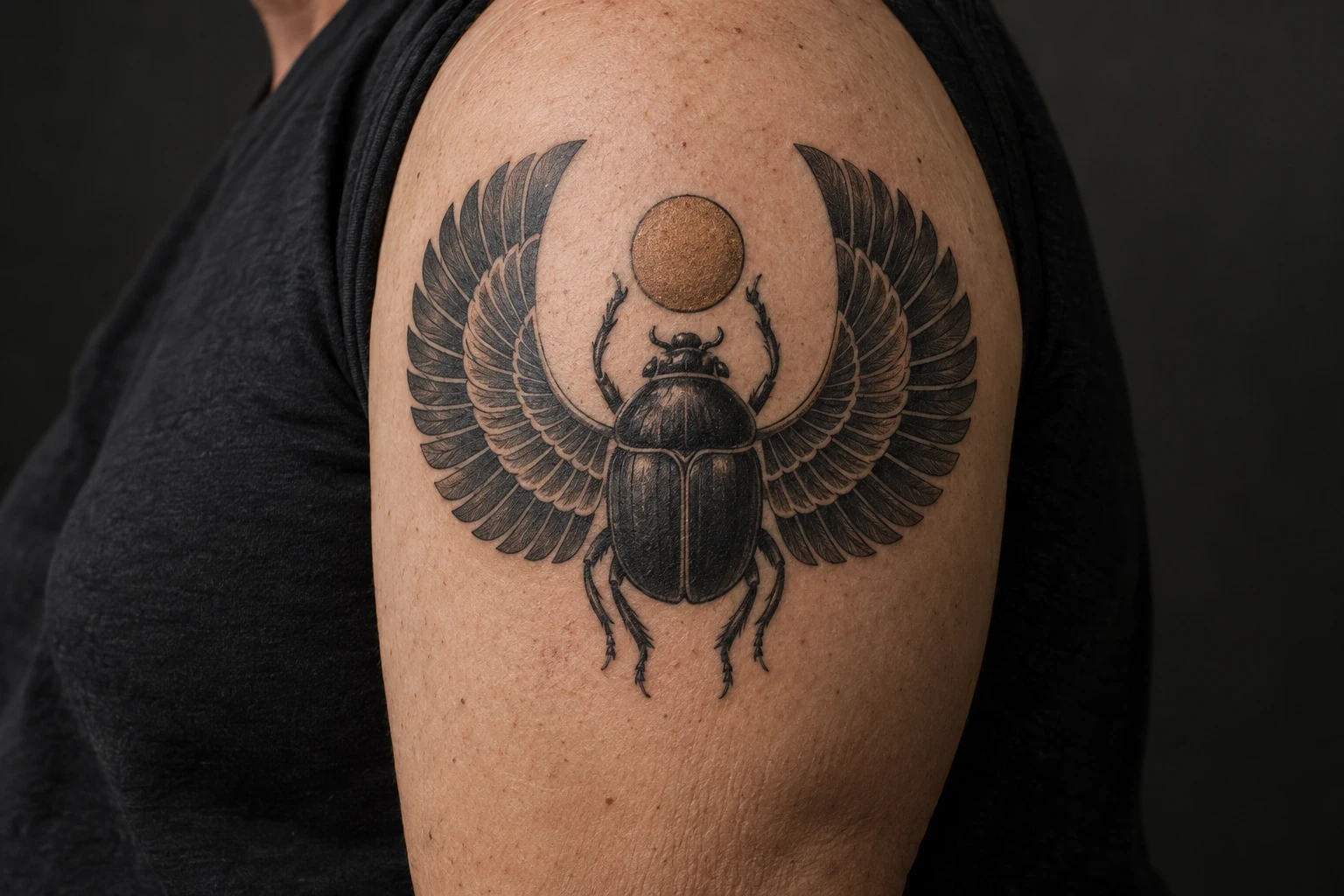
4. A scarab beneath a sun disk
A terracotta disk adds one clear colour accent above the black beetle. Its position draws the eye upward and makes the design taller without making the shell more complicated. The sun reference has a documented connection to ancient Egyptian scarab imagery; the exact arrangement shown here is a modern tattoo concept.
The upper arm suits this vertical stack. Leave a visible gap between the disk and the head so the two forms do not merge. A black-and-grey disk is another option if you prefer a single-colour composition.
5. A dotwork scarab with a soft halo
Stipple shading gives the shell a softer surface than a solid fill. Dense dots near the shell edges suggest a rounded form, while a faint halo adds atmosphere around the beetle. The darkest marks still belong to the insect, so the frame does not compete with it.
A shoulder placement gives the oval composition a curved surface. Ask the artist to keep the outer halo sparse and the legs distinct. More dots are not always more detail: clear changes in tone can be more useful than a uniform field of tiny marks.
6. A turquoise and cobalt scarab
Blue and turquoise shell panels create a vivid colour option. Black outlines separate the panels and anchor the legs, so the design does not rely only on colour differences. The result takes an illustrative approach rather than trying to reproduce a particular archaeological object.
An outer upper arm gives the shell enough width for distinct colour areas. Discuss the actual inks and healed examples with your artist; a generated image cannot show how a colour will look on your skin after healing. Keep any extra background simple.
7. A scarab inside a diamond
A narrow diamond frame turns the scarab into a tall geometric composition. The beetle supplies rounded shapes inside the straight border, creating a contrast without needing an extra symbol. Open space around the head and legs keeps the frame from cutting through the insect.
The inner forearm suits the pointed vertical outline. Review where the top and bottom points land when your wrist bends. If you want a compact version, shorten the frame rather than shrinking the beetle until the leg gaps become hard to read.
8. A carved-amulet scarab
This black-and-grey concept borrows the rounded form and incised shell markings of a carved scarab amulet. Shading suggests a small object resting on the skin, while the central seam keeps the beetle shape recognisable. It offers a quieter alternative to broad ornamental wings.
Use a documented museum object as a starting reference if historical detail matters to you. This version avoids inscriptions. A tattoo that includes an ancient name or phrase should be checked by someone qualified to read the script, rather than copied from an unverified decorative image.
9. A scarab between leafy sprigs
Two slim leafy branches give the beetle a soft vertical border. They leave open space near the legs and taper toward the top, making the composition feel lighter than a closed wreath. The plants function as decoration here; no ancient religious meaning is assigned to them.
A forearm allows the sprigs to follow the length of the arm. Keep the leaves larger than tiny dots and let a few gaps break the pattern. The beetle should remain easy to identify before you notice the surrounding foliage.
10. An ornamental scarab with teardrops
Curved flourishes and three suspended teardrop shapes turn the scarab into a jewellery-inspired composition. The shell stays central while the lower ornaments extend the design. Keeping those ornaments separate makes each shape readable and avoids a tangled outline beneath the beetle.
The upper arm offers room for the hanging elements. Check the distance between the lowest teardrop and any existing work. Treat this as modern ornament, not a reconstruction of a named ancient pendant or a symbol with a universal fixed meaning.
11. A realistic black-and-grey beetle
A naturalistic scarab focuses on the domed shell, paired wing cases and six legs. Restrained shading suggests surface and volume without adding a symbolic frame. It suits someone who likes the insect itself as much as the cultural associations of scarab imagery.
The calf gives this approach a broad vertical area. Bring real beetle reference photographs alongside the concept, and ask the artist to check the head, legs and shell structure. Small highlights should support the form rather than turn the insect into a glossy plastic object.
12. A scarab with negative-space shell stripes
Broad bare-skin curves break up a dark shell. These stripes create a graphic pattern while retaining the closed oval body and central seam. The contrast comes from the relationship between the black fill and the uninked areas, rather than from added colour.
An upper-arm version can carry wider skin breaks than a miniature tattoo. Ask the artist to redraw the stripes at the chosen size and keep them clear of the outer edge. The design should still read as a beetle if you view it with slightly unfocused eyes.
13. A scarab framed by partial circles
Partial concentric circles give the beetle a calm geometric setting. Breaks in the rings stop the border from running through the legs. The rounded frame echoes the shell, but the offset openings prevent the design from feeling like a dense circular badge.
The forearm offers a useful surface for comparing the circle width with the insect. Keep the ring spacing generous and resist adding several more layers simply to fill the available skin. Our minimalist tattoo ideas offer other examples of using open space.
14. A brick-red illustrative scarab
Muted brick-red shell panels sit inside a bold black outline. The limited palette gives the insect colour without turning every part into a separate accent. A few bare-skin breaks divide the panels and prevent the red from becoming one flat block.
The upper arm gives this illustrative style enough room for confident shapes. Ask for healed examples of similar red-and-black work before choosing the palette. This is a traditional-inspired modern composition, not a claim that the colours reproduce an ancient Egyptian tattoo practice.
15. A small simplified scarab
The smallest option removes most shell decoration and keeps only the rounded body, central seam and short legs. Its appeal comes from proportion rather than ornament. A simple scarab can work as a standalone piece without needing a sun disk or a larger Egyptian-themed composition.
Place it above the wrist with enough room for the legs to remain separate. There is no universal minimum measurement that suits every artist and design. Let your artist set the size after checking the stencil, and be willing to make it larger than the thumbnail that first caught your eye.
Placement and scale
The inner forearm suits a narrow standalone beetle or a tall framed design. The upper arm offers width for colour panels and ornament, while the upper back can accommodate a wider winged composition. A calf can provide room for a naturalistic insect with more shading. These are starting points to discuss with your artist rather than rules that fit every body.
Check the stencil in a relaxed posture and from the viewing direction you intend. If the shell seam or leg gaps disappear at the chosen size, simplify the details or increase the scale. Ask how the design will sit alongside existing work and whether any part crosses an area that moves substantially.
For intricate shells, compare real healed examples from the artist’s portfolio. A crisp generated concept shows a drawing, not how those marks will settle in skin. No illustration can guarantee that tiny gaps will remain unchanged over a fixed number of years.
Keeping historical references accurate
Choose a museum reference if you want to follow a specific scarab amulet. Record the object’s identity and the features you like, such as the rounded shell or carved seams. Avoid presenting a modern ornamental design as an exact copy of an ancient object unless it actually follows one.
None of these concepts uses hieroglyphic inscriptions. If you add a name or phrase, have it checked by someone qualified to read the relevant script and review the final stencil. An attractive row of symbols is not evidence that the wording is correct.
Colour, linework and caring for the tattoo
Blackwork, stippling and colour each need clear separation between the shell, legs and surrounding elements. Ask the artist to choose line weights and spacing for the actual stencil rather than tracing every mark in a reference image. Colour can provide contrast, but it should support a readable outline.
The American Academy of Dermatology notes that ultraviolet light can fade some tattoo inks. For healed tattooed skin exposed to sunlight, it recommends broad-spectrum, water-resistant sunscreen with SPF 30 or higher and reapplication at least every two hours. Follow fresh-tattoo aftercare instructions separately and ask your artist about any uncertainty.
Questions about scarab tattoos
Is a scarab tattoo always an Egyptian symbol?
A scarab can be drawn as an insect without a religious frame. Ancient Egyptian associations are especially relevant when you choose a sun disk, an amulet reference or ceremonial-looking wings. Explain your intended meaning to the artist so the design supports it.
Do real scarabs have feathered wings?
The feather-like wings in these concepts are ornamental. They are distinct from the closed shell panels of the beetle. If you want a naturalistic tattoo, bring real insect references and have the anatomy checked rather than using a ceremonial composition as a zoological reference.
Can a scarab tattoo be small?
A simplified standalone beetle is the clearest starting point for a small piece. Remove elaborate wing bands, dense stippling and narrow ornamental gaps before reducing the whole drawing. The artist should set the final size after evaluating the stencil.
Does it need a sun disk?
No. A disk can emphasise the solar association and add a focal point, but a standalone shell can also express your interest in the scarab. Avoid adding several unrelated motifs unless you can explain how you want them arranged.
Should I copy one of these images exactly?
Bring the image as a composition reference. Ask the artist to refine the anatomy, spacing, colour and placement for you. Generated images can contain details that need redrawing, and they cannot replace a checked stencil or a conversation about the finished tattoo.
A clear brief for your tattoo artist
Choose the shell treatment first, then decide whether the tattoo needs wings, a disk or a simple frame. Bring the concept, your preferred placement and any museum reference that informs the meaning. Ask the artist to show how the design reads at its proposed size before adding more detail. A recognisable beetle and clear spacing are a strong foundation for a personal scarab tattoo.