No, Kristen Bell does not have any real tattoos. The images of her covered in ink come from a comedy sketch she filmed for Funny or Die in January 2012, and every piece in it was fake. Snopes rated the viral claim that she has 214 tattoos False. Bell has said she would like a tattoo, but she has never gone through with one.
That has not stopped the question circulating for more than a decade. Screenshots from the sketch still get passed around as though they were candid photographs, and the actress most people associate with Veronica Mars, Frozen and The Good Place keeps appearing on lists of heavily tattooed celebrities she has no business being on. Here is where the story started, what was actually in the video, and the one tattoo Bell has said she might really get.
Where the 214-Tattoo Rumour Started
The sketch went up on Funny or Die on 7 January 2012 and was posted to YouTube on 24 January, with entertainment outlets picking it up through early February. It was built as a mock behind-the-scenes featurette. In it, Bell explains with a completely straight face that she has 214 professional tattoos and nine more she did herself, and that she has to arrive on set 12 to 14 hours early so the makeup department can cover all of them.
The timing carried the joke. House of Lies, the Showtime series Bell co-starred in, had just premiered, so a bit about the extraordinary lengths needed to hide her body art from camera landed as plausible-sounding industry trivia. The comedy came from the gap between that premise and Bell’s public image, which is about as far from a full bodysuit as a Hollywood career gets.
Snopes examined the claim directly and rated it False. There is no credible photograph, red carpet appearance or interview in which Bell displays permanent ink.
What Was Actually in the Video
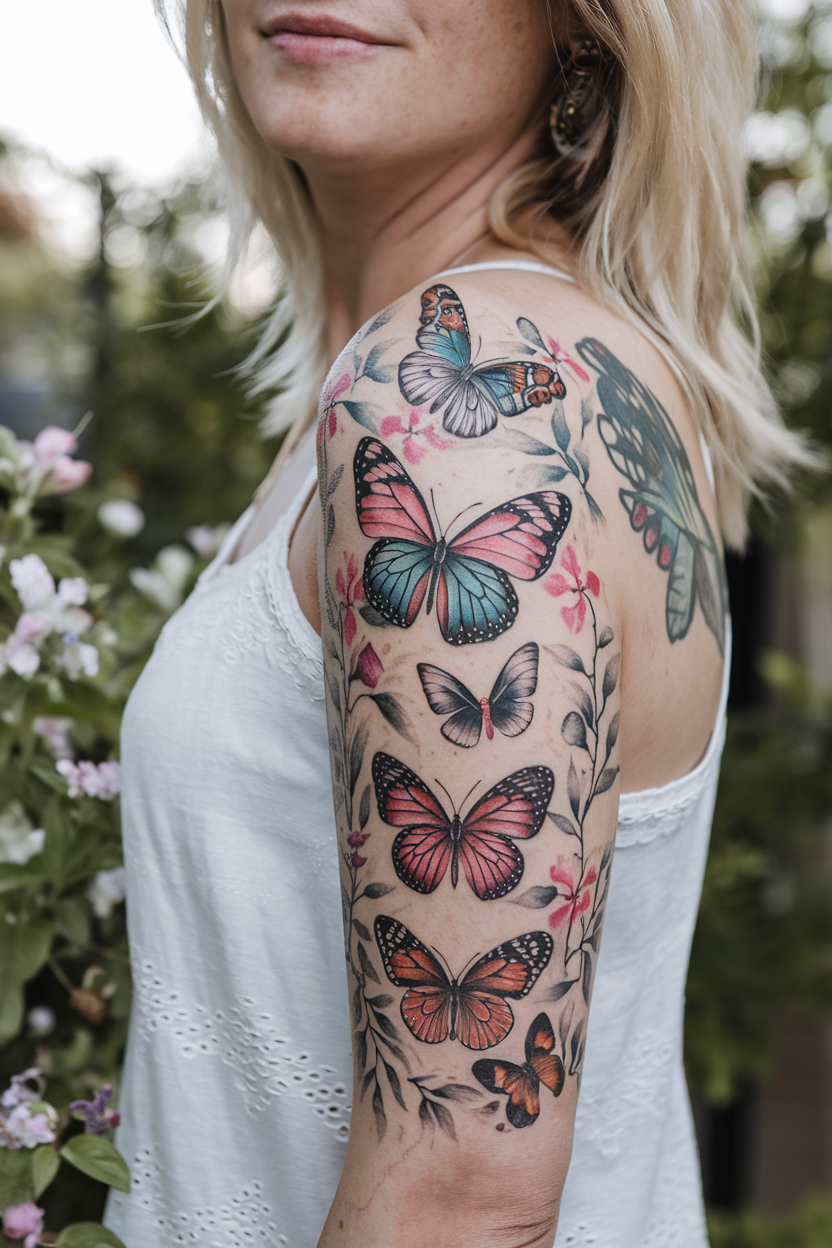
The fake tattoos were chosen to be funny rather than flattering. Among the pieces visible in the sketch were a portrait of Willy Wonka, portraits of both Steve Urkel and his alter ego Stefan Urquelle from Family Matters, tribal armbands, a set of orthodontic headgear rendered across her skin, the phrase I Heart Windows 95, a pink-haired troll doll, and butterflies.
Read as a list it is a catalogue of deliberately dated choices, which is exactly why it works. It is worth separating the joke from the categories, though. Portrait realism is one of the most technically demanding things a tattooer does, and a well-executed face takes hours of layered black and grey. Butterflies are not a punchline either. They are among the most requested designs in any studio, and the symbolism behind a butterfly tattoo is a good deal more considered than the sketch implies. The same motif reads completely differently as a delicate butterfly chest piece than it does stacked up in a comedy montage.
What the video does capture accurately is how much heavy coverage changes a performer’s working life. Actors with extensive visible work genuinely do sit through long makeup sessions before camera days, in much the same spirit as the planning that goes into real tattoo cover-up work. The sketch exaggerated the number, not the principle.
Why the Clip Keeps Resurfacing
The sketch has had several separate viral lives and the pattern is always the same. A clip gets cropped, the Funny or Die framing disappears, and the footage circulates on TikTok and image boards as a genuine reveal. Viewers who were children in 2012, or not born yet, have no particular reason to recognise it as a comedy upload.
Two things make it convincing. The temporary work in the sketch was applied properly rather than drawn on, so it photographs like real ink at low resolution. And the delivery is deadpan the whole way through, with no wink to camera.
If you want to check a celebrity tattoo claim for yourself, find the original upload rather than the repost, then check whether the same ink appears in any photograph taken outside that one shoot. Permanent work shows up everywhere. A one-day application never does. It is the same instinct worth applying when you are researching your own design and running into the difference between a healed fine line tattoo and a freshly stencilled photograph.
The Tattoo Kristen Bell Has Said She Would Actually Get
Bell has never ruled a tattoo out. In a 2016 Wired appearance she said she had always wanted one, and attributed part of her hesitation to her husband Dax Shepard, who she said does not like tattoos on women. In a podcast appearance reported in 2020 she described a specific idea she had been weighing: a back piece carrying the phrase there is no such thing as other people’s children, a line that sums up a view she has spoken about often.
That puts her in the largest and least discussed category of tattoo customer, the long-term considerer. People in it have the concept, sometimes the exact wording, and no appointment. The sticking points are almost always placement, size, and the suspicion that the phrase will read differently in ten years.
Those are solvable problems. A text piece lives or dies on typeface and line weight far more than on wording, which is why working through quote tattoo ideas or a set of Latin phrase designs is more useful than agonising over the sentence alone. Long lines of text suit a spine or back placement, though that area sits near the top of most charts of how much a tattoo hurts.
If a full back piece feels like too much for a first commitment, small meaningful designs and first tattoo ideas for women cover the same emotional ground at a fraction of the sitting time, and a practical guide to getting a tattoo for the first time covers what the appointment itself involves. Budget is rarely the obstacle people assume either, since small tattoo pricing starts lower than most first-timers expect.
See Your Design Before You Commit
If you have been circling an idea for years the way Bell has, the useful next step is seeing it rather than describing it. The Tattoobuild AI tattoo generator turns a written idea into a finished design in seconds instead of the weeks a custom consultation queue usually takes. You can run unlimited variations on the same concept, changing script style, line weight, scale and placement until one of them stops feeling like a compromise, then save the ones worth keeping to your own gallery to take to an artist. Plans start from $6.
Trying twenty versions of a phrase costs a few minutes and nothing else, and it is a far better position to walk into a studio from than a single screenshot. It is also the cheapest insurance against the outcome nobody plans for, which is a design that has to be worked around later.