A belly tattoo for women is one of the most forgiving placements on the body for large artwork, and one of the least forgiving for the wrong style. The space is generous, but the skin moves more than almost anywhere else.
I have spent a lot of hours in shops looking at stomach pieces, and the pattern is consistent: the ones that still look sharp five years later were drawn to follow the body, not stamped flat across it.
The belly also gives you control that most placements do not. It is completely hidden under a t-shirt and fully visible in a bikini, which is why so many people who cannot have visible ink at work end up here or on the ribs.
This guide covers the design styles that actually work on the stomach, how the four main placement zones differ, what the sitting realistically feels like, and how to care for it while it heals.
Which Belly Placement Is Right for You?
Every zone of the abdomen behaves differently. This is the comparison I walk people through before they commit to a size.
| Placement | Typical pain | Best suited to | Things to weigh |
|---|---|---|---|
| Upper abdomen | High near the sternum, moderate lower down | Symmetrical designs, ornamental work, pieces that continue onto the sternum | Bone is close to the surface at the centre; breathing moves the area constantly |
| Around the navel | Moderate, sharper right at the rim | Mandalas, radial designs, anything with a natural centre point | Artists usually leave a small clean margin around the navel itself |
| Lower abdomen | Moderate, rising near the hip bones and pubic line | Horizontal florals, script, pieces that connect to hip tattoos | The zone most affected by pregnancy and weight change |
| Side belly / flank | High – thin skin over the floating ribs | Long flowing designs, snakes, vines, waist-following compositions | Hardest zone to sit still for; often split across sessions |
| Full stomach panel | Varies by zone; the whole range in one piece | Blackwork, ornamental coverage, large narrative pieces | Multiple sessions, and needs one plan drawn before any needle touches skin |
What Makes the Belly Different From Any Other Placement
The stomach is soft tissue over a moving core, which changes almost everything about how a tattoo behaves there.
Unlike a forearm, the skin here stretches and relaxes with breathing, posture, weight and pregnancy. A design that looks perfectly balanced while you are lying flat on the table can read differently once you stand up.
Good artists account for this by drawing the stencil on you standing, then checking it seated and lying down. If an artist skips that step on a large stomach piece, that is worth asking about.
Pain is the other honest factor. The belly is not the worst placement on the body, but the flanks and the area just under the sternum are genuinely tough, and it lands high on most tattoo pain rankings for a reason.
The core muscles also make it hard to stay still — every flinch, laugh or deep breath moves the canvas, which is why stomach sessions often run shorter than an equivalent arm session.
Belly Tattoo Ideas for Women, by Style
These are the style families I see holding up best on the stomach, with the caveat that execution matters more than category.
Floral and Botanical Designs
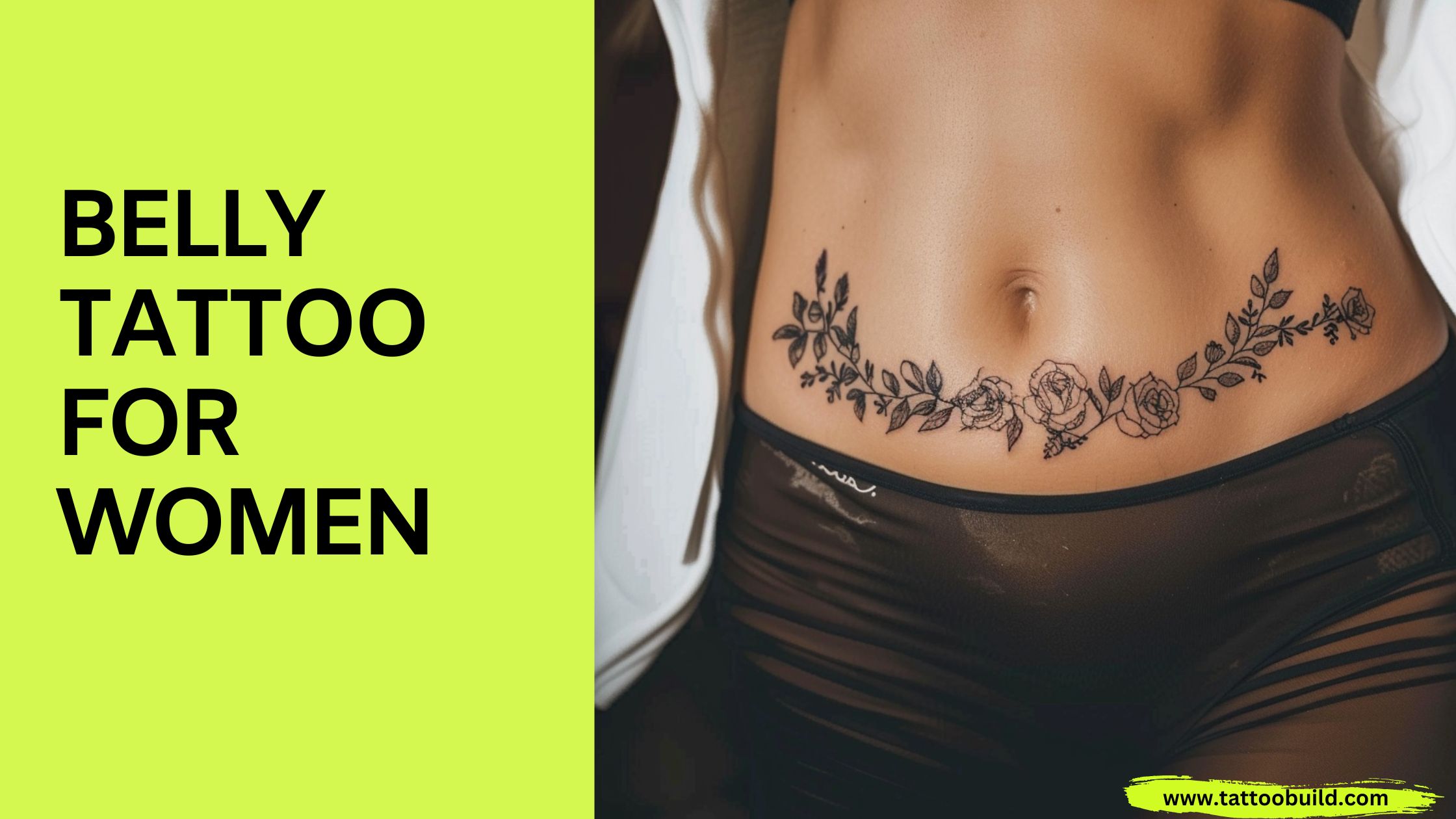
Florals are the most requested belly tattoo for women, and there is a practical reason beyond the look: organic shapes tolerate movement.
A rose that shifts slightly when you bend still reads as a rose. A perfect circle does not survive the same distortion.
The strongest versions I have seen use one anchor bloom with smaller elements trailing off it, rather than an even scatter of same-sized flowers. That gives the eye somewhere to land.
Peonies, roses and magnolias suit larger stomach areas because the petal mass gives the artist room for depth. Wildflowers, sprigs and birth flowers work better as smaller, lower-belly pieces.
If you want colour, ask to see healed colour work on a stomach specifically — not just a healed arm.
Mandalas and Ornamental Geometry
The navel is the only natural centre point on the human torso, which makes it close to perfect for radial designs.
Every mandala belly tattoo I have looked at closely does the same thing: it leaves a small clean margin right at the navel rim and builds outward from there.
Geometry is the least forgiving style on this placement. Straight lines and repeated shapes make any stretching visible, so the drawing has to be mapped onto the curve rather than laid flat over it.
Ornamental linework, dotwork shading and lace-style filigree all work well here, and they extend naturally toward the hips or sternum later if you decide to grow the piece.
If you are drawn to this direction, look through dedicated mandala designs for women before your consultation so you can point at specific line weights.
Snakes, Butterflies and Creature Designs
Snakes are the single best-suited animal for the stomach, because a snake is drawn to wrap and the waist gives it something to wrap around.
Run the body from the lower ribs, across the abdomen and toward the opposite hip, and the design uses the curve instead of fighting it.
Butterflies and moths tend to sit higher, centred just below the sternum, with the wings mirrored across the midline. Symmetry is the whole appeal, so the stencil placement has to be exact.
Big cats, birds and koi all appear on stomachs too, though they usually need more space than people expect — a detailed animal squeezed small loses its features as it heals.
There is a full guide to snake tattoo ideas for women if that is the direction you are leaning.
Script, Quotes and Lettering
Script on the belly is a genuine mixed bag, and I would rather be honest about that than sell it.
Lettering is made of consistent strokes, so any stretch shows immediately. Horizontal script across the lower abdomen is the most exposed to change from weight shifts and pregnancy.
What works better: shorter phrases, placed vertically along the flank or tucked under the ribline where the skin moves less.
Serif and fine-line fonts also thicken as they age. Every artist I have asked about long script recommends going a size larger than feels necessary and keeping the letter spacing generous.
Abstract and Fine Line Work
Abstract pieces — brushstroke shapes, sketch lines, unfinished-looking compositions — suit the stomach because there is no “correct” shape to distort.
Fine line work is the more popular request, and it comes with a real trade-off. Thin lines look delicate on day one and can soften noticeably over years, particularly on skin that stretches.
I am not telling anyone to avoid it. I am saying go in knowing that a fine line stomach piece may want a touch-up sooner than the same design on a forearm.
A good middle ground is mixed line weight: a slightly heavier structural outline with fine detail inside it, so the design keeps its shape even as the fine work settles.
Full Stomach Panels and Coverage Pieces
A full abdomen piece is a different project from a single design, and it should be treated that way from the first consultation.
These are planned as one composition across multiple sessions, usually outlined first and then filled zone by zone.
Blackwork and heavy ornamental styles are the most reliable choices at this scale, because solid areas and bold structure hold their read as the skin changes.
Expect the flanks to be the hardest sittings and the centre of the stomach to be the easiest. Most artists I have spoken to break these into sessions of three to four hours rather than pushing through a full day.
Placement Variations Across the Abdomen
Two people can ask for the same design and end up with very different tattoos depending on which zone it lands in.
Upper Abdomen
Sits between the ribs and the navel, close to the sternum. This zone moves least when you sit or bend, which makes it the safest home for symmetrical work.
The trade-off is pain near the centre, where there is little between needle and bone.
Around the Navel
Designs that wrap the belly button rather than sit beside it feel deliberate instead of accidental.
The rim itself is sensitive, and artists generally will not tattoo directly into the navel — expect a small clean gap by design, not by oversight.
Lower Abdomen
The most private zone, easily covered by anything higher than low-rise jeans, and a natural partner to hip tattoos if you extend later.
It is also the zone most affected by pregnancy and significant weight change, which is worth factoring in honestly rather than hoping around.
Side Belly and Flank
The flank gives you the longest continuous run of skin on the torso, which is why snakes, vines and flowing florals end up here.
It is also the toughest sitting on the abdomen. Thin skin over the floating ribs, and no muscle to buffer it.
Small and Minimal Belly Tattoos
Not every stomach tattoo needs to be a project. A crescent moon beside the navel or a small symbol under the ribs is a two-hour appointment at most.
Small pieces here are also the easiest to build on later, since you are leaving most of the canvas open.
Aftercare and Healing for a Belly Tattoo
The stomach is a high-friction, high-sweat area, which makes aftercare here a little more demanding than an outer arm.
Your artist’s instructions come first — they know what they used on your skin. What follows is the general shape of good aftercare, not medical advice.
Wash gently with clean hands and fragrance-free soap, pat dry with a clean paper towel, and apply a thin layer of whatever moisturiser your artist recommended. The American Academy of Dermatology has straightforward guidance on caring for tattooed skin.
Clothing is the part people underestimate. Waistbands sit exactly where a lower belly tattoo heals, so loose high-waisted or low-rise clothing for the first two weeks makes a real difference, and our full tattoo aftercare guide covers the rest of the routine.
Keep it out of pools, hot tubs and direct sun while it is healing, and once it is fully settled, sunscreen is the single best thing you can do to keep the linework crisp. If you notice spreading redness, heat, swelling that worsens after a few days, pus or a fever, see a doctor — the FDA lists infection and allergic reaction as the main risks to watch for, and neither is something to manage at home.
Common Mistakes — and What to Do If You Are Still Not Sure
The mistake I see most often is choosing the design before choosing the placement, then forcing it to fit.
The second is underestimating the sitting. People book a six-hour first appointment on their flank and tap out at three, which leaves a half-finished piece to live with until the next slot.
The third is booking around a life change rather than after one. If pregnancy is on the horizon in the next year or two, most artists will suggest waiting or keeping the piece to the upper abdomen.
On existing stretch marks, results vary a lot and depend on how mature the marks are — we go into what is realistic in tattooing over stretch marks.
If the stomach is not quite right, the neighbouring placements give you most of the same privacy: sternum pieces for symmetry, ribs for long vertical designs, hips for something that only shows when you want it to.
Frequently Asked Questions
How painful is a belly tattoo?
It varies by zone. The centre of the stomach is one of the more tolerable areas on the torso because there is soft tissue between the needle and anything sensitive, while the flanks and the area just under the sternum are genuinely sharp. Most people I have spoken to describe the belly overall as moderate, with a few difficult stretches rather than constant intensity. The bigger challenge is holding still, since the core moves with every breath.
Will pregnancy ruin a belly tattoo?
Not necessarily, but it can change one. The lower abdomen stretches the most, so designs placed there are the most likely to distort, while upper abdomen and flank pieces usually fare better. Skin also varies enormously from person to person, so no artist can promise you a specific outcome. If you are planning a pregnancy soon, many artists will suggest waiting or choosing a higher placement.
How long does a belly tattoo take to heal?
The surface usually looks healed in two to three weeks, while the deeper layers keep settling for a couple of months. The stomach can take slightly longer than an arm because clothing rubs it and the area sweats and folds. Keep waistbands off it, avoid soaking it, and give it time before judging how the linework looks. If anything looks or feels wrong rather than simply itchy, check in with your artist or a doctor.
Can you tattoo over the belly button?
Artists tattoo around the navel, not into it. The rim is sensitive, the skin folds unpredictably, and a navel piercing adds another complication. A well-designed navel piece leaves a small clean margin at the rim on purpose, which is what gives mandalas and radial designs their centre.
How much does a belly tattoo cost?
It depends entirely on size, style and your artist’s rate, which differs hugely by city and by reputation. A small piece near the navel is typically a single short appointment, while a full stomach panel is several multi-hour sessions and priced accordingly. The most useful thing you can do is ask for an estimate in sessions rather than a flat number. Be wary of a quote that is far below everyone else’s in your area.
Quick Summary
- Pick the zone first, then the design. Upper abdomen, navel, lower belly and flank all behave differently.
- Organic styles — florals, snakes, abstract work — tolerate the belly’s movement better than rigid geometry or long script.
- The navel is a natural centre point, which is why mandalas and radial designs suit this placement so well.
- The flanks and the area under the sternum are the painful parts; the centre of the stomach is comparatively manageable.
- Fine line work looks beautiful here but may want a touch-up sooner than it would on a forearm.
- Ask to see healed stomach photos from your artist, not just fresh ones — healed work tells you how it ages.
- Keep waistbands, pools and sun off it while it heals, and use sunscreen on it for life afterwards.
- If pregnancy is likely in the near future, consider waiting or placing the piece on the upper abdomen.