Back lion tattoo ideas for men can start with a simple placement decision: one shoulder blade, the space between both shoulders, or a composition that continues toward the waist. A strong portrait does not need to fill the whole back, and a full-back design needs more than an enlarged face.
These 16 concepts compare different outlines, expressions and amounts of coverage. Use the images to decide what you want the lion to do in the composition, then ask an artist to redraw it for your back. The same approach can suit people of any gender; this collection focuses on the men’s back-placement brief.
Image disclosure: Every image is an original AI-generated tattoo placement concept. The people and tattoos are illustrative mockups, not real or healed client work. They do not predict how ink will look on your skin or replace an artist’s drawing, stencil fitting or healed portfolio.
Choose the footprint before the details
Start by marking the outer boundary: where should the top, sides and lowest point of the tattoo end? A rounded portrait, a long mane and a walking animal occupy the back in different ways. Compare those silhouettes before choosing a crown, flowers or background.
For a wider subject comparison, browse our lion tattoo ideas. For this back-focused collection, the useful question is how much space you want the design to occupy. Decide whether the shoulders should remain mostly open, whether the face should sit on the center line and whether you want room for future additions.
| Layout | Visual direction | Question for the artist |
|---|---|---|
| One shoulder blade | Compact and asymmetric | Which direction should the lion face? |
| Centered upper back | Broad portrait or horizontal animal | Where should the design stop below the shoulders? |
| Upper to lower back | Vertical face-and-mane composition | How will the lower section taper or finish? |
| Framed portrait | Defined ornamental boundary | How much space separates the frame from the mane? |
1. A centered upper-back portrait
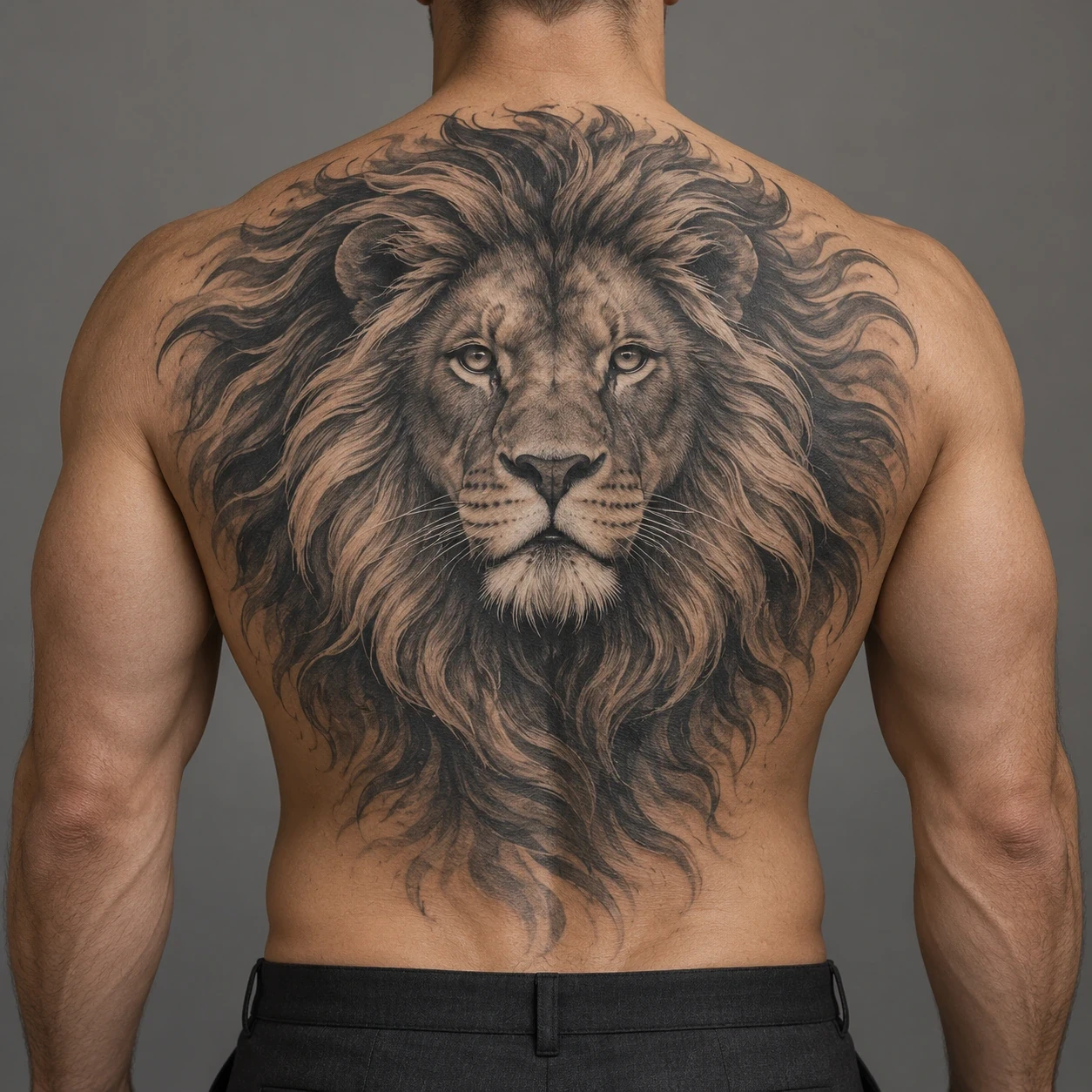
A forward-facing lion uses the space between the shoulders as a balanced frame. The face carries the expression, while the rounded mane gives the tattoo a clear outer edge. In this concept, the lower back stays open rather than becoming an unfinished extension of the portrait.
Compare the height of the face with the width of the mane. Ask the artist to mark the eyes, nose and bottom of the design on a placement photograph. If you want a standalone upper-back piece, agree on that lower boundary before adding loose strands.
2. A full-back lion with a long mane
This version uses a long tapering mane to connect the upper and lower sections. The face sits high, and the hair narrows toward the waist. That creates a vertical composition rather than a large circular head floating in the middle of the back.
The lower mane needs a deliberate finish. Ask where the longest strands should end relative to your waistband and how much open skin should remain at the sides. Remove extra hair marks if they distract from the main flow; full coverage does not require equal detail everywhere.
3. A profile on one shoulder blade
A side-profile lion changes the balance immediately. The muzzle points outward on the left shoulder blade, with the mane contained behind it. The opposite side remains open, making this a useful comparison for someone who wants a single localized piece.
Ask whether the lion should look toward the spine or toward the arm. Both produce a different relationship with the empty space around it. Check the ear, visible eye and nose in the proposed drawing, and review the placement with your arms relaxed.
4. A roaring lion across the shoulders
The open mouth becomes the center of this broad upper-back concept. The mane spreads outward, while the dark mouth and lighter muzzle create a strong contrast. It has a more forceful expression than the calm portraits elsewhere in the collection.
Review the jaw and teeth before focusing on fur texture. The mouth should read as one connected form, with a clear upper and lower jaw. Ask the artist how they would preserve the expression while simplifying details that are too small for your chosen size.
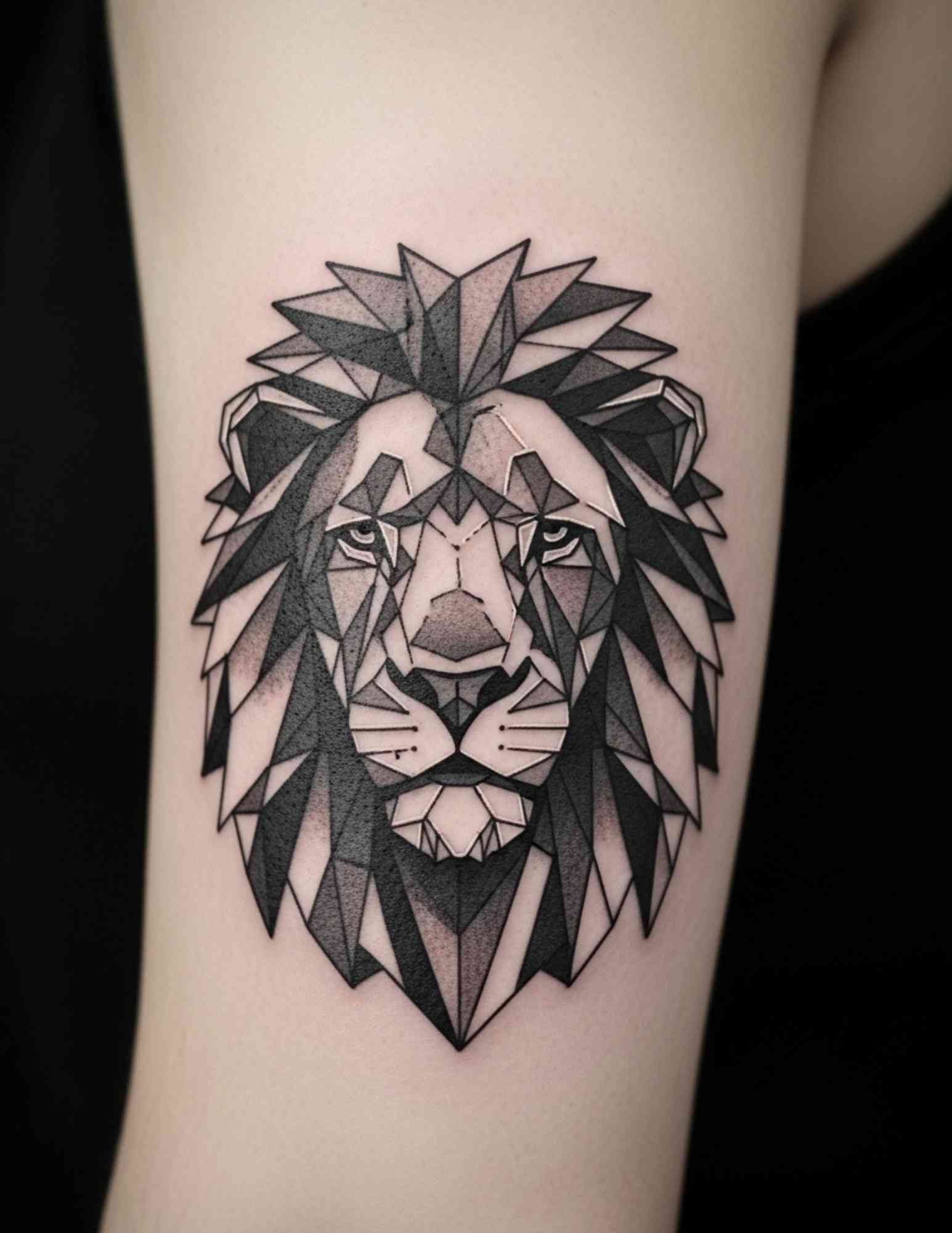
5. A geometric lion built from facets
Angular lines replace much of the fur in this concept. Triangular sections define the mane, cheekbones and muzzle, with dark facets scattered among open areas. The outer shape still reads as a lion, but the construction is deliberately graphic.
Decide which lines define the animal and which are decorative. Keeping every possible triangle can make the face harder to follow. Our geometric lion tattoo ideas offer more style comparisons; here, pay particular attention to the width across your back.
6. A split portrait with realism and geometry
One half uses shaded fur and the other uses angular linework. The shared face links them: the eyes, nose and muzzle must belong to the same head. The contrast gives a centered back piece two visibly different textures without introducing a second subject.
Ask the artist to check alignment before refining either half. Compare the eye level, cheek width and meeting point at the nose. A clean division is more convincing than two unrelated half-portraits pushed together, and the outer mane can remain uneven if that supports the drawing.
7. A lion wearing a simple crown
The crown adds height above a calm front-facing portrait. Its three main points make a separate silhouette, while the mane fills the larger area below. The concept uses a plain ornamental crown rather than a highly detailed object covered in tiny stones.
Tell the artist what the crown means to you, if anything; there is no need to adopt a fixed interpretation. Check the spacing above the ears and the relationship between the crown’s width and the forehead. Keep the points clear of the nape if you want a contained back piece.
8. A lion portrait above one rose
A single rose gives the portrait a rounded lower section. Both subjects use black and grey, so the difference comes from the rose’s layered petals and the lion’s flowing mane. The flower provides an intentional ending below the face.
Choose which subject should dominate. If the lion is the focus, avoid enlarging the rose until it competes with the head. Ask the artist to separate the outer petals from the mane and decide where the leaves should stop before adding another bloom.
9. A lion inside an ornamental frame
Scrollwork gives this portrait a defined boundary across the upper back. The curls spread wider than the face, and the pointed lower ornament provides a centered finish. This is a generic decorative frame, with no claimed religious or cultural identity.
Judge the frame at the same time as the lion. There should be enough open space to distinguish the mane from the surrounding curls. Ask which sections of ornament can be reduced, especially around the ears, where several dark forms can compete.
10. A bold blackwork lion
Large black shapes and open skin gaps form the mane and face. This version avoids a field of tiny fur marks, so the silhouette and the facial divisions do most of the work. It is a useful contrast to the softly shaded portraits in this collection.
Discuss the amount of solid black you actually want. Ask the artist to show the black areas and untouched gaps as a simple drawing first. The eyes and muzzle need to stay identifiable within that structure; a dramatic outline alone is not enough to resolve the face.
11. A dotwork portrait on the shoulder blade
Stippled dots build the light and dark areas of this smaller right-shoulder-blade portrait. The placement leaves most of the back open. The concept compares a contained, textured head with the much wider compositions shown above.
Ask to see healed dotwork examples at a comparable size. Decide how much of the mane needs texture and where simpler open areas could help. The dots should support the expression rather than become the only thing you notice about the design.
12. An open-line lion between the shoulders
Broken contours suggest the mane without filling every strand. A few stronger marks describe the eyes, nose and mouth, leaving most of the surrounding skin visible. This is a simplified drawing rather than a miniature version of a detailed realism portrait.
Ask the artist to choose a workable size for the actual lines and gaps. Do not assume the image can be reduced indefinitely. Try the outline on a placement photograph and decide whether the open space feels intentional before adding shading to fill it.
13. A lion beneath a plain sun disc
A thin circle above the mane adds a simple second shape. The face remains the center of attention, while the circle gives the upper part a clear boundary. The disc is a decorative element here, without a claimed universal or sacred meaning.
Check where the circle meets or disappears behind the mane. A deliberate overlap is clearer than several near-touching lines. Ask the artist whether the round shape should stay centered on the spine or be adjusted to balance the portrait’s particular outline.
14. A lion with an acacia-tree landscape
The portrait sits above a small landscape with a broad tree canopy and low hills. The scene makes the lower section different from another length of mane. It adds a setting while keeping the lion as the larger subject.
Keep the landscape subordinate if the face is your priority. Ask the artist how many background details the final size can support, and decide whether the tree needs to touch the mane or sit below a visible gap. Avoid adding more animals merely to fill the remaining skin.
15. A colour neo-traditional lion
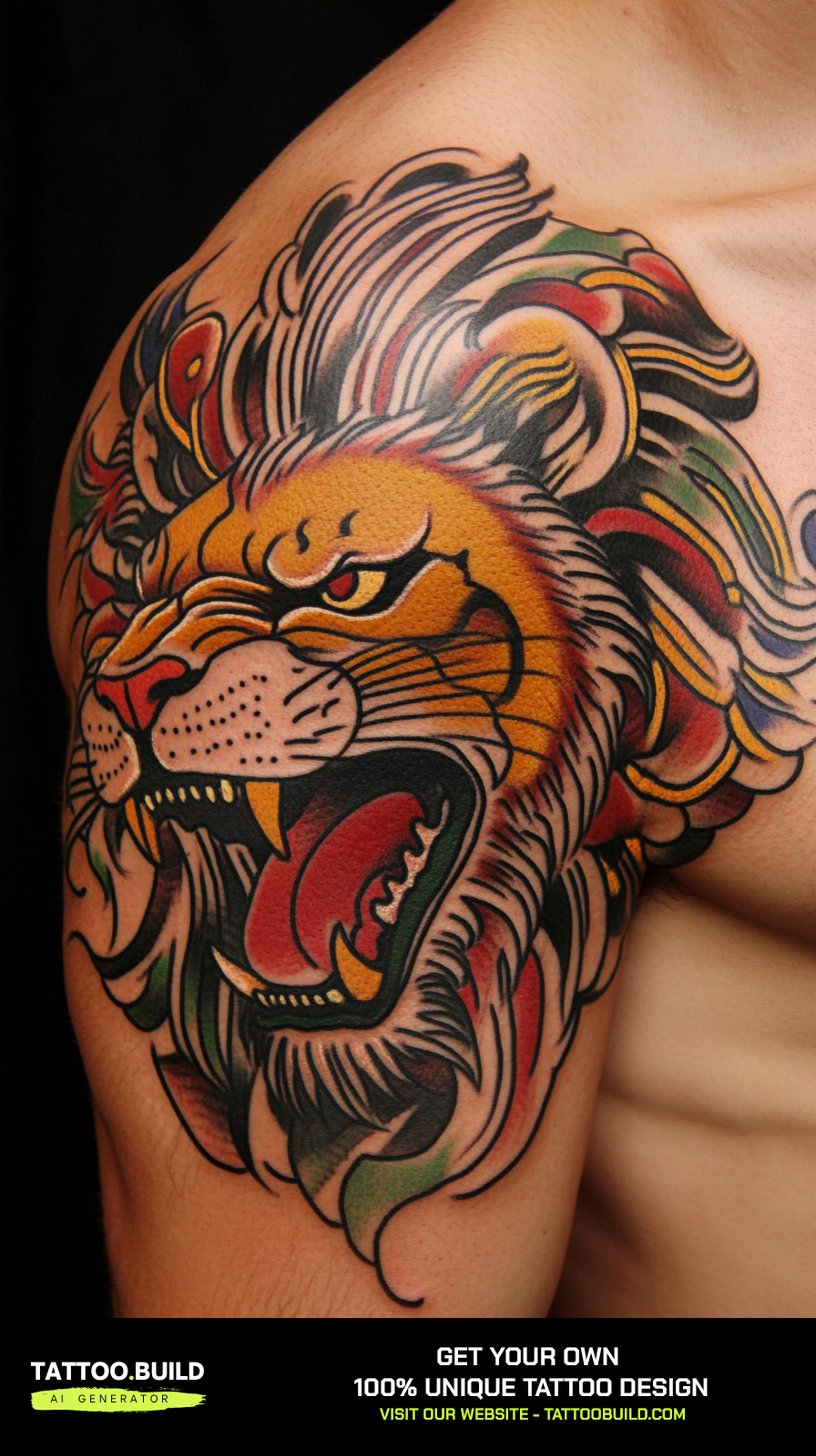
Gold and rust sections, dark outlines and green leaf accents give this lion a different visual character from the grey portraits. The mane is organized into broad shapes. Here, gold describes the colour choice, not a promise of reflective metallic ink.
Compare the design as an outline before deciding on the final palette. Ask the artist how the colours relate to your skin tone and their own healed work. You can simplify or remove the leaves if you want the lion’s head to be the entire composition.
16. A walking lion across the upper back
A full animal makes a horizontal layout rather than a portrait. The head faces left, the body crosses the center and the curved tail finishes on the opposite side. The lower back stays bare, so the tattoo reads as one complete upper-back piece.
Review the body before the mane: the legs, paws, back line and tail should connect coherently. Ask the artist to test the animal’s total width on your back, including the tail. A comfortable margin at both sides can be more useful than pushing the outline to the edges.
Fit the drawing to your back
Bring a straight-on photograph with your arms relaxed, along with a few references that show the style you want. Explain which boundary matters most: the collar line, shoulder edges, center line or waistband. Ask the artist to show the full outer shape rather than only a close-up of the face.
Compare a contained piece with a larger plan
If you want an upper-back tattoo, make its ending part of the brief. A portrait with a clear bottom edge can stand on its own. If you already want a larger back composition, discuss the whole layout before committing to a small central head that may constrain later work.
Look at more than the straight-on view
Review the stencil while standing naturally, then ask the artist to check it as you move your shoulders. A design on a body has to be considered on that body. A generated rear-view image cannot establish the correct dimensions or symmetry for you.
Keep a clear priority
Choose one main feature: the expression, the geometric structure, the broad mane or the animal’s full-body shape. Add a crown, rose or landscape only if it supports that priority. Our tattoo styles guide can help you compare the kind of drawing you want before selecting an artist.
Make the consultation specific
A useful brief might be: “A calm lion portrait on the upper back, centered between the shoulders, with open skin around the mane and no background.” Another might be: “A walking lion across the shoulders, with all four paws visible and the lower back left clear.” Both give the artist more direction than asking for something powerful.
If the lion represents courage, family, a personal milestone or something else to you, explain that in your own words. The design does not need to carry a meaning shared by everyone. For a religious, heraldic or other specific emblem, bring a reliable reference rather than treating a generic lion drawing as an accurate version of it.
Ask to see healed examples of the artist’s work in a comparable style and scale. Discuss the drawing process, estimate, appointment plan and touch-up terms. A generated image cannot establish a standard price, number of sessions or pain score, so get those practical expectations directly from the studio.
Plan aftercare and looking after the tattoo
Ask the artist for written instructions suited to the fresh tattoo and discuss how you will manage clothing and reach the area during care. Get medical advice from a doctor or dermatologist for individual skin concerns; an inspiration gallery cannot assess them.
For healed tattooed skin, the American Academy of Dermatology’s tattoo-care guidance recommends broad-spectrum, water-resistant SPF 30 or higher when exposed to the sun, applied before going outside and reapplied at least every two hours. It notes that UV light can fade some tattoo inks. Follow your artist’s fresh-tattoo instructions rather than treating healed-skin guidance as a substitute.
The AAD also recommends seeing a dermatologist for a reaction or a change in tattooed skin. Source checked 19 October 2026. The illustrations here do not show healing stages or guarantee a particular result.
Back lion tattoo questions
Should the lion go on the upper back or cover the whole back?
Choose the footprint you want first. A rounded head or walking lion can make a complete upper-back piece. A long mane or a planned background can extend a composition downward. Ask the artist to compare both outlines on a photograph of your back.
Can a lion back tattoo be simple?
Yes. The outline and blackwork concepts show two ways to reduce detail. Keep the recognizable face and outer shape, then let the artist decide which lines are necessary at your chosen size. Simpler does not have to mean very small.
Does a lion tattoo have to mean strength?
No. You can choose it for the animal, its appearance or a personal association. If you want to communicate something specific, explain that to the artist and decide whether the expression or supporting elements help express it.
Is black and grey better than colour?
They create different effects. Compare the shaded, blackwork and colour examples as drawings, then look at the artist’s healed portfolio. Choose the approach you prefer without assuming that one palette guarantees a better result for every person.
How should I prepare references for the artist?
Choose a few images and label what you like about each: the placement, expression, mane shape or amount of open skin. Include a photograph of the intended area and be clear about what you want the artist to change. Use these concepts as a brief for an original drawing.