A Saint Michael tattoo can center on an armored, winged figure, a scene with a dragon, a portrait or a simpler sword-and-wings emblem. The first decision is which part of the subject matters to you: the figure, the narrative or the attributes associated with Michael in Christian art.
These 16 Saint Michael tattoo ideas compare 13 figure-based designs and three symbolic emblems. Some suit a tall composition, while others use a round frame or a compact silhouette. Choose the reference and overall shape before asking an artist to fit the details to your placement.
Image disclosure: Every image is an original AI-generated tattoo concept on a plain background. These are not real or healed client tattoos, historical artworks or approved religious icons. A tattoo artist needs to redraw and review the anatomy, objects and spacing before tattooing.
Understand the reference before choosing the design
In Revelation 12:7–9, Michael and his angels fight the dragon, which the passage identifies with the Devil and Satan. That text supplies the narrative behind many images of Michael confronting a dragon. The stylized creatures in this article are artistic shorthand, not literal illustrations of every detail in the passage.
The sword and scales also have an art-historical context. The National Gallery’s entry for Giovanni dal Ponte’s Saint Michael roundel describes a sword for fighting the devil and scales associated with the Last Judgement. Scales are a traditional artistic attribute; they are not an object specified in Revelation 12:7–9.
A wearer may choose the subject as an expression of faith, courage, remembrance or a personal struggle. Those are possible personal associations, not a universal tattoo meaning or a promise of protection. A winged sword alone is an emblem inspired by the imagery and will not identify Michael as precisely as a complete, clearly referenced figure.
For broader compositions, compare our angel tattoo ideas and angel tattoo drawings. Use them for layout comparisons while keeping the specific Saint Michael attributes clear.
1. Michael above a small dragon
The full figure and small dragon create a narrative composition with an obvious upper and lower section. Wings broaden the silhouette, while the lowered sword gives it a strong vertical line. The creature stays secondary to Michael rather than filling half the image.
Ask the artist to keep the feet, dragon and sword separate enough to read. If the lower section becomes crowded, simplify the creature before adding more scales or rock texture. This concept refers to the biblical battle through a restrained scene without graphic injury.
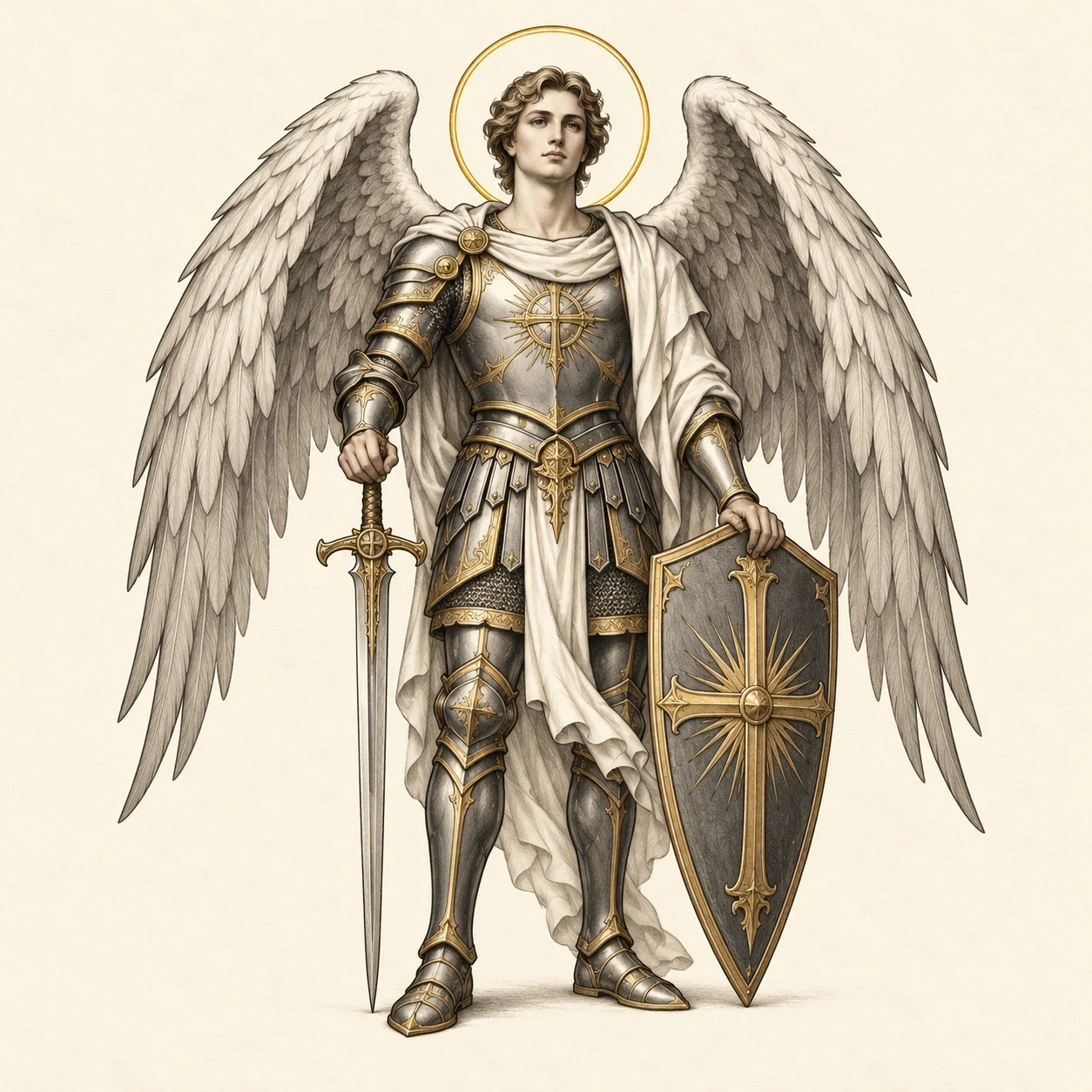
2. A standing figure with a shield
A shield gives the figure a broad shape on one side, balancing the sword on the other. The standing pose keeps the design calm and structured. A simple halo and open wings make the central body easy to locate within the composition.
Agree on the shield’s outline and how the arm connects to it before adding ornament. The sword should remain one clear object. This arrangement needs enough room for the hands and armor; shrinking the entire illustration may sacrifice the details that explain the pose.
3. Michael with a spear and serpent
A long spear creates a narrow direction through the design. The small serpent adds a lower narrative element without requiring a large dragon. Wings and armor still establish the central figure, while the spear changes the silhouette from the sword-based concepts.
Check that the hand grips one continuous shaft and that the spear ends where intended. The serpent should remain a separate, complete shape near the feet. Discuss how much of that supporting creature you need instead of compressing a complicated scene into the remaining space.
4. A sword and balance scales
The sword and two-pan balance make the attributes part of the composition. This direction connects to Western Christian art in which Michael appears with scales, giving the design a different emphasis from a dragon scene. A clear central figure holds the objects together.
Have the artist resolve the scale’s crossbar, hanging lines and pans before refining armor or feathers. Those connections are easy to lose in a small drawing. Decide which object should attract attention first and let the other remain a supporting feature.
5. A kneeling figure resting on a sword
A kneeling pose changes the mood from a standing victory scene to a quieter, contemplative composition. Hands resting on the sword’s pommel provide a central focus. The bent leg and wings create a wider shape than a straight standing figure.
This is a modern compositional choice, not a claim that the pose illustrates a particular passage. Ask the artist to check the knees, feet and hand positions carefully. Keep the sword readable between the arms and leave space around the lower silhouette.
6. An armored portrait bust
A head-and-shoulders design brings attention to the face, halo and armor instead of a full-body scene. Wing sections behind the shoulders provide context without needing an entire feather span. The result can use a compact shape while retaining a figure-based reference.
Choose the expression and armor outline before working on small decorative details. Ask how much of the wing structure is necessary to explain the subject. A portrait needs a carefully drawn face, so review the artist’s comparable work rather than treating the generated face as a finished stencil.
7. A simple linework figure
Open linework reduces the subject to its main pose, wings and sword. Fewer shaded areas make the structure easier to inspect. This direction is useful when you prefer an airy drawing but still want a complete figure rather than a symbolic emblem.
Simplicity does not mean retaining every tiny feather as a thin line. Ask the artist which marks explain the pose and which can disappear. Review the hands and sword at the intended tattoo size before deciding whether the figure needs more space.
8. A bold blackwork silhouette
Dark areas and open channels make the figure’s outline the priority. The wings and lowered sword establish the overall shape before the viewer studies the armor. Broad contrast gives this concept a different character from the fine-hatched version.
Plan the areas that remain skin as deliberately as the black sections. A few separated feather groups are more useful than a solid mass with no clear edge. Have the artist check that the sword and limbs do not disappear into the shadows.
9. Engraving-style armor and wings
Hatched shading builds texture across the armor and layered feathers. The full-length figure supplies a clear outer shape, with the fine marks supporting it. This direction suits someone drawn to illustrated detail rather than broad color panels.
Ask which hatching can be enlarged or removed for the chosen placement. The dark and light areas should still work without every fine stroke. View the whole design at normal size before approving a close-up of its most intricate section.
10. A stained-glass-inspired arch
Blue, red and gold sections give the figure an architectural frame. Dark divisions suggest stained glass while the arch provides a distinct outer boundary. The sword, wings and halo remain the central subject instead of becoming small decoration inside a busy window.
Keep the larger color sections clear and limit the number of narrow compartments. This is an illustrated glass effect, not a photograph of a church window. The artist can adjust the panel shapes around the figure rather than copying every dividing line.
11. Bold color with a red cloak
A red cloak, gold halo and strong outlines create a direct, colorful figure study. The waist-up composition reduces the number of small body details compared with a full-length scene. Wings and a vertical sword supply a recognizable structure around the armor.
Choose the palette together so the cloak and wings do not compete. Ask the artist to keep the hand-to-sword connection clear and decide where the lower edge should finish. The drawing should end intentionally rather than look like a full figure cropped by accident.
12. A figure inside a pointed arch
A narrow pointed frame gives the design a tall architectural shape. Partly folded wings allow the figure to sit within it without needing an enormous span. Open space inside the arch separates the armor and sword from the border.
Check the frame with the intended body placement, especially where it curves. Keep the background quiet enough for the figure to remain dominant. A single clean arch can communicate the idea without adding miniature columns, windows and stonework to every gap.
13. A round portrait medallion
A circular frame changes the format from a vertical figure into a compact portrait. The halo and wing details sit around the head and armor, with a simple double border containing the composition. The face becomes the main focal point.
Ask the artist to judge the face and border at the same time. A heavy rim can overwhelm a small portrait, while an overly detailed face can crowd the inner circle. Leave out lettering unless you have a specific, verified text and enough room for it.
14. A winged sword and halo emblem
This design uses a sword, two wings and a halo without a human figure. It offers a symbolic reference to the imagery rather than a literal portrait of Saint Michael. Symmetry makes the outer shape easy to compare across different placements.
Keep the sword straight and the feather groups distinct. Tell the artist whether the halo should float above the hilt or sit behind it. If identifying Michael unambiguously matters to you, discuss adding a more specific reference or choosing a figure-based design instead.
15. A shield, sword and leafy-branch emblem
A cross-marked shield sits in front of the sword, with leafy branch branches framing the lower section. This is a modern emblem rather than a claim to reproduce a historical insignia of Saint Michael. The limited objects create a compact, structured design.
Choose which element leads the composition: the shield, sword or branches. Avoid adding so many small leaves that the main outline becomes difficult to see. The cross is an intentional Christian element here, so discuss its form and significance as part of your own brief.
16. A sword and scales emblem
The last concept isolates the sword and balance scales beneath a small halo. Removing the figure makes the objects themselves the subject. It is an attribute-based interpretation connected to Michael’s depiction in art, rather than a miniature version of the full-figure design.
Ask the artist to keep the scale mechanically coherent, with the pans hanging from a clear crossbar. Decide how the lines overlap the blade before refining their weight. If the design becomes too dense, reduce the ornament rather than leaving ambiguous connections.
Fit the composition to the available space
Forearm, calf and other tall placements
A standing figure, pointed arch or long sword creates a tall design. Compare the full width of the wings with the usable width of the placement before deciding how much detail to retain. A narrow central body can fit while the wing tips still wrap out of view.
Ask the artist to show the drawing in a natural stance and from more than one angle. Choose the direction of the face and sword deliberately. If the wings need to fold inward or the shield needs to move, those are drawing decisions to settle before tattooing.
Upper arm, shoulder and broader placements
A kneeling figure or wider wing span needs a different outline from a narrow arch. Give the artist a reference showing the whole subject, including the feet and weapon tip. Let them adapt the pose around the body rather than cropping away parts that do not fit.
Smaller portraits and emblems
A medallion or attribute-based emblem can reduce the number of separate subjects. It does not remove the need for space between lines. Ask which facial details, feathers or scale chains the artist would simplify at the size you are considering. Reducing the number of objects may communicate the idea more clearly than shrinking a full battle scene.
Keep religious context and artistic choices distinct
Michael’s imagery is not identical in every Christian context. The Orthodox Church in America’s account of the Synaxis of Michael and the Bodiless Powers emphasizes Michael’s leadership among the heavenly powers. Western paintings may emphasize the dragon scene, armor or the scales. These references can inform the brief without turning one modern tattoo drawing into a universal religious standard.
Devotional images and tattooing are questions people approach differently within Christian communities. This article offers design comparisons, not a religious verdict. If the design is an expression of your faith, discuss the subject and its intended use with a knowledgeable leader in your own tradition as well as the tattoo artist. The concepts here are not presented as liturgical icons or church-approved designs.
Be specific about identification. A generic angel with a sword does not establish every detail of a Saint Michael reference, and a winged sword can also have meanings unrelated to Michael. If you want the subject to be clear, agree on a reliable source image and the attributes you want retained. The last three designs in this collection are explicitly modern emblems.
Before approving the drawing, check each hand, the path of the sword or spear, the wing attachments and any creature at the feet. A scale should have a clear crossbar and hanging pans. Extra ornament cannot compensate for an object that does not connect coherently. Treat the AI image as a visual starting point for an artist’s corrected drawing.
If you include a verse reference, verify the book, chapter and verse. If you include actual wording, choose the translation and check it character by character. Revelation 12:7–9 is the battle reference discussed above; this article does not turn a paraphrase into a scriptural quotation. None of the concepts needs lettering.
Ask practical questions before booking
Request a quote for the final drawing, size, placement and color plan. Ask whether the proposed work is one appointment or several, and what any touch-up policy includes. The illustrations are not booking specifications and cannot establish a standard price or session length.
Get written aftercare guidance from the artist and discuss any relevant clothing, work or activity requirements. For healed tattooed skin, the American Academy of Dermatology recommends broad-spectrum, water-resistant SPF 30 or higher sunscreen before going outside and reapplication at least every two hours. It notes that UV light can fade some tattoo inks.
Follow the artist’s instructions for a fresh tattoo and ask a clinician about skin concerns. The AAD advises seeing a dermatologist for reactions or changes in tattooed skin. Sources were checked on 18 October 2026. These concept illustrations do not show healing stages or predict an individual result.
Saint Michael tattoo questions
What does a Saint Michael tattoo mean?
The biblical battle and Michael’s depiction in Christian art provide the reference. A wearer may connect the subject with faith, courage, remembrance or a personal experience. Explain your own intention rather than assuming a single meaning applies to everyone or that a tattoo guarantees protection.
Does the design need a dragon?
No. A dragon makes the battle narrative more explicit, but a figure can also use armor, wings, a sword or other referenced attributes. Choose the composition with your artist. A simple emblem is a different direction from a complete figure and should be described as such.
Why do some Saint Michael designs include scales?
Scales appear in historical Christian art associated with judgement, as the National Gallery explains for the Giovanni dal Ponte roundel linked above. They are an artistic attribute, not a detail stated in Revelation 12:7–9. Include them if that reference is part of the design you want.
Can the tattoo be small?
A small version generally needs fewer objects and less detail. Compare an emblem or portrait with the complete figure and dragon scene. Ask the artist what they would simplify at your intended size instead of preserving every line from a large illustration.
Is black and grey or color better?
Choose based on the drawing and the artist’s work. Black and grey can emphasize the figure’s structure, while restrained color can separate a cloak, halo or framed panel. Review healed examples in the style you prefer; generated colors are not a prediction of a real tattoo’s appearance over time.
How should I prepare the reference?
Choose one main concept and list the elements to keep: for example, a standing figure, folded wings and a point-down sword. Add the intended placement and any personal or religious context. Give the artist room to correct the anatomy and redraw the subject for your body.