A Japanese-inspired hand tattoo needs a clear focal point. A flower, a curling wave or a compact mask can use the back of the hand well, but the drawing still has to work when the fingers move and the wrist bends. A large sleeve reference rarely becomes a good hand design just by shrinking it.
These 16 Japanese hand tattoo ideas compare floral, animal, mask and landscape directions. Some use bold color and black framing; others leave more skin visible. Use the images to choose a composition, then ask an artist experienced in Japanese-style work and hand placements to redraw it for you.
Image disclosure: Every image in this guide is an AI-generated design concept. These are not photographs of real or healed client tattoos, and they do not represent a particular artist’s portfolio. The designs include modern interpretations rather than a claim that every combination follows a traditional Japanese tattoo system.
Start with the shape of the hand
Choose the boundaries before choosing all the details. A centered flower can form a rounded composition, a fish or branch can follow a diagonal, and a wave can stretch across the hand. Decide whether the design should stop at the wrist, meet an existing sleeve or leave an open margin around it. The concepts here keep the fingers separate from the main subject.
For a broader introduction to motifs and layouts, explore our Japanese tattoo designs guide. If you prefer a quieter drawing, our minimal Japanese tattoo ideas show how fewer elements can change the overall effect.
Ask the artist to check the stencil with your hand resting, your fingers gently spread and your wrist in a normal position. Choose which way you want the subject to face while your arm hangs naturally. That is more useful than approving a perfectly flat image without seeing it on your own hand.
1. Yellow chrysanthemum with dark leaves
A chrysanthemum uses the broad central area of the hand as a round flower shape. Yellow petals stand apart from the dark leaves, and the pointed outer petals make the silhouette more distinct than a simple circle. The flower remains the main subject without a separate background scene.
Choose the overall petal rhythm before adding fine lines. A few strong layers can explain the flower clearly. Ask the artist which small divisions they would open up at your intended size, and where the leaves should finish near the wrist and knuckles.
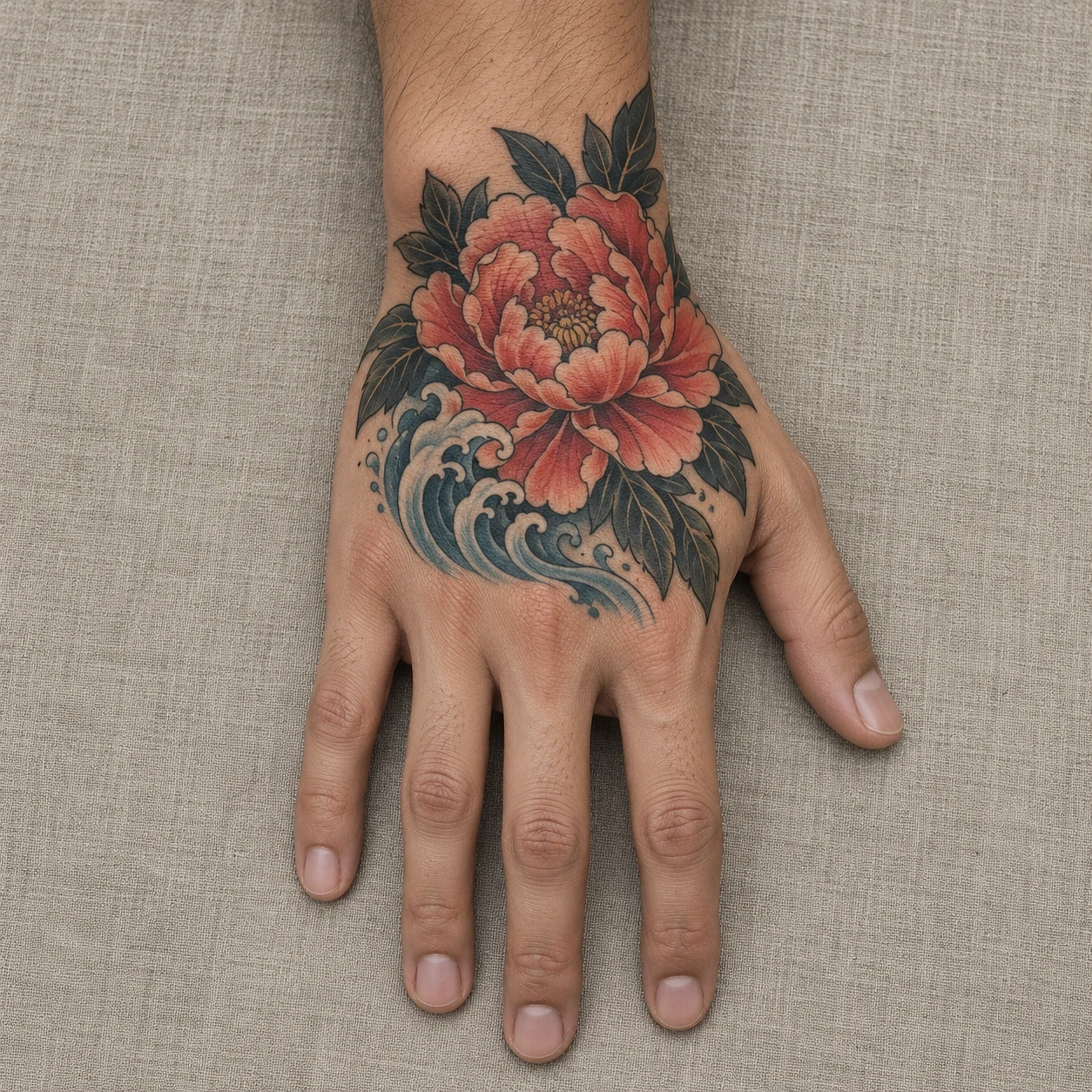
2. Coral peony with grey leaves
Broad overlapping petals give this peony a softer, fuller outline. Coral color carries the flower while grey leaves keep the surrounding shapes quieter. The arrangement feels complete as a single hand piece, making it a useful direction if you do not want to connect it to a sleeve.
Compare the flower’s center with its outer edge: both need to remain clear. Give the artist permission to change the number of petals and move the leaves. Copying every small fold from the concept is less useful than preserving its full, open shape.
3. Cherry blossoms on a short branch
Three pink blossoms on a short branch create a diagonal arrangement with visible skin between the flowers. This offers a lighter composition than full-hand background work. The branch gives the separate blossoms one shared direction rather than scattering them across the hand.
Keep the ends of the branch intentional. Ask the artist where the line should begin and stop, and how the blossoms sit when you move your thumb. Avoid adding extra petals to every remaining gap; the open spaces are part of this design’s appeal.
4. A blue curling wave
A curling wave makes movement the main feature. Broad blue bands and pale foam tips can fill the back of the hand without needing a second subject. The curve also offers a clear direction for the drawing, which you can check with your arm held naturally at your side.
Let the artist simplify the foam before deciding on a final size. Too many narrow curls can distract from the main arc. Discuss whether the wave should finish cleanly at the wrist or share its direction with a larger piece, such as the compositions in our Japanese full sleeve tattoo ideas.
5. A curved koi with water accents
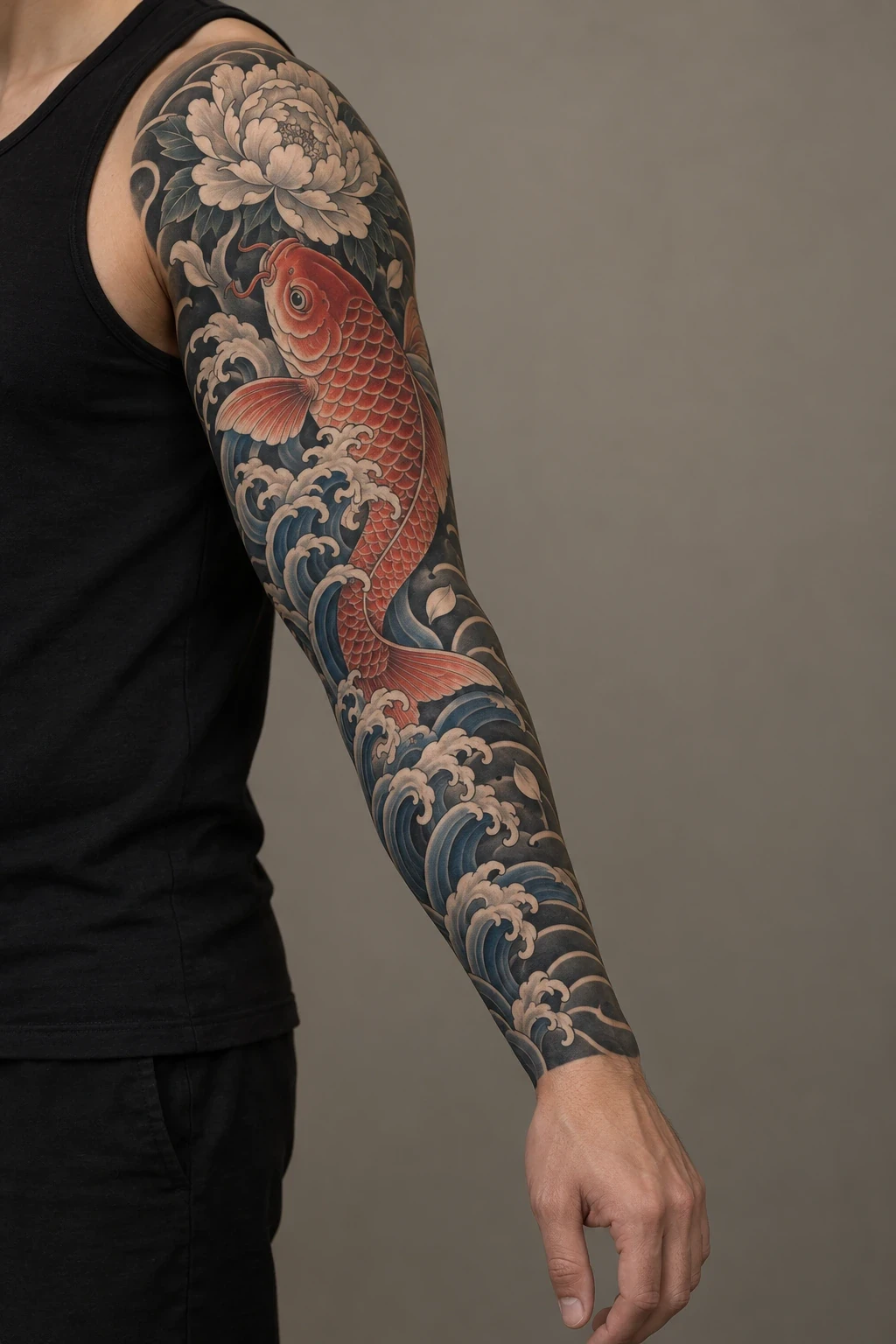
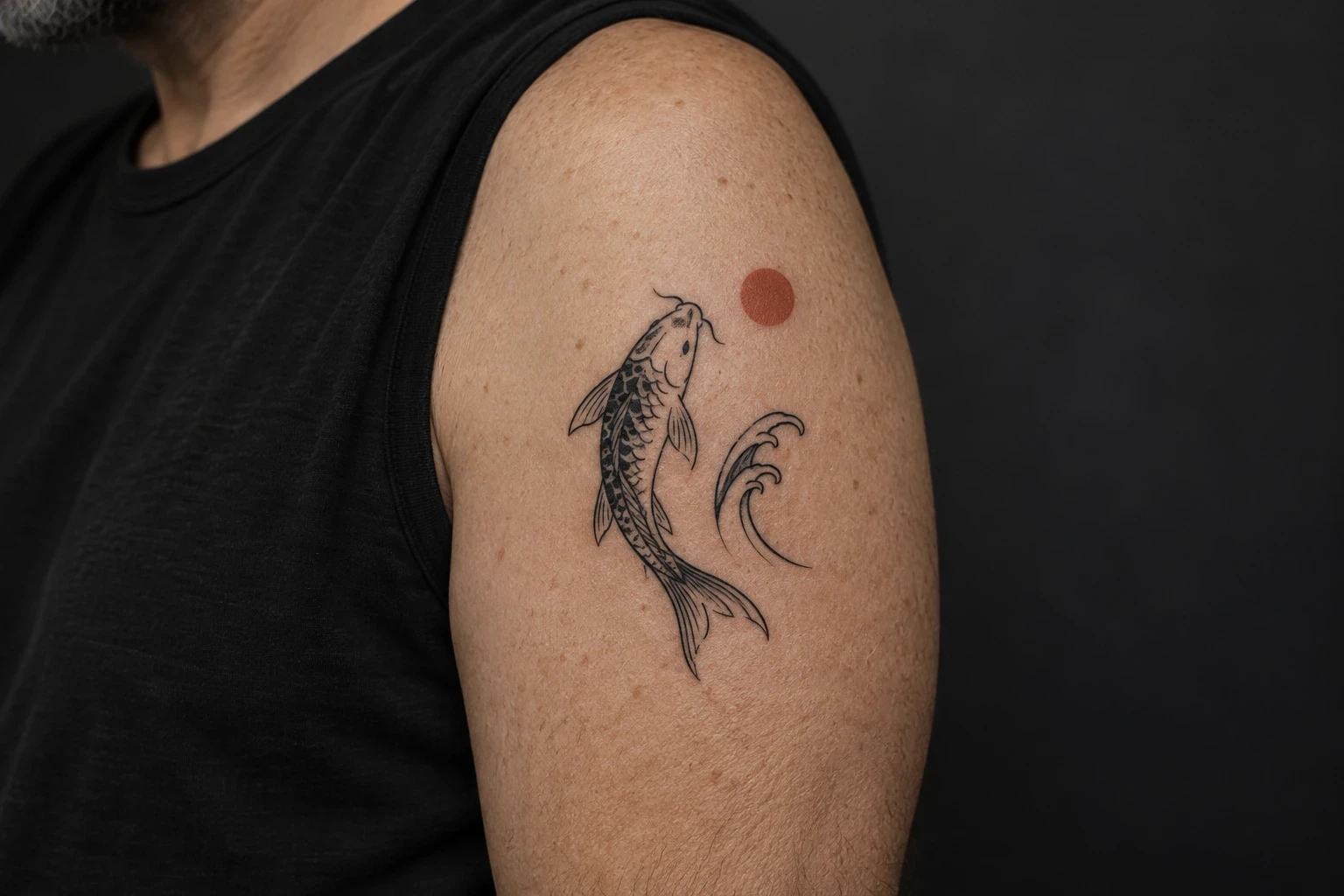
One koi provides a compact animal subject with a strong head-to-tail direction. Orange and black areas separate the body from small blue water accents. A gentle curve can use the hand’s diagonal space without sending the fish onto several fingers.
Check that the head, fins and tail remain individually readable. If the body pattern starts to dominate the fish’s outline, ask for larger color sections or fewer markings. Decide the swimming direction on a stencil rather than relying on a fixed meaning for an upward or downward angle.
6. A dragon head in grey and red
A dragon head concentrates the design into a face rather than trying to fit a long coiling body onto the hand. Horns, whiskers and the muzzle create the silhouette. Restrained red accents give the grey drawing a focal color without filling every section.
The face needs a resolved structure before it needs more scales. Ask your artist to check the jaw, eyes and horn connections, and to remove whiskers that crowd the outer boundary. If a full dragon is the goal, use the hand as one part of a larger planned composition.
7. A red oni-inspired mask
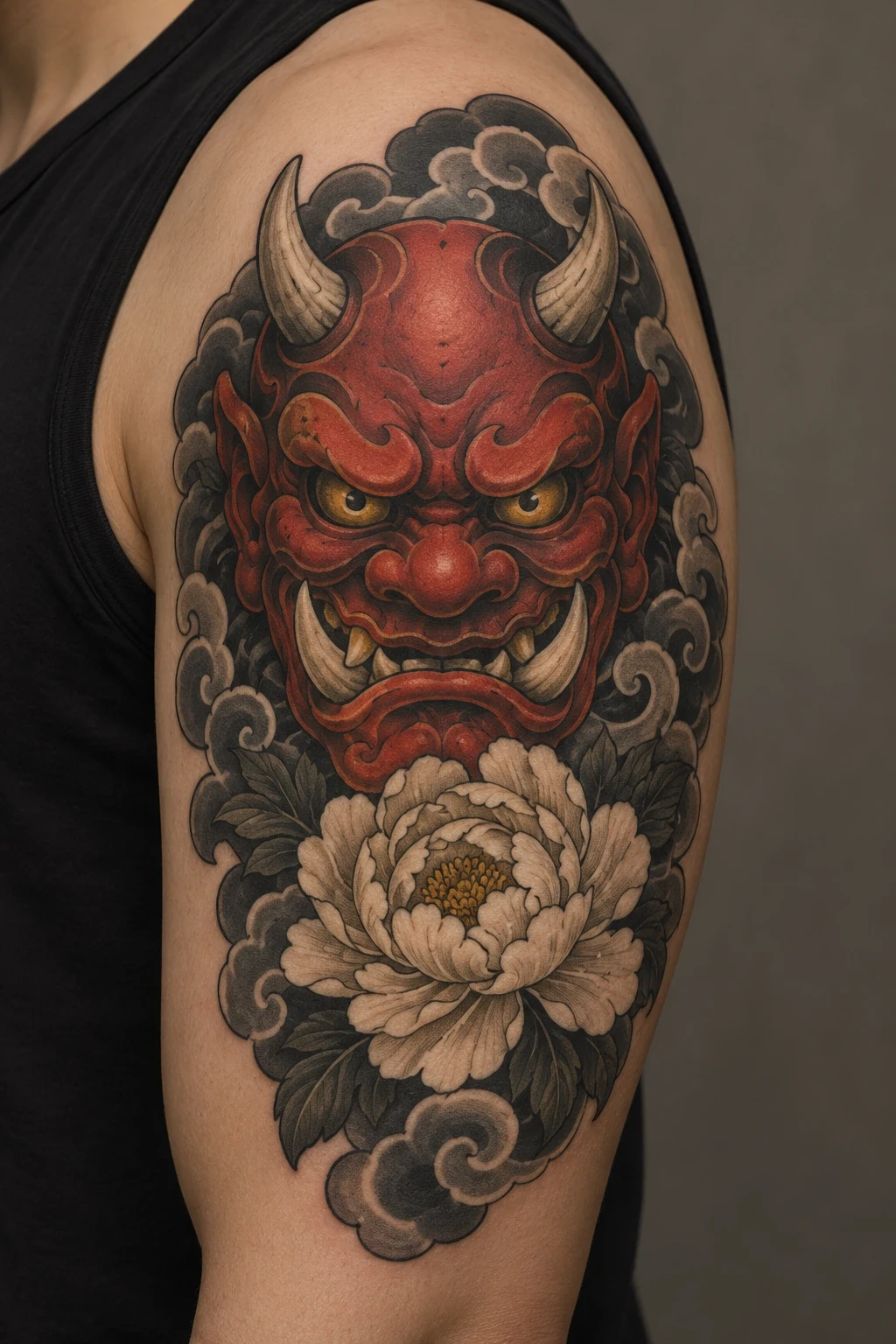
A frontal red mask makes a strong central shape. Short horns, a broad nose and lower tusks give this concept its character, with dark shading around the face. The compact mask can stand alone without surrounding flowers or an elaborate background.
Bring a clear reference for the kind of mask you want. Oni and hannya-inspired designs are different directions, and a generated image is not enough to establish the exact features. Our Japanese oni mask tattoo designs compare more mask and framing options.
8. An ivory hannya-inspired mask
The ivory palette and angular face make this mask a different choice from the broad red oni concept. Narrow horns and red accents create contrast around the face. Its vertical structure can help organize the space between the wrist and the knuckles.
Choose the mask reference before adding decoration. Have the artist resolve the eyes, mouth and horn shape from reliable theatrical or art references. Do not rely on a generic caption to assign a personal meaning: tell the artist what draws you to the expression and which features you want retained.
9. A black and grey snake in an S curve
A single S curve gives the snake a readable route across the hand. The head and tapering tail provide clear endpoints, while a restrained pattern keeps the body connected. This direction works as an illustration of one animal rather than a tightly packed knot of coils.
Draw the whole body path first and add the surface details second. Where the snake changes direction, the curve should stay clear without relying on tiny scales. Ask the artist how much of the hand the shape needs and whether the tail should point toward the wrist or the fingers.
10. Red maple leaves and curved accents
Three pointed red leaves create a loose diagonal composition. Short black curves give the arrangement a shared direction, while gaps between the leaves preserve their individual shapes. The result can feel energetic without a large animal or face as its center.
Review the leaf silhouettes at the size you plan to wear. Keep the main points clear and simplify the smallest internal lines if necessary. Ask the artist to place the black accents deliberately so they frame the leaves instead of filling every available space.
11. Golden ginkgo leaves on a small branch
Fan-shaped ginkgo leaves offer a softer outline than the pointed maple design. Their golden color and notched upper edges provide the visual identity. A small branch connects the leaves while allowing the hand’s skin to remain visible around them.
Choose the balance between the leaves before adding fine veins. One larger fan shape with two supporting leaves reads differently from three equal leaves. If you want a very spare design, ask the artist which leaf contributes most to the composition and which could be omitted.
12. A black and grey bamboo branch
Bamboo gives this hand concept a directional, brush-like shape. Stem joints and long leaves create contrast between straight and tapered marks. A black and grey palette keeps attention on the line and the spacing rather than on multiple colors.
Use the diagonal as a guide, not a requirement to cross every joint. Have the artist decide where the stem ends and where each leaf joins. The design should look intentional with your hand at rest, and the smallest leaf clusters should not compete with the main stem.
13. A compact crane with open wings
A white crane with black wing tips and a red crown offers a more open bird composition. The wings provide width, while the neck gives the design a central curve. The surrounding skin is important because it helps separate the bird’s pale body from the hand.
Check the silhouette before choosing feather details. Ask the artist to make the neck, wings and legs connect clearly in the final drawing. A hand-sized bird may need fewer feather lines than a larger arm or back reference, particularly near the wing tips.
14. A folding fan with blossom details
A half-open fan turns the hand design into a broad graphic object. Cream panels, dark ribs and small red blossom accents create a restrained palette. The pivot gives the shape a clear center, so the fan does not need a complicated scene painted across every panel.
Ask how the fan should align with the knuckles and wrist. The ribs need to meet coherently, and the blossom decoration should stay secondary to the outer shape. Leaving out lettering keeps this concept focused; any requested text would need separate language verification.
15. A mountain and water landscape
A blue mountain with a pale snowcap above broad water arcs creates a simplified landscape. It offers a different scale of subject from the close-up flowers and masks. The limited elements keep the scene from becoming a tiny picture crowded with buildings, trees and clouds.
Treat the mountain and water as an illustrated composition rather than a literal geographic view. The artist can adjust their proportions to fit your hand. If the landscape needs many more details to express what you want, discuss using a larger placement instead.
16. A blackwork chrysanthemum with open petals
This chrysanthemum takes a different approach from the yellow flower: solid black areas and open petal channels create the contrast. Curved framing near the wrist makes the composition more substantial. The design depends on the separation of its larger shapes rather than on color.
Agree on which areas will remain skin before tattooing. Keep the petal channels purposeful and give the flower a clear outer boundary. Compare the outline weight and background density with our broader hand tattoo ideas if you are still deciding how much coverage you want.
Fit the design to the placement you will actually wear
A centered back-of-hand piece
For a standalone piece, mark the available area between the wrist and knuckles. A flower or frontal mask can sit within that space without needing to continue onto the fingers. Leave room around the design in the reference you bring so the artist can judge its full boundary.
Choose the direction while your arm hangs comfortably. A face that looks upright to you when you raise your hand will face differently to someone standing in front of you. Neither choice is automatically correct; agree on the orientation before the artist applies the final stencil.
A hand-to-wrist connection
If you already have a sleeve, bring photographs of it from the front, back and sides. The new piece needs a plan for where it meets the wrist, including the background direction, palette and amount of open skin. Let the artist decide whether a shared wave, leaf or dark curve creates the clearest connection.
Fingers and knuckles are a separate decision
These concepts focus on the back of the hand. Do not assume that adding matching finger marks is a small finishing detail. Discuss those areas separately, with their own placement drawing and examples from the artist’s healed portfolio. It is reasonable to keep the fingers clear even with a substantial central piece.
If you are uncertain about the visibility of a hand tattoo, ask the artist to compare the concept on your wrist or forearm. Review your own work, uniform and daily-activity requirements before booking. This is a personal planning decision, and no inspiration image can tell you how a particular workplace will respond.
Use references carefully
Japanese-inspired imagery includes several distinct subjects, and the label alone does not make every drawing traditional. Decide whether you want an artist’s contemporary interpretation or a composition built within their Japanese tattoo practice. Ask them to explain the pairing of motifs and the background rather than attaching a fixed meaning to every color.
For example, chrysanthemums appear in Japanese art beyond tattooing: the Metropolitan Museum of Art records Hokusai’s Yellow Chrysanthemums on a Blue Ground as a Japanese woodblock print from around 1825. An artwork can help you discuss petal shapes and color, but that does not establish one universal meaning for a chrysanthemum tattoo.
Mask references deserve the same care. The Ohtsuki Noh Theatre’s mask guide identifies hannya with a woman suffering from jealousy and anger. That theatrical context is useful when choosing a mask; it does not tell you what a tattoo must mean personally. The mask concepts above are stylized and need an artist’s review of the face and horns.
For animals, trace the complete outline before examining the surface pattern. A fish needs a clear head, fins and tail; a crane needs a coherent neck and wing structure. For flowers, look for a readable center and distinct outer petals. Let the artist change those details rather than asking them to reproduce an AI image without correction.
If you add Japanese writing, verify the exact wording, meaning and character form with a fluent reader before tattooing. None of these concepts requires lettering. A reliable translation and a tattooable character drawing are separate parts of that decision.
Discuss hand-specific aftercare before booking
Explain your usual handwashing, gloves, tools, sports and other daily activities to the artist. Ask how their written aftercare instructions apply to those activities and how you should plan the appointment. Do not assume you can follow the same schedule as someone with a tattoo on a different body area.
For healed tattooed skin, the American Academy of Dermatology recommends broad-spectrum, water-resistant sunscreen with SPF 30 or higher before going outside, reapplied at least every two hours. It notes that ultraviolet light can fade some tattoo inks. Follow your artist’s instructions for a fresh tattoo and ask a clinician about skin concerns.
The AAD also advises seeing a dermatologist for a reaction or a change in tattooed skin. These sources were checked on 17 October 2026. The generated images do not show healing stages or predict how your skin will respond.
Japanese hand tattoo questions
What is a good Japanese-inspired design for the back of the hand?
Start with one subject you can recognize from its outline: a flower, wave, compact mask or a clearly drawn animal. Choose the overall coverage and orientation first. The best option for your hand depends on the artist’s drawing and the available space, not just the motif’s name.
Can a Japanese hand tattoo be small and simple?
Yes, but simplify the drawing rather than shrinking a detailed sleeve reference. A short blossom branch or a few ginkgo leaves offer a different amount of coverage from a full mask. Ask the artist to show you what details they would remove at the proposed size.
Should I choose color or black and grey?
Compare the larger shapes in both versions. Color can distinguish petals or a koi pattern, while black and grey can emphasize the outline and shaded structure. Review the artist’s own healed work in the approach you prefer. The illustrations here are concepts, not evidence of long-term color performance.
How much does a Japanese hand tattoo cost?
Request a quote for the actual drawing, placement, color plan and appointment. Ask what is included and what the artist’s touch-up policy covers. This guide does not provide a standard price because the concepts are not fixed booking specifications.
Do Japanese hand tattoos have one set meaning?
No. The subject may have an art, folklore or theatrical context, while the wearer may have a personal reason for choosing it. Tell your artist which context matters to you. Avoid treating a generic online meaning as a rule that applies to every drawing or wearer.
What should I bring to the consultation?
Bring your preferred concept, photographs of any existing wrist or sleeve work and a short brief describing the details you want to keep. Include how much of the hand you want covered, which direction you prefer and any concerns about daily activities. Ask to see healed hand work before committing to the final drawing.