A hand tattoo is the one placement you cannot take back at the end of the day. It sits in every handshake, every photo and every job interview you will ever have, which is exactly why it deserves more planning than any other spot on your body.
I have sat with a lot of guys who walked into a shop wanting knuckle lettering and walked out with a forearm piece instead, and almost none of them regretted the swap. The hand is not a beginner placement.
That said, when a hand tattoo is designed properly for the hand rather than shrunk down from an arm design, nothing else looks like it. The ideas below are grouped by what actually holds up on this skin, not just what looks good on the day.
If you are still weighing placements, it is worth reading through cool arm tattoo ideas for guys before you commit to something this visible.
Which Hand Placement Is Right for You?
Not every part of the hand behaves the same way. This is roughly how the four main zones compare, based on what artists consistently tell me and what I have watched heal.
| Placement | Pain Level | How Well It Holds Ink | Best Suited To |
|---|---|---|---|
| Back of the hand | High | Good — the most reliable zone on the hand | Bold centrepieces, ornamental work, animals |
| Fingers | Very high | Poor — fades and blurs fastest | Simple symbols, single letters, small shapes |
| Knuckles | Very high | Poor to fair — constant flexing breaks lines | Short bold lettering, thick simple shapes |
| Side of hand / thumb web | Moderate to high | Fair to good | Script, small linework, discreet first pieces |
| Palm | Extreme | Very poor — often needs repeated sessions | Experienced collectors only |
If pain is the part you are most worried about, the wider tattoo pain chart puts hands in context against the rest of the body.
Why Hand Tattoos Behave Differently
The skin on your hands is doing a job no other skin on your body is doing. It stretches, grips, gets washed constantly and sees more UV than almost anywhere else.
Hands also have a thin dermis over a lot of bone and tendon, which is part of why the sensation is sharper here than on a thigh or an outer arm.
The bigger issue is cell turnover. Hands regenerate skin faster than most areas, and every wash, every bit of friction and every hour in the sun pushes pigment out sooner than it would elsewhere.
In practice that means most hand tattoos need a touch up at some point, often within the first year or two. Every artist I have asked treats that as normal rather than as a failure.
None of this makes hand tattoos a bad idea. It just means the design has to be chosen with fading in mind from the start, which is the single thing most people get wrong.
Hand Tattoo Ideas for Men That Actually Hold Up
1. Blackwork and Solid Black Designs
If you want one recommendation that covers most people, this is it. Solid black shapes and heavy blackwork survive on hands better than anything else.
The reason is simple: when a design fades, it loses definition first. A piece built from bold shapes still reads as those shapes after ten years, while a delicate one turns into a grey smudge.
In my experience the guys who are happiest with their hand tattoos five years on are almost always the ones who went bolder than they originally wanted. There are plenty more directions to take this in the blackwork tattoo ideas for men collection.
Ask your artist to size the linework up by a notch from whatever the drawing looks like on paper. On hands, that extra weight is insurance.
2. Ornamental and Mandala Work
The back of the hand is a naturally flat, roughly symmetrical panel, which is why ornamental patterns sit on it so comfortably.
Mandala and geometric ornamental work also has a practical advantage: it is built from repeating elements, so a small amount of fading does not destroy the composition.
The key is spacing. Patterns that look tight and detailed on a screen tend to close up as they heal, so the gaps between lines need to be more generous than feels right.
3. Script and Lettering
Lettering on hands is the most requested and the most frequently regretted. That is not an argument against it, just a reason to be careful about where it goes.
The side of the hand and the thumb web hold lettering far better than the knuckles do. Knuckles flex hundreds of times a day, and that movement breaks up fine strokes.
Keep it short. A single word or a few letters at a decent size will outlast a full sentence squeezed into the same space every time.
For wording that is worth committing to, word tattoo ideas for men is a useful starting point.
4. Skulls and Dark Traditional
Skulls work on hands for a structural reason as much as an aesthetic one: a skull is essentially a bold shape with strong internal contrast, which is exactly the recipe for longevity here.
Traditional and neo traditional treatments suit the hand particularly well because the style already relies on thick outlines and flat colour or solid black.
I have seen fine line photorealistic skulls on hands and, honestly, most of them looked considerably worse two years in. Skull tattoo ideas for men covers the range if this is the direction you want.
5. Snakes and Wrapping Subjects
The awkward part of any hand tattoo is where it stops. A hard edge at the wrist rarely looks intentional.
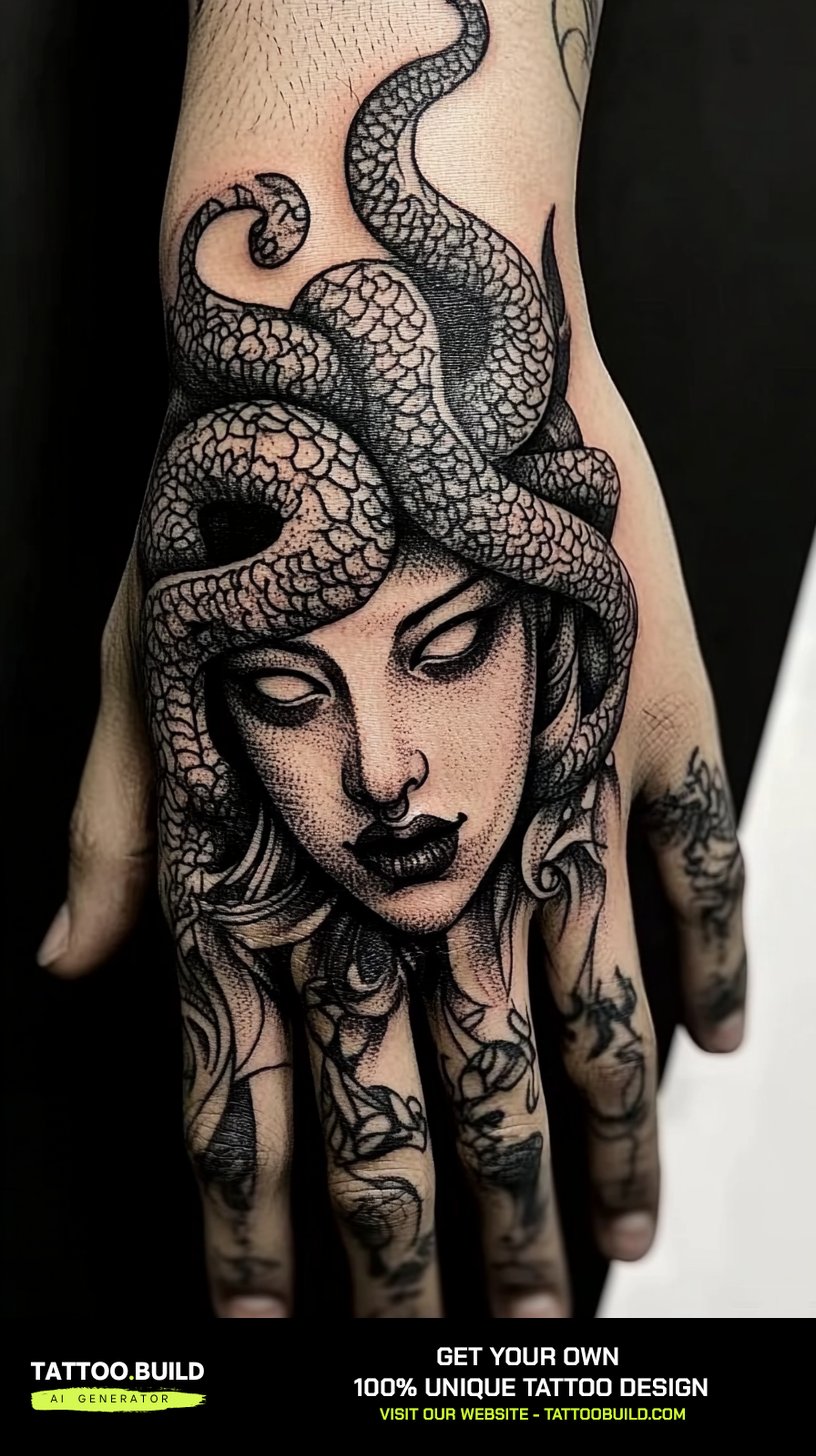
Subjects that wrap solve this. A snake coming up over the wrist bone onto the back of the hand gives the design a natural entry point and exit.
This is also the easiest way to make a hand piece look connected to future arm work rather than stranded on its own. The snake tattoo for men guide goes deeper on composition.
6. Minimalist and Single Symbol Designs
If this is your first hand tattoo, a single small symbol near the thumb web or on the side of the hand is the lowest risk way in.
It is quick, it heals fast relative to a full hand piece, and it tells you honestly how your skin takes ink in this area before you commit to anything larger.
When I tested how visible a small hand piece really is day to day, the surprise was how often it disappears entirely depending on how you hold your hand. Small meaningful tattoo ideas for men has designs that scale down cleanly.
7. Geometric and Sacred Geometry
Geometric work looks superb on hands and is genuinely difficult to execute there. Straight lines across a curved, moving surface expose every wobble.
This is one of the few styles where I would say the artist matters more than the design. Look specifically for healed geometric hand work in a portfolio, not fresh photos.
Fresh linework always looks crisp. Healed linework is the honest test, and any artist confident in this style will happily show you both.
8. Japanese and Traditional Asian Motifs
Japanese style solves the hand tattoo problem almost by design. It uses bold outlines, strong black and, crucially, background filler.
That filler — waves, wind bars, clouds — gives the piece somewhere to fade out rather than a hard stop at the wrist.
It also scales. A hand piece done in this style can be extended into a sleeve years later without redrawing anything, which is worth thinking about now rather than later.
9. Animals and Simplified Portraits
Lions, wolves and eagles all appear on hands constantly. The ones that work have been redrawn for the hand, not shrunk to fit it.
Simplification is the whole game here. Fur texture and subtle gradients that read beautifully on a chest piece turn into grey mush at hand size.
A good artist will strip a portrait back to its strongest shapes before they even stencil it. If yours does not offer to, that is worth asking about.
If a Hand Tattoo Is Not Quite Right
There is no shame in deciding the hand is not the place. These placements give you most of the visual impact with considerably less commitment.
The Inner Wrist
Close enough to the hand to be seen constantly, easy to cover with a watch or sleeve, and it holds ink noticeably better.
The Forearm
The most forgiving visible placement on the body. Detail survives, healing is straightforward and the canvas is large enough for real composition. Small forearm tattoo ideas for men is a good place to start.
The Side of the Wrist and Thumb
A halfway house. Visible when you want it to be, discreet when your hand is at your side, and less punishing to sit through.
Aftercare and Healing for Hand Tattoos
Hands are the hardest placement to heal well, and the reason is not mysterious. You wash them constantly and you cannot stop using them.
Expect your artist to give you specific instructions that differ from their standard arm advice, usually around keeping the piece clean without over saturating it and moisturising more often than you would elsewhere. Follow theirs over anything you read online, including this page.
Sun exposure is the main long term enemy. Hands catch more UV than almost any other part of the body, and UV is what breaks pigment down. Sunscreen on a healed hand tattoo genuinely extends its life.
Watch the healing closely. Spreading redness, increasing pain after the first few days, swelling that gets worse rather than better, or any discharge means you should see a doctor rather than wait it out — hands are a poor place to let an infection run. The NIH StatPearls overview of tattoo complications covers what to watch for, and the American Academy of Dermatology guidance on tattoo care is a reliable general reference.
Plan for a touch up. Budget for it and ask your artist upfront what they charge — many include one within a set window.
Common Mistakes and Still Not Sure?
The most common mistake by a wide margin is choosing a design that is too fine for the placement. It looks perfect for three weeks and disappointing for the next ten years.
The second is going to a generalist. Hands are a specialist placement, and plenty of excellent artists will tell you honestly that it is not their strength.
The third is underestimating the visibility. Some industries genuinely still care, and it is worth being clear eyed about your own field before you sit down.
If you are worried about an existing hand piece rather than a new one, tattoo cover up ideas covers what is realistic. And if the pain is the sticking point, the most painful tattoo spots will tell you where hands actually rank.
Frequently Asked Questions
Do hand tattoos hurt more than other placements?
For most people, yes. There is very little fat between the skin and the bone across the back of the hand and fingers, and the area has a dense supply of nerve endings. Fingers and knuckles are usually reported as sharper than the back of the hand. Pain is individual though, so treat any ranking as a guide rather than a promise.
How long do hand tattoos last before they fade?
Hand tattoos generally fade faster than tattoos elsewhere on the body, largely because of friction, frequent washing and sun exposure. Many people find they need a touch up within the first year or two, and periodically after that. Bold, high contrast designs hold up considerably better than fine line work. Your artist can give you a realistic expectation for the specific design you are considering.
Will a hand tattoo affect my job prospects?
It depends heavily on your industry and region. Attitudes have shifted a lot in creative, trade and hospitality work, while some client facing corporate roles, uniformed services and certain regulated professions remain more conservative. If you are early in a career or unsure about your field, this is worth honestly assessing before you commit. A hand tattoo is not something you can cover for an interview.
Can hand tattoos be removed or covered up?
Both are possible but neither is straightforward. Laser removal on hands typically takes multiple sessions and results vary considerably depending on ink colours and depth. Cover ups on hands are limited by the amount of usable space and by how well the area holds ink. Speak to a qualified laser practitioner or a cover up specialist for an assessment rather than assuming it can be undone easily.
Should a hand tattoo be my first tattoo?
Most artists advise against it, and I would agree. You learn a lot from your first tattoo about how you handle the sensation and how your skin heals, and it is better to learn that somewhere less visible and less demanding. Many reputable artists will decline to do hands on someone with no other work. That is a sign of a good artist, not an obstacle.
Quick Summary
- Bold, high contrast designs outlast fine line work on hands by a wide margin — go heavier than feels natural.
- The back of the hand holds ink best; fingers, knuckles and palms fade fastest.
- Keep lettering short and place it on the side of the hand rather than across the knuckles.
- Choose subjects that wrap over the wrist so the design has a natural place to begin and end.
- Ornamental, blackwork, Japanese and simplified traditional styles are the most reliable choices.
- Look for healed hand work in an artist’s portfolio, not fresh photos.
- Budget for at least one touch up, and use sunscreen on healed hand tattoos.
- If it would be your first tattoo, start somewhere else — most good artists will tell you the same.