A flower tattoo on a man is not a soft choice — done with the right line weight and scale, it is one of the most versatile and durable pieces of ink he can carry. After years of watching guys stall out in the consultation chair over whether a rose belongs on their forearm, I can tell you the ones who commit almost never regret it.
When I first started paying close attention to men’s floral tattoo designs, I assumed they would read as delicate. In practice, a heavily shaded rose or a bold traditional peony reads as confident rather than fragile.
The difference is almost never the flower itself. It is line weight, scale, placement, and what the flower is paired with.
In this guide I walk through what these designs actually mean, how the major styles compare, fifteen ideas I keep coming back to, and the practical details nobody mentions until you are already under the needle.
Which Masculine Flower Style Is Right for You?
Style matters more than flower choice. The same rose can look like a biker patch or a pencil sketch depending on how it is executed.
| Style | How It Reads | How It Tends to Age | Typical First Session |
|---|---|---|---|
| Black-and-grey realism | Moody, photographic, heavy on contrast | Softens gradually; mid-greys are usually the first to fade | 3–5 hours for a forearm rose |
| American traditional | Bold, graphic, unmistakably tattoo-like | Generally the most forgiving over decades | 2–3 hours for a single bloom |
| Blackwork / illustrative | Stark, high-impact, almost woodcut | Holds shape well; solid black can need a touch-up | 2–4 hours |
| Neo-traditional | Decorative and rich, with saturated colour | Good, provided the outlines are committed | 4–6 hours |
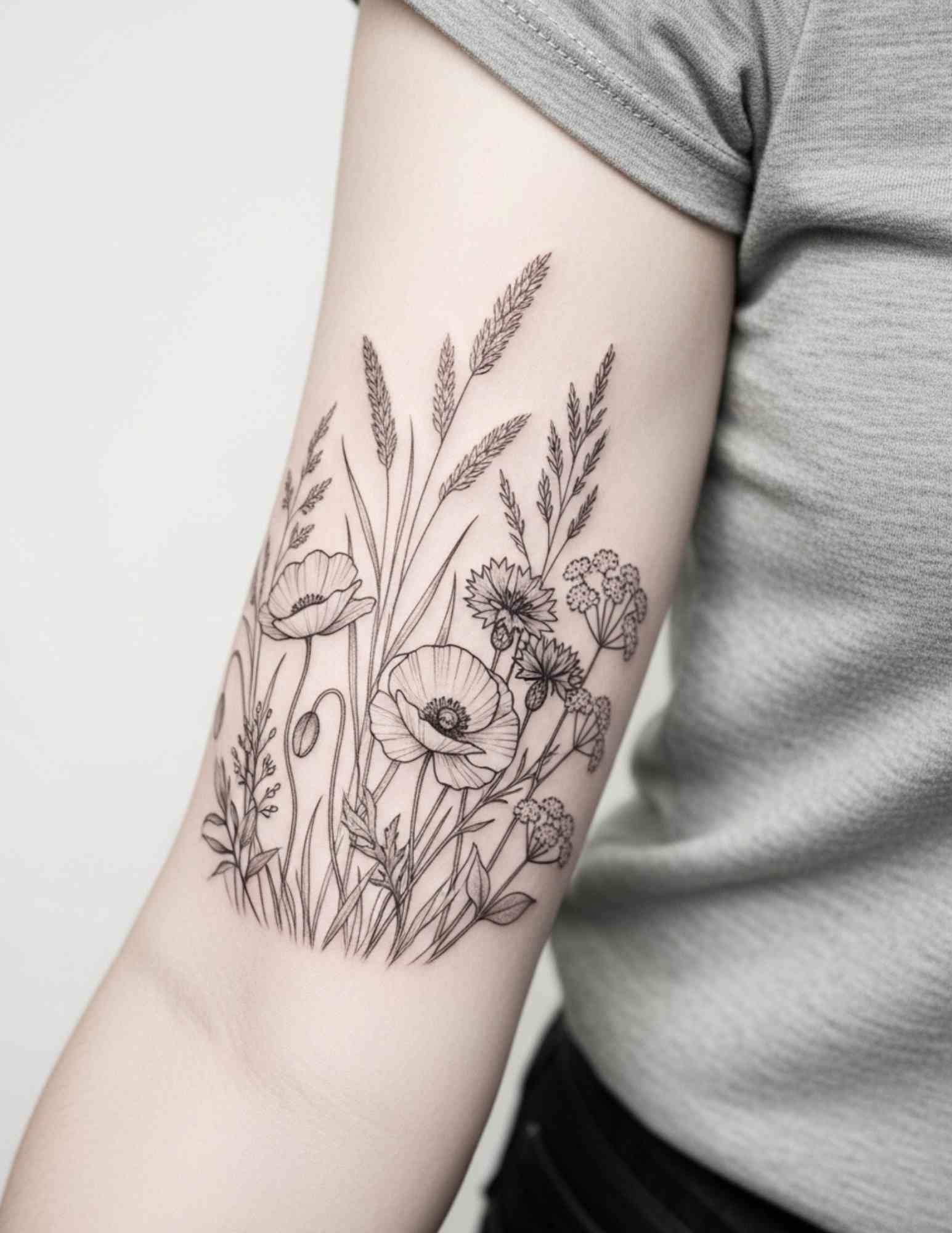
| Fine line | Quiet, sketch-like, understated | The least forgiving; expect blur on high-wear spots | 1–2 hours |
If you want one recommendation: for a first floral piece, bold outlines beat fine detail every time. A design that looks slightly too heavy on day one usually looks correct at year ten.
What Flower Tattoos Actually Mean for Men
Floral symbolism is old and genuinely layered, which is part of the appeal — the meaning does the heavy lifting while the design stays simple.
The rose is the obvious anchor: love, yes, but also sacrifice and the cost of devotion. Add thorns and the reading shifts noticeably — I go deeper into that in the guide on rose with thorns tattoo meaning.
Chrysanthemums carry strong associations with longevity and, in Japanese work, with the imperial line. Lotuses point toward rebirth and coming through something difficult.
Poppies have become shorthand for remembrance in a lot of Commonwealth countries, which makes them a common choice for memorial pieces. Birth-month flowers give you a way to carry a person without printing a name.
Here is the honest part: most people who see your tattoo will not know any of this. The symbolism is for you, and that is a perfectly good reason to choose it — just do not expect it to be legible to strangers.
15 Masculine Flower Tattoo Ideas That Hold Up
These are grouped by what makes each one work, rather than presented as a ranked list. Every design below is the kind of thing I would happily take into a consultation as a reference.
1–2. Black-and-Grey Roses on the Forearm
This is the default for a reason. The forearm gives you a flat, visible canvas with reasonably forgiving skin, and a single rose at roughly palm size fills it without crowding.
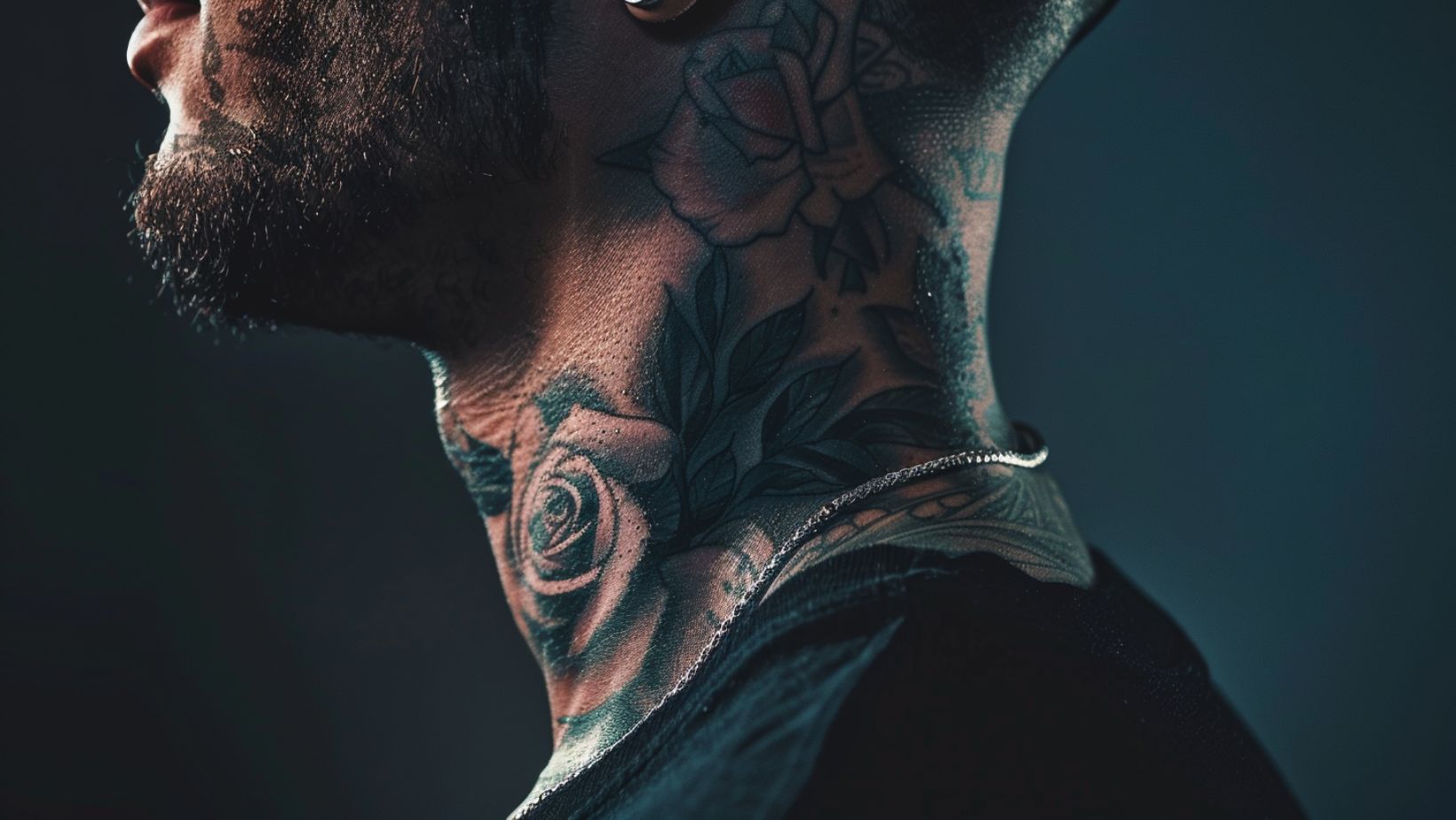
What makes these read as masculine is the shadow. When I look at the two pieces below, the petals are not outlined and filled in evenly — they are built out of deep black cores fading to light grey at the edges.
Ask your artist for high contrast and a limited grey range. Three or four distinct values usually holds up better than a smooth ten-step gradient, which tends to flatten as it settles.
If you want the same weight without any grey at all, an all-black treatment is worth considering — the black rose tattoo for men guide covers that variation in detail.
3–4. Rose-and-Skull and Burning Rose Variations
Pairing is the oldest trick for shifting how a floral piece reads, and the skull is the most reliable partner.
The contrast does the work — something living against something dead, which is why the combination has stayed in rotation for over a century. I cover the symbolism properly in the flower and skull tattoo meaning guide.
One practical note from watching these go wrong: give the skull and the flower different levels of detail. When both compete for attention, the design turns into noise at arm’s length.
The burning rose is the other variation I like. Flame is largely negative space and movement, so it adds visual energy without adding much ink — which also means it holds up well as it ages.
5–8. Bold Placements: Thigh, Hand, and Neck
Placement changes the statement more than any stylistic decision. The same rose on a thigh and on a throat are not the same tattoo socially.
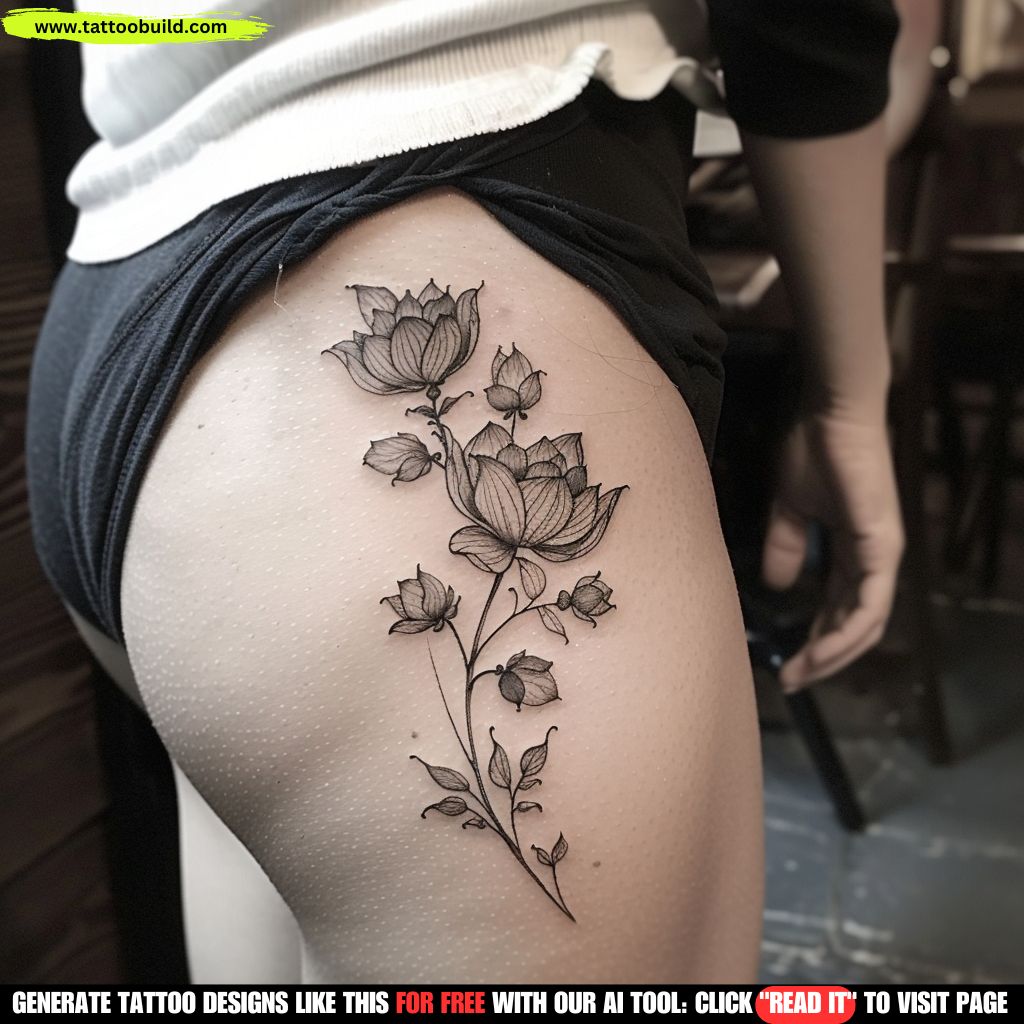
The thigh is, in my experience, the most underrated spot for men’s florals. It is a large, curved canvas that lets a design be genuinely big, and it is covered by default.
Hands and necks are a different conversation. They are high-visibility, high-wear, and they fade faster than almost anywhere else on the body — knuckle and finger work especially.
Both spots also hurt considerably more than an outer arm, and plenty of artists will not tattoo hands or throats on a first-timer at all. If you are weighing it up, the most painful tattoo spots breakdown is worth reading before you book.
Be realistic about your work too. Visible tattoos are far more accepted than they were twenty years ago, but “far more accepted” is not the same as universally fine.
9. Rose Vine and Flowing Linework
A vine solves a problem single-flower designs cannot: how to cover length without committing to a full sleeve.
Because the vine wraps, it follows the muscle instead of sitting on top of it. That is what makes it look like it belongs on the arm rather than like a sticker.
The catch is that a wrapping design has to be drawn on your actual arm, not on paper. Every artist I have asked about vine work says the same thing — freehand or stencil applied in position, then adjusted while you stand there.
It is also an easy piece to extend later. Add a second pass of leaves or another bloom in a year and it grows naturally, which is harder to do with a self-contained design.
10–11. Traditional and American Traditional Florals
If you care about how a tattoo looks in twenty-five years rather than twenty-five days, this is the style to take seriously.
American traditional uses heavy black outlines, a small palette of saturated colours, and almost no subtle gradation. Every one of those choices exists because the style was developed before modern inks and needles, when tattoos had to survive on working bodies.
The trade-off is honest: you give up realism to buy longevity. A traditional rose will never look like a photograph, and it will still be perfectly readable long after a fine-line piece has gone soft.
Colour holds up better here than people expect, too. Red and green in traditional work are usually laid down solidly rather than blended, and solid saturation ages far better than a wash.
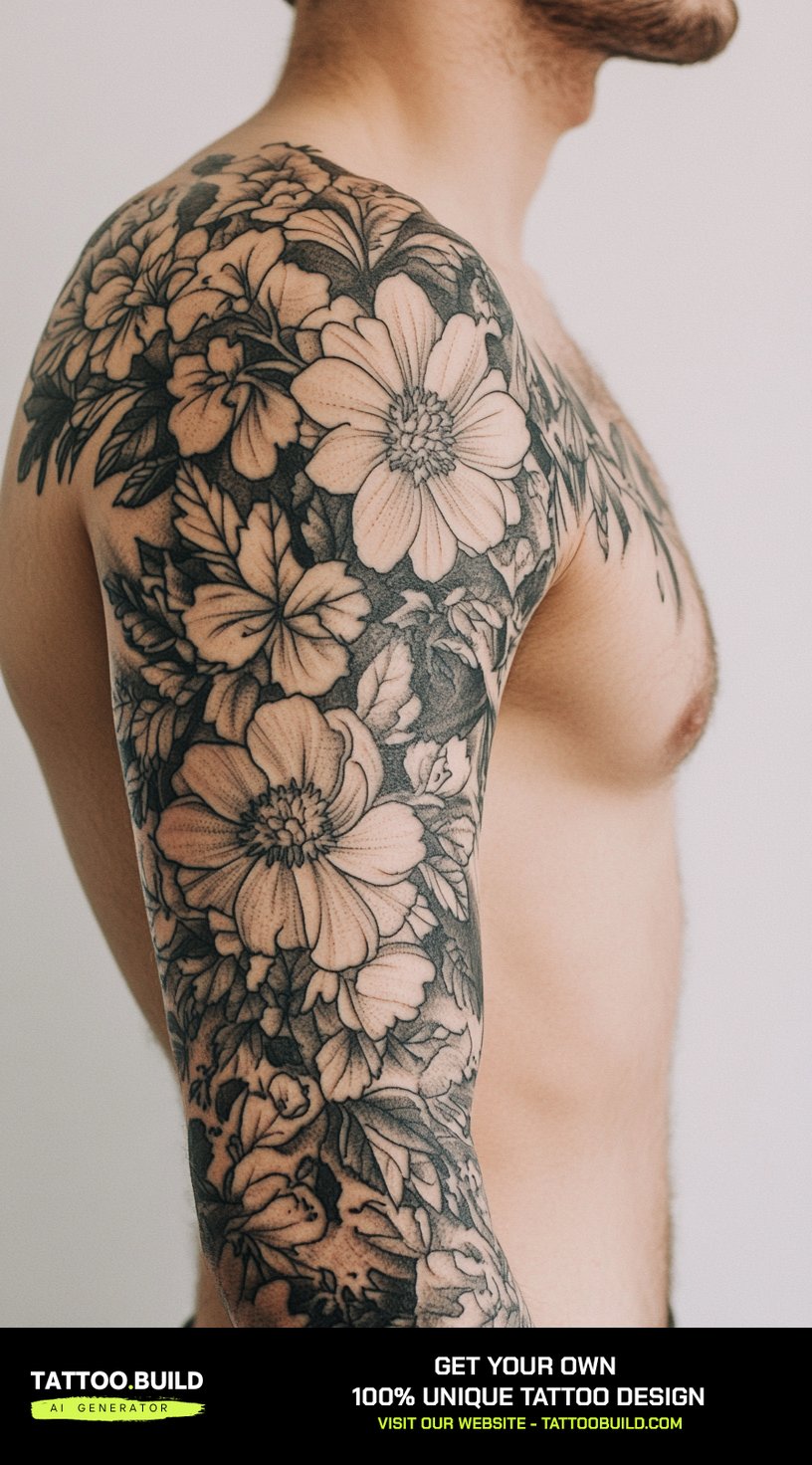
12–13. Sleeves and Large-Scale Floral Work
Scale is the single biggest lever you have, and most guys underuse it.
A floral sleeve is not a collection of separate flowers. The good ones have a flow — usually a diagonal running from wrist toward shoulder — with the blooms sitting as focal points along that line.
Expect this to be a project, not an appointment. A full floral sleeve realistically runs four to eight sessions spread over several months, because your skin needs to recover between passes.
Plan the whole sleeve before the first needle touches you, even if you only book the first third. Sleeves assembled one unrelated tattoo at a time are the most common regret I hear about. There is more on structuring these in the floral sleeve tattoo ideas for men guide.
14–15. Bird-and-Rose and Mixed-Motif Designs
Mixing motifs is how you make a floral piece feel specific to you rather than generic.
Birds work particularly well because they bring a different shape language — wings and tail feathers are all long diagonals, which cut against the round mass of petals.
Swallows, eagles, and ravens each pull the reading in a different direction. A swallow-and-rose sits squarely in traditional territory; a raven-and-rose lands somewhere much darker.
Other pairings worth asking about: daggers, compasses, snakes, and lettering. The rule I would hold to is one supporting element, not three — crowded compositions are the fastest way to a tattoo that reads as a blur.
Flower Alternatives Worth Considering
Roses dominate this category, which is exactly why the alternatives are worth a look — they get you a floral piece nobody else in the room has.
Lotus and Chrysanthemum
Both come out of Japanese and wider Asian tattoo traditions, and both are built for scale. A chrysanthemum in particular is essentially a mass of layered petals, which makes it ideal for filling a shoulder or chest panel.
If you go this route, find an artist who actually works in Japanese style. The petal structure and the way the background wind or water is handled are specific conventions, not decoration you can improvise.
Poppy, Lily, and Birth Flowers
Poppies have a clean, simple silhouette and a strong remembrance association, which makes them a frequent choice for memorial work.
Birth-month flowers are the quiet option I recommend most often. You get a personal reference to a specific person without any lettering — and lettering is what dates a tattoo fastest.
Peony and Magnolia for Larger Canvases
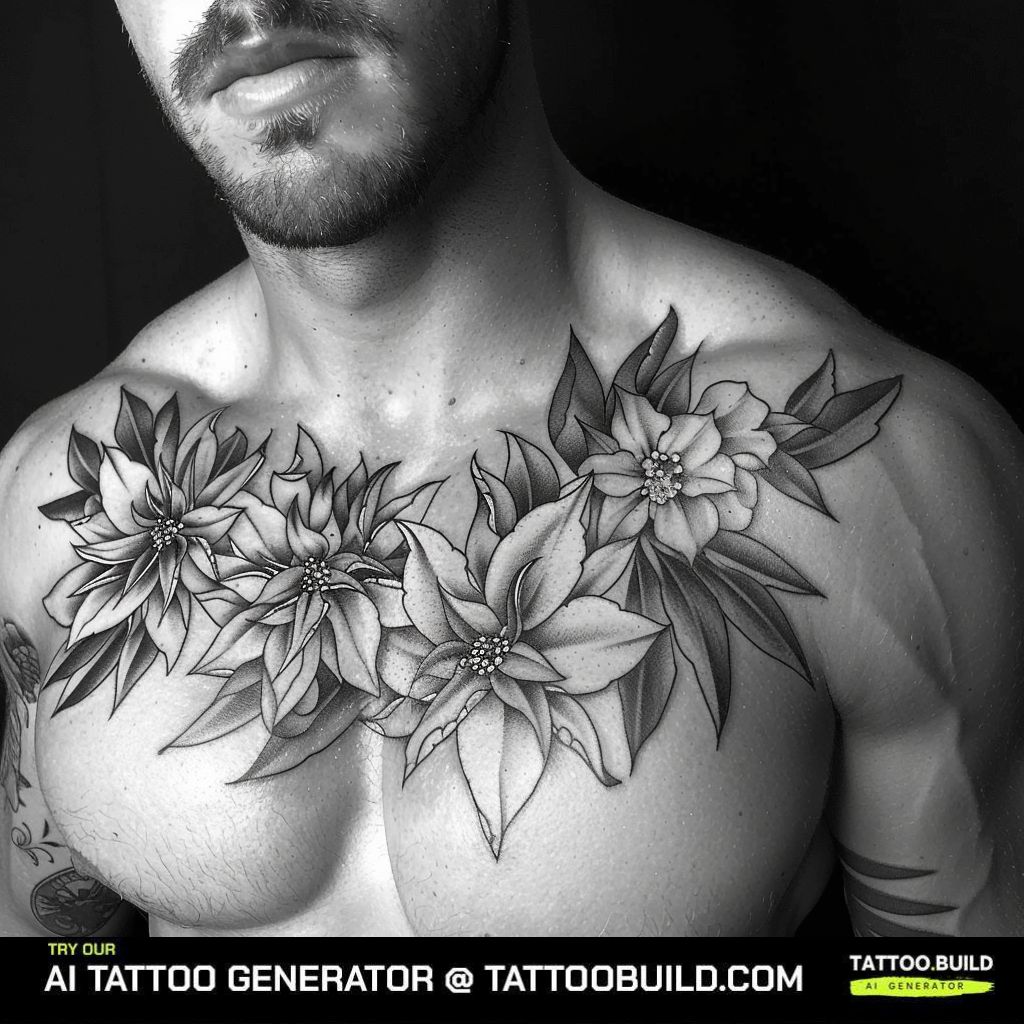
Peonies are the most underrated masculine flower on this list. They are big, dense, and structurally complex enough to carry a chest piece on their own.
Magnolias are the opposite approach — fewer, larger petals with more open skin between them. If you want a floral piece that does not read as busy, that is the shape to ask about. For smaller placements, the floral forearm tattoo ideas for men guide has options sized for a single session.
Placement, Pain, and Healing: The Practical Side
The part of the process people research least is the part that determines how the tattoo actually turns out.
Pain is real but manageable and, more importantly, finite. Outer arm and outer thigh are the gentlest options; ribs, sternum, inner arm, hands, feet, and neck are meaningfully worse. Eat properly beforehand and do not drink the night before — thin blood makes for a harder session and a patchier result.
Healing usually takes two to four weeks on the surface, with the deeper layers settling over a couple of months. Expect flaking and itching in the first fortnight; that is normal, and picking at it is how you lose detail. The tattoo healing stages guide walks through week by week.
I am not a medical professional, and neither is your artist. Tattooing breaks the skin, so infection, allergic reaction to pigment, and raised scarring are all genuine possibilities. Follow your artist’s aftercare instructions, and if you see spreading redness, heat, pus, or a fever, see a doctor rather than asking the internet.
The FDA’s tattoo and permanent makeup fact sheet and Mayo Clinic’s guide to tattoo risks and precautions are both worth ten minutes before your first appointment. Long term, sunscreen does more to preserve a tattoo than any other single thing.
Still Not Sure? Common Mistakes to Avoid
Going too small is the mistake I see most. A rose shrunk to fit a two-inch space loses the internal shading that makes it look like a rose at all.
Choosing an artist by price rather than portfolio is the second. Look specifically for healed photographs of floral work, not fresh ones — fresh tattoos all look sharp.
Bringing in a reference and asking for an exact copy is the third. Good artists will adapt a design to your anatomy, and that adaptation is most of what you are paying for.
The last one is chasing a style that does not suit the placement. Fine line on a hand, or dense realism on a finger, will not hold. If you want maximum durability, the blackwork tattoo ideas for men collection shows what a heavier approach looks like.
Frequently Asked Questions
Are flower tattoos too feminine for men?
No, and in my experience this worry disappears the moment someone sees a well-executed piece in person. What reads as feminine is usually small scale, thin lines, and pastel colour rather than the flower itself. The same rose rendered large, with heavy outlines and deep black shading, reads as bold. Floral work has been a staple of traditional men’s tattooing for well over a century.
Which flower is best for a first tattoo?
A rose, honestly. Every artist can draw one well, the shape is forgiving at most sizes, and it works in every style from traditional to realism. A peony is the next best option if you want something less common and have the room for it. I would avoid anything requiring very fine detail for a first piece, because you do not yet know how your own skin takes ink.
How much do masculine flower tattoos hurt?
It depends almost entirely on placement rather than on the design. Outer forearm, outer bicep, and outer thigh are usually described as uncomfortable but easily tolerable. Ribs, sternum, inner arm, hands, feet, and neck are a significant step up. Most people find the first twenty minutes the worst, after which it becomes more of an endurance exercise than a sharp pain.
How long does a floral tattoo take to heal?
The surface typically closes over in two to four weeks, while the deeper skin continues settling for roughly two to three months. Colour and contrast often look slightly duller around week three and then sharpen again as the outer layer finishes turning over. Keep it clean, keep it lightly moisturised, and keep it out of the sun. If anything looks infected rather than simply irritated, get it seen by a doctor.
Do flower tattoos age well?
The style determines this far more than the subject does. Bold traditional and blackwork florals generally age best because they rely on strong outlines and solid fills. Black-and-grey realism holds up reasonably well, though the mid-tones tend to soften first. Fine line florals are the least durable, particularly on hands, feet, and other high-friction areas, and many will need a touch-up within a decade.
Quick Summary
- Style, scale, and line weight decide whether a floral piece reads as masculine — not the flower you pick.
- Bold outlines and high contrast beat fine detail on a first tattoo, and they age far better.
- Black-and-grey roses on the forearm are the reliable default, and there is no shame in the obvious choice.
- Pairing a flower with a skull, flame, bird, or dagger shifts the whole reading — but stick to one supporting element.
- The thigh is the most underrated placement; hands and necks hurt more and fade faster.
- Plan a sleeve in full before the first session, even if you only book part of it.
- Bold traditional and blackwork age best; fine line ages worst, especially on high-wear skin.
- Follow your artist’s aftercare, use sunscreen long term, and see a doctor — not a forum — if something looks infected.