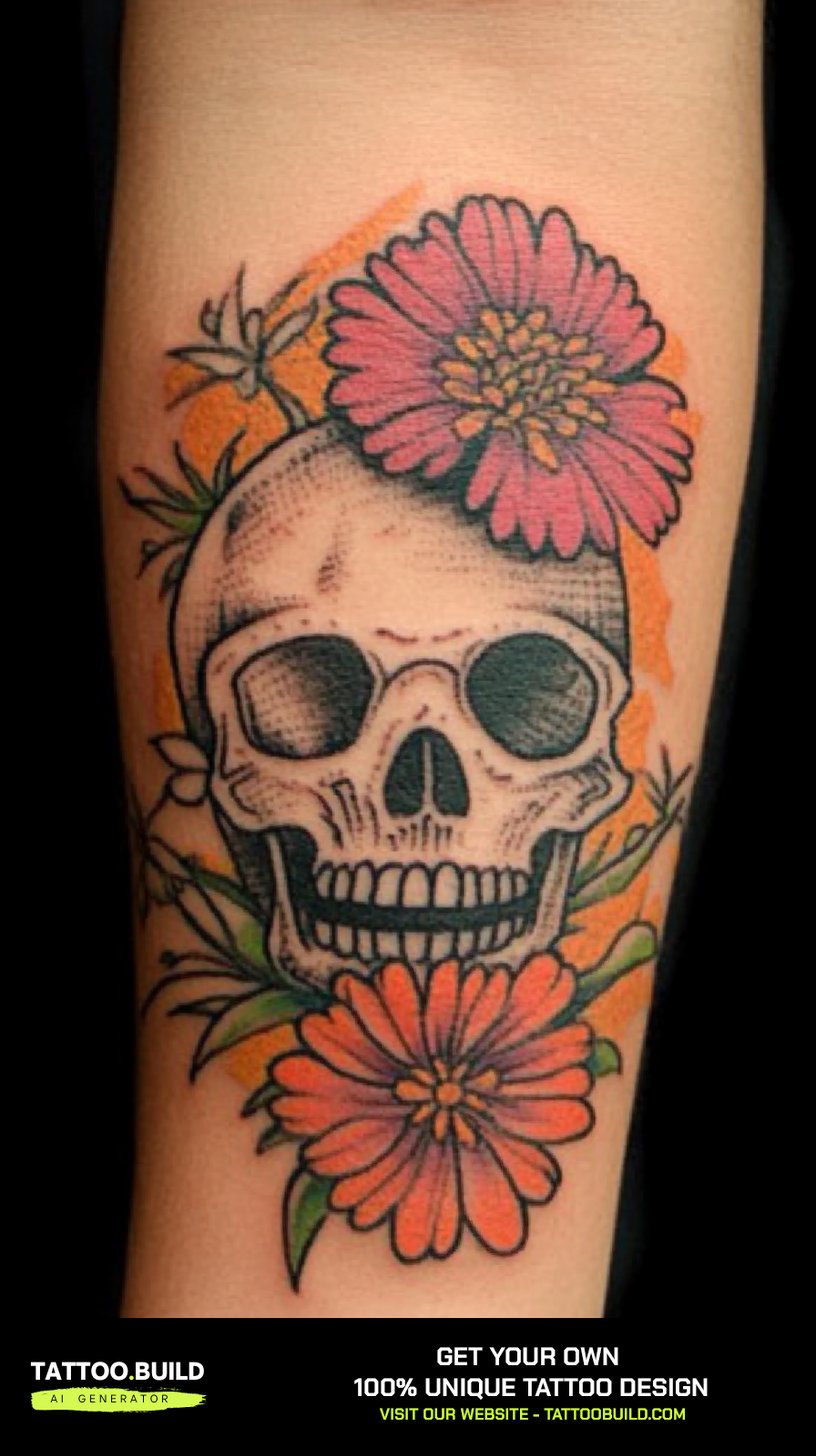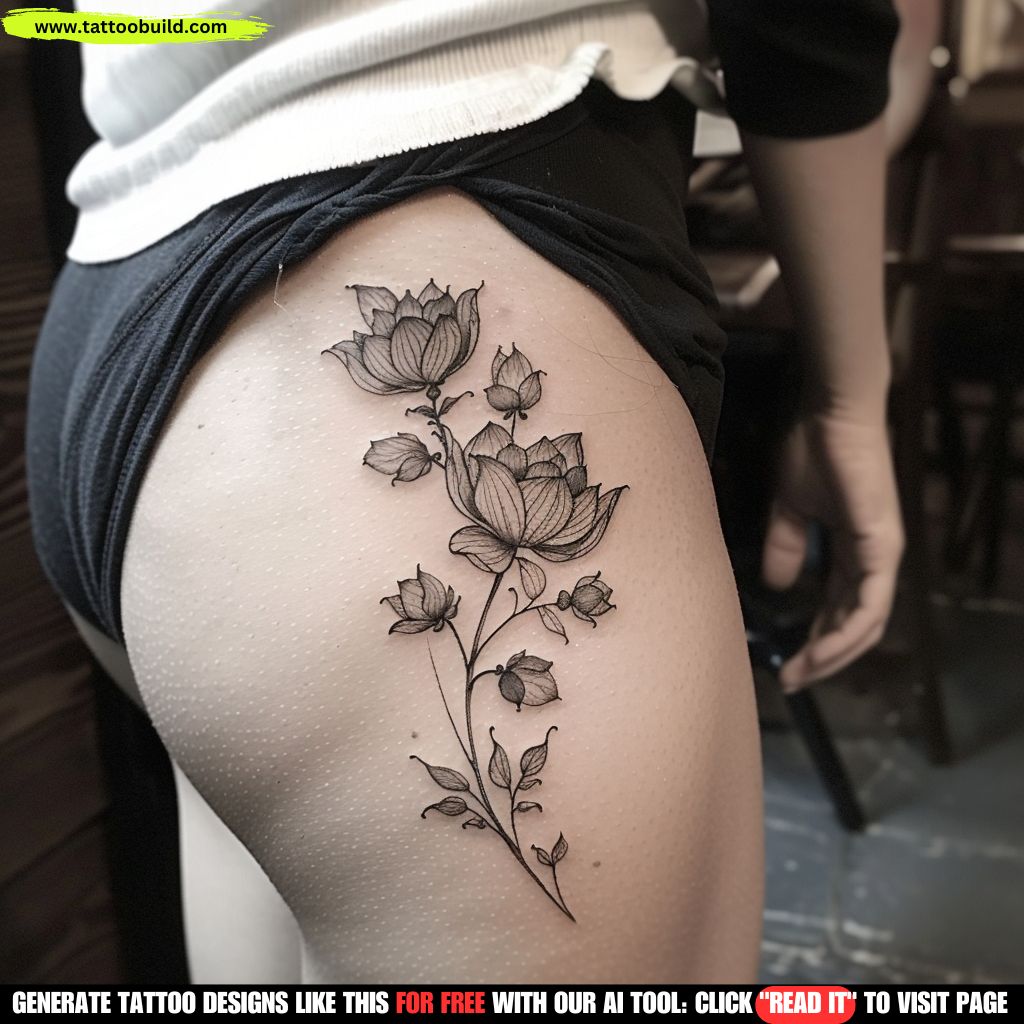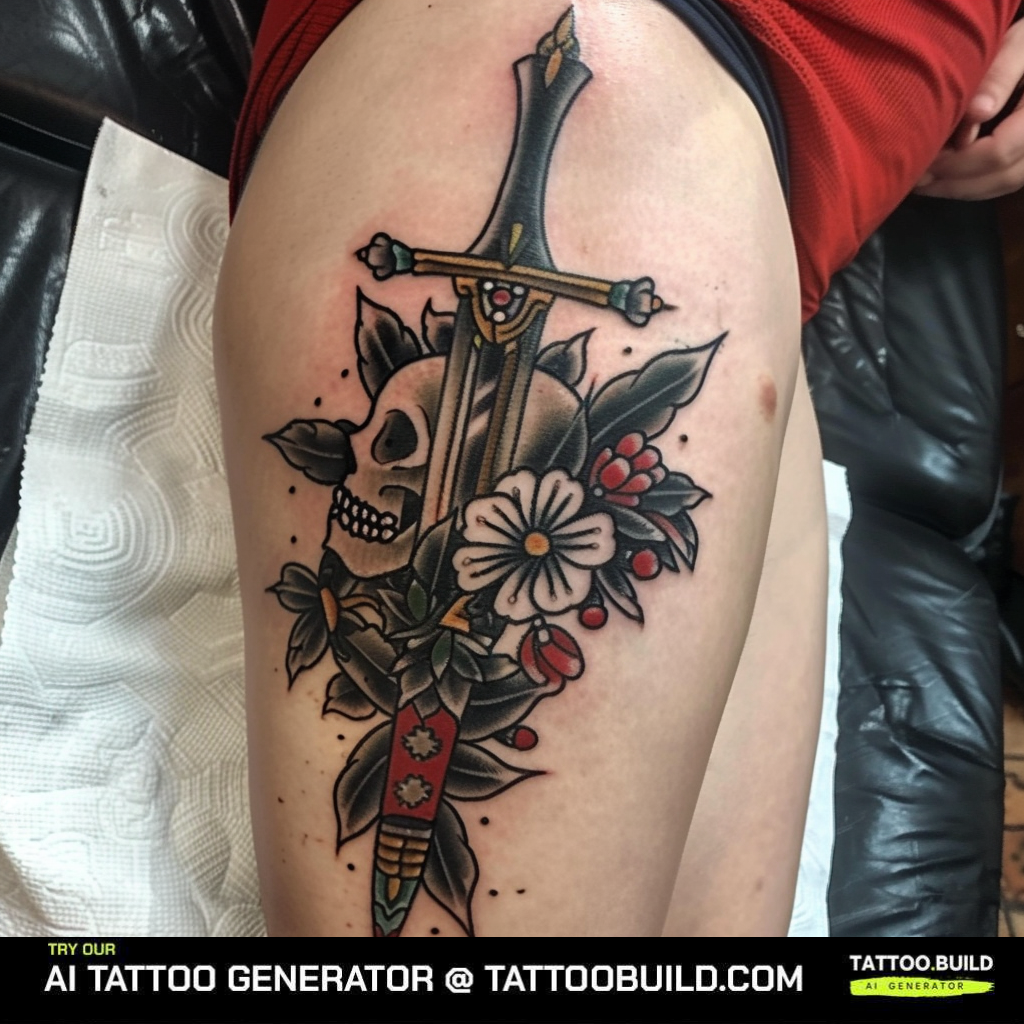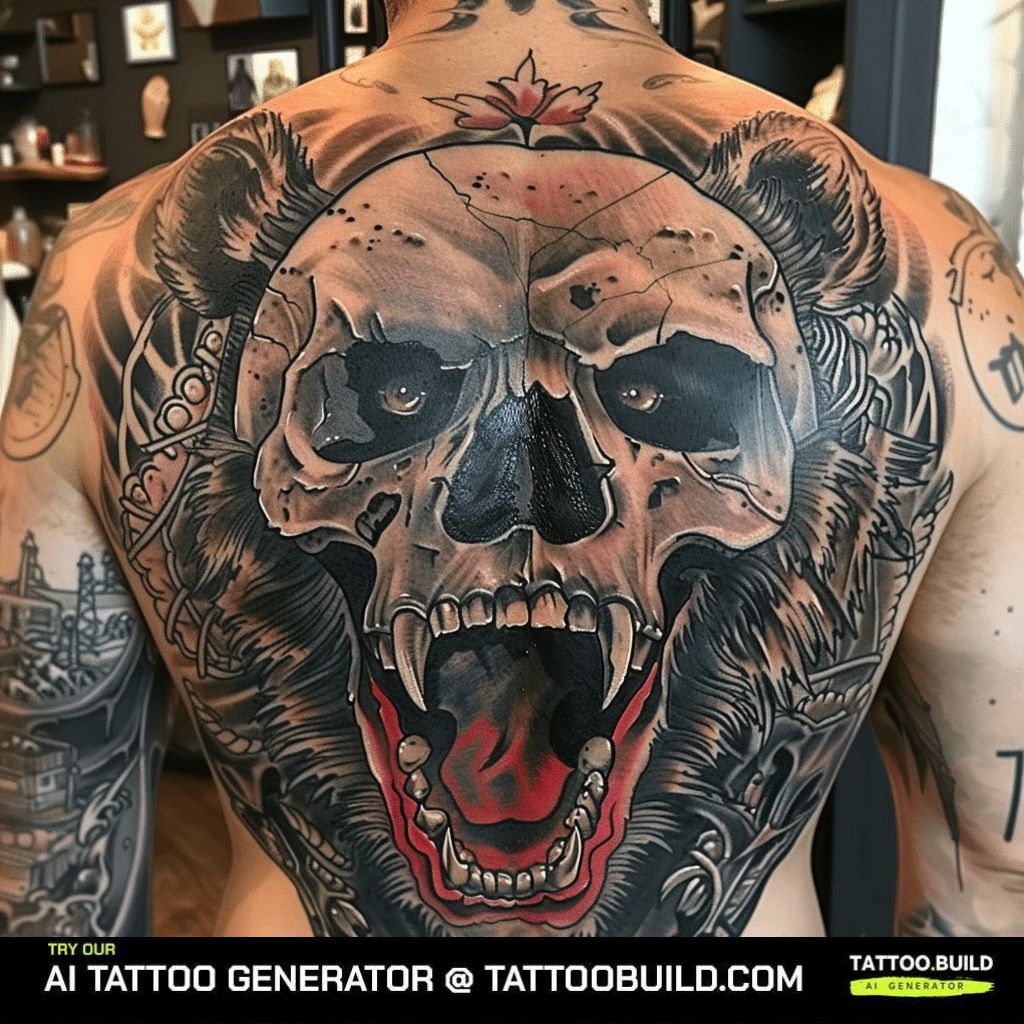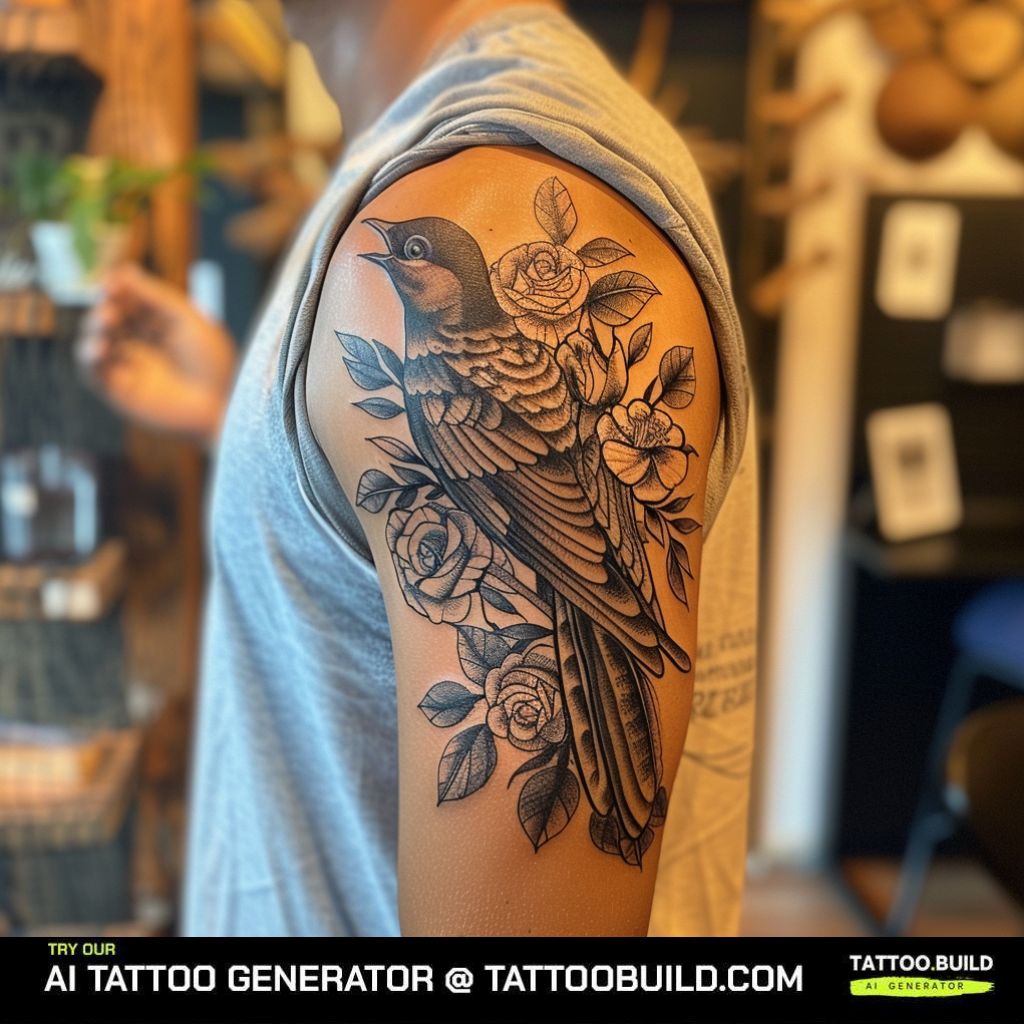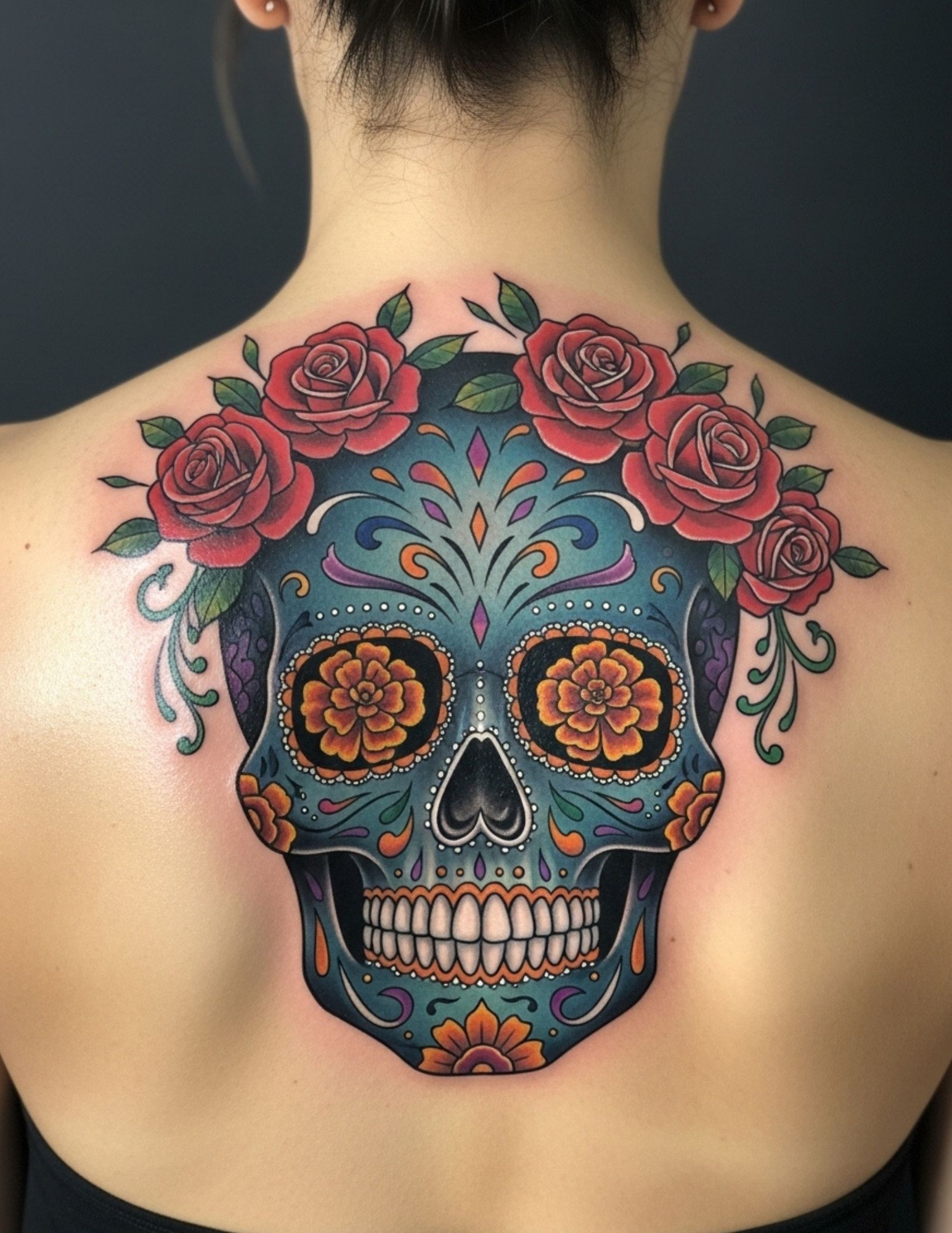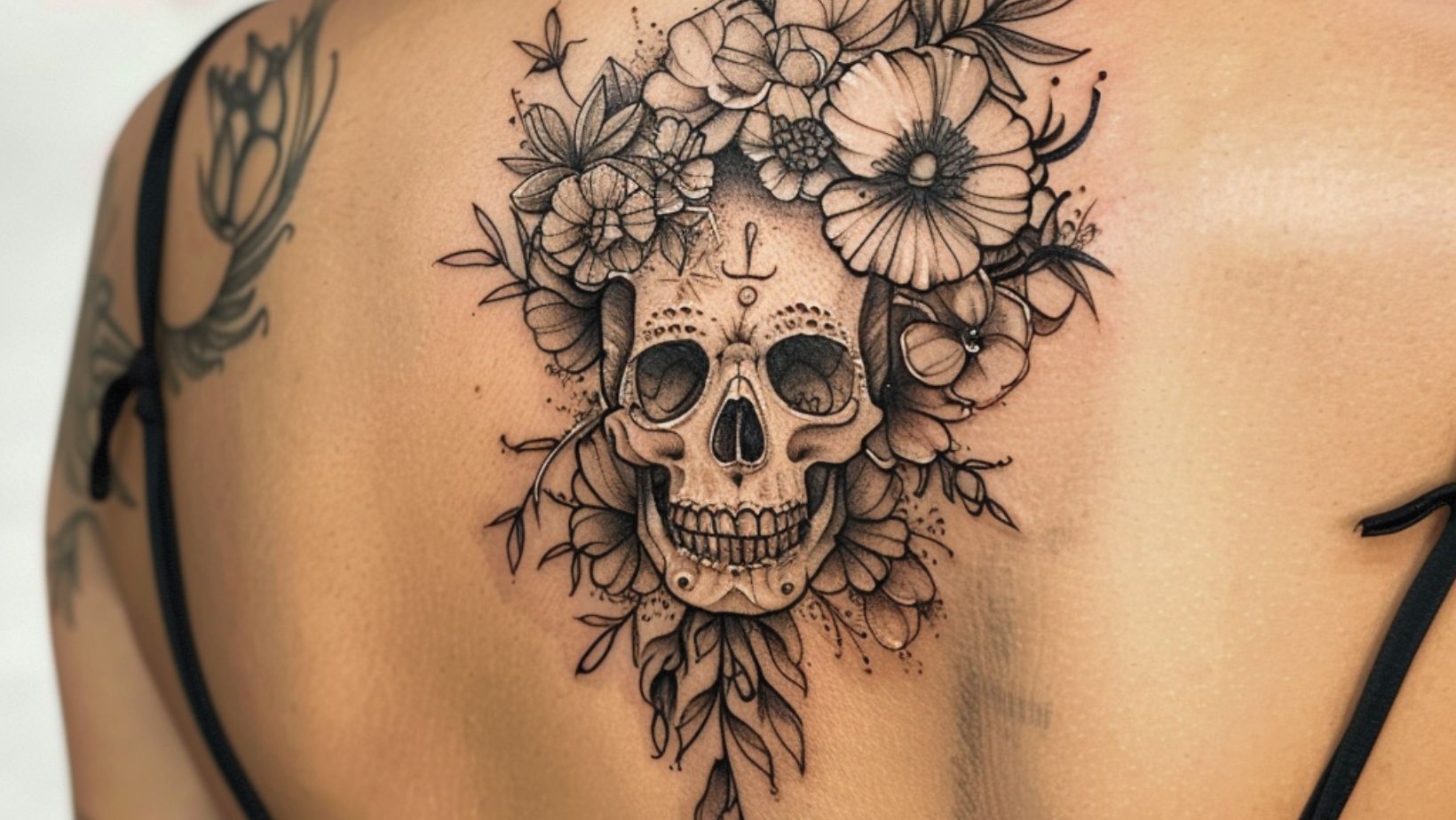
A flower and skull tattoo is the shortest way to say two opposite things at once: that everything ends, and that something beautiful grows out of the ending. That single tension is why the design has survived a century of shifting tattoo fashion.
I have watched this combination move through almost every style booth I have sat in — bold traditional, black and grey realism, fine line, blackwork — and it works in all of them, which is unusual. Most motifs only look right in one or two.
What changes is the emphasis. Push the skull and you get a memento mori. Push the flowers and you get a memorial, or a piece about growth after loss. The same two objects, read completely differently depending on which one your artist gives the most room.
Below I have laid out what the pairing actually means, which flowers change that meaning, how each style handles it, and where on the body it tends to sit best. If you want to browse compositions first, our wider skull and flower tattoo gallery is a good place to start.
Which Style Is Right for You?
| Style | What It Emphasises | Typical Size | How It Ages |
|---|---|---|---|
| American Traditional | Bold shape, clear symbolism | 4-8 inches | Excellent — built for it |
| Black & Grey Realism | Bone texture, depth, mood | 6 inches and up | Good if shaded, not stippled |
| Neo-Traditional | Colour, ornament, decoration | 5-10 inches | Very good |
| Fine Line | Delicacy, subtlety | 2-5 inches | Softens fastest; expect touch-ups |
| Sugar Skull | Celebration, remembrance | 4-8 inches | Good, colour dependent |
| Blackwork / Dotwork | Graphic contrast, negative space | Any | Excellent for solid fill |
If you are undecided, my honest advice is to pick the row that matches how much maintenance you are willing to do. Fine line is the most beautiful on day one and the most demanding at year five.
Why the Skull and Flower Pairing Works So Well
The skull is one of the oldest symbols in Western art. It appears in still life painting as memento mori — a reminder that the viewer will die, placed in the frame precisely so nobody forgets it.
Flowers, in that same tradition, carry the opposite message and the same one. They are alive, and they are the shortest-lived thing in the painting. A cut flower is already dying while you look at it.
Put the two together and the meaning stops being grim. It becomes a statement about a cycle rather than an endpoint, which is why so many people choose this design after a loss rather than as a warning.
In my experience the emotional weight of the piece is decided almost entirely by the flower, not the skull. Roses read as love and grief. Marigolds read as remembrance. Wildflowers read as freedom. The skull mostly stays the same.
There is also a practical reason artists love it. A skull is a hard, angular object and flowers are soft and organic, so the two shapes contrast naturally and the composition almost designs itself.
Flower and Skull Tattoo Ideas by Style
American Traditional Skull and Rose
The traditional version is the ancestor of every other take on this design. Bold black outline, a tight palette of red, green, yellow and black, and almost no fine detail inside the skull.
It exists in that form for a reason. Sailors and soldiers were getting tattooed by artists who knew the ink had to still read as a skull twenty years later, in bad light, on weathered skin.
When I have asked older artists which flash they redraw most often, the skull and rose combination comes up every time. It is the safest possible choice if you want something that will still look intentional in 2050.
The trade-off is that traditional does not do subtlety. If you want a quiet, delicate piece this is the wrong direction entirely.
Black and Grey Realism
Realism turns the skull into an object with weight. You get cracked bone, shadowed eye sockets, and petals that catch light on one edge.
It needs size. Every realism artist I have talked to gives roughly the same floor: below about six inches the detail collapses into grey mush as it heals and spreads.
The other requirement is a genuine specialist. Realism is the least forgiving style to get wrong, because the eye knows immediately when a skull is anatomically off.
Ask to see healed photographs, not fresh ones. Fresh realism always looks incredible; healed realism at three years is the actual test.
Neo-Traditional
Neo-traditional keeps the bold outline of traditional work but throws out the restricted palette. You get deep jewel tones, ornamental framing, and far more rendering inside the shapes.
This is my favourite direction for anyone who wants the design to look decorative rather than dark. A neo-traditional skull with peonies reads closer to a painting than a warning.
It suits larger flowers particularly well. Peonies and chrysanthemums have enough petal mass to carry the colour work that defines the style.
Expect it to take longer than traditional. The ornament and colour packing add hours that a simpler design would not.
Fine Line and Micro-Realism
Fine line strips the design back to single-needle outlines and soft grey wash. No heavy black, no bold outline, often no colour at all.
It is genuinely lovely, and I want to be straight about the cost: fine line is the style most likely to need work later. Thin lines spread as skin ages, and small details can blur together.
Placement matters more here than anywhere else. Inner forearm, inner bicep and back tend to hold fine line better than hands, feet or anywhere that sees constant sun and friction.
If you go this route, budget mentally for a touch-up somewhere in the first few years. Most fine line artists expect it and many price it in.
Sugar Skull and Day of the Dead
A sugar skull is not just a decorated skull. It comes from Día de los Muertos, where decorated skulls and marigolds honour specific people who have died.
That origin is worth knowing before you commit. If the piece is a memorial, our guide to sugar skull tattoo designs covers the traditional decorative elements and what they refer to.
Visually it is the brightest version of this design by a wide margin. Marigold orange, ornamental scroll, colour packed edge to edge.
It is also the only version of the flower and skull tattoo that reads as joyful rather than sombre, which is exactly the point of the tradition it comes from.
Blackwork and Dotwork
Blackwork takes the opposite approach to realism. Instead of rendering the skull, it flattens everything into solid black shapes and bare skin.
Negative space does the drawing. The highlight on a petal is not lighter ink, it is untouched skin, which means the design depends entirely on the artist reading the shapes correctly.
Dotwork is the softer cousin. Shade is built from thousands of individual dots rather than packed black, giving a texture that sits somewhere between engraving and shadow.
Both age extremely well. Solid black is the single most durable thing you can put in skin, and it holds an edge long after fine detail has softened.
Animal Skulls with Wildflowers
Swapping the human skull for an animal one changes the tone completely. A steer or ram skull pulls the design toward western and desert imagery rather than gothic.
Deer skulls are the most requested version I have seen, usually because antlers give the artist somewhere natural for the flowers to grow from.
It also softens the message. An animal skull with wildflowers reads as nature and cycle rather than mortality, which suits people who like the composition but not the memento mori reading. The bear skull version carries its own separate symbolism around strength.
Horns and antlers give you strong horizontal lines to build around, which is a real advantage on wide placements like the chest or upper back.
Change the Flower, Change the Meaning
This is the part most people skip, and it is the part that actually decides what your tattoo says.
Roses
The default, and still the strongest. Roses carry love, grief and beauty-with-a-cost all at once, and the thorns do real symbolic work — something our guide to the meaning of a rose with thorns goes into properly.
Marigolds
The Day of the Dead flower. If your piece is about remembering a specific person, marigolds say that more precisely than roses do.
Peonies and Chrysanthemums
Both bring an East Asian reference and both give the artist far more petal mass to work with. Chrysanthemums in particular are associated with longevity, which sits interestingly against a skull.
Wildflowers and Poppies
Wildflowers read as freedom and impermanence rather than romance. Poppies carry a specific remembrance association in Commonwealth countries, so choose them deliberately rather than decoratively.
Lilies and Lotus
Lilies appear at funerals across much of Europe and North America, which makes them a natural memorial choice. Lotus carries rebirth, and pairs almost too neatly with a skull.
Where to Put a Flower and Skull Tattoo
Placement is not just aesthetic. It changes how much detail survives, how much it hurts, and how often you will be explaining it to strangers.
Forearm
The forearm is the most requested placement for this design and the easiest to recommend. It is flat enough for detail, visible when you want it, and one of the gentler sits.
A vertical layout works better than a horizontal one here, with the skull anchoring one end and stems running along the limb. Our forearm tattoo ideas collection shows how that composition scales.
The inner forearm holds fine detail noticeably longer than the outer, simply because it gets less sun.
Upper Arm and Shoulder
The shoulder cap curves in two directions at once, which means the stencil has to be adjusted on your body rather than designed flat on paper.
It is a comfortable sit and it hides easily. It is also the natural anchor point if you ever want to grow the piece into a floral sleeve.
Tell your artist upfront if a sleeve is a possibility. Placing the skull with that in mind costs nothing now and saves an awkward reworking later.
Back and Spine
The upper back is the flattest, largest canvas on the body and the best place for an ambitious composition.
Spine pieces demand symmetry, and they are one of the sharper sits — the needle passes close to bone with very little tissue in between.
The obvious downside is that you will never really see it. That bothers some people more than they expect.
Thigh
The thigh is my usual suggestion for a first large piece. It is forgiving, it heals well, and it is easy to keep covered while it does.
The shape is naturally vertical, so long-stemmed flowers suit it. There are more layouts in our floral thigh tattoo gallery.
Fresh ink on the thigh does rub against clothing, so loose trousers for the first week are worth planning for.
Chest and Ribcage
A sternum piece has to be symmetrical or the eye catches the error instantly. This is not the placement for an artist you have not seen do symmetry before.
Ribs are, in my experience and in almost everyone else I have asked, the most painful common placement. Thin skin directly over bone, and breathing moves the surface constantly.
The payoff is a dramatic canvas that follows the body rather than sitting on top of it.
Hand, Neck and Calf
Hands fade faster than anywhere else on the body. Washing, sun and constant friction all work against fine detail, so keep hand designs bold and simple.
The calf is genuinely underrated — it heals quickly, it hurts less than most people expect, and it holds a medium-sized composition comfortably.
Getting It Right: Practical Advice Before and After
Bring reference images, but bring them as direction rather than instruction. The best results I have had came from handing an artist three images and a sentence about what the piece is for, then getting out of the way.
Be honest about budget before the stencil goes on, not after. A large realism piece is usually several sessions, and an artist who knows your ceiling can design something that finishes properly within it.
On healing, follow the aftercare your artist gives you rather than anything you read online, including this. They know their ink, their needles and their local climate. Surface healing usually takes a couple of weeks, with the deeper layers settling over the following months.
If something looks genuinely wrong — spreading redness, heat, swelling that increases rather than decreases after the first days, discharge, or a fever — that is a doctor, not a tattoo forum. The Mayo Clinic’s guidance on tattoo risks covers what infection and allergic reaction actually look like. Go to a licensed studio, and never attempt to tattoo or remove ink yourself.
Sunscreen once healed. It is the single cheapest thing you can do to keep the piece looking the way it did in the chair.
Common Mistakes and How to Avoid Them
Going too small for the style. The most frequent regret I hear is a realism skull sized for a wrist. The detail simply cannot survive at that scale.
Choosing a flower for how it looks without checking what it means. Poppies and marigolds in particular carry specific associations that people discover after the fact.
Booking with an artist whose portfolio does not include this kind of work. Someone brilliant at lettering is not automatically good at bone structure. Ask specifically to see skulls and flowers in their healed work.
Letting the flowers become filler. If the blooms exist only to fill space around the skull, the composition looks unbalanced. They should be doing as much work as the skull is.
Still undecided on the pairing itself? A butterfly and skull, or a skull with a dagger, covers similar symbolic ground in a different visual language.
Frequently Asked Questions
What does a flower and skull tattoo mean?
It represents the coexistence of life and death rather than a choice between them. The skull stands for mortality and the passing of time, while the flower stands for beauty, growth and the fact that living things are temporary too. Together they usually read as acceptance rather than warning. The specific flower shifts the meaning considerably, so choose it deliberately.
Is a skull and flower tattoo masculine or feminine?
Neither, in practice. I have seen the same core design read as either depending on line weight, colour and flower choice. Heavier black outlines and animal skulls tend to be read as more masculine; soft grey wash, fine line work and roses or peonies tend to be read as more feminine. The composition is flexible enough to go whichever direction you want it to.
How much does a flower and skull tattoo cost?
It depends far more on size, style and your artist’s hourly rate than on the subject. A small fine line piece may be a single short session, while a full black and grey realism back piece can run across several sittings. Rates vary widely by city and by artist reputation, so ask for a quote based on your actual design. Most reputable studios will give you a range before you book.
How painful is it?
Placement decides this almost entirely. Ribs, spine, sternum, hands and feet are the sharper sits because there is little tissue between needle and bone. Outer thigh, calf, upper arm and outer forearm are considerably more comfortable. Pain is also individual, so treat any ranking including this one as a rough guide rather than a promise.
Which flower should I pick?
Start from what the tattoo is for. If it is a memorial for a specific person, marigolds or lilies carry that meaning most directly. If it is about love or loss more broadly, roses remain the strongest choice. If it is about freedom or impermanence, wildflowers suit better. Tell your artist the reason and they will usually suggest something you had not considered.
Quick Summary
- The flower and skull tattoo means life and death held together, not opposed — a cycle rather than an ending.
- The flower decides the emotional tone: roses for love and grief, marigolds for remembrance, wildflowers for freedom.
- Traditional and blackwork age best; fine line looks the most delicate but needs the most upkeep.
- Realism needs size — roughly six inches and up — and a genuine realism specialist.
- Forearm and thigh are the easiest placements; ribs, spine and hands are the hardest.
- Sugar skull versions come from Día de los Muertos and carry a specific remembrance meaning.
- Animal skulls soften the design toward nature and cycle rather than mortality.
- Follow your artist’s aftercare, and see a doctor rather than a forum if healing looks wrong.
Ready to Ink Your Dream Tattoo?
Ditch the endless internet search for generic designs. Tattoobuild’s tattoo design tool helps you create unique tattoos in seconds:
- Open & Describe: Open the studio and tell the tool what you envision. Be specific about subject, style and details.
- Generate & Choose: The tool generates multiple designs from your description. Browse the options and pick the one that fits.
This gives you a clear reference point for your artist, which is worth more than a folder of screenshots from someone else’s arm.