Polynesian tattooing is one of the oldest continuous tattoo traditions on earth, and it is also one of the easiest to get wrong. The patterns are not decoration — almost every shape in a traditional Polynesian tattoo is a word in a visual language, and putting the wrong words on your arm is a real risk.
I have spent a lot of hours looking at Pacific work, both in portfolios and in person, and the pieces that land hardest are never the busiest ones. They are the ones where the wearer can tell you what each panel means. That is the difference between a Polynesian tattoo and a generic tribal tattoo designs.
The cultures of the Pacific — Maori, Samoan, Hawaiian, Tongan, Marquesan, Tahitian — each built their own distinct system of patterns, meanings and ritual context. They overlap, but they are not interchangeable, and treating them as one pool is the single most common mistake I see.
Below are 18 directions worth considering, with honest notes on which ones are open to anyone and which ones are not. The word “tattoo” itself comes from the Polynesian tatau, a point Britannica traces back to eighteenth-century European contact with the Pacific.
Photo: @tu_moko
Which Polynesian Tradition Is Right for You?
Before you pick a motif, pick a tradition. This is how I would summarise the four you are most likely to encounter in a Western studio.
| Tradition | Visual signature | Typical placement | Open to outsiders? |
|---|---|---|---|
| Maori (ta moko / kirituhi) | Flowing curved spirals, koru forms, carved-looking lines | Face, thighs, back, shoulder | Ta moko: no. Kirituhi (the non-genealogical version): yes, with a knowledgeable artist |
| Samoan (tatau) | Dense, dark, highly structured banding and fine repeated fill | Waist to knee (pe’a), arms | The full pe’a is earned within the culture; Samoan-inspired patterning is more open |
| Hawaiian (kakau) | Strong geometric rows — triangles, chevrons, negative-space bands | Arm, shoulder, ribs, leg | Generally yes, though some family motifs are not |
| Marquesan | Fine, tightly packed geometry; the Marquesan cross | Chest, full body, hands | Widely tattooed today; still worth researching each motif |
If you only take one thing from that table: the closed designs are closed for a reason, and a good artist will tell you so before you ask.
Why Polynesian Patterns Carry So Much Weight
In most Western tattoo styles, the meaning lives in the subject. A rose means one thing, an anchor another. Polynesian work is different — the meaning lives in the pattern itself.
A row of triangles is not filler. Depending on the tradition it can reference shark teeth, protection, or a warrior’s status. Change the spacing and you can change what it says.
That is why I always ask an artist to walk me through a Polynesian stencil panel by panel before the needle comes out. Every artist I have asked has been happy to do it, and a couple have quietly redrawn sections once I explained what the piece was actually meant to commemorate.
Ta moko in particular is not a style you order from a flash sheet. As Te Papa, the Museum of New Zealand explains, a ta moko encodes a specific person’s whakapapa — their genealogy — which is precisely why a copied one is meaningless at best.
The practical upshot is simple. Budget more time for the design conversation than for the tattoo, and expect a specialist to charge accordingly — see our guide to how much tattoo designs cost if you are planning the money side.
18 Polynesian Tattoo Ideas for Men
1. Maori Ta Moko Face Tattoo
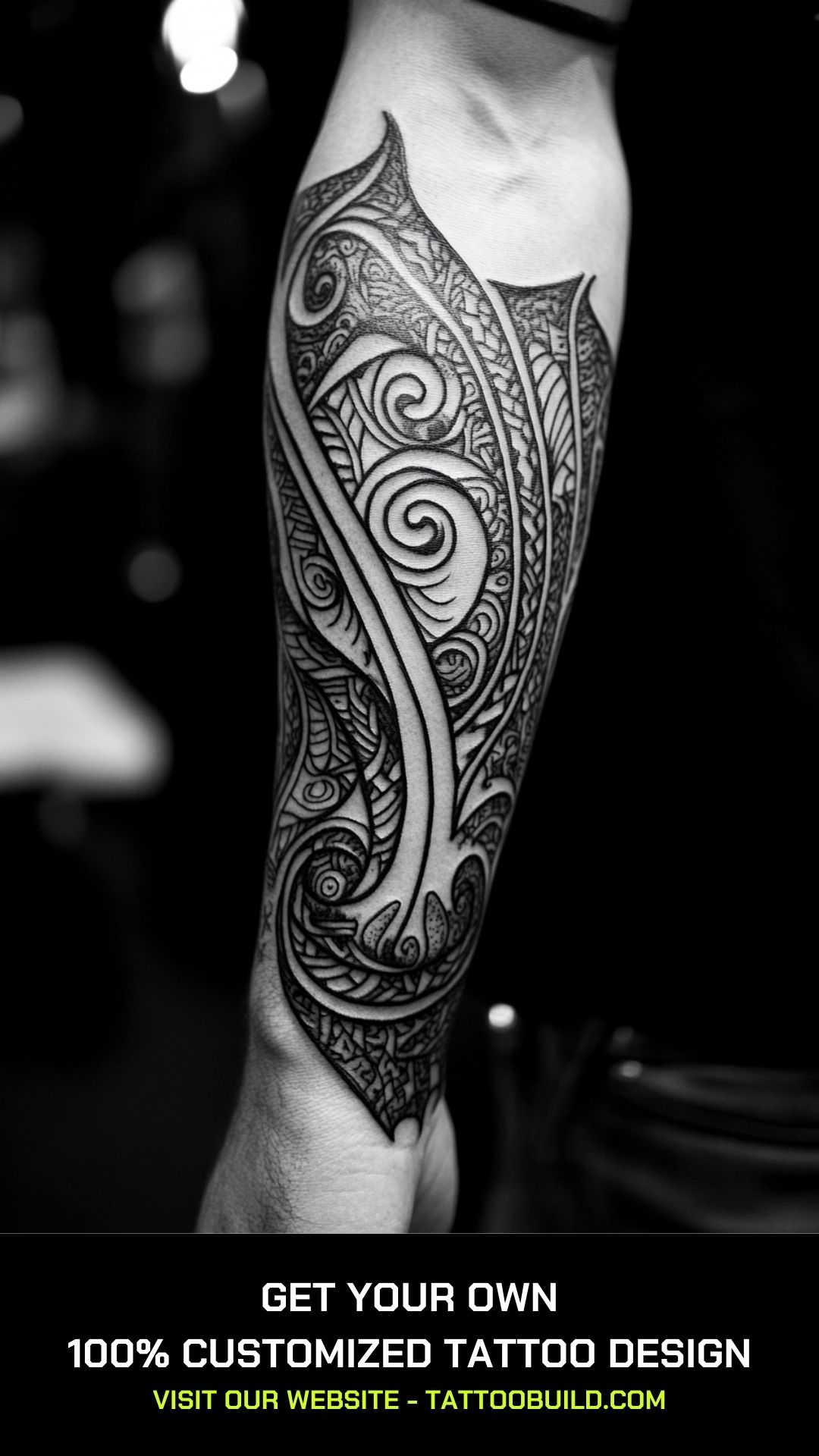
The ta moko is the traditional Maori facial tattoo, and it is unique to the individual wearing it. The curved lines record ancestry, tribal affiliation and personal history.
This one is not a design choice for most readers. Ta moko is worn by Maori, applied by a tohunga ta moko, and carries obligations that do not transfer. The non-genealogical version — kirituhi — is the respectful route for everyone else, and a skilled artist can build something striking within it.
If the Maori visual language is what draws you, our wider guide to Maori tattoo ideas covers the motifs that are open without stepping on a closed tradition.
2. Samoan Pe’a
The pe’a runs from the waist to just below the knee in dense, near-solid black, applied by a tufuga ta tatau using traditional hand tools.
It is a serious undertaking — multiple sittings, significant pain, and a genuine risk of infection if aftercare slips. It is also a mark of status within Samoan culture rather than a design anyone can commission.
What outsiders can take from it is the aesthetic logic: high contrast, disciplined repetition, and pattern that follows the body rather than sitting on top of it.
Photo: @southpacificnesians
3. Hawaiian Kakau Arm Band
Hawaiian kakau leans on bold geometric rows — triangles, chevrons and strong negative space. An upper-arm band is the classic application.
In my experience this is the most forgiving Polynesian design for a first piece. It reads clearly from across a room, it wraps naturally, and the repeat structure means a small area still looks complete.
Expect a band of this kind to take a few hours rather than a full day, depending on width and how tight the fill is.
Photo: @kealoha_designs
4. Marquesan Cross
The Marquesan cross is a balanced four-point motif built from fine geometric bands, usually read as harmony between the elements.
It is one of the few Polynesian designs that works well small. I have seen it sit comfortably on a shoulder blade, a calf, or the back of the hand without losing its internal detail.
The trap is scaling it down too far. Below roughly palm size, the internal bands start to close up as the ink settles.
5. Polynesian Sleeve
A full sleeve built from Polynesian patterning is one of the most visually powerful arm concepts available to men, full stop.
The reason is structural. Unlike a collage sleeve, a Polynesian sleeve is designed as one composition, so the panels flow into each other and the arm reads as a single object.
When I have watched artists build these, the stencil work takes as long as several hours of tattooing. Plan on multiple sessions and resist the urge to fill every gap — negative space is what makes the pattern legible. Our guide to full sleeve tattoos for men covers the planning side.
Photo: @julianotattoo
6. Turtle (Honu) in Polynesian Style
The turtle — honu in Hawaiian, fonu in Samoan — represents longevity, navigation and the link to ancestors across most of the Pacific.
Its shell is the best pattern canvas in the entire Polynesian vocabulary, because the natural segments give an artist somewhere obvious to put distinct motifs.
This is a strong choice if you want one contained piece rather than a sprawling composition. More on the symbolism in our sea turtle tattoo meaning guide.
Photo: @pelu_tattoo
7. Tiki Face
Tiki figures represent ancestral guardians, and the face is usually rendered as pure geometry — eyes, nose and mouth built from shapes rather than drawn realistically.
A tiki face gives a Polynesian composition a focal point, which matters on larger pieces where repeated pattern can otherwise flatten out.
Check with your artist which tradition the specific tiki form comes from — the Marquesan, Hawaiian and Maori treatments are visually distinct and carry different associations.
Photo: @jxrtattoos
8. Shark (Mano) in Polynesian Pattern
Shark teeth — niho mano — are among the most widely used motifs across the Pacific, standing for protection, strength and adaptability.
They appear as triangle rows inside larger compositions far more often than as a whole shark, and honestly the rows tend to age better than a detailed shark silhouette.
If you want the animal itself rather than the tooth pattern, our shark tattoo ideas guide covers the other approaches.
Photo: @frankly.sasha.tattoo
9. Maori Koru
The koru is an unfurling fern frond, symbolising new life, growth and renewal. It is the single most recognisable Maori motif.
Because it is a spiral, it fits curved placements beautifully — the outer shoulder, the calf, the ribs. A single koru works as a small standalone piece in a way most Polynesian motifs do not.
It is drawn from a real plant, which is why a good koru is never a perfect geometric spiral. The taper matters.
10. Wave Pattern Sleeve Element
Wave patterns represent the ocean, change and the journeys that connected the Pacific islands.
In a sleeve, waves are the connective tissue. They carry the eye between denser panels and stop a composition from reading as a stack of unrelated blocks.
I would rarely build a whole piece from waves alone, but I would not build a Polynesian sleeve without them either.
11. Sun Motif in Polynesian Style
The sun motif — a radiating disc framed by triangular rays — typically references leadership, brilliance and greatness.
It gives a composition a natural centre without needing extra size, which makes it useful on a chest or shoulder where you want one anchor point.
It also sits well on its own as a mid-size piece, roughly hand-sized, if a full composition is more than you want.
12. Spearheads Pattern
Spearhead rows stand for courage, protection and the warrior role. Visually, they are how an artist steers direction across a panel.
Point them one way and the pattern reads as moving up the arm; reverse them and it reads as moving down. Small decision, big effect on how the piece feels.
They are almost never used alone — treat them as a component rather than a design in themselves.
13. Chest Piece in Polynesian Style
A Polynesian chest piece spans both pectorals in symmetrical black panels, often extending onto the shoulders.
Symmetry is the whole game here. If the stencil is even slightly off-centre, the finished tattoo will look wrong and no amount of detail will rescue it.
Expect your artist to spend real time on stencil placement with you standing, not lying down — the chest shifts noticeably between the two.
14. Enata (Human Figure) Pattern
Enata are small stylised human figures, usually arranged in repeating bands. They represent people — family, ancestors, relationships.
This is how you write specific people into a Polynesian piece without resorting to names or portraits, and in my experience it is the motif clients find most personally meaningful once it is explained to them.
Inverted enata carry a different reading in some traditions, so it is worth asking rather than assuming.
15. Maori Back Piece
The back gives Maori-style work the room it actually wants. Large koru spirals can run across the shoulders and down the spine without being cramped.
A back piece of this scale is a multi-session commitment measured in tens of hours, not a single sitting.
If you are weighing up the canvas, our roundup of back tattoo designs for men shows how different styles use the same space.
Photo: @mokokauri_tamoko
16. Ocean and Island Composition
An ocean-and-island composition renders waves, land forms and sometimes a navigational element in tribal geometry.
It is a common way to mark a specific home island or a family’s migration route, which makes it one of the more personal Polynesian directions.
It also gives an artist a reason for the layout — the geography dictates where the panels go, rather than pure aesthetics.
17. Polynesian Forearm Band
A forearm band is a clean cuff of stacked pattern rows, usually two to four inches wide.
This is the lowest-commitment entry point into Polynesian work. It is visible when you want it to be, covered by a long sleeve when you do not, and it leaves the upper arm free if you later extend into a sleeve.
It is also the placement I would recommend to anyone testing whether they actually like living with bold black work. See more options in our meaningful forearm tattoos for guys guide.
Photo: @sililo.tattoo
18. Contemporary Polynesian Fusion
Contemporary fusion blends Polynesian patterning with other styles — geometric linework, blackwork negative space, or realism panels set inside traditional borders.
Done well, it is genuinely modern. Done badly, it reads as Polynesian pattern used as background texture, which is the version I would avoid.
The test I apply: can you still name what each Polynesian panel means? If the answer is no, the fusion has eaten the tradition rather than building on it.
Alternatives and Variations Worth Considering
If the traditional route does not fit, these are the adjacent directions I see most often.
Kirituhi Instead of Ta Moko
Kirituhi uses Maori design language without the genealogical content of ta moko. It is the honest option for non-Maori who love the aesthetic, and many Maori artists offer it explicitly.
Pacific-Inspired Blackwork
Pure blackwork borrows the contrast and negative-space logic of Polynesian tattooing without claiming any specific cultural motif. Less loaded, still bold.
Single-Motif Pieces
One honu, one koru, one Marquesan cross — a single well-researched motif is often a better first Polynesian tattoo than a half-finished sleeve.
Half Sleeve Rather Than Full
Shoulder to elbow gives you most of the visual impact at roughly half the cost and healing burden, and it leaves the forearm open for later.
Practical Tips Before and After You Sit
Find an artist who specialises. Polynesian work is a distinct skill set, and a great realism artist is not automatically a great Polynesian artist — ask to see healed photos, not just fresh ones.
Bring your story, not a reference image. The best sessions I have watched start with the client explaining what the piece commemorates, and the artist building the pattern from that.
On healing: large areas of solid black are demanding on the skin. The American Academy of Dermatology recommends keeping a new tattoo clean, moisturised and out of direct sun, and warns that signs of infection — spreading redness, swelling, heat, pus or fever — need a doctor rather than a wait-and-see approach.
Sun is the long game. Solid black Polynesian work generally holds up well over decades, but UV exposure fades it faster than anything else, and a healed piece under regular sunscreen will simply look better in twenty years.
None of this is medical advice. If you have a skin condition, a clotting disorder, or you are on medication that affects healing, talk to your doctor before booking, and tell your artist too.
Still Not Sure? Common Mistakes to Avoid
Mixing traditions in one piece without knowing it. Maori curves and Samoan banding are both beautiful; jammed together arbitrarily they read as generic tribal to anyone who knows the difference.
Copying a specific person’s tattoo from social media. In a tradition where the design encodes a real individual’s history, this is the equivalent of wearing someone else’s name.
Going too big too early. A forearm band you love beats a sleeve you tolerate, and you can always extend.
Not asking what it means. If your artist cannot explain a panel, that is information. Browse our broader collection of Polynesian tattoo ideas and tribal tattoo designs first so you arrive with vocabulary rather than just a mood board.
Frequently Asked Questions
Can a non-Polynesian person get a Polynesian tattoo?
In most cases yes, provided you choose designs that are open rather than restricted. Ta moko and the Samoan pe’a carry cultural roles that are not transferable, but kirituhi and general Polynesian-inspired patterning are widely tattooed on people of all backgrounds. The respectful route is to work with an artist who knows the tradition and can tell you which motifs are which. Going in with questions rather than a printout is the single best thing you can do.
How much does a Polynesian tattoo cost?
It depends heavily on size, artist and region, so any single figure would be misleading. What is reliable is the shape of the pricing: Polynesian work is usually quoted by the session or as a flat project price rather than by the hour, because so much of the labour is design. Specialists who draw custom patterns for each client generally charge more than studios working from flash. Our cost guide walks through how to budget for a multi-session piece.
Does Polynesian tattooing hurt more than other styles?
Large areas of solid black usually hurt more than linework simply because the skin gets worked over repeatedly. Placement matters more than style, though — ribs, inner arm, sternum and the area over bone are harder going than the outer arm or calf regardless of what is being tattooed. Traditional hand-tapped tatau is a different experience again and is generally described as more intense than machine work. Eat beforehand, and tell your artist when you need a break.
What do the triangle patterns in Polynesian tattoos mean?
Rows of triangles most commonly represent shark teeth, known as niho mano in several Pacific languages, and are associated with protection, strength and adaptability. The exact reading varies by tradition and by how the triangles are arranged, spaced and oriented. That variation is the point — the same shape can say different things in Samoan and Hawaiian work. Ask your artist to explain the specific version they are drawing for you.
How long does a Polynesian sleeve take to complete?
Most full Polynesian sleeves take several sessions spread over weeks or months rather than a single sitting. The design stage alone can run to hours before any tattooing begins, because the whole arm is planned as one composition. Healing between sessions matters too — artists generally want an area substantially healed before working adjacent skin. Treat the timeline as a project rather than an appointment.
Quick Summary
- Pick a tradition first — Maori, Samoan, Hawaiian or Marquesan — before you pick a motif.
- Ta moko and the full Samoan pe’a are culturally restricted; kirituhi and general Polynesian patterning are not.
- Every shape carries meaning, so ask your artist to explain the stencil panel by panel.
- Start with a forearm band, a honu or a Marquesan cross if this is your first Polynesian piece.
- Sleeves, chest pieces and back pieces are multi-session projects — budget time, money and healing accordingly.
- Negative space is what makes the pattern readable; resist filling every gap.
- Choose an artist who specialises in Pacific work and shows healed photos.
- Keep new work clean and out of the sun, and see a doctor for any sign of infection.