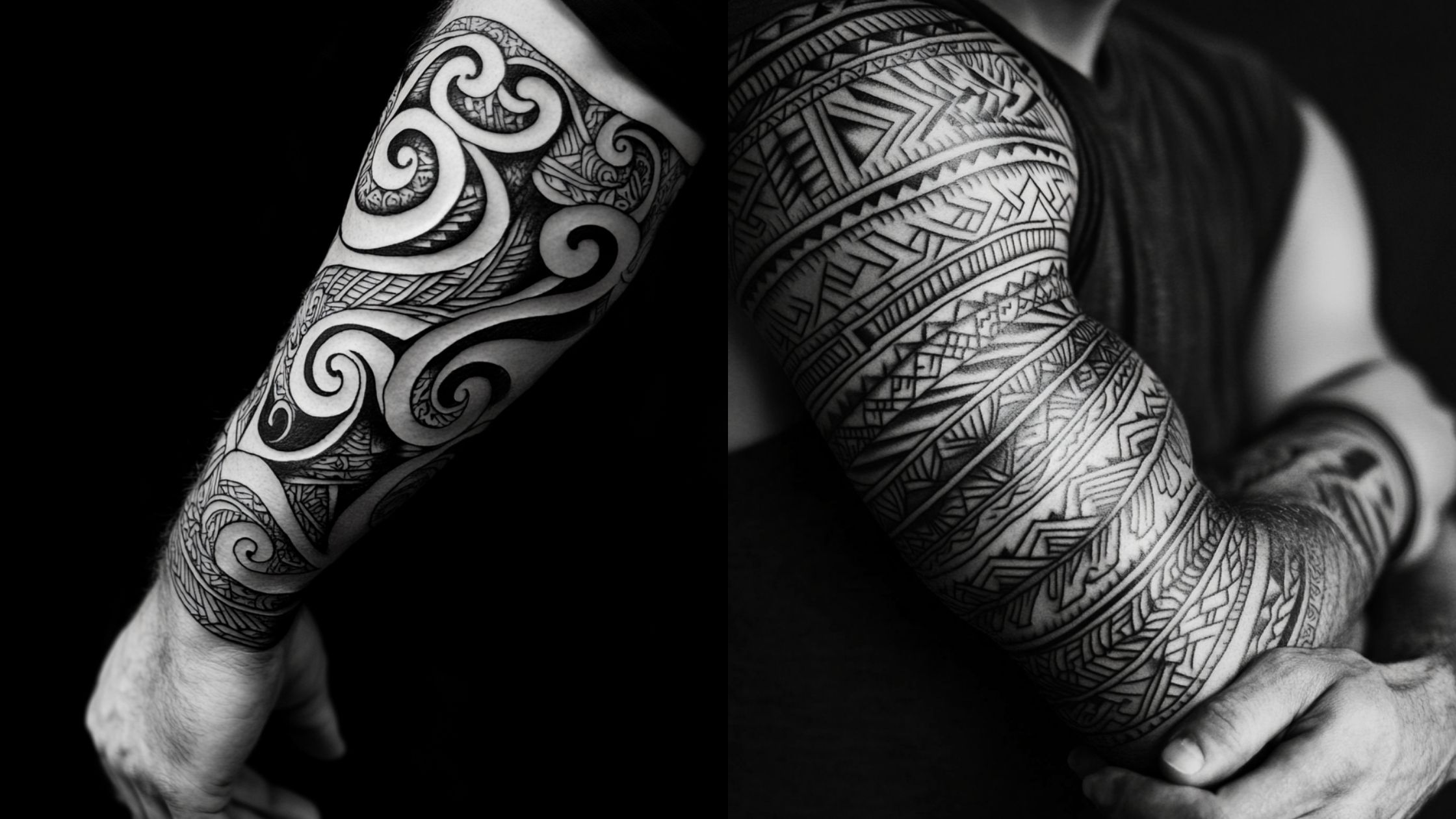
A Maori tattoo is not a pattern you pick off a wall — it is a language, and the shapes carry meaning whether or not the wearer can read them. That single fact changed how I approach this style entirely.
I have spent the last several years photographing and writing about Polynesian-influenced work, and Maori designs are the ones people get wrong most often. They see the bold black spirals, assume it is decorative tribal work, and book the first artist with a portfolio full of curves.
The result is usually a tattoo that looks close but reads as noise to anyone who actually knows the art form. Every Maori and Pacific artist I have spoken to says the same thing: the spacing and the flow matter more than the individual motifs.
So this guide covers the designs, but it also covers the part most listicles skip — what these marks mean, what the difference is between ta moko and kirituhi, and how to commission something you will still be proud of in twenty years.
Ta Moko vs Kirituhi: Which Is Right for You?
This is the first question worth settling, and almost nobody asks it before booking. The distinction is about whakapapa — genealogy — not about how the tattoo looks.
Ta moko is the traditional practice belonging to Maori, and the marks encode a specific person’s ancestry, iwi and life story. Kirituhi literally means "skin writing" and describes Maori-style artwork made for people without Maori descent.
Kirituhi is not a lesser version. It is the respectful term for the same visual language used decoratively, and many Maori artists tattoo it happily. The problem only starts when someone wears a piece that claims a lineage that is not theirs.
| Approach | Who it is for | What the design encodes | What to ask your artist |
|---|---|---|---|
| Ta moko | People of Maori descent | Whakapapa, iwi, hapu, personal history | Whether they work with your whanau history and tikanga |
| Kirituhi | Anyone, regardless of descent | Personal themes told through Maori motifs | Which motifs are open to use and which are not |
| Wider Polynesian | Anyone drawn to the broader style | Samoan, Marquesan or Hawaiian pattern systems | Whether they are mixing traditions or keeping one |
| Maori-inspired blackwork | People who want the aesthetic only | Nothing culturally specific by design | How to keep it clearly distinct from sacred motifs |
What the Patterns in a Maori Tattoo Actually Mean
Maori design is modular. A handful of core motifs get combined, stretched and mirrored to fill a body part, and each one carries an idea.
Koru is the unfurling silver fern frond — new life, growth, a beginning that has not finished yet. It is the shape most people recognise even if they cannot name it.
Hei matau, the stylised fish hook, points to prosperity, safe travel over water and a link to Tangaroa. Manaia is the figure with a bird’s head and a human body, usually read as a guardian.
Then there are the fill patterns that do the real work: pakati (dog-skin cloak notching, associated with courage), unaunahi (fish scales, abundance) and ahu ahu mataroa (steps, achievement). These are what give a piece its texture and rhythm.
The Te Ara Encyclopedia of New Zealand is the best free starting point if you want to read further before your consultation, and it is written with Maori input rather than about Maori from outside.
If you love the density and contrast but not the cultural weight, blackwork designs give you a similar visual punch without borrowing a specific people’s iconography.
Maori Tattoo Ideas by Placement
Placement is not cosmetic in this style. Traditional layouts assign different regions of the body to different aspects of a person, and even in modern kirituhi the flow of a design is built around the limb it sits on.
1. Maori Leg Tattoos
The leg gives you the longest uninterrupted canvas on the body, which is why so much traditional Maori work — puhoro in particular — was placed from waist to knee.
What I like about leg pieces is that they let the pattern breathe. Bands can widen over the thigh, narrow at the knee, and open out again across the calf, so the design reads as one continuous movement rather than a set of stickers.
The single biggest mistake I see on legs is uniform density. When every square inch is filled at the same weight, the tattoo turns into a dark blur from three metres away. Good artists leave deliberate negative space so the motifs still separate once the ink settles.
Expect a full leg to take several long sessions. Every artist I have asked plans this style in stages rather than trying to finish a limb in one sitting, and the outline usually gets laid freehand on the skin first so it follows your specific muscle shape.
For layout inspiration outside the Polynesian tradition, the leg sleeve drawings gallery is a useful comparison on how designs wrap a calf.
2. Maori Arm Sleeve Tattoos
The sleeve is the most requested Maori placement I come across, and it is also the most forgiving because the arm is a simple cylinder.
A well-built Maori sleeve usually has a spine — one dominant line or band that travels the length of the arm — with secondary patterns growing off it. Without that spine the piece looks like separate tattoos that happen to touch.
Shoulder caps are where artists tend to put the heaviest motif, because the deltoid is a wide, flat plane that can hold a manaia or a large spiral without distortion.
Ask to see healed photos, not fresh ones. Solid black in this style spreads slightly as it settles, and an artist who packs their lines too tight will show you crisp day-one photos that look muddy a year later.
If you are weighing up styles for a full arm, our guide to full sleeve tattoos for men is worth a look for how other traditions handle the same real estate.
3. Maori Tattoos for Men
Most Maori work I photograph on men is large-scale and high-contrast, which suits the style — these patterns were designed to be seen across a marae, not squinted at.
Chest and shoulder combinations are common because the pectoral gives a broad symmetrical field and the design can spill onto the upper arm naturally.
If you want something meaningful rather than purely decorative, bring your artist themes, not motifs. Tell them about the water, the family, the work — and let them choose which shapes say it. That is how the tradition actually functions.
Symmetry is optional. A lot of clients assume both sides must mirror; traditionally they often did not, because the two halves of a piece could refer to different sides of a person’s family.
4. Maori Tattoo Ideas for Women
There is a persistent myth that Maori designs are a men’s art form. They are not — moko kauae, the chin moko worn by Maori women, is among the most significant expressions of the practice.
For kirituhi work on women, I most often see forearm bands, thigh pieces and shoulder-to-collarbone designs, generally with slightly finer linework and more open space than the men’s pieces above.
Finer does not mean smaller. Some of the strongest women’s Maori-style work I have seen covers an entire thigh, but uses thinner strokes so the pattern reads as lace rather than armour.
One honest caveat: fine linework in this style ages less predictably than bold linework. If you want a delicate version, ask your artist directly how they expect it to look after a decade.
5. Maori Tattoo Patterns from New Zealand
If you want the real reference material rather than Pinterest reposts, look at carving and weaving as well as tattoos.
Whakairo (carving) and kowhaiwhai (the painted rafter patterns in a wharenui) share a design grammar with moko, and studying them teaches you more about flow than any tattoo gallery will.
The collections at Te Papa Tongarewa are searchable online and are a far better source than the stencil sheets circulating on design sites, most of which are copies of copies.
Bringing three or four genuine reference images to a consultation changes the conversation completely. It tells the artist you care about the tradition rather than the trend.
6. Maori Inner and Upper Arm Designs
The inner upper arm is softer, less exposed skin, and it takes fine detail well — but it is also one of the more tender spots to sit through.
Outer upper arm pieces are the most common entry point into this style. They are visible when you want them to be, coverable at work, and big enough to hold a real composition.
A design that stops abruptly at the deltoid line tends to look unfinished. In my experience the pieces that age best either wrap fully around the arm or taper deliberately into a point.
For non-Polynesian alternatives in the same placement, the upper arm tattoo drawings collection covers a wider range of approaches.
7. Maori Armbands and Half Sleeves
The armband is the most misunderstood Maori-style tattoo. Done well it is a clean, self-contained ring of pattern; done badly it is a black stripe.
The difference is almost always internal variation — a good band has at least two or three distinct motif zones inside it, so your eye has somewhere to travel.
Half sleeves are the sweet spot for most first-timers. They give the artist enough room to build a proper composition without committing you to the cost and healing of a full arm.
Shoulder-to-elbow is the standard span. Elbow-to-wrist works too, but the wrist end needs a strong terminating motif or the design looks cut off.
8. Maori Turtle (Honu) Tattoo Designs
The turtle is worth flagging because it is more strongly associated with the wider Pacific — Hawaiian honu and Samoan work especially — than with Maori tradition specifically.
That does not make it a bad choice. It makes it a kirituhi or pan-Polynesian choice, and it is worth knowing which you are asking for.
Design-wise the turtle is a gift, because the shell divides naturally into panels and each panel can carry a different fill pattern. It is one of the few motifs that works small as well as large.
Common readings across Pacific cultures include longevity, navigation and family. Meanings differ between islands, so ask your artist which tradition they are drawing on rather than assuming.
9. Large-Scale Upper Arm and Shoulder Compositions
Once you go past a half sleeve, the design stops being a pattern and starts being architecture.
At this scale artists usually work freehand directly on the skin with a marker, because a printed stencil cannot account for how your particular shoulder moves.
Expect to stand up, flex, and be redrawn several times before any needle touches you. That consultation time is not the artist stalling — it is the part that determines whether the piece looks right in motion.
Budget for multiple sittings and a healing gap of a few weeks between them. Every reputable artist I have asked refuses to rush this.
Alternatives and Variations Worth Considering
If you love the look but are unsure about wearing Maori iconography specifically, there are several honest routes to a similar result.
Wider Polynesian Styles
Samoan tatau and Marquesan patterning share ancestry with Maori design but have their own distinct grammar. Marquesan work in particular is more geometric and grid-based.
These carry their own cultural weight too, so the same consultation questions apply — but an artist trained in one of these traditions can tell you exactly what is open and what is not.
Neo-Tribal and Contemporary Blackwork
Neo-tribal has had a serious revival, and it borrows the bold-black, negative-space logic without lifting specific sacred motifs.
It is the option I most often suggest to people who admit, when pushed, that what they actually want is the aesthetic.
Celtic and Nordic Knotwork
If interlocking pattern is the appeal rather than Pacific culture specifically, Celtic knot designs scratch a very similar itch and may connect more directly to your own ancestry.
Single-Motif Pieces
You do not need a sleeve. A single well-drawn koru or hei matau on the forearm, done at a decent size, often looks better than a rushed large piece.
Practical Tips Before You Book
Find an artist who specialises. General-practice tattooists can copy the shapes, but Polynesian and Maori work is a discipline of its own and the flow is what gives it away.
Where you can, seek out Maori or Pacific artists. Beyond the obvious point about respect, they will simply build a better composition and can tell you when a motif is not appropriate for you to wear.
Never bring in a design printed off a stencil site and ask for it exactly. Those files are frequently someone’s personal moko, and wearing another person’s whakapapa is the one thing everyone in this field agrees is out of bounds.
On pain: solid black packing over bone hurts more and takes longer than most people expect. Our guide to the most painful tattoo spots is worth reading before you pick a placement.
On healing: heavy black saturation can weep and scab more than fine line work, and it needs consistent care. Follow our tattoo aftercare guide and, more importantly, your artist’s written instructions.
If a healing tattoo shows spreading redness, swelling that gets worse after the first few days, heat, pus, or you run a fever, stop searching online and see a doctor. Infection and allergic reactions are treatable when caught early — this article is not medical advice and cannot diagnose anything.
Common Mistakes and What to Do Instead
Copying a real person’s moko. It is the equivalent of tattooing a stranger’s family tree on yourself. Ask for original work built around your own themes.
Going too small. This style relies on contrast between filled and open areas, and below a certain size those areas merge into a smudge as the tattoo ages.
Mixing traditions without meaning to. A Maori koru next to a Samoan band next to a Hawaiian honu can look fine, but it should be a deliberate choice you and your artist discussed.
Underestimating the commitment. Solid blackwork is among the harder styles to cover or remove later, so treat the design decision as close to permanent.
Still weighing it up? How much a sleeve tattoo costs will help you plan the budget, and browsing half sleeve tattoo drawings is a good way to test whether you actually want the scale you think you do.
Frequently Asked Questions
Can I get a Maori tattoo if I am not Maori?
Yes, in the form of kirituhi — Maori-style artwork created for people without Maori descent. Kirituhi uses the same visual language but is not tied to a specific whakapapa, so it does not claim an ancestry that is not yours. Many Maori and Pacific artists tattoo kirituhi and will guide you on which motifs are open to use. The one thing to avoid is copying an existing personal moko, which is widely considered off-limits.
What is the difference between ta moko and kirituhi?
Ta moko is the traditional Maori practice in which the design records a person’s genealogy, iwi, hapu and life story. Kirituhi translates roughly as skin writing and refers to Maori-style designs made decoratively for anyone. The visual vocabulary overlaps heavily; the difference is what the marks are claiming about the wearer. If you are unsure which you are being offered, ask your artist directly before the stencil goes on.
What do the spirals in a Maori tattoo mean?
The spiral most people recognise is the koru, based on the unfurling frond of the silver fern, and it is generally read as new life, growth and beginnings. Larger double spirals often signal a joining — two families, two paths, a partnership. Meanings are not rigid across every iwi, so the same shape can be read slightly differently by different people. Your artist should be able to explain the specific reading behind the design they draw for you.
How long does a Maori sleeve take to complete?
Most of the artists I have asked plan a full Maori sleeve across several long sessions rather than one marathon sitting, with healing gaps of a few weeks in between. The freehand drawing stage alone can take an hour or more before any tattooing starts. A half sleeve is considerably shorter and is a realistic first commitment. Anyone promising a full arm in a single day is worth a second thought.
Do Maori tattoos hurt more than other styles?
The style involves a lot of solid black packing, which generally means longer time under the needle in each area than an outline-and-shade design of the same size. Placement matters more than style, though — ribs, inner arm and anywhere over bone tend to be the hardest regardless of what is being tattooed. Most people find the second half of a long session harder than the first. Eating properly beforehand and scheduling shorter sittings both help more than people expect.
Quick Summary
- Know the terms first. Ta moko encodes Maori ancestry; kirituhi is the respectful term for Maori-style work on people without Maori descent.
- Never copy an existing moko. Bring themes from your own life and let the artist choose the motifs.
- Learn the core shapes. Koru for growth, hei matau for prosperity and safe travel, manaia for guardianship, pakati and unaunahi as fill.
- Go big enough. Contrast between filled and open areas is what makes the style work, and small pieces lose it as they age.
- Choose a specialist. Maori and Pacific artists build better compositions and can tell you what is appropriate to wear.
- Expect freehand work. Large pieces are drawn on the skin so the pattern follows your muscle, not a flat stencil.
- Plan for multiple sessions. Solid black saturation takes time and needs healing gaps between sittings.
- Take healing seriously. Follow your artist’s aftercare instructions, and see a doctor for spreading redness, worsening swelling or fever.