The rose is the most tattooed flower in the history of Western tattooing, and a sleeve built around it is one of the few tattoo concepts that has never really gone out of fashion. A well-executed rose sleeve is the closest thing tattooing has to a permanent safe bet.
I have spent a lot of time looking at rose sleeves — healed ones, fresh ones, half-finished ones sitting under a stencil — and the pattern is consistent. The flower is complex enough to stay interesting at full-arm scale, simple enough that a competent artist can draw it from any angle, and loaded with enough rose tattoo symbolism that it means something without needing explanation.
What separates a good rose sleeve from a mediocre one is almost never the individual roses. It is the composition: how the blooms connect, how the arm reads when it rotates, and what the artist does about the elbow.
Below are 19 directions a rose sleeve can take, with honest notes on what each one demands of you and your artist. Some of these are easy wins. A few of them I would only recommend to people willing to search hard for the right specialist.
Which Rose Sleeve Style Is Right for You?
Before the ideas themselves, it helps to understand how the major styles differ on the things that actually matter long-term: ageing, time in the chair, and what you end up with.
| Style | How it ages | Typical session load | Best if you want |
|---|---|---|---|
| Traditional American | Ages best of any option — heavy outlines and flat fills stay readable longest | Fewest sessions of the colour options | A sleeve that still reads clearly across a room in thirty years |
| Neo-traditional | Very good — keeps the outline, so blended colour has a frame to fade into | Moderate to heavy | Traditional structure with richer, more dimensional colour |
| Black and grey | Good, though pale highlight areas soften first | Moderate | Tonal elegance and an easier future cover or extension |
| Colour realism | Most demanding — needs diligent sun protection and usually touch-ups | Heaviest | Botanical accuracy and painterly depth |
| Watercolour | Softest over time, especially where there is no outline underneath | Light to moderate | A loose, painterly sleeve rather than a graphic one |
| Blackwork / dark floral | Strong — solid black holds shape well | Moderate, but heavy black is harder on the skin per sitting | High contrast and a gothic mood |
Session load in that table is relative, not absolute — a full sleeve is a multi-session project in every style, and your artist’s pace matters more than the style does.
What Actually Determines How a Rose Sleeve Turns Out
Style choice gets most of the attention in consultations, but it is not the biggest variable.
The elbow is the single most technically demanding part of any sleeve. The skin there folds, stretches and creases constantly, and ink behaves differently in it. A good sleeve artist will have a specific, articulable approach to the elbow section — ask about it directly and listen to how confident the answer sounds.
Flow is the second variable. A sleeve is a cylinder, not a flat page, and a design that looks perfect on paper can break apart when the arm turns. Artists who design sleeves well usually stencil in stages and adjust on the body rather than committing the whole layout up front.
Skin tone matters more than most guides admit. Pale colours, white highlights and delicate grey wash read very differently on different skin, and an honest artist will tell you which parts of a reference photo will not translate. If nobody mentions this, ask.
Then there is simple endurance. Full sleeves are typically built over multiple long sessions spread across months. In my experience the people happiest with their finished sleeve are the ones who booked a realistic cadence and did not try to rush it.
19 Rose Sleeve Tattoo Ideas
Each of these is a complete direction rather than a variation on the same theme. Several can be combined, and most good artists will happily blend two of them.
1. Traditional American Rose Sleeve
A full sleeve of traditional American roses: bold outlines, flat red fills, green leaves, hard black shadow.
This is the grandfather of every rose sleeve concept, with roots in sailor tattooing and about a century of refinement behind it.
If you only care about one thing, care about how the tattoo will look in twenty years, and traditional wins that argument outright.
The reason is mechanical rather than nostalgic. A heavy outline gives the ink inside it a boundary, so when the fill inevitably spreads a little with age it spreads into a shape that is already drawn.
Every artist I have asked about longevity has said some version of the same thing: bold lines and simple colour separation are the safest bet on skin.
The composition trick with traditional is repetition. Several roses of similar size and treatment, spaced evenly around the arm, read as one deliberate sleeve rather than a collection.
2. Neo-Traditional Rose Sleeve
Neo-traditional keeps the confident outline of traditional work but fills it with dimensional colour and more complex shading.
The proportions are usually slightly stylised, which is what gives neo-traditional roses their particular personality.
In my experience this is the style most people actually want when they say they want a traditional rose sleeve. They want the boldness without the flatness.
Expect richer colour transitions, more depth in the petal folds, and often a broader palette than the traditional red-and-green.
It is a middle path that ages nearly as well as traditional while looking considerably more contemporary.
3. Black and Grey Rose Sleeve
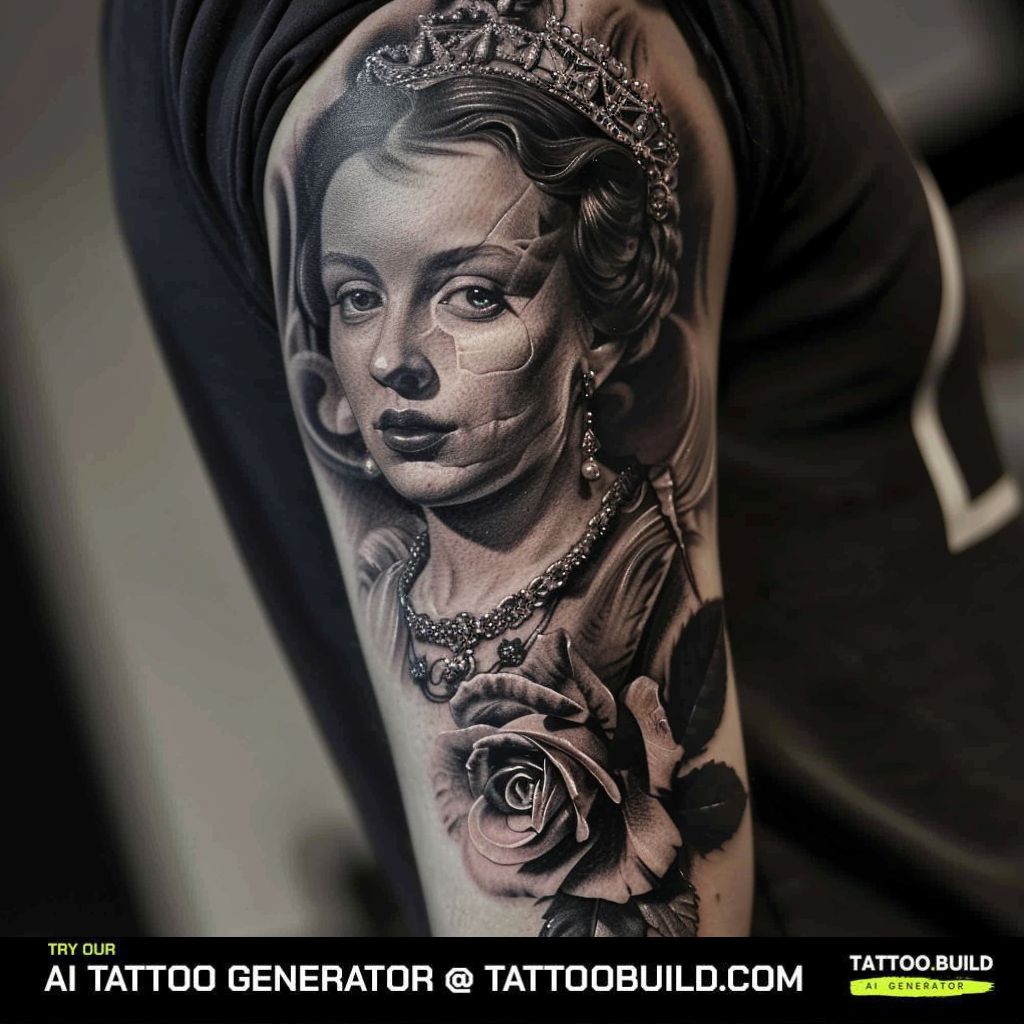
Roses rendered across the full grey range, from near-black shadow to pale, almost untouched highlight.
Removing colour forces everything onto form and light. There is nowhere to hide a weak composition.
When I have compared healed colour sleeves against healed black and grey sleeves of the same age, the black and grey work tends to look more intentional, partly because grey wash softens gracefully while colour shifts unevenly.
It also leaves you more options later. Adding to or reworking a black and grey sleeve is simpler than matching an existing colour palette years on.
If this is the direction you are leaning, it is worth browsing more black and grey tattoo ideas before you commit to a layout.
4. Colour Realism Rose Sleeve
Petals rendered with botanical accuracy, each rose a specific colour rather than a generic red.
Deep velvet red, pale cream, coral, dusty pink and yellow across one arm reads like a painted garden.
This is the most demanding option on this list, both for the artist and for you.
Colour realism needs an artist with a genuine realism portfolio — not a stylised portfolio with one realistic piece in it — and it needs long sittings.
It also needs the most aftercare discipline of any style here, because sun exposure dulls soft colour transitions faster than it dulls solid black.
Budget for at least one touch-up session a year or two after the sleeve is finished. Most realism artists expect this and price accordingly.
5. Rose and Snake Sleeve
A snake woven through the roses, travelling the length of the arm.
This solves a real compositional problem. A sleeve made only of roses can sit still on the arm; the serpent gives it one continuous line of movement.
It works in traditional, neo-traditional and realism equally well, which is unusual for a combination concept.
The symbolism of the snake — renewal, transformation, temptation depending on which tradition you draw from — also gives the piece a second layer of meaning beyond the flower.
Placement tip from experience: let the snake cross the elbow rather than the roses. A long, flexible body handles that crease far better than a wide bloom does.
6. Dark Floral Rose Sleeve
Roses rendered as though lit by very little light: deep blacks, dramatic shadow, minimal highlight.
Dark floral is not the same as black and grey. Black and grey uses the full tonal range; dark floral deliberately compresses it toward the bottom.
The result is moodier and more graphic, and it sits well on people who want florals without anything soft about them.
One practical caution: heavy black over a large area is tiring to sit through and can be harder on the skin in a single session than lighter shading.
Good artists split it across more appointments for exactly that reason.
7. Botanical Illustration Rose Sleeve
Roses drawn in the language of nineteenth-century botanical plates: fine linework, stippled shading, accurate leaf and thorn structure.
Often accompanied by labels, cross-sections or the suggestion of a plate border.
This is the most literary of the rose sleeve styles, and it suits people who like the flower as a plant rather than as a symbol.
The risk is fineness. Very delicate stipple and hairline work can blur over the years, particularly on high-movement areas like the inner elbow.
In my experience the botanical sleeves that hold up best are the ones where the artist quietly thickened everything about twenty per cent compared with the reference plate.
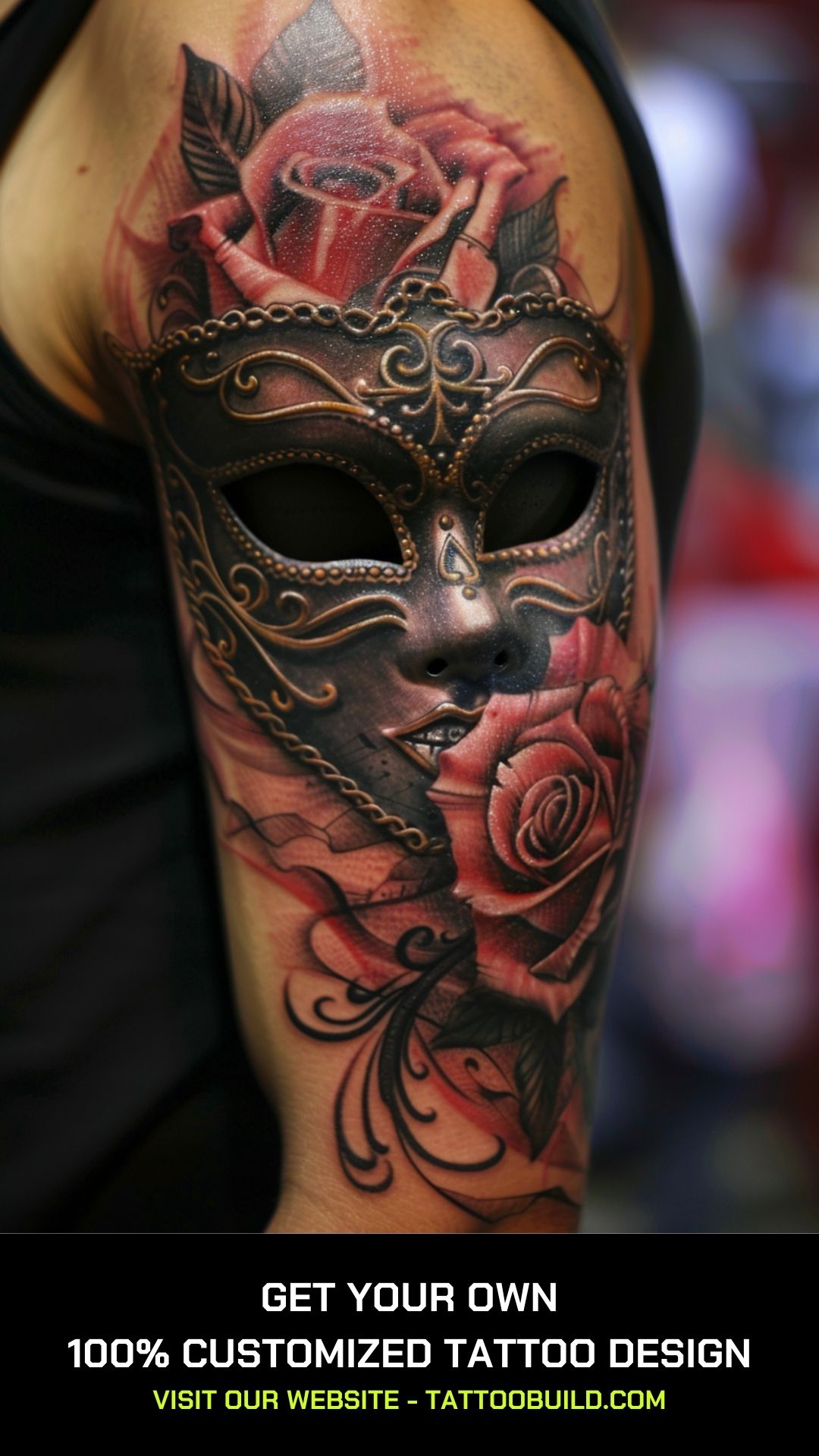
8. Rose and Skull Sleeve
Roses and skulls woven together across the arm: beauty and mortality in the same composition.
It is one of the oldest combination ideas in Western tattooing and it has stayed popular because it works visually, not only symbolically.
The skull gives the sleeve a hard, high-contrast anchor. Without something like it, a full arm of flowers can read as decoration rather than as a piece.
Two or three skulls in a full sleeve is usually plenty. I have seen sleeves with five or six and they start to compete with the roses instead of supporting them.
Placement matters here too: skulls sit best on the flatter planes — outer bicep, forearm top — where the shape will not distort.
9. Watercolour Rose Sleeve
Soft washes of colour bleeding at the edges, blooms suggested by colour rather than defined by outline.
Watercolour rose sleeves look genuinely different from everything else on this list, and from a distance they can look like nothing else on skin.
They are also the style I would most strongly urge you to think about long-term.
Colour with no underlying structure has nothing to hold its shape as it settles. Many artists now build a light grey or line understructure beneath the washes for exactly this reason, and I would ask any artist you consult whether they do.
If they say no and have healed photos from five years ago that still look sharp, believe the photos. If they have no healed photos at all, that is your answer.
10. Japanese-Influenced Rose Sleeve
Roses treated as an element inside a Japanese composition: bold outline, saturated colour, wind bars, waves or cloud work filling the background.
The rose is not a traditional Japanese motif, so this is a hybrid rather than an authentic Japanese sleeve, and good artists are upfront about that.
What it borrows is the thing Japanese tattooing does better than any other tradition: compositional flow around the body.
Background elements carry your eye around the arm and solve the empty-space problem that catches a lot of Western floral sleeves.
If this appeals, look at real Japanese tattoo designs first so you understand what you are borrowing and can discuss it honestly with your artist.
11. Half Sleeve Rose Bouquet
Roses and supporting botanicals from shoulder to elbow, or elbow to wrist, as one dense bouquet.
The bouquet approach gives you a lush, full composition in a smaller commitment.
This is what I most often suggest to people who are unsure about a full sleeve. You get a finished-looking piece, and the design can be extended later if you want it.
The key is asking the artist to design it as a half sleeve that could extend, rather than as a standalone piece you later try to bolt onto.
There are more layout options worth studying in this floral half sleeve guide before your consultation.
12. Rose with Thorns Only Sleeve
Long, curving, heavily thorned stems form the structure of the sleeve, with a small number of blooms as focal points.
The thorns become the architecture and the roses become the emphases. It is the inverse of how most rose sleeves are built.
It reads as tougher and more austere than a bloom-heavy sleeve, and it uses far less colour, which keeps sessions shorter.
The meaning attached to thorns — beauty that defends itself, love with a cost — is part of why people choose this variant over a fuller arrangement.
It is also one of the easiest layouts to wrap cleanly around the elbow, because a stem can bend where a bloom cannot.
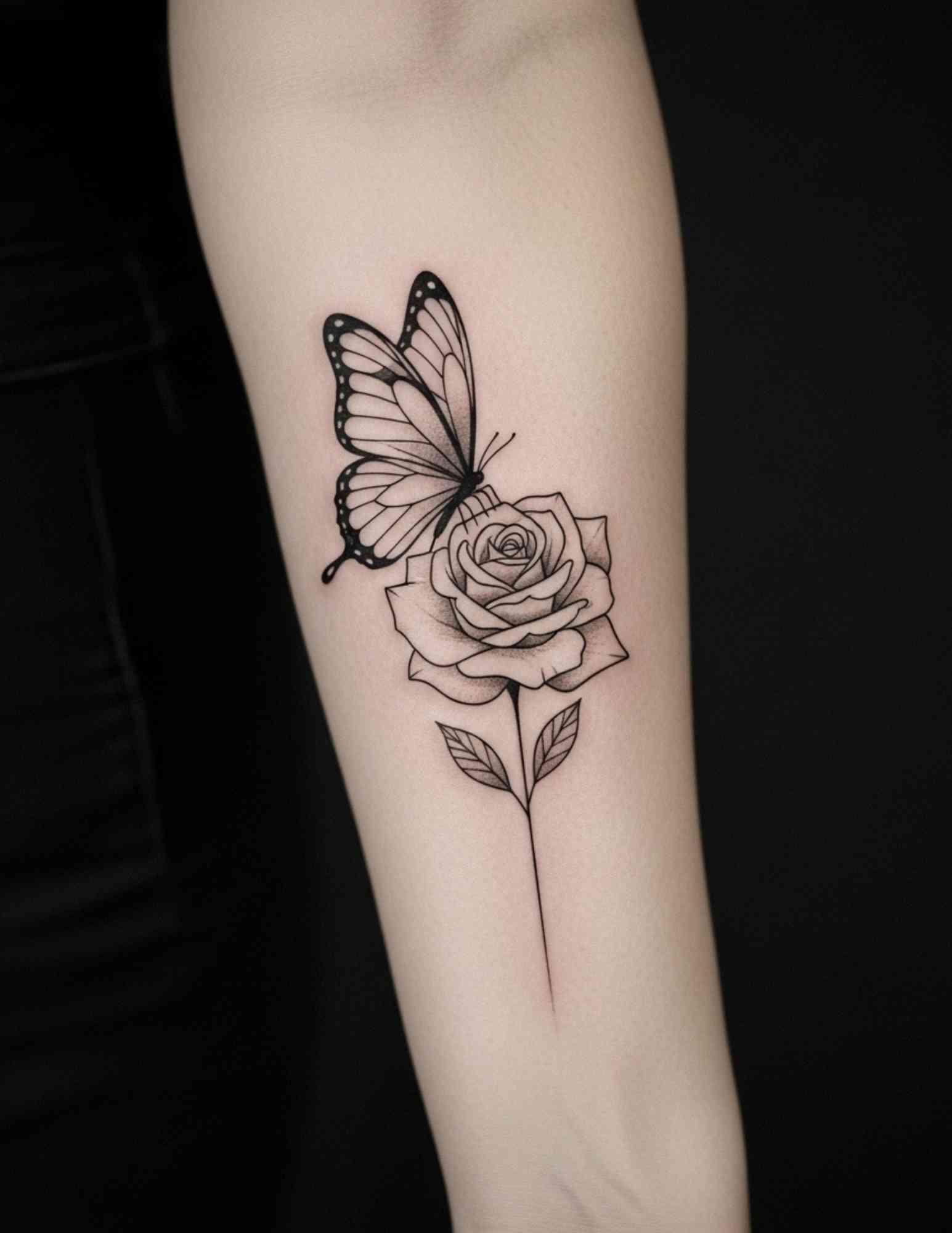
13. Rose and Butterfly Sleeve
Roses as landing places, butterflies as the movement between them.
The combination gives the arm two very different shapes to look at, which keeps a colour sleeve from becoming visually repetitive.
Butterflies are also genuinely useful as filler. They occupy the awkward spaces between blooms without adding another heavy element.
In colour, the contrast between petal texture and wing pattern is the whole appeal. In black and grey the two can start to blur together, so most artists I have watched build this one push for colour.
Plenty more direction available in this collection of butterfly tattoo ideas if that half of the concept is the part you care about.
14. Single Colour Rose Sleeve
Every rose in the sleeve worked in one colour: deep purple, midnight blue, sepia, black or white.
The restriction is the point. One palette across a whole arm makes the sleeve read as a single designed object rather than a set of tattoos that happen to be adjacent.
White ink is the one colour I would think hardest about. It behaves unpredictably depending on skin tone and sun exposure, and it is the most likely of any option here to look different in five years than it did the week it healed.
Purple, blue and sepia are far more reliable choices if you want something other than red.
Ask to see healed work in the specific colour you are considering, not fresh photos.
15. Geometric Rose Sleeve
Organic blooms connected by geometric linework: triangles, arcs, mandala segments, repeating patterns.
The geometry does real compositional work. It fills space between roses with something intentional instead of leaving gaps or adding more filler foliage.
It also gives the sleeve a rhythm, which is hard to achieve with flowers alone.
The technical demand is precision. Wobbly geometry is far more obvious than a slightly uneven petal, so this style needs an artist with visibly steady linework in their healed portfolio.
Worth noting that geometric elements are harder to alter later than florals are, so be reasonably sure about the layout before you start.
16. Peeling Skin with Rose Sleeve
A trompe-l’oeil effect where the outer skin appears to peel or tear back, revealing roses beneath the surface.
It is a concept piece and it lives or dies entirely on execution.
Done well, the illusion is startling. Done adequately, it just looks like a shape with a rose in it.
This is the one idea on the list where I would say plainly: if you cannot find an artist with several healed examples of this specific effect, choose something else.
General realism skill does not transfer automatically to convincing skin-tear work, and half-successful illusions are very hard to rescue.
17. Rose with Banner Sleeve
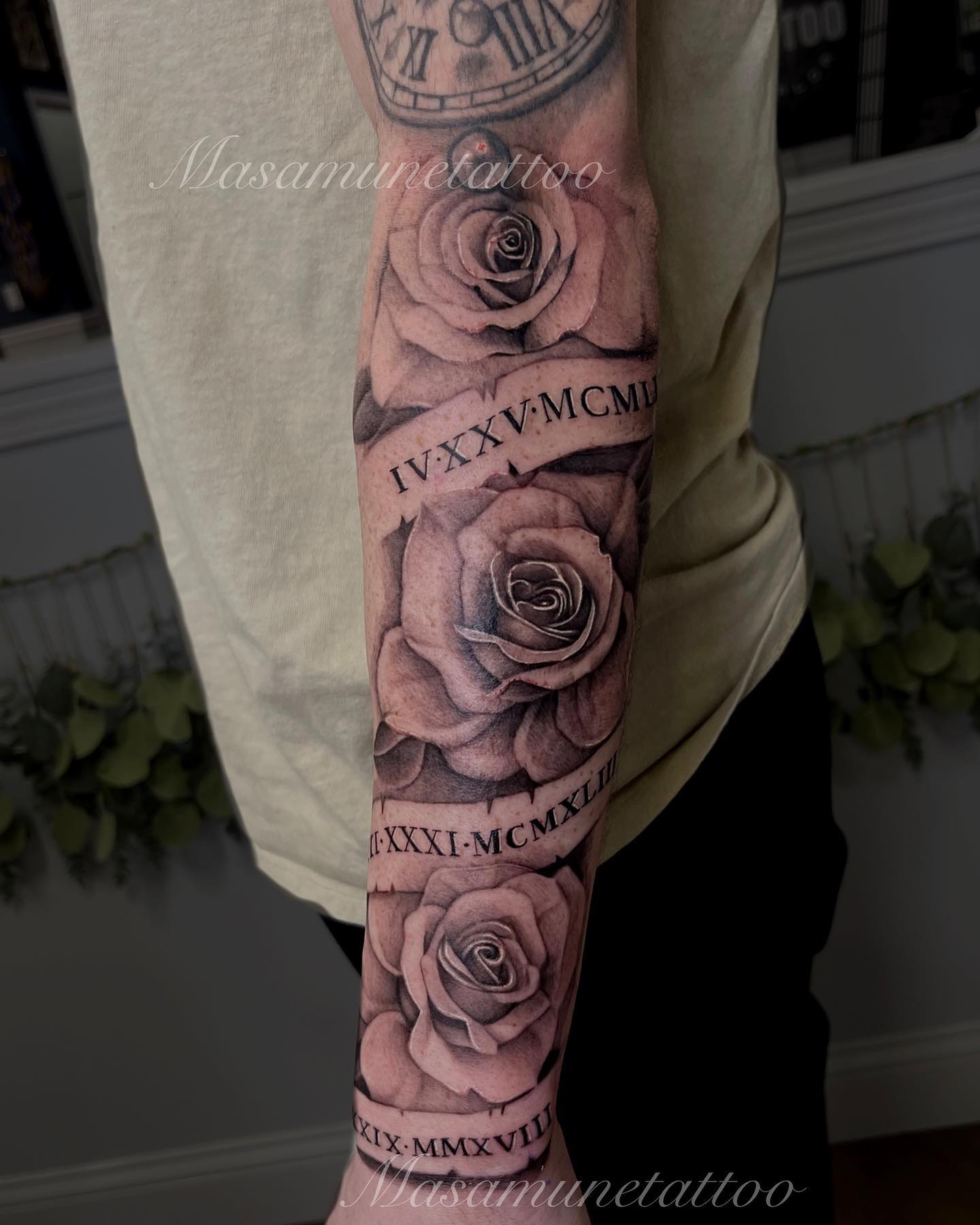
Traditional roses with banner scrolls woven around them, carrying names, dates, phrases or single words.
The rose and banner is about as classic as American tattooing gets, and it solves the problem of how to include text without it looking bolted on.
The practical advice I would give is to keep banner text short. Three or four words per banner stays readable; a full sentence compressed into a scroll rarely does.
Think carefully about names. Banners are very hard to remove or repurpose cleanly, and lettering is the most literal element on your arm.
Dates, places and words tend to age better than names do.
18. Decomposing Rose Sleeve
Roses shown across the full arc of their life: the tight bud, the open bloom, the fading flower, the dried and curling petal.
It is the memento mori idea again but without a skull anywhere in sight, and it is far more subtle for it.
It is also the most narratively satisfying way to build a rose sleeve, because the arrangement has a direction: you can read it from shoulder to wrist.
It suits detailed realism or neo-traditional best. The decay needs enough texture to be legible as decay rather than as a poorly drawn bloom.
Discuss the order with your artist before anything is stencilled. Which end of the arm holds the fresh blooms changes the whole feel of the piece.
19. Custom Species Rose Sleeve
Real, identifiable rose species rather than generic stylised blooms: Rosa gallica, Rosa damascena, the wild dog rose, each with its correct leaf shape, thorn pattern and petal count.
The sleeve becomes a botanical record as well as a tattoo.
This is the option for people who want the piece to mean something specific — a species from a garden, a country, a person’s name.
It requires research on your side, not just the artist’s. Bring proper reference: photographs of the actual species, ideally several angles.
In my experience the consultation for this style takes longer than for any other on the list, and that is time well spent.
Variations Worth Considering Instead of a Full Sleeve
A full sleeve is a serious commitment of money, time and skin. These are the variations I most often see people land on instead, and none of them is a lesser choice.
The Quarter Sleeve
Shoulder to mid-bicep, or elbow to mid-forearm. It is enough space for three or four well-drawn roses and a proper composition, and it usually finishes in one or two sessions.
It is also the easiest format to extend later without the join being obvious.
The Wrapping Vine
A single thorned stem spiralling the arm with blooms at intervals, leaving most of the skin bare.
This reads as a sleeve from a distance while using a fraction of the ink, and the vine as a motif carries its own symbolism of growth and continuity.
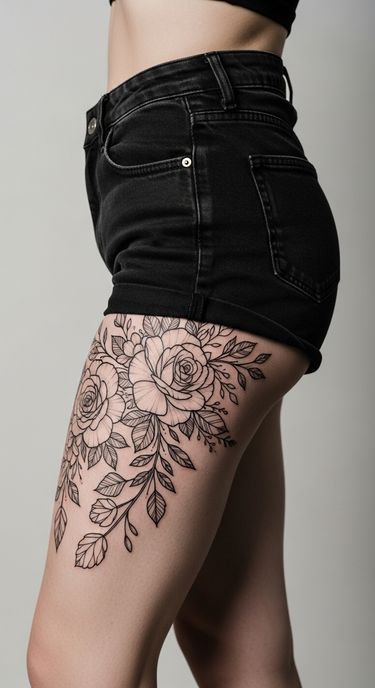
The Leg Sleeve
The thigh and calf offer larger, flatter, more forgiving surfaces than the arm, with no elbow to negotiate.
If you work somewhere with a visible-tattoo policy, this is the obvious answer, and roses scale up beautifully on a thigh.
The Panel Sleeve
Roses covering only the outer arm, with the soft inner arm left blank.
It hurts considerably less, costs less, and still reads as a full sleeve when your arms are at your sides.
Planning, Healing and Aftercare for a Rose Sleeve
Plan the whole sleeve before the first needle touches you, even if you are building it over two years. Retrofitting a composition around existing tattoos is the most common source of regret I hear about.
Keep your sessions consistent with one artist wherever possible. Rose sleeves depend on a unified hand — petal shapes, shading density and line weight all vary between artists in ways that are very visible across one arm.
For healing, follow the specific instructions your artist gives you over anything you read online, including this. Studios adjust their aftercare advice to their own inks, machines and local climate. The general principles — keep it clean, keep it moisturised, do not pick, stay out of the sun and out of pools while it heals — are well summarised by the American Academy of Dermatology.
Sun protection after healing is the single highest-value habit for a colour rose sleeve. Ultraviolet exposure is what dulls soft colour transitions, and a sleeve is on one of the most sun-exposed parts of the body.
Know the warning signs. Some redness, swelling and tenderness in the first few days is normal; spreading redness, increasing pain after day three, pus, or fever is not. The Mayo Clinic’s overview of tattoo risks covers infection and allergic reaction in plain terms. If you see any of those signs, contact your artist and see a doctor — this article is not medical advice and cannot substitute for either.
If you have a history of skin allergies, keloid scarring, or you are on medication that affects healing or bleeding, raise it at the consultation and with your doctor before you book. Red pigment in particular is a known, if uncommon, cause of delayed allergic reaction, which the US Food and Drug Administration notes in its consumer guidance on tattoo inks.
Common Mistakes — and What to Do If You’re Still Not Sure
The most frequent mistake is choosing an artist by proximity rather than by portfolio. A rose sleeve is a years-long relationship with someone’s drawing habits. Travel for the right person.
The second is designing around one reference photo. Bring five or ten images that show what you like about petal shape, shading, density and colour separately, then let the artist build something original from them.
The third is filling every millimetre. Negative space is what lets individual roses read as individual roses. Sleeves that are solid from shoulder to wrist often look like texture rather than flowers.
The fourth is starting at the wrist. Most artists prefer to begin on the upper arm where the skin is more forgiving and the stakes of a slightly imperfect first session are lower.
Still weighing it up? It is worth looking at how other people have handled the same space — these half sleeve tattoo ideas for women and these floral sleeve ideas for men both show layouts that solve the composition problem in different ways.
Frequently Asked Questions
How long does a full rose sleeve take to complete?
A full rose sleeve is a multi-session project, not a single appointment. Most artists build one across several long sittings spaced weeks apart so each section can heal properly. The exact number depends on the style, your artist’s pace and how much detail the design carries — colour realism takes considerably longer than traditional. Ask your artist for their own estimate at the consultation, since it varies enormously between studios.
Does a rose sleeve hurt more than other tattoos?
Pain varies by location on the arm far more than by subject matter. The inner bicep, the inner elbow and the wrist are generally reported as the most uncomfortable areas, while the outer forearm and outer bicep are usually easier. A sleeve is not more painful per square inch than any other tattoo — it simply covers more of the difficult areas. Eat beforehand, stay hydrated, and tell your artist when you need a break.
Can I mix styles within one rose sleeve?
You can, but it needs to be planned deliberately from the start rather than assembled over time. Mixing traditional and realism in one arm without a unifying element usually looks unresolved. The mixes that work tend to share one constant — the same palette, the same line weight, or a consistent background treatment — that ties the different approaches together. Discuss it openly with your artist before booking.
Should I choose colour or black and grey for a rose sleeve?
Both age well when they are done properly, so the decision is mostly aesthetic. Black and grey tends to be more forgiving over time and easier to add to or rework later. Colour gives you the botanical range that makes roses distinctive, but it asks more of you in sun protection and occasional touch-ups. If you are undecided, look at healed photos of both from your prospective artist rather than fresh ones.
What does a rose sleeve tattoo mean?
There is no single fixed meaning. Roses have carried associations with love, beauty, devotion, grief and remembrance across many cultures, and the specific reading usually depends on colour, on what accompanies the flower, and on what the wearer intends. A rose with a skull leans toward mortality; a rose with a banner name leans toward memorial or devotion. The most honest answer is that a rose sleeve means what you decide it means.
Quick Summary
- Traditional and neo-traditional rose sleeves age the most reliably, because bold outlines give spreading ink a boundary to spread into.
- Black and grey is the most forgiving choice long-term and the easiest to extend or rework later.
- Colour realism gives the richest result but demands a specialist artist, the longest sessions and the most sun discipline.
- Combination concepts — snake, skull, butterfly, banner — solve the movement and contrast problems that pure floral sleeves run into.
- The elbow is the hardest part of any sleeve; ask your artist specifically how they handle it before you book.
- Plan the entire composition up front, even if you are tattooing it over two years, and stay with one artist wherever possible.
- Consider a quarter sleeve, wrapping vine or panel sleeve if a full arm is more commitment than you want right now.
- Follow your artist’s aftercare instructions, protect the healed sleeve from sun, and see a doctor promptly if you notice signs of infection.