A rose on a man’s arm is not a soft choice — it is one of the oldest and most durable pieces of imagery in Western tattooing. It sat on sailors’ forearms a hundred years ago for the same reason it works now: it is a shape that reads clearly from across a room.
I have watched this exact request go from something guys asked about quietly to one of the most common walk-in requests on a Saturday. The hesitation has mostly disappeared.
What has not changed is how many people pick the wrong version of it. The rose is easy to draw badly and easy to place badly, and the arm punishes both. If you want the symbolism first, the full breakdown of rose tattoo meaning is worth reading alongside this.
Below is what actually matters: which styles hold up, where on the arm to put it, what it costs you in pain and healing, and the mistakes I see repeated most.
Which Rose Style Is Right for You?
Every rose tattoo decision collapses into one question: how much detail do you want, and are you willing to maintain it?
| Style | Look | Best Placement | How It Ages |
|---|---|---|---|
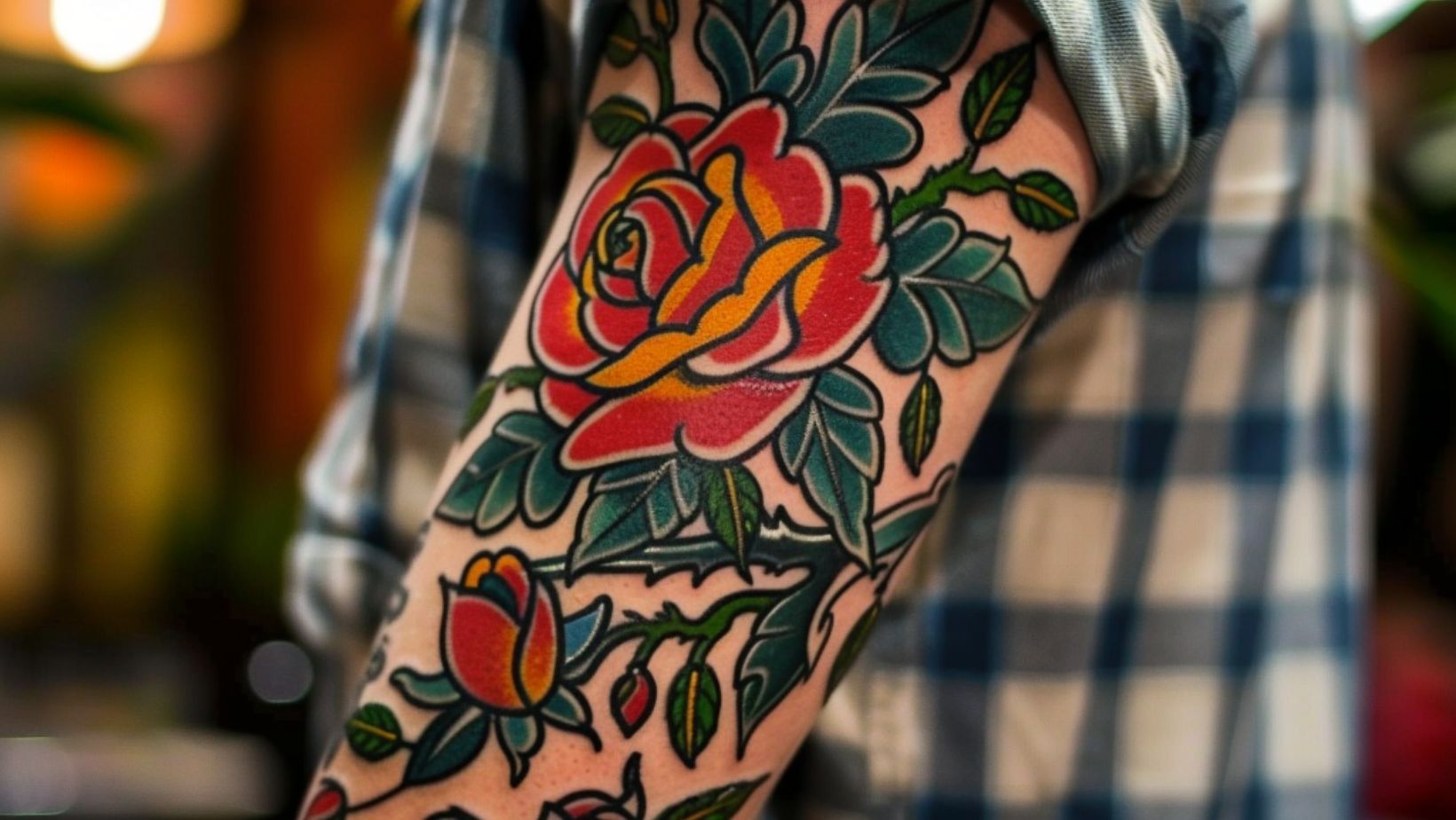
| American Traditional | Bold black outline, red/green/yellow only, flat shading | Outer forearm, upper arm | Ages best of any style; least detail |
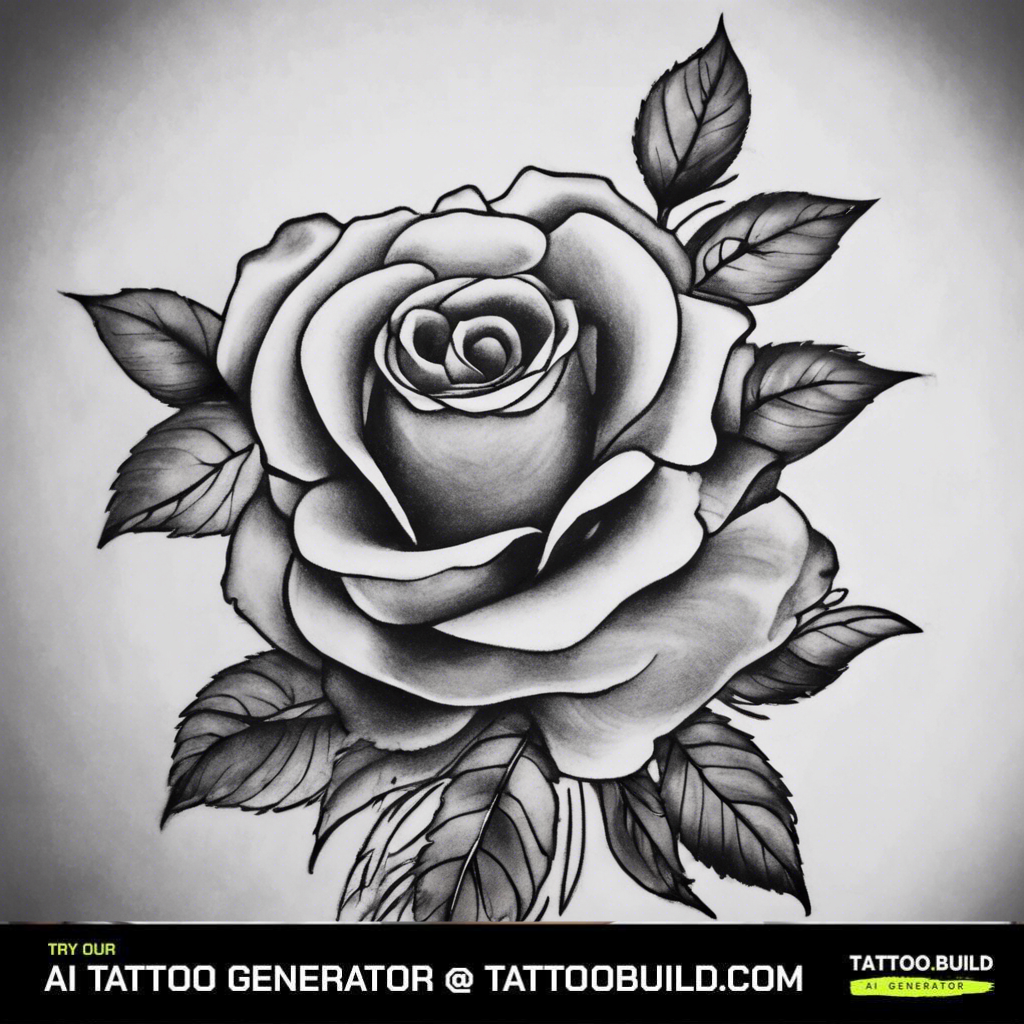
| Black & Grey Realism | Smooth grey wash, photo-like petals, no outline | Inner forearm, bicep | Stunning at year one; needs touch-ups |
| Neo-Traditional | Medium outline, wider palette, decorative detail | Upper arm, half sleeve | Middle ground on detail and longevity |
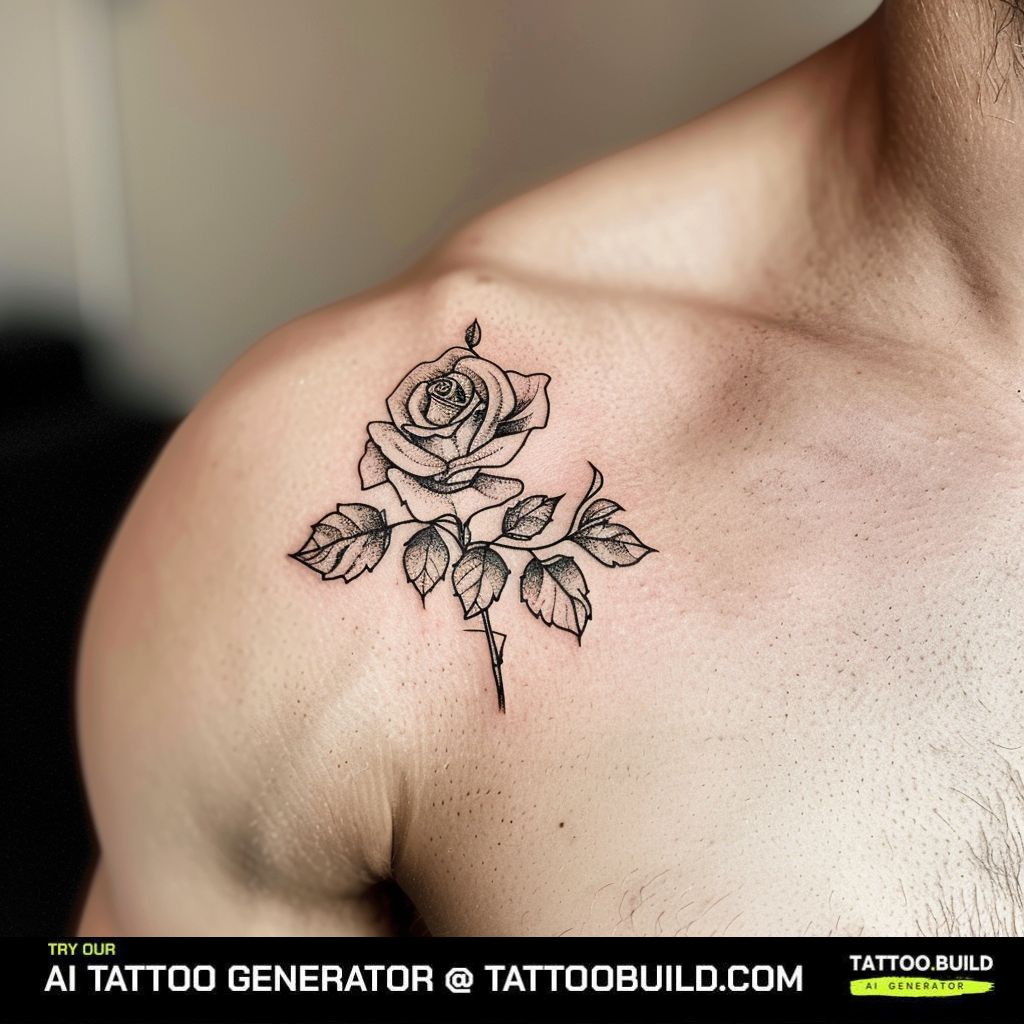
| Fine Line | Single-needle thin line, minimal shading | Inner arm, wrist | Softest look; blurs fastest on arms |
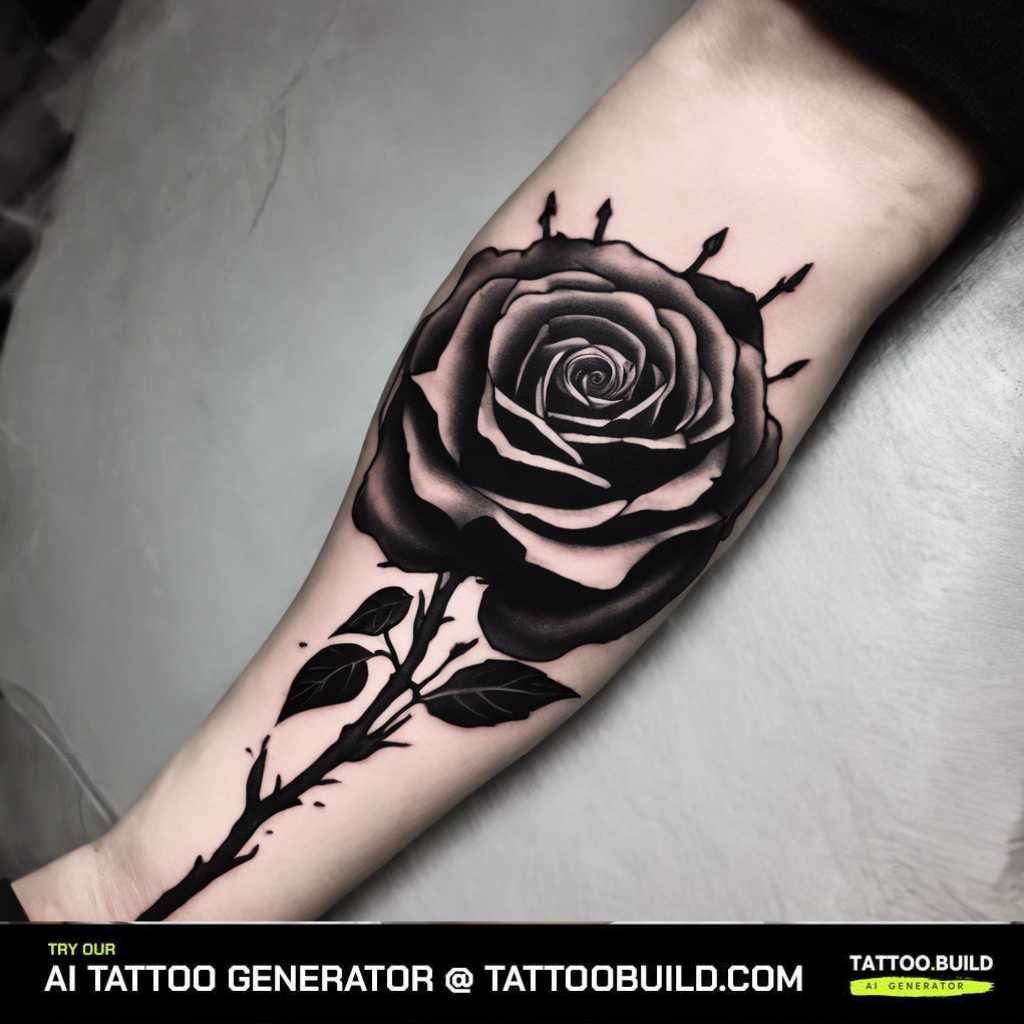
| Blackwork / Illustrative | Heavy solid black, stippling, etched texture | Forearm, full sleeve | Very durable; hardest to cover later |
If you want one recommendation and nothing else: American traditional or bold black and grey on the outer forearm. Those two combinations are the ones I see aging well ten and fifteen years out.
Why the Rose Works So Well on a Man’s Arm
The arm is a cylinder, and a rose is a spiral. That is the whole reason this pairing has survived.
A bloom drawn from a three-quarter angle wraps naturally around a forearm or bicep without the design fighting the shape of the limb. Square, symmetrical subjects do fight it, which is why they so often end up looking pasted on.
The rose also scales in a way that very few subjects do. The same drawing works at two inches on the inner wrist and at eight inches across a bicep, because its structure is a repeating pattern of petals rather than a fixed silhouette.
There is a practical reason too. Roses are among the most-tattooed subjects in the trade, which means almost every competent artist has drawn hundreds of them and can build one that fits your arm rather than tracing a photo.
And roses combine. They fill gaps in a sleeve, sit behind a portrait, wrap around a dagger. If you are thinking longer term, look at how they function inside a half sleeve layout before you commit to a standalone piece.
Rose Tattoo Ideas for the Arm
These are the versions that come up most in consultations, and the honest trade-off attached to each.
1. The Single Traditional Rose
One bloom, bold black outline, flat red and green fill, placed on the outer forearm or the outside of the bicep.
This is the most reliable rose tattoo a guy can get, and I say that without much hedging. The heavy outline holds the shape as the ink spreads slightly over the decades, and the limited palette means there is nothing delicate to lose.
It is also the cheapest and fastest of the options here, often a single short sitting. The trade-off is detail: you are getting a stylised rose, not a photographic one, and if you wanted realism you will be disappointed.
If it is your first tattoo, this is the version I would point you toward.
2. Black and Grey Realistic Rose
Smooth grey wash, no hard outline, petals built from shading alone.
When it is done by someone who genuinely specialises in black and grey, this is the most impressive rose on the list. The petals can look close to photographic on the inner forearm where the skin is smoother.
The catch is maintenance and artist selection. Soft grey shading fades faster than solid black, and a realistic rose from an artist who mostly does traditional work often heals into a grey blur. Look through healed portfolio photos specifically, and compare against examples like black and white rose forearm work before booking.
3. The Burning or Dying Rose
A rose with flames, wilting petals, or petals falling away from the bloom.
This is the most common way guys add weight to the motif, and it usually carries a specific meaning — a loss, an ending, something the person came out the other side of.
Design-wise, flames give an artist somewhere to put movement and fill negative space, which often makes for a stronger composition than the bloom alone. Darker rose variations take the same idea further with heavier black.
One caution from experience: wilting petals drawn too finely disappear first. Ask for the fallen petals to be drawn with real weight, not as faint outlines.
4. Rose and Bird Combinations
A rose paired with a swallow, an eagle, or a raven, usually with the bird above and the rose anchoring the lower half.
This is one of the oldest combinations in Western tattooing and it composes almost automatically. The bird’s wings give you a horizontal element to balance the vertical stem.
Traditional swallows in particular sit well with traditional roses because they share a visual language — same line weight, same palette. If that direction appeals, traditional swallows in black and grey show how the pairing works without color.
Rose designs and the prompts behind them
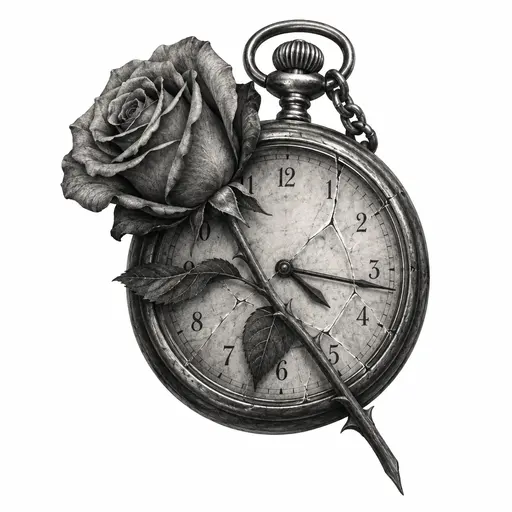
An old pocket watch stopped at 4:17, its glass cracked, a single rose lying across the face
Use this idea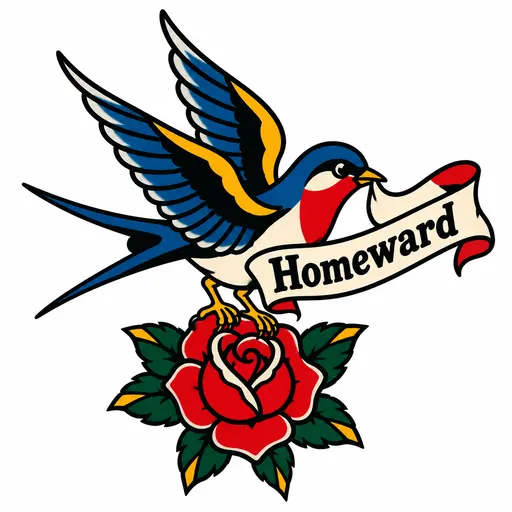
A swallow carrying a banner that reads "Homeward", with a red rose beneath its feet
Use this idea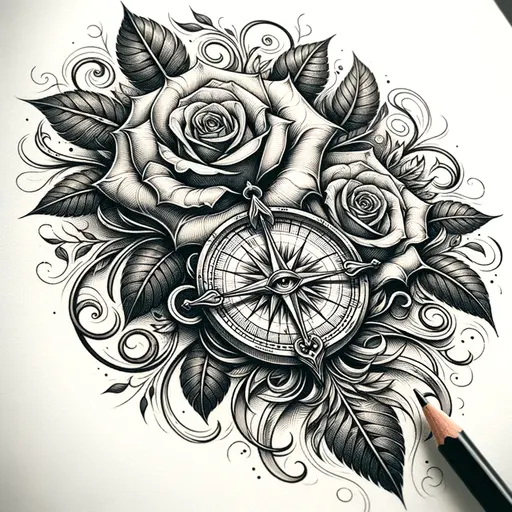
2 roses, stems with thorns, leaves compass eye of providnce
Use this idea
5. Rose with Skull or Dagger
The rose softening a hard subject, or the hard subject grounding the rose — depending on which way you want to read it.
Every artist I have asked has a stack of these in their portfolio, which is both a recommendation and a warning. It is well-trodden ground, so the execution is usually excellent, but it is not an original idea and you should not pretend otherwise.
The life-and-death contrast is the obvious reading, and it is a real one. If the dagger side interests you more than the rose, the skull and dagger meaning guide covers that half of the composition.
6. Color Roses Beyond Red
Pink, purple, white, black-filled — each carries a different association, and each behaves differently in skin.
Red is the default because red pigment is dense and holds reasonably well. Lighter colors like pink and pale purple generally sit less strongly over time, particularly on arms that see a lot of sun.
White ink highlights are the riskiest of all. They look sharp for the first year and frequently go invisible or yellow after that. I would not build a design that depends on them.
7. The Rose Sleeve
Multiple blooms connected by vines, filler shading and negative space across the whole arm.
The mistake here is treating a sleeve as a collection of individual roses. It is not — it is one composition, and it needs to be mapped across the arm before the first needle touches skin.
Good rose sleeves repeat the same bloom at different scales and use vines and shading as connective tissue. If you are planning one, it is worth looking at how sleeve drawings are laid out before your first session so you understand what you are agreeing to.
Budget realistically: a sleeve is a multi-session project measured in months, not an afternoon.
8. Small and Minimal Roses
A single small bloom on the inner wrist, the inner bicep, or tucked behind the elbow.
Small works if the design is simplified to match. A rose shrunk down from a detailed drawing loses its internal petals within a few years and closes into a dark shape.
Tell your artist the size first and let them draw for that size. Simpler design approaches tend to hold up far better than shrunk-down complex ones.
Alternatives and Variations Worth Considering
If the rose is not quite landing for you, these come up as the nearest alternatives.
Other Flowers That Read Masculine
Chrysanthemums, thistles and poppies all carry weight without the romantic association. Masculine flower tattoo options covers the range in more depth.
Vine and Stem Work Without the Bloom
Some guys want the wrapping movement without the flower. Rose vine designs give you the line and the flow with far less visual softness.
Extending Onto the Hand
Continuing the piece past the wrist changes it from a tattoo you can cover to one you cannot. Hand rose tattoos are a genuinely different decision, and hands also fade faster than arms because of constant washing and sun.
Going Fully Black
Heavy blackwork roses trade all detail for permanence. Blackwork is about as durable as tattooing gets, with the honest downside that they are very hard to cover or lighten later.
Practical Advice Before and After You Get It
Pick the artist before you pick the design. A specialist in your chosen style will improve your idea; a generalist will execute it as drawn, which is usually worse.
Ask to see healed photos, not fresh ones. Fresh work looks good almost universally — healed work is where technique shows. Any artist confident in their work will have healed shots.
On aftercare, follow the instructions your specific artist gives you rather than anything you read online, including this page. The general principles are consistent — keep it clean, keep it out of sun and standing water, do not pick at it — but the American Academy of Dermatology guidance on tattoo care is a reasonable baseline if your artist gave you nothing in writing.
Know the risks honestly. Allergic reactions to pigment, infection, and granulomas are uncommon but real, and red pigment is the one most often associated with reactions. The FDA tattoo and permanent makeup fact sheet sets out what is and is not regulated. If something looks wrong while healing, see a doctor rather than a forum.
Common Mistakes — and What to Do Instead
Going too small for the detail you want. This is the number one regret I hear. Detail needs room; if you want realism, give it forearm-sized space.
Bringing a photo of someone else’s healed tattoo and asking for a copy. Good artists will decline, and the ones who agree are usually not the ones you want.
Ignoring how the piece fits the rest of the arm. If you plan to fill the arm eventually, plan the whole layout now. Map the full canvas before you commit the first panel.
Choosing placement by pain tolerance alone. The inner arm hurts more, but it also holds fine detail better than the outer forearm. Pain lasts hours; placement lasts decades. Browsing broader tattoo ideas for men can help you separate the two decisions.
Frequently Asked Questions
Is a rose tattoo too feminine for a guy?
No, and in my experience this is the single most common worry guys bring to a consultation about roses. The rose has been a staple of men’s tattooing since the American traditional era, sitting alongside daggers, anchors and swallows on sailors’ arms for a century. What reads as masculine or feminine is style and construction, not the flower itself. A heavy-outlined traditional rose and a soft fine-line rose are the same subject drawn in two completely different voices.
How much does a rose tattoo on the arm cost?
Price depends far more on size, style and your artist’s hourly rate than on the subject. A palm-sized traditional rose is usually a single short sitting, while a detailed black and grey piece covering the forearm often runs several hours across one or two sessions. Most shops quote either a flat piece price or an hourly rate, and many have a shop minimum. Ask for a written quote at consultation rather than guessing from what someone paid in another city.
Does a rose tattoo hurt more on the inner or outer arm?
The outer arm and the meat of the bicep are generally among the more tolerable spots on the body. The inner arm, the inner elbow and anywhere close to the wrist tend to be sharper because the skin is thinner and closer to bone and nerves. Pain is genuinely individual though, and plenty of people find the reverse true for them. If you are anxious about it, start on the outer forearm and see how you handle a shorter session.
Should I get my rose in black and grey or color?
Black and grey is the safer long-term choice on an arm, particularly if you already have other black and grey work or if the arm gets a lot of sun. Color roses look fantastic fresh and red pigment generally holds reasonably well, but color work typically needs more maintenance over the years. In my experience, the people happiest with color roses are the ones who accepted up front that a touch-up every several years is part of the deal. Talk it through with your artist, since their pigments and technique matter here.
How long does a rose arm tattoo take to heal?
The surface usually looks settled within two to three weeks, while the deeper layers of skin generally take a couple of months to fully settle. During that window keep it clean, follow the aftercare instructions your artist gave you, and keep it out of pools, hot tubs and direct sun. If you see spreading redness, heat, swelling that worsens after the first few days, pus, or you run a fever, stop searching online and see a doctor — those are signs of infection, not normal healing.
Quick Summary
- The rose has been standard men’s tattoo imagery for over a century — the masculinity question is about style, not subject.
- American traditional and bold black and grey age the best of any rose style on an arm.
- Fine line roses look softest but blur fastest, especially at small sizes on the arm.
- The outer forearm and bicep are the most forgiving placements; the inner arm holds detail better but hurts more.
- Red pigment holds reasonably well; pale pinks, purples and white highlights usually do not.
- Size the design for the detail you want — shrinking a detailed rose is the most common regret.
- A rose sleeve is one composition mapped in advance, not a set of separate roses added over time.
- Follow your artist’s aftercare, and see a doctor for spreading redness, pus, worsening swelling or fever.
Ready to Ditch the Generic Designs? Try Our Tattoo Generator
Here at TattooBuild, we have made the process easier than ever. Try our AI tattoo image generator and take a mockup to your consultation instead of a description.
- Open the Studio & Choose Your Plan: Try a design first, then start a plan that fits your needs.
- Describe Your Dream Tattoo: The more detail you give — style, placement, color, mood — the closer the output lands.
- Generate Your Designs: You get multiple unique concepts, either mocked up on a body part or on a plain background.
Bring the result to your artist as a starting point, not a final stencil — the best pieces still come from a human adapting the idea to your arm.