A leg sleeve lives or dies at the drawing stage, long before a needle touches skin. The leg is the largest single canvas most people will ever tattoo, and it is also the least forgiving of a design that was never planned as a whole.
I have sat through three long leg sessions of my own and spent a lot of hours in shops watching artists redraw stencils on a thigh that refused to cooperate. The pattern is always the same: the pieces that look effortless were drawn to the leg, not printed onto it.
This guide walks through leg sleeve tattoo drawings the way an artist approaches them — layout first, subject second, detail last. You will find style breakdowns, composition rules that actually hold up on a curved limb, and honest notes on pain, budget and healing.
If budget is the deciding factor for you, it is worth reading what a sleeve tattoo actually costs before you fall in love with a full-leg concept. The drawing is free. The leg is not.
Which Leg Sleeve Layout Is Right for You?
Before style comes coverage. These four layouts cover almost every leg project I have seen walk into a shop.
| Layout | Coverage | Typical Sessions | Best For | Main Trade-off |
|---|---|---|---|---|
| Full leg sleeve | Hip or upper thigh to ankle | Six to twelve-plus | One large narrative or theme | Longest commitment and highest cost |
| Upper half sleeve | Thigh down to just above the knee | Three to six | Easy to cover at work, softer skin | Rarely visible unless you choose it to be |
| Lower half sleeve | Knee to ankle, calf and shin | Three to six | Shorts weather, gym visibility | Shin and ankle are noticeably sharper to sit |
| Panel or wrap build-up | Separate pieces joined later | Open ended | Spreading cost over years | Needs a plan early or the joins look forced |
Session counts vary enormously with detail, colour and how long you can sit. Treat the column as a planning range from experience, not a quote.
Why the Drawing Stage Matters More on a Leg
An arm is roughly a cylinder. A leg is not — it is a series of changing volumes, and that is what makes leg sleeve tattoo drawings genuinely difficult.
The thigh is broad and flat-ish at the front, the knee bends and creases, the calf bulges out to one side, and the shin is a thin layer of skin over bone.
A drawing that ignores those transitions will look distorted the moment you stand up. I have watched a beautifully rendered flat sketch collapse into something unreadable once it was stencilled around a calf.
Good artists solve this by drawing on a photograph or a tracing of your actual leg, then adjusting the stencil freehand on the day. Expect that, and do not panic when they redraw.
The other reason to plan early is continuity. A leg sleeve is built over months or years, and the only thing that keeps session eight looking related to session one is a layout decided at the start.
Leg Sleeve Tattoo Drawing Ideas by Style
These are the styles I see hold up best over a whole leg. Each one solves the leg’s shape in a different way.
Japanese and Oriental Leg Sleeves
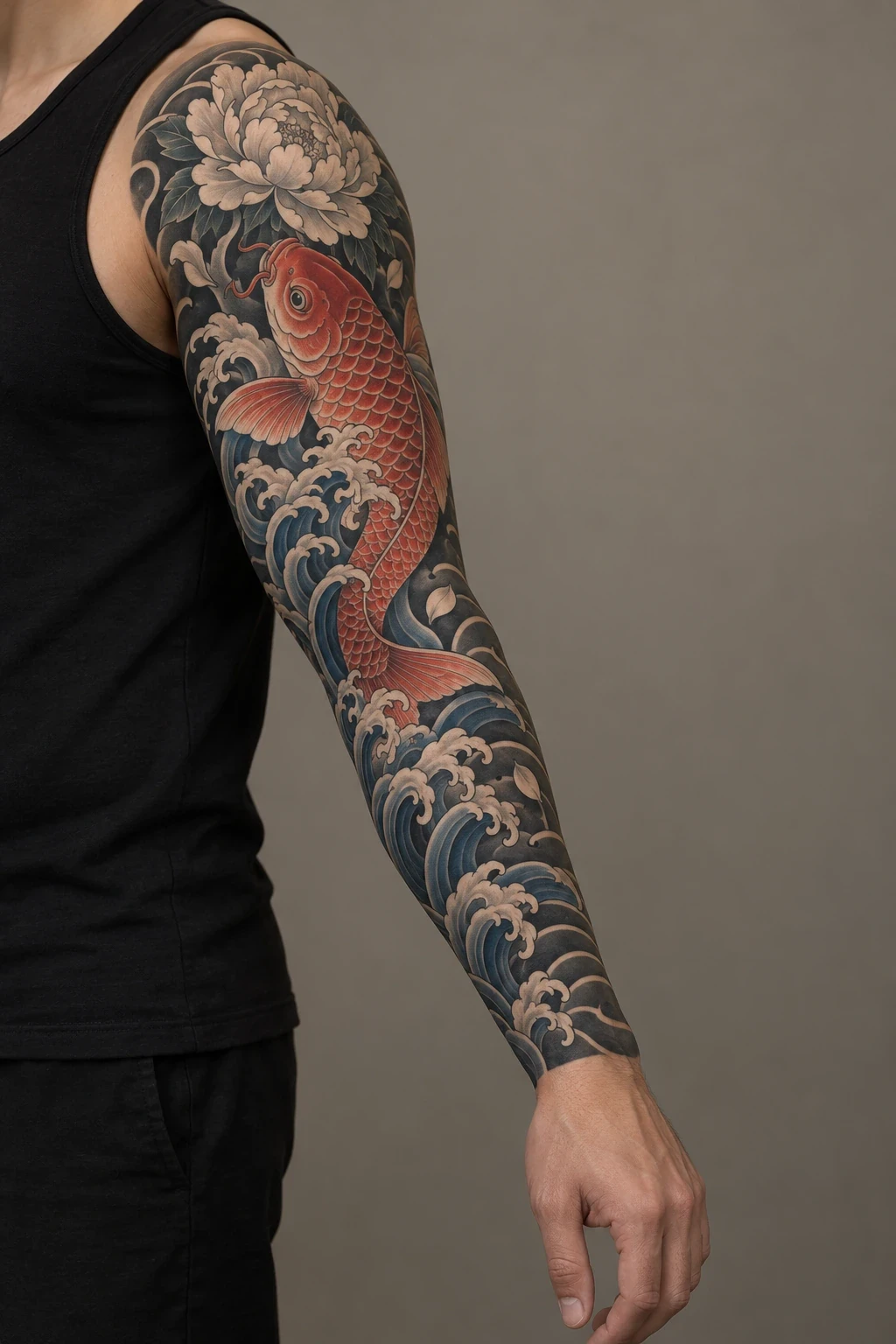
Japanese work was more or less designed for large limbs, which is why it remains the default answer for a full leg.
The system is simple: one or two large subjects — a dragon, koi, hannya mask, tiger — sit inside a background of waves, wind bars, clouds or maple leaves.
That background is the reason Japanese leg sleeves flow so well. It fills the awkward zones behind the knee and around the ankle without ever looking like filler.
Every artist I have asked about first-time full legs suggests this style first, because the background can be extended session after session without breaking the composition. If the imagery interests you, the symbolism in Japanese tattoo designs is worth reading before you commit to a subject.
Nature, Forest and Landscape Sleeves
Landscape sleeves suit the leg because the leg is tall and narrow, exactly like the scenes people want on it.
Pine forests, mountain ridges, rivers and night skies stack vertically, so a tree line can run from ankle to knee and a peak can sit on the calf muscle.
In my experience the mistake here is scale. Cram a whole national park onto a shin and it turns into grey mush after five years of healing and blowout.
Pick two or three landscape elements and let them breathe. A single treeline plus one strong silhouette will still read across a room in a decade.
Blackwork and Ornamental Sleeves
Blackwork treats the leg as an architectural surface rather than a picture frame, and it is brutally effective on legs.
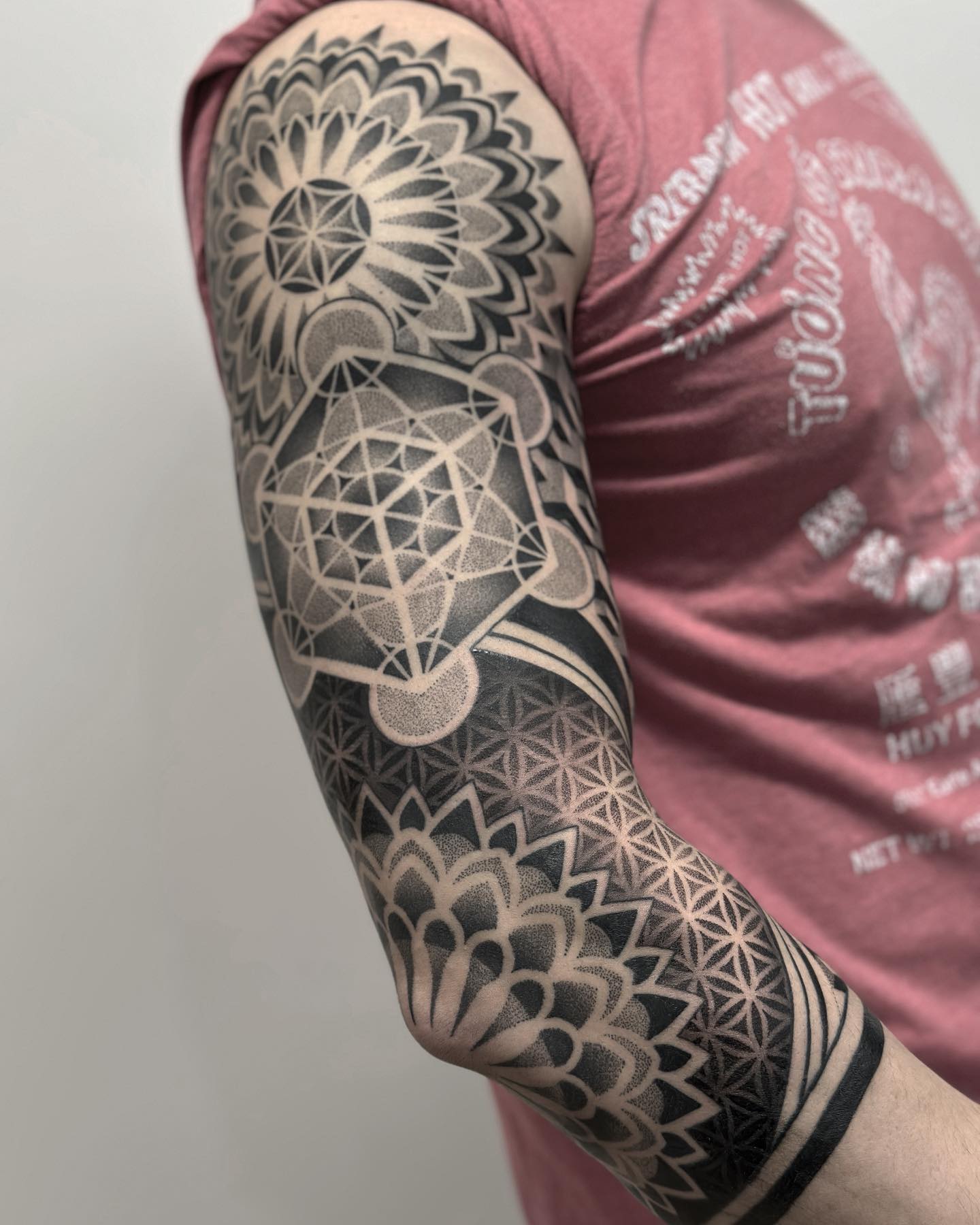
Solid black bands, dotwork gradients, mandalas and repeating pattern work wrap around the limb rather than sitting on one face of it.
Because the pattern repeats, an artist can extend it session by session with almost no risk of the new work clashing with the old.
The honest downside: heavy black is difficult to cover or lighten later, and large solid-black areas can take longer to settle. If the look appeals, browse blackwork tattoo designs to see how much variation exists inside the style.
Geometric and Sacred Geometry Sleeves
Geometric leg sleeve tattoo drawings are the most technically demanding pieces on this list, and the least forgiving of a rushed stencil.
Straight lines and perfect circles reveal every misalignment once they curve around a calf, so the artist has to distort the drawing deliberately to make it look correct on a moving leg.
I would only take this style to someone with a portfolio full of healed geometric work, not just fresh photos.
Ask specifically to see healed line work at the back of a knee. That is where geometric sleeves fall apart. There is a broader collection of geometric sleeve tattoo ideas worth reviewing first.
Realism and Portrait Sleeves
Realism on a leg is spectacular when it works and disappointing when it does not, with very little middle ground.
The calf is the best real estate on the body for a realistic focal piece: broad, muscular, and it holds ink well.
The shin and the area just above the ankle are far less kind to fine tonal work, so most experienced artists keep detail high and let the lower leg carry softer background.
Plan for larger sizing than you think you need. Realism shrinks visually as it heals, and undersized portraits are the single most common leg regret I hear about.
Norse, Viking and Mythology Sleeves
Mythology sleeves give you something Japanese work also offers: a built-in visual system.
Knotwork, runes, ravens, wolves and weapon motifs interlock, so the connective tissue between subjects is part of the style rather than an afterthought.
The one thing worth checking is meaning. A handful of Norse symbols have been appropriated by extremist groups, and a good artist will tell you which ones without being asked.
When I researched my own leg concept, that conversation with the artist saved me from a symbol I would have regretted permanently.
Neo-Traditional and Bold Colour Sleeves
If you want a leg sleeve that still looks sharp in twenty years, heavy outlines and saturated colour are the safest bet on this page.
Neo-traditional builds a leg from a series of framed subjects — animals, flowers, daggers, portraits — connected by leaves, drapery or ornamental filler.
Because each subject is self-contained, you can genuinely add one per session without a master plan, provided the artist keeps line weight and palette consistent.
In my experience this is the most beginner-friendly route to a full leg, and the easiest to pause halfway through without it looking unfinished. There are plenty of sleeve filler ideas that work specifically for connecting these panels.
If a Full Leg Sleeve Feels Like Too Much
Most people I know who now have a full leg did not set out to get one. They got one good piece and kept going.
Start with a Calf Piece
The calf is the least painful part of the leg for most people and the most visible in shorts, which makes it the natural first move.
Sized generously, a calf piece can later become the anchor for everything else. Plenty of calf tattoo ideas work as standalone tattoos too.
Start with a Thigh Panel
The thigh is soft, easy to hide, and gives an artist the most room to work with. It is the usual starting point for larger narrative designs, and a common route into half leg sleeve tattoo ideas for women.
Build a Shin Panel
A narrow vertical panel down the shin is a real commitment on pain, but it makes a striking standalone piece and defines the front of a future sleeve.
Band and Wrap Build-Ups
Ornamental bands around the calf or above the ankle can be added to gradually until they merge. This is the cheapest path to coverage, spread over years.
Preparing For and Sitting Through a Leg Sleeve
Leg sessions are long. Eat a real meal beforehand, bring sugar, and drink more water than feels necessary the day before and the day of.
Wear something you can get fully out of the way — loose shorts for lower-leg work, and be prepared for the thigh to require more than that.
Pain varies more than any chart suggests, but shin, ankle, inner thigh and the back of the knee are consistently the sharpest zones. The breakdown in our guide to the most painful tattoo spots matches what most people report.
Healing a leg is harder than healing an arm because you walk on it. Swelling around the ankle is common, elevation helps, and American Academy of Dermatology advises keeping fresh work clean, moisturised and out of the sun while it settles. If anything looks infected — spreading redness, heat, pus or fever — see a doctor rather than asking the shop.
Still Not Sure? Common Leg Sleeve Mistakes
The mistake I see most often is collecting individual tattoos and hoping they will eventually merge. They usually do not.
The second is choosing an artist by price rather than by healed portfolio. A leg sleeve is a multi-year relationship, and cover-up work costs far more than the original.
The third is underestimating the total spend. Total the sessions honestly before booking the first one, and assume the project grows rather than shrinks.
The fourth is ignoring aftercare in week two, when the itching starts and the tattoo looks dull. Our tattoo aftercare guide covers what is normal and what is not.
Finally, tattoo inks are not comprehensively regulated for safety in the way medicines are, and the FDA notes that reactions and infections do occur. Mayo Clinic has a plain-language rundown of the risks worth reading once before a project this size.
Frequently Asked Questions
How long does a full leg sleeve tattoo take?
Most full leg sleeves are built across six to twelve sessions, often spread over a year or more. The exact number depends on detail, whether the piece is colour or black and grey, and how long you can realistically sit. Artists usually book four to six hour sessions for legs, with healing time of a few weeks between. In my experience the calendar time is driven more by your artist’s waiting list than by the tattooing itself.
Do leg sleeve tattoos hurt more than arm sleeves?
In general the leg has both easier and harder zones than the arm. The calf and outer thigh are comparable to the outer arm, while the shin, ankle, inner thigh and back of the knee are usually sharper. Pain is highly individual, so treat any pain chart as a rough guide rather than a promise. Long sessions tend to be more about endurance than peak pain.
Can I get a leg sleeve if I already have separate leg tattoos?
Usually yes, though it takes more planning. An experienced artist can design a background and connective work that absorbs existing pieces, and some tattoos may need reworking or partial cover-up. Bring clear photographs of everything you already have to the consultation. Be prepared for the honest answer that one or two pieces may not fit the new plan.
Should a leg sleeve be colour or black and grey?
Black and grey generally ages more predictably and is easier to extend or repair over time. Colour has more immediate impact but usually needs touch-ups sooner, particularly on the lower leg where sun exposure is heaviest. Mixed approaches, such as black and grey with limited colour accents, are common and work well. The right answer mostly depends on which style you want, since some styles are effectively defined by their palette.
How do I keep a leg sleeve looking good long term?
Sunscreen is the single most effective thing you can do once the tattoo is fully healed. Keep the skin moisturised, avoid soaking fresh work in pools or baths while it is healing, and book touch-ups when your artist recommends them rather than waiting for visible fading. Weight changes and muscle gain can also shift a design over years, which is worth mentioning at the planning stage.
Quick Summary
- Decide coverage first — full leg, upper half, lower half or a panel build-up.
- Choose a style with a built-in background system if you want an easy path to a full sleeve.
- Insist the drawing is made for your leg, not a flat sketch resized to fit.
- Size focal subjects larger than feels necessary, especially for realism.
- Put your strongest imagery on the calf and outer thigh, softer work on shin and ankle.
- Judge artists on healed photographs, not fresh ones.
- Budget for the whole project, not the first session.
- Protect the finished sleeve with sunscreen and see a doctor, not a forum, if healing goes wrong.