The calf is the most forgiving large canvas on the female body — big enough for a real design, flat enough to keep its shape, and coverable with a single pair of jeans.
I have watched friends agonise for months over ribs and sternum placements, then get their calf done in one four-hour sitting and wonder what they were so worried about.
Over the past few years I have sat in on more calf sessions than any other leg placement, and the pattern is consistent: women come in wanting something visible on their terms. Something they can show at the beach in July and hide at a client meeting in September. If you are still deciding between placements, our guide to leg tattoos for women covers the whole leg.
Below are the designs that actually hold up, what the calf feels like under the needle, and the honest limits of the placement.
Which Calf Tattoo Style Is Right for You?
Every style I list here behaves differently on calf skin. The table is a starting point, not a rule.
| Style | Best Size on the Calf | Typical Sitting | How It Ages |
|---|---|---|---|
| Fine line / micro-realism | 3–6 inches, outer calf | 1–2 hours | Softens fastest; expect a touch-up in a few years |
| Black and grey floral | 6–10 inches, follows the muscle | 3–5 hours | Very well when shading is layered, not flat |
| Bold traditional | 5–8 inches, centred | 2–4 hours | The most durable option by a wide margin |
| Colour realism | 8 inches and up | Multiple sessions | Depends heavily on sun exposure |
| Blackwork / ornamental | Wraps the calf | 4–8 hours across sessions | Excellent, though solid black needs careful healing |
| Minimalist symbols | Under 3 inches, back of calf | Under an hour | Fine, but can look lost on a large calf |
If the fine line row appealed to you, browse our fine line tattoo ideas before you commit to a size.
Why the Calf Works So Well for Women’s Tattoos
The calf has three things going for it that most placements do not: muscle depth, a relatively flat surface, and stable skin.
Muscle depth matters because pain in tattooing tracks closely with how near the needle sits to bone and dense nerve clusters. The gastrocnemius gives the artist a cushion to work against, which is why most people describe the calf as moderate rather than brutal.
The flatness matters for design. A calf holds a circular or vertical composition without warping it the way a bicep or a rib cage does, so what you approve on paper is close to what you wear.
Stable skin is the underrated one. The calf does not stretch dramatically with modest weight change or pregnancy the way the stomach, hips, and upper thighs can, so linework tends to stay where the artist put it.
The trade-off is circulation. The lower leg sits at the bottom of your circulatory system, so swelling during healing is more noticeable here than on an arm — something I will come back to in the aftercare section.
Calf Tattoo Ideas for Women That Actually Work
Floral and Botanical Designs
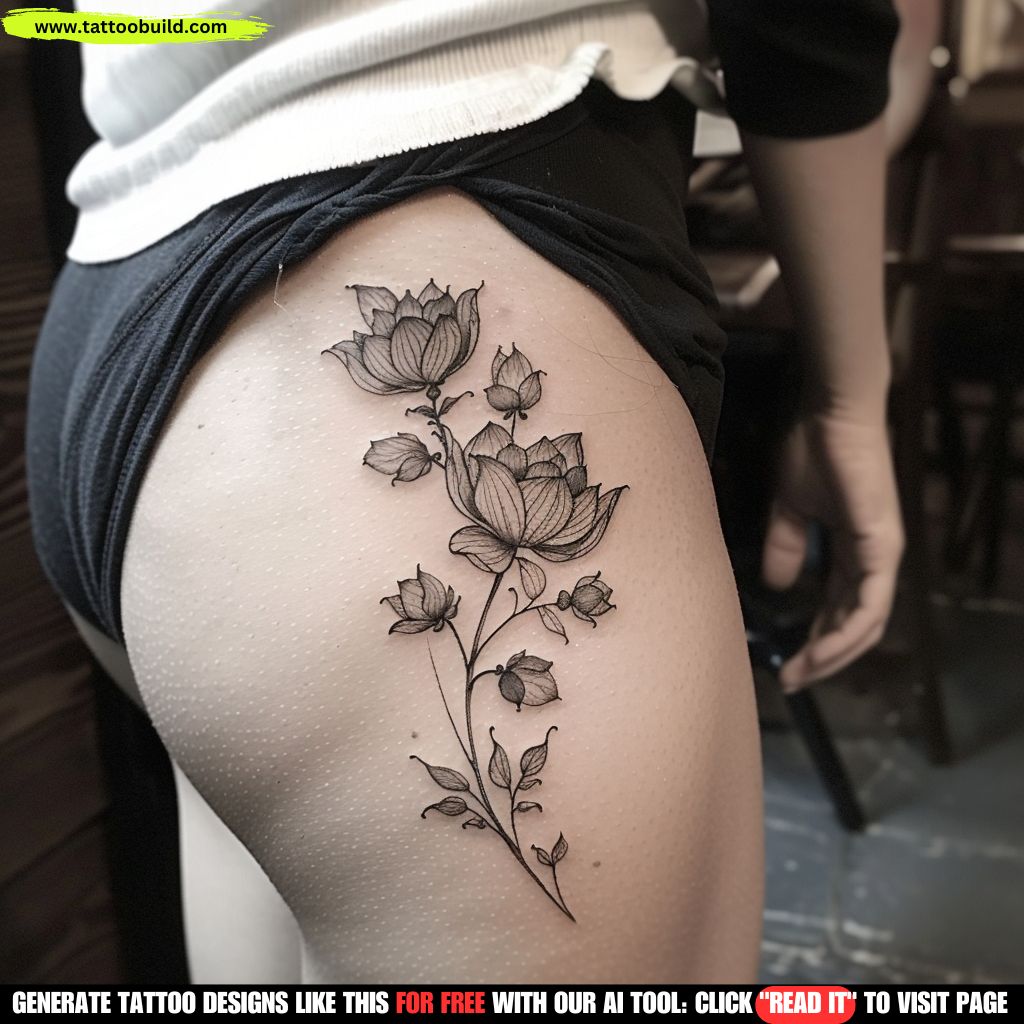
Florals are the single most requested calf design among the women I have talked to, and the calf rewards them.
The reason is proportion. A rose or peony needs roughly four to six inches to show its petal structure, and the calf gives you that without the design running onto skin that moves.
The strongest floral calf pieces I have seen follow the muscle line rather than sitting flat in the middle of it — the stem starts near the ankle, the bloom lands on the fullest part of the calf, and leaves taper toward the back of the knee.
Colour or black and grey both work. Red and pink blooms read beautifully on the calf but need shade protection long-term; black and grey needs less maintenance.
For more botanical direction, our floral leg tattoo designs collection is worth a scroll.
Sun, Moon and Celestial Pieces
Celestial designs sit somewhere between minimalist and ornamental, which makes them a good middle option.
A sun and moon composition works on the calf because it is naturally circular, and a circle needs a surface that will not distort it.
The version I keep seeing done well uses fine dot shading rather than solid fill — a stylised sun face, soft stippling, and small star accents around the edge.
The catch with heavy stippling is longevity. Dotwork that is spaced too finely can blur into a grey haze over the years, so ask your artist how they space their dots and whether they would recommend a slightly bolder version.
Feather and Bird Designs
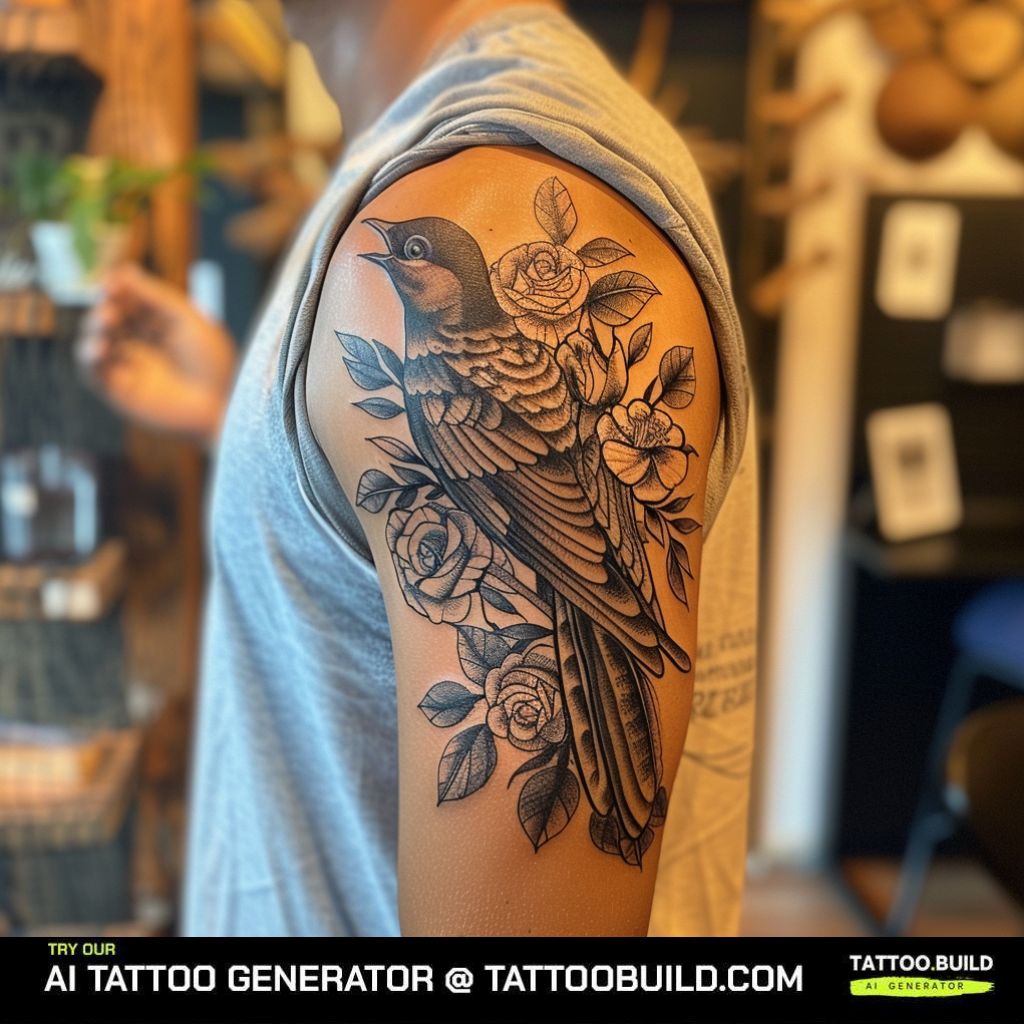
A feather is one of the few designs that genuinely suits the calf’s shape without any redrawing.
It is naturally long and tapered, so it follows the vertical line of the leg instead of fighting it.
Every artist I have asked prefers feathers at five inches or more. Below that, the barbs — the individual strands — get too close together and fill in as a solid shape within a few years.
The most durable feather tattoos I have seen keep clear negative space between strands and use a defined spine down the centre for structure.
There is more in this direction in our feather tattoo drawings for females gallery.
Bold Statement Pieces: Phoenix, Dragons and Serpents
If you want the calf to carry one large design rather than several small ones, this is the category.
A phoenix works particularly well because its tail feathers can flow down toward the ankle while the body sits on the fullest part of the muscle.
Black and grey shading suits these designs on the calf. Solid black fills heal slower on the lower leg, and heavy colour packing on a large area usually means two or three sittings.
Do not let anyone talk you into a large statement piece as a first tattoo without a consultation. The design needs to be drawn on your leg, not on paper, because calf shape varies enormously between people.
Our phoenix tattoos for women page has the reference material for this style.
Roses and Single-Flower Blackwork
A single black rose is probably the most requested standalone calf design after florals generally.
It works because a rose has built-in depth. The layered petals give the artist somewhere to put contrast, which is what keeps a tattoo readable from across a room.
Ask for the darkest shadows to sit under the petal edges rather than spread evenly across the flower — flat shading is what makes a rose look like a grey blob after a decade.
See more variations in our rose tattoo ideas collection.
Landscape and Nature Scenes
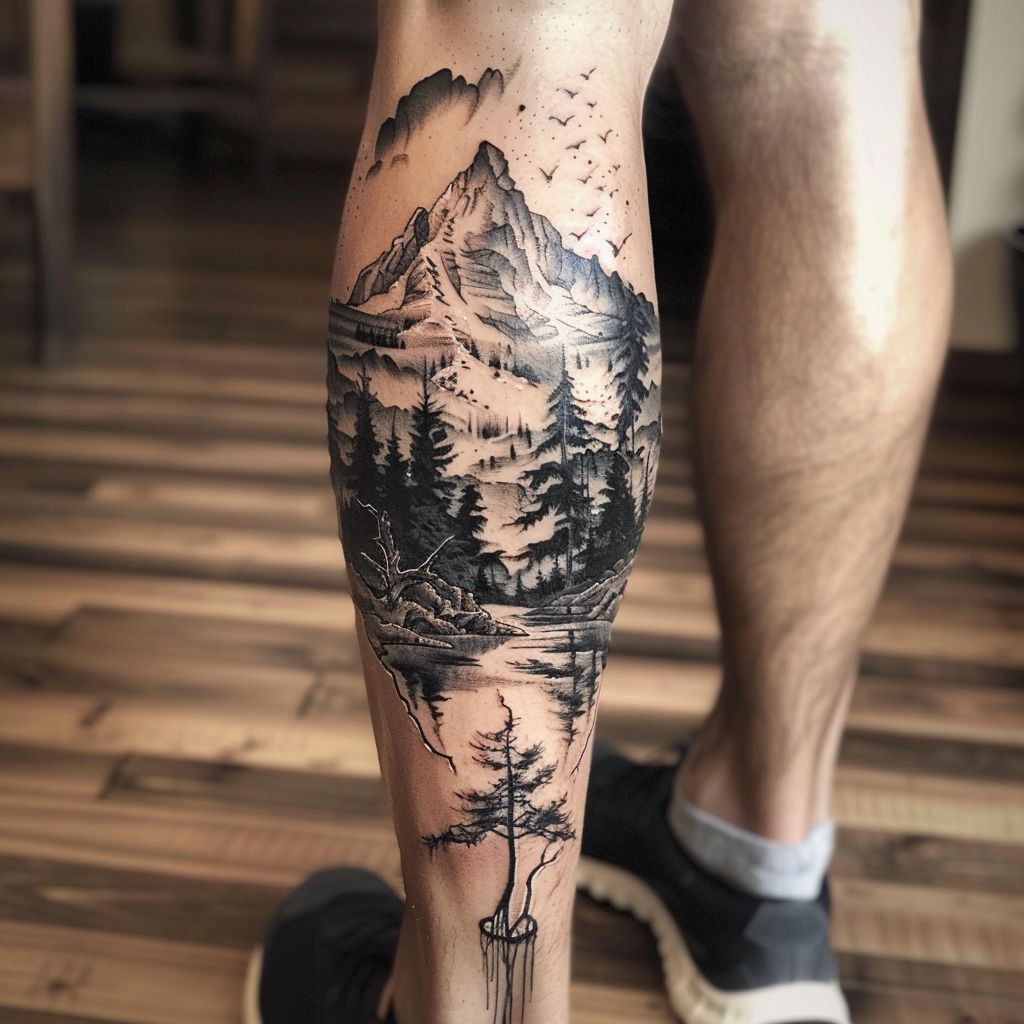
Mountains, trees and horizon lines have become a common calf request, and the placement suits them.
A landscape needs width to establish perspective, and the calf gives you three to four inches of usable width even on a slim leg.
The technical challenge is atmosphere. Distant mountains should be lighter than foreground trees, and that gradient is easy to lose in healing if the light tones are put in too faintly.
When I have seen these age badly, it is almost always because the sky was left as bare skin with no anchor — the design floats. A soft frame or a defined ground line fixes it.
Minimalist and Fine Line Options
Not everyone wants the calf to be a centrepiece, and small work here is a legitimate choice.
A short quote, a constellation, a single line-drawn plant — these sit well on the back or inner calf where they are only visible from certain angles.
Be realistic about scale. A two-inch design on a calf can look accidental rather than intentional; placing it slightly off-centre or near the ankle usually reads better than dead centre.
Our minimalist tattoo ideas page is a good place to gauge how small is too small.
Wrap-Around and Partial Leg Sleeves
A calf piece is often the first panel of a leg sleeve, whether or not you intend it that way at the time.
If there is any chance you will extend it, tell your artist at the consultation. It costs nothing to leave the composition open at the top and bottom, and it saves an awkward join later.
Ornamental and blackwork designs wrap the calf better than pictorial ones, because they do not have a single ‘front’ that has to face the viewer.
For a sense of the full commitment, look at leg sleeve tattoo drawings.
If the Calf Is Not Quite Right: Nearby Alternatives
The calf is not the only leg placement, and it is worth knowing what the neighbours offer.
The Shin
More visible from the front, and noticeably more painful because the bone sits directly under thin skin.
It suits long, narrow designs and is a good option if you want the tattoo seen without turning around.
The Thigh
The largest canvas on the leg and among the least painful areas on the outer side.
The trade-off is skin movement — thigh skin changes more with weight than calf skin does.
The Ankle
Small, delicate, and easy to hide, but the bone makes it sharp and fine detail blurs quickly there.
The Back of the Knee
Rarely a standalone placement. It is painful, heals awkwardly, and is best used as a connector within a larger leg piece.
Aftercare: What the Calf Needs That an Arm Does Not
Most standard aftercare advice applies here, but the lower leg has two quirks worth planning around.
The first is swelling. Because the calf is the lowest part of your body when standing, fluid pools there — elevating the leg for the first two or three evenings makes a real difference, and mild puffiness in the first few days is normal rather than alarming.
The second is friction. Socks, boots, jeans and gym equipment all rub the calf. Loose trousers for the first week is not fussiness; it is the difference between clean healing and scabbing that pulls ink out.
Keep it clean, keep it lightly moisturised rather than smothered, and keep it out of the sun. Our tattoo aftercare guide covers the day-by-day detail.
One honest caveat: this is general guidance, not medical advice. If you see spreading redness, heat, pus, or a fever, that needs a doctor rather than an internet article — and if you have any history of allergic reaction to pigments or metals, raise it with your artist before the appointment, not after. The US Food and Drug Administration publishes a plain-language fact sheet on tattoo inks and reactions that is worth reading first.
Still Not Sure? Common Calf Tattoo Mistakes
These are the regrets I hear most often, and all of them are avoidable at the consultation stage.
Going too small for the space. A design that looked substantial on a phone screen can disappear on a calf — always see it printed at actual size and taped to your leg.
Ignoring the direction the design faces. A tattoo drawn to be viewed straight-on will be seen side-on most of the time on a calf. Ask which way it will read when you are walking.
Booking a large piece for late spring. You will want it out of the sun and out of the water for several weeks, so autumn and winter are the practical seasons for a big calf project.
Choosing the artist by price rather than portfolio. If you want a sense of what things reasonably cost, our tattoo cost guide sets expectations — but the cheapest quote is rarely the one you want on your leg for life. For choosing a safe studio, the US Centers for Disease Control and Prevention guidance on sterile practice and single-use needles is a useful baseline.
Frequently Asked Questions
How painful is a calf tattoo for women?
Most people I have spoken to rate the calf as moderate — noticeably easier than ribs, sternum or ankle, and roughly comparable to the outer thigh. The muscle gives the needle something to work against, which dulls the sensation. The back of the calf near the knee crease and the area closest to the shin bone are the sharper spots. Pain is individual, though, so treat any chart as a rough guide rather than a promise.
How long does a calf tattoo take to heal?
The surface usually looks settled within two to three weeks, while the deeper layers keep healing for a couple of months. Lower-leg tattoos often feel slower than arm tattoos because of swelling and clothing friction. Elevating the leg in the evenings and avoiding tight boots genuinely speeds things up. If anything looks infected rather than simply irritated, see a doctor.
Will a calf tattoo stretch if I gain or lose weight?
Calf skin is more stable than stomach, hip or upper-thigh skin, so moderate weight change usually has little visible effect. Significant muscle gain from serious calf training can shift a design slightly, but the change is generally proportional rather than distorting. Pregnancy affects the calf far less than the torso. No placement is entirely immune, but this is one of the safer ones.
How much does a calf tattoo cost?
It depends almost entirely on size, detail and your artist’s hourly rate, which varies widely by city and reputation. A small fine line piece is typically an hour of shop time; a full calf blackwork or realism piece runs across multiple sessions. Ask for an estimate in hours rather than a flat figure, since that is how most artists actually price. Always confirm whether a deposit comes off the final total.
Can I get a calf tattoo if I run or go to the gym?
Yes, but plan around the first two weeks. Sweat, friction from leggings and compression socks, and shared gym equipment are all things to keep off a fresh tattoo. Most artists suggest skipping leg-heavy training and swimming until the surface has closed over. Light upper-body work is usually fine within a few days — ask your artist for their specific guidance.
Quick Summary
- The calf is a moderate-pain placement with stable skin, making it one of the most forgiving large canvases for women.
- Florals, feathers, celestial designs, roses and landscapes all suit the calf’s vertical, slightly curved shape.
- Aim for five inches or more on detailed designs — fine detail below that tends to blur as the tattoo ages.
- Bold traditional and layered black and grey age best; very fine dotwork and light colour need the most maintenance.
- Have the design drawn on your leg at the consultation, not just approved on paper.
- Elevate the leg in the evenings for the first few days and wear loose trousers for the first week.
- Book large pieces for autumn or winter so healing is not competing with sun and swimming.
- Signs of infection — spreading redness, heat, pus, fever — are a doctor’s job, not an aftercare balm’s.