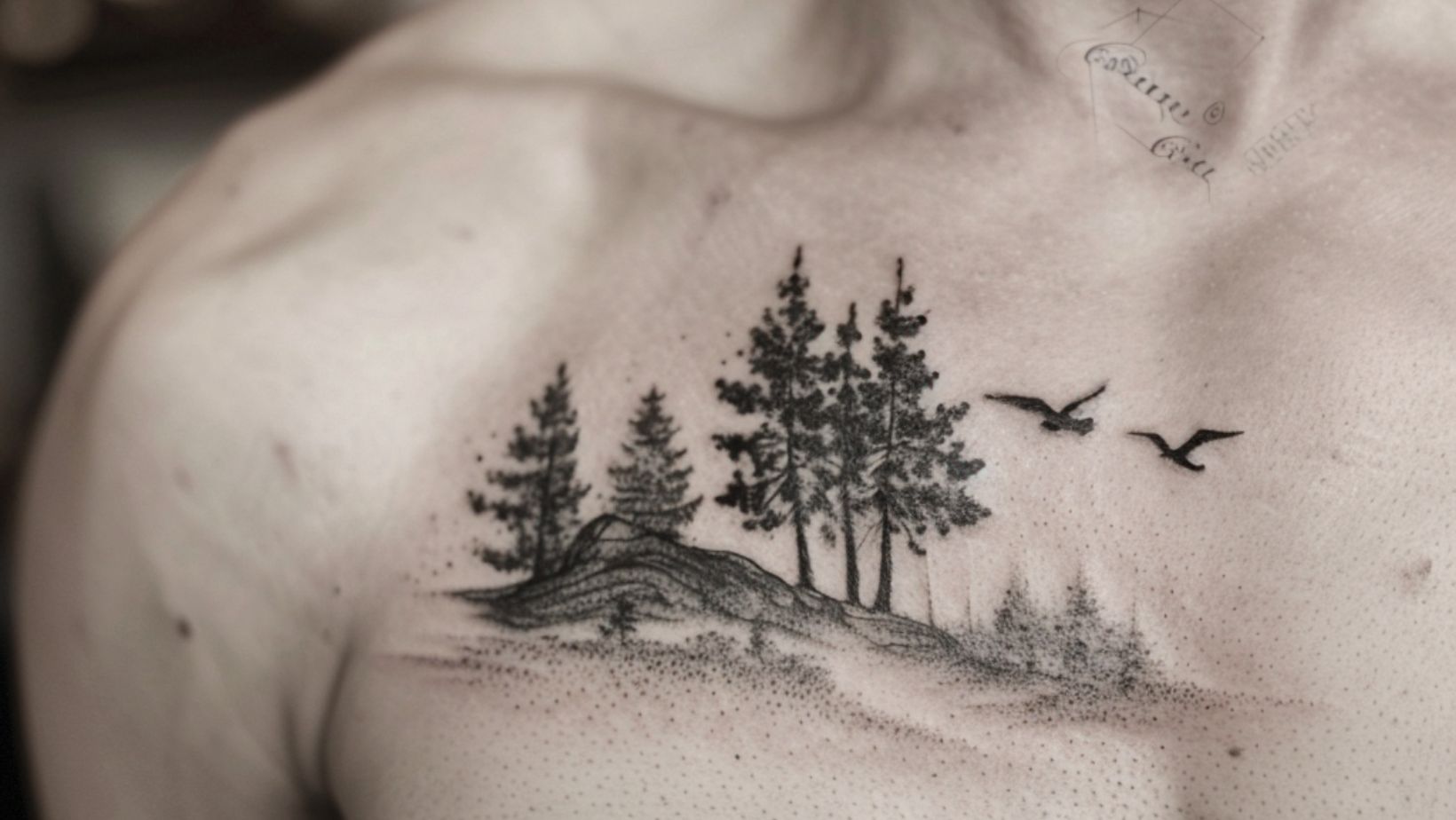
A nature tattoo for men is one of the few design choices that almost never dates, because mountains, trees and open water carried meaning long before tattooing had trends to follow. I have spent years sketching, researching and talking artists through these designs, and nature is the theme clients circle back to more than any other.
When I started paying attention to what men actually keep on their skin for decades, the pattern was hard to miss. Peaks, pines, wolves, waves and skies age far better than novelty pieces or logos.
In my experience the appeal comes down to two things: a nature tattoo says something about you without needing a caption, and it scales. The same subject works as a two-inch forearm piece or a full back scene.
Below I walk through the subjects that come up most, what each one tends to symbolize, the placements that flatter them, and the aftercare that keeps the detail readable years later. If you want a wider starting point first, our roundup of simple tattoo designs for men pairs well with everything here.
Which Nature Tattoo Style Is Right for You?
Pick the style before you pick the subject. The same mountain looks like two different tattoos in fine line versus heavy blackwork.
Style decides how the piece ages far more than the subject does. Line weight, contrast and spacing are what still read clearly in fifteen years.
Here is the breakdown I use when someone is undecided. Treat it as a starting map, not a rulebook — a good artist will bend any of it for the right design.
| Style | Best For | Overall Vibe | Aging & Upkeep |
|---|---|---|---|
| Fine line | Small pines, single peaks, subtle wrist or inner-arm pieces | Delicate, modern, minimal | Thin lines soften first; expect a touch-up sooner than with bolder work |
| Black & grey realism | Forests, wildlife, layered landscapes | Photographic, deep, dramatic | Ages well when contrast is strong and the piece is given real size |
| Bold blackwork | Mountains, waves, high-impact silhouettes | Graphic, heavy, unmistakable | Among the most durable; solid black holds its shape for years |
| Geometric | Stylized peaks, wolves, compasses, framed scenes | Clean, structured, contemporary | Holds up well when lines are spaced rather than crowded |
| Watercolor | Sunsets, skies, soft atmospheric scenes | Painterly, colorful, expressive | Color usually fades faster than black; plan on earlier touch-ups |
| Neo-traditional | Animals, botanicals, framed nature motifs | Illustrative, bold outline, rich color | Strong outlines keep it readable even as color softens |
If a graphic look pulls at you, heavy blackwork translates nature subjects into high-contrast pieces that stay legible from across a room.
Why Nature Tattoos Resonate with Men
Nature carries meaning that feels earned rather than borrowed, and that is most of why these designs stay popular decade after decade.
Mountains and old trees usually read as endurance. They stand through weather, and plenty of men want that reminder somewhere they can see it.
Water, waves and birds in flight tend to point toward freedom and movement. Every artist I have asked says these are the pieces travelers and outdoor people gravitate to first.
Forests, roots and new growth often stand for renewal — recovery, a fresh start, or simply the sense that things keep going. The symbolism is flexible enough that two men can get the same pine and mean completely different things by it.
There is also a practical reason worth naming. Nature has no fixed shape, so an artist can stretch a scene to fit a calf, a rib panel or a shoulder without the design looking squeezed.
That flexibility is why I usually steer first-timers toward a nature subject. It is hard to outgrow, and it gives you somewhere to build if you later want a bigger piece.
Nature Tattoo Ideas for Men and What They Mean
These are the subjects that come up most often, with the trade-offs I would actually mention if you were sitting across from me with a sketchbook.
Mountain and Peak Tattoos
Mountains are the workhorse of this category. They look right at almost any size, and they suit fine line, blackwork and realism equally well.
Most men read them as a challenge met or still ahead. Some pick a range they have actually climbed, which I think is the strongest version of the idea.
The common failure is cramming three ridgelines, a treeline, a river and a sky into a piece the size of a credit card. Give it room or simplify the silhouette. Our dedicated guide to mountain tattoo ideas for men has more layout options.
If you only remember one thing about mountain pieces, make it this: negative space is what sells the depth. The white of your skin standing in for snow or mist does more work than extra shading.
Tree and Forest Tattoos
Trees give you two very different options: a single specimen tree, or a dense treeline that reads as texture from a distance.
A single oak or pine with visible root structure tends to carry family and grounding. A repeating pine band reads more like place and landscape.
Forests are also the most forgiving subject for wrapping a limb, because a treeline has no obvious front or back. That makes them a favorite for calves and forearms.
If the symbolic side is what draws you, the tree of life tattoo is the most developed version of the idea and works well as a chest or back centerpiece.
Wolf and Wildlife Tattoos
Wolves, bears, stags and eagles bring a face into the design, which changes how people react to it. Animals get read as character rather than scenery.
Wolves in particular tend to stand for loyalty and family as often as they stand for independence, which surprises people who expect the lone-wolf reading.
Animal realism is the least forgiving work in this whole category. An eye or a muzzle that is slightly off is obvious in a way a crooked ridgeline never is, so this is where artist selection matters most.
If you are set on wildlife, look through wolf tattoo ideas and compare healed photos, not just fresh ones. Healed work tells you how the artist’s shading actually settles.
Ocean and Wave Tattoos
Waves are the most movement-heavy subject here, and they behave differently on the body than a static landscape does.
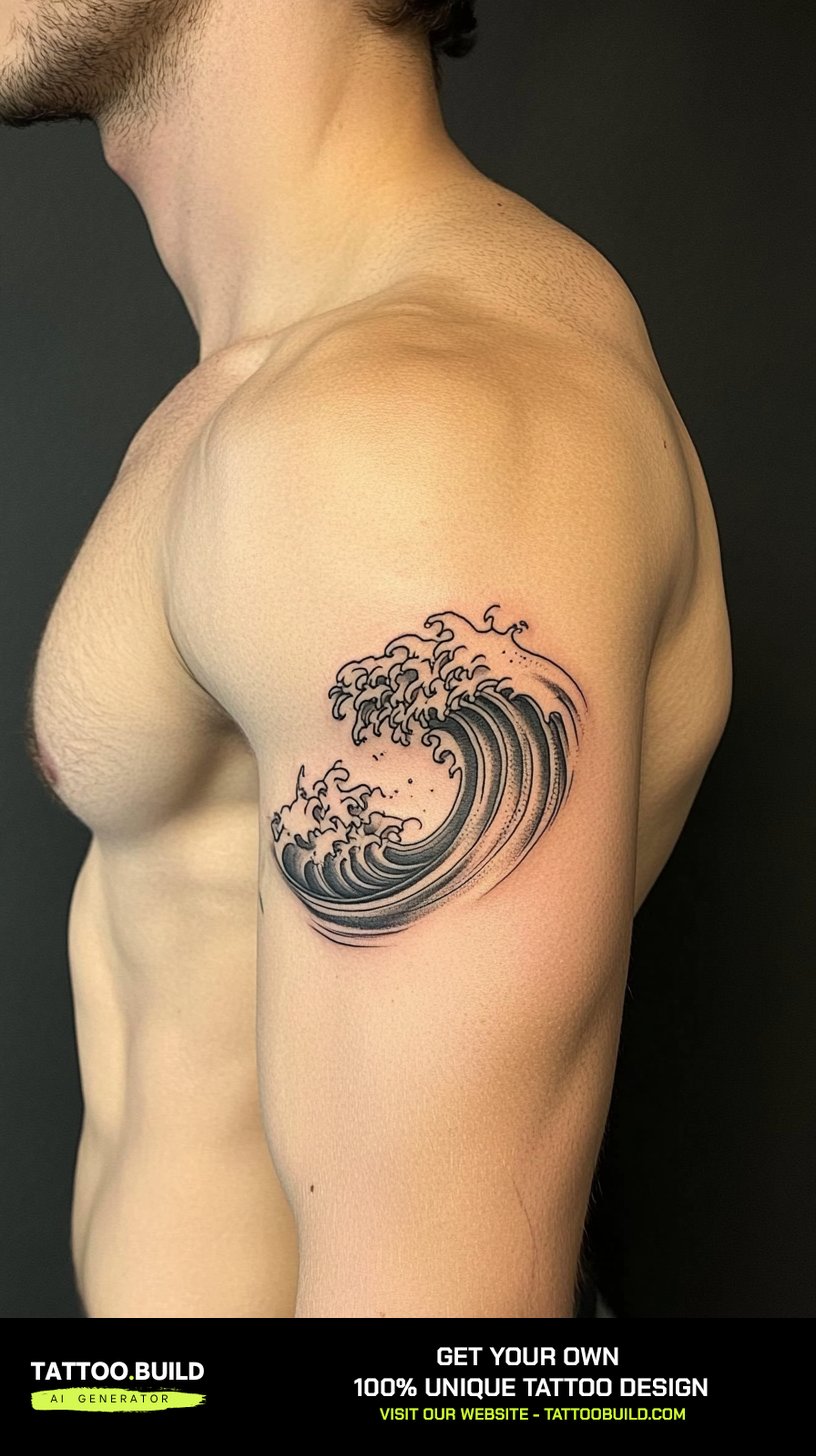
A curling wave follows muscle. On a forearm or calf it flows with the limb; on a flat panel like the outer shoulder it can look stranded.
Japanese-influenced water is the most durable version, because the linework is deliberately bold and the negative space is planned from the start.
For surfers and divers this is usually the first piece, and it expands easily later. Browse ocean tattoo ideas if you want to see how far the subject stretches.
Sun, Moon and Sky Tattoos
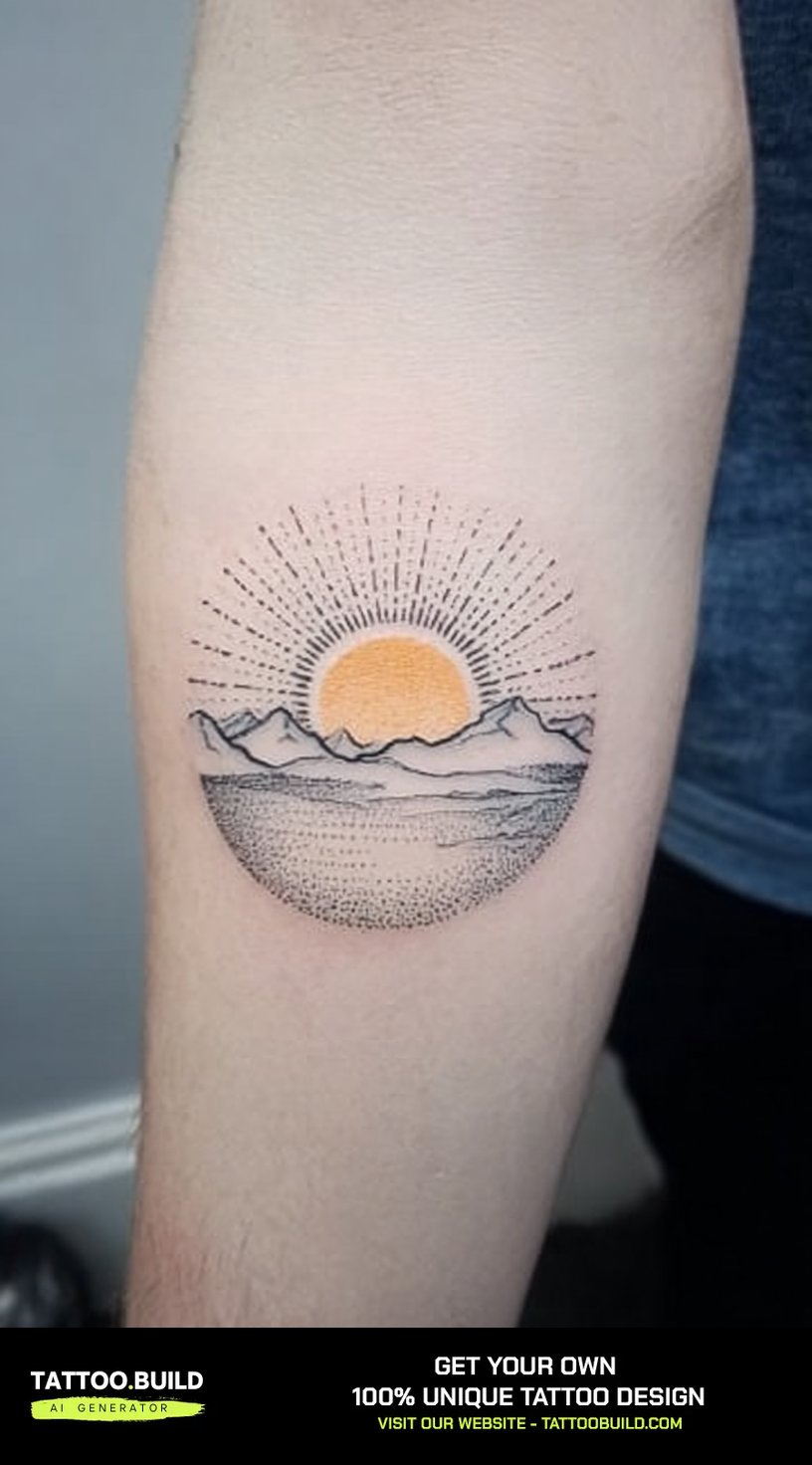
Skies are the cheapest way to add scale to a small piece. A sunburst behind a ridgeline turns a flat silhouette into a scene.
Sunrises usually get chosen for beginnings, sunsets for closure, and a sun-and-moon pairing for balance between two sides of a person.
Radiating line work is the one place where I would push you toward fewer, heavier lines rather than many thin ones. Dense rays sitting close together are the classic way a crisp tattoo turns into a grey smudge over a decade.
Stars and constellations fold in naturally here too, especially for men who want something personal without an obvious symbol attached to it.
Compass and Landscape Tattoos
A compass set into a landscape is one of the most requested men’s designs I come across, and for good reason — it adds direction to a scene that would otherwise just be pretty.
The geometry of a compass rose also gives the artist a clean anchor point, which helps a loose landscape feel composed rather than scattered.
Coordinates are a common add-on. Check them twice before the needle touches skin; I have heard more than one story about a transposed digit.
The inner forearm suits this best because the compass stays upright when your arm hangs. See compass forearm tattoos for guys for placement examples.
Full Nature Sleeves and Large-Scale Scenes
A sleeve is a different commitment. It is multiple sessions, a real budget, and a design that has to make sense from every angle.
The best nature sleeves I have seen were mapped as one piece from the start, even when they were tattooed over a year or more.
Collecting separate small tattoos and hoping an artist can stitch them into a sleeve later is the most expensive mistake in this article. It usually means cover-ups, filler, or living with awkward gaps.
If this is where you are headed, read through sleeve tattoo ideas for men first and go into your consultation with a full-arm concept rather than a single image.
Placement Options for a Nature Tattoo
Placement changes the design as much as style does, so it is worth deciding early rather than at the shop.
Forearm and Inner Arm
The forearm is the most popular spot for a first nature piece, and the easiest one to live with.
It heals reliably, you can see your own tattoo, and a vertical scene fits the shape naturally. The inner arm holds fine detail better because it gets less sun.
The trade-off is visibility. If your workplace is conservative, the inner forearm is usually the compromise that keeps everyone comfortable.
Leg and Calf
Calves give you a broad, curved canvas that suits treelines and wrapping landscapes better than almost anywhere else.
They are easy to cover day to day, which makes them a common pick for men who want a large piece without it becoming their introduction.
Healing takes a little more care because of swelling and clothing friction. For more on this area, see our guide to leg tattoos for males.
Chest and Back
These are the only placements that let a landscape breathe at full width, which is why panoramic scenes end up here.
They also tolerate detail well, since the skin moves less than it does over a joint. The downside is sessions that run long and a healing period you feel every time you lie down.
Ribs, Shoulder and Spine
Ribs hurt more than most spots for most people, but a vertical treeline or a wave panel fits the shape unusually well.
Shoulders and spines suit symmetrical designs — a centered tree, a mirrored range — because the body already gives you an axis to work from.
Variations Worth Considering
If the standard black-and-grey landscape is not quite you, these are the directions I see men take most often.
Geometric and Stylized Nature
Framing a landscape inside a circle, hexagon or triangle turns a scene into a graphic, and it solves the problem of where a design should stop.
It also reads well small, which is why it suits inner forearms and the back of the arm.
Negative-Space Blackwork
Here the ink becomes the sky and your skin becomes the mountain. Done well it is striking, and it is one of the most durable approaches there is.
The catch is that large solid black is difficult to modify later, so treat it as close to permanent in shape as well as placement.
Color Accents Instead of Full Color
A single warm band in a sunrise, or a touch of green in an otherwise grey forest, gives you color without the fade risk of a fully saturated piece.
This is the compromise I suggest most often, because the black structure keeps the tattoo readable even after the color softens.
Small and Micro Nature Pieces
A single pine, a wave line, a tiny peak — small nature tattoos work when they are one clear shape rather than a shrunken landscape.
Ask your artist honestly whether the design will still read at that size in ten years. A good one will tell you when to size up.
Aftercare and Keeping a Nature Tattoo Sharp
Detailed nature work has more to lose than a simple design does, so aftercare matters more here than almost anywhere else.
Follow the instructions your artist gives you over anything you read online, including this page — they know the ink, the depth and the aftercare products they used.
The general pattern is consistent though: keep it clean, wash gently with unscented soap, moisturize lightly rather than heavily, and leave scabs alone. The American Academy of Dermatology has a clear public guide to caring for tattooed skin.
Sun is the single biggest long-term threat to a detailed piece. Once it is fully healed, sunscreen on exposed nature tattoos does more for sharpness than any lotion.
Healing tattoos are open skin, so some redness and tenderness in the first days is normal. Spreading redness, increasing pain, heat, swelling or discharge is not — contact your artist and see a doctor rather than trying to manage it yourself. Mayo Clinic’s overview of tattoo risks and precautions is a sensible place to read further, and the FDA publishes a tattoo and permanent makeup fact sheet on ink safety.
This article is general information from someone who works with designs, not medical advice. Anything involving your skin, your health or a reaction belongs with a professional.
Still Not Sure? Avoid These Common Mistakes
Most regrets I hear about are not about the subject. They are about size, artist choice or rushing.
Going too small for the detail level is number one. A forest with twelve distinguishable trees needs space, and no artist can defeat that.
Choosing by price is number two. A nature realism piece from a cheap generalist usually costs more to fix than it saved.
Booking a specialist matters: an artist whose portfolio is full of lettering is not the right hand for a black-and-grey landscape. If you are still narrowing down your direction, our wider collection of tattoo ideas for men and our guide to geometric tattoo ideas for men are both good places to keep browsing.
Finally, sit with the design. If you still want it in three months, that is the strongest signal you will get.
Frequently Asked Questions
What is the most popular nature tattoo for men?
Mountains come up more than anything else in my experience, with trees and wolves close behind. They scale from tiny to full-back without losing their shape, and the meanings attached to them — endurance, grounding, loyalty — are easy to relate to. They also combine well, which is why the mountain-and-pine pairing is so common. If you are undecided, a simple peak is a low-risk first piece.
How much does a nature tattoo cost?
It depends on size, detail, placement and the artist’s rate, so there is no honest single figure. Small pieces are usually quoted as a flat minimum, while anything larger is typically charged by the hour or by the session. A detailed black-and-grey landscape costs considerably more than a fine-line silhouette of the same width because of the shading time. Ask for a written quote at consultation, and expect a deposit.
Do nature tattoos age well?
Generally yes, and better than most themes, because the subjects tolerate a little softening. Bold, well-spaced designs hold up best; very fine lines and heavy color tend to need touch-ups sooner. Sun exposure is the biggest variable you actually control. Most people find a touch-up every several years keeps a detailed piece looking current.
Where is the best place for a nature tattoo?
The forearm and calf are the easiest starting points because they heal reliably and suit vertical scenes. The chest and back are the right call when you want a wide landscape with real depth. Ribs and spine work for symmetrical or vertical designs but are more painful for most people. Match the placement to the shape of the design rather than the other way round.
Is a large, detailed nature tattoo safe?
Getting tattooed by a licensed artist in a clean, properly equipped studio is generally considered safe for most healthy adults. As with any tattoo there is some risk of infection or allergic reaction, and larger pieces mean more open skin at once, so aftercare discipline matters more. Tell your artist about skin conditions, allergies or medications before you book. If anything looks or feels wrong while healing, contact your artist and see a doctor rather than treating it yourself.
Quick Summary
- Nature tattoos for men stay relevant because the subjects were never trends to begin with.
- Choose the style first — fine line, blackwork, black-and-grey realism, geometric or neo-traditional — because style drives how the piece ages.
- Mountains, trees, wolves, waves, skies and compasses are the subjects that come up most and combine most easily.
- Match the design’s shape to the placement: vertical scenes on forearms and calves, wide landscapes on the chest and back.
- Give detail real estate; shrinking a complex scene is the most common regret.
- Plan a sleeve as one composition from the start rather than assembling it from separate tattoos.
- Protect healed work from the sun — it does more for long-term sharpness than any aftercare product.
- Pick your artist on healed portfolio work in your chosen style, not on price.