Roses and peonies take up most of the oxygen in floral tattooing, and I understand why — they are bold, they are legible from across a room, and every artist has drawn a thousand of them. But the fern is the plant I keep coming back to when someone tells me they want something botanical that nobody else in their friend group already has. A fern tattoo gives you structure without a bloom: repetition, symmetry and fractal detail, carried by a plant that was already old when the first dinosaurs showed up.
I have watched fern pieces heal on four different people over the last few years, and the thing that surprised me most is how differently they age depending on how tightly the leaflets are packed.
That is really the whole craft question with ferns, and most of this guide circles back to it. If you are drawn to the thinnest, most delicate version of the plant, it is worth reading up on fine line tattoo work generally before you book, because the same rules apply.
Below are 20 fern ideas, grouped by what they actually do on the body rather than listed at random, plus the practical stuff — placement, size, species choice and the mistakes I see most often.
Which Fern Tattoo Style Is Right for You?
Style matters more than subject with ferns. The same frond can read as a botanical illustration, a bold graphic mark, or a soft wash of colour depending entirely on how it is rendered.
| Style | Best for | Placements that suit it | What to expect long term |
|---|---|---|---|
| Fine line botanical | Accuracy, delicacy, a specimen-sheet look | Forearm, calf, upper back, ribs | Lines soften and thicken; very tight leaflets can merge, so scale up |
| Blackwork / silhouette | Maximum legibility at a distance | Outer arm, thigh, shoulder, shin | Holds its shape best of any fern style; touch-ups are usually simple |
| Watercolour | Softness, colour, a painterly feel | Inner arm, thigh, upper back — low-sun areas | Pale washes fade fastest; plan on a refresh and keep it out of the sun |
| Koru / Māori-influenced | Symbolic weight, bold graphic form | Shoulder, calf, forearm | Ages very well; research the cultural context before committing |
| Negative space | Drama, a modern graphic look | Forearm band, thigh, calf | Depends on the solid black around it staying even — pick an artist who packs black well |
Why the Fern Works So Well on Skin
A fern is one of the few plants whose whole visual appeal is structure rather than colour. Strip a rose down to black line and you lose most of what makes it a rose. Strip a fern down to black line and you lose nothing at all.
Ferns are also genuinely ancient. They are a vascular plant group that reproduces by spores rather than seeds and appears in the fossil record long before flowering plants — Britannica’s overview of ferns is a decent starting point if you want the botany behind the symbolism.
Symbolically, that age does a lot of work. Most people who come to a fern want the resilience reading: the plant that thrives in deep shade where almost nothing else will grow, quietly, without needing to flower to justify itself.
There is a second reading too, tied to the unfurling frond — new growth, emergence, starting again. That is where the koru comes from, and Te Ara, the Encyclopedia of New Zealand covers how deeply ferns sit in New Zealand culture.
And practically, a frond is a shape that bends. It arches, tapers and fills awkward gaps, which is why fern work turns up so often as connective tissue in wildflower and botanical pieces rather than only as a standalone subject.
20 Fern Tattoo Ideas, Grouped by What They Do
I have grouped these by the design problem they solve rather than numbering them one to twenty in a random order. Most people arrive knowing the feeling they want, not the style name.
1. Fine Line Botanical Ferns
This is the specimen-sheet approach: the central stem (the rachis) and each individual leaflet (the pinna) drawn in precise, even black line, with no fill and minimal shading.
Maidenhair fern is the standout here. Its leaflets are small rounded fans on stems so dark and thin they almost read as wire, and a good fine line artist can make that contrast sing.
In my experience this is the style that most often gets tattooed too small. The temptation is to keep it dainty, but every leaflet needs a gap of clear skin around it that will still be a gap in fifteen years.
A reasonable rule I have heard from more than one artist: if the smallest gap between two leaflets is narrower than the needle grouping doing the outline, redraw it bigger. Fine line ferns want space, not shrinkage.
2. The Koru, or Unfurling Frond
The koru is the tightly coiled young frond at the moment it begins to open, stylised in Māori art into a teardrop spiral.
It carries a specific meaning — new life, growth, emergence — and it is one of the most recognisable botanical motifs in the world.
It also comes with responsibility. The koru is not a generic swirl, and if you want a Māori-influenced rendering rather than a naturalistic botanical one, it is worth understanding the context around Māori tattoo design and, ideally, working with an artist who has a genuine relationship with that tradition.
Rendered naturalistically instead — just a young frond, drawn as it actually looks — it is culturally neutral and still beautiful. Both options are open; they are just not the same option.
3. The Crozier: Fiddlehead Close-Up
A crozier is the botanical name for that coiled tip, and cropping the design down to the spiral alone makes for a very strong small tattoo.
It works because a spiral is one of the few shapes that stays legible at almost any size. Shrink a whole frond and it turns to mush; shrink a spiral and it is still a spiral.
When I tested this idea on paper at about two inches, it held up far better than any full-frond version at the same scale. It is my usual recommendation for a first small botanical piece.
4. Blackwork Ferns
Fill the leaflets solid and the fern becomes a silhouette. You lose the interior detail and gain enormous contrast.
This is the style I would push anyone toward if they want a fern that is still obviously a fern from across a room in twenty years. Blackwork designs generally hold their edges better than fine line because there is simply more ink holding the shape.
The trade-off is that species-specific detail disappears. A blackwork fern reads as fern, not as Dryopteris, and if botanical accuracy is the point, this is the wrong route. Choose blackwork for impact, fine line for identification.
5. Negative Space Ferns
Here the ink is the background and the frond is the untouched skin inside it — a solid black block or band with the fern cut out of it.
It is a striking look and, done well, genuinely modern. It is also the style most dependent on the artist’s technical ability, because the whole effect collapses if the surrounding black heals patchy.
Ask to see healed photos specifically, not fresh ones. Solid black looks perfect on everyone the day it is done; what matters is how it looks a year later.
6. Watercolour and Coloured Ferns
Green is the obvious choice, but the fern pieces I like most use colour sparingly — a wash of sage or blue-grey bleeding past the outline rather than a full-colour fill.
Watercolour tattoos do fade faster than black and grey, particularly the palest washes, and anything on a sun-exposed limb will need attention sooner.
Every artist I have asked about this says the same thing: watercolour that has a black line structure underneath it ages far better than watercolour with no line at all. With ferns you already have that structure for free.
7. Ferns Paired With a Second Motif
Ferns combine well precisely because they are quiet. They do not compete with the thing next to them.
The moon is the most common partner — fronds curling around a crescent, which slots neatly into the broader family of moon tattoo designs. It works because the crescent’s curve and the frond’s arch are the same gesture.
Mushrooms are the other natural fit, since the two genuinely grow together. A fern with a couple of small toadstools at its base builds a patch of forest floor rather than a floating plant.
And then there is the fern-and-skull pairing, which is growth-and-decay shorthand. Done heavily it tips into cliche; done with restraint — a small skull, fronds doing most of the work — it is one of the better botanical-and-skull combinations out there. Let the fern lead and the second motif stay small.
8. Species-Specific Ferns
There are thousands of fern species and they look nothing alike. Picking a real one is the single easiest way to make a fern tattoo feel personal rather than generic.
Tree ferns give you a whole plant — fibrous trunk, crown of arching fronds — which suits a long vertical placement like the outer thigh or the side of the calf.
The silver fern, Cyathea dealbata, or ponga, is the New Zealand one: a clean single frond, pale on its underside, and a national symbol with real weight behind it.
Tropical species with broad, deeply split fronds are the most forgiving of all. Fewer, bigger shapes means it reads clearly from further away and needs less maintenance than a lacy species ever will.
If a fern grows where you grew up, tattoo that one. Bring a photograph of the actual plant to your consultation — any artist who does botanical work will be glad of it.
Placement Variations Worth Considering
Ferns are unusually placement-flexible, because a frond is essentially a long tapering line with detail hanging off it. That shape fits places a round flower cannot.
Fern as Sleeve Filler
This is probably the most common use of ferns in tattooing and almost nobody books it deliberately. Fronds are what artists reach for to link larger elements in a botanical sleeve.
If you already have scattered pieces on one arm, fern work is a genuinely good way to tie them together without adding another focal point.
The Spine Fern
A single frond running down the spine is close to a perfect match of subject and placement: the rachis lines up with the vertebrae and the leaflets fan out symmetrically.
Be honest with yourself about the sitting, though. The spine is one of the more demanding spots, and it is worth checking a spine tattoo guide before you commit to a long vertical session.
Shoulder and Upper Arm
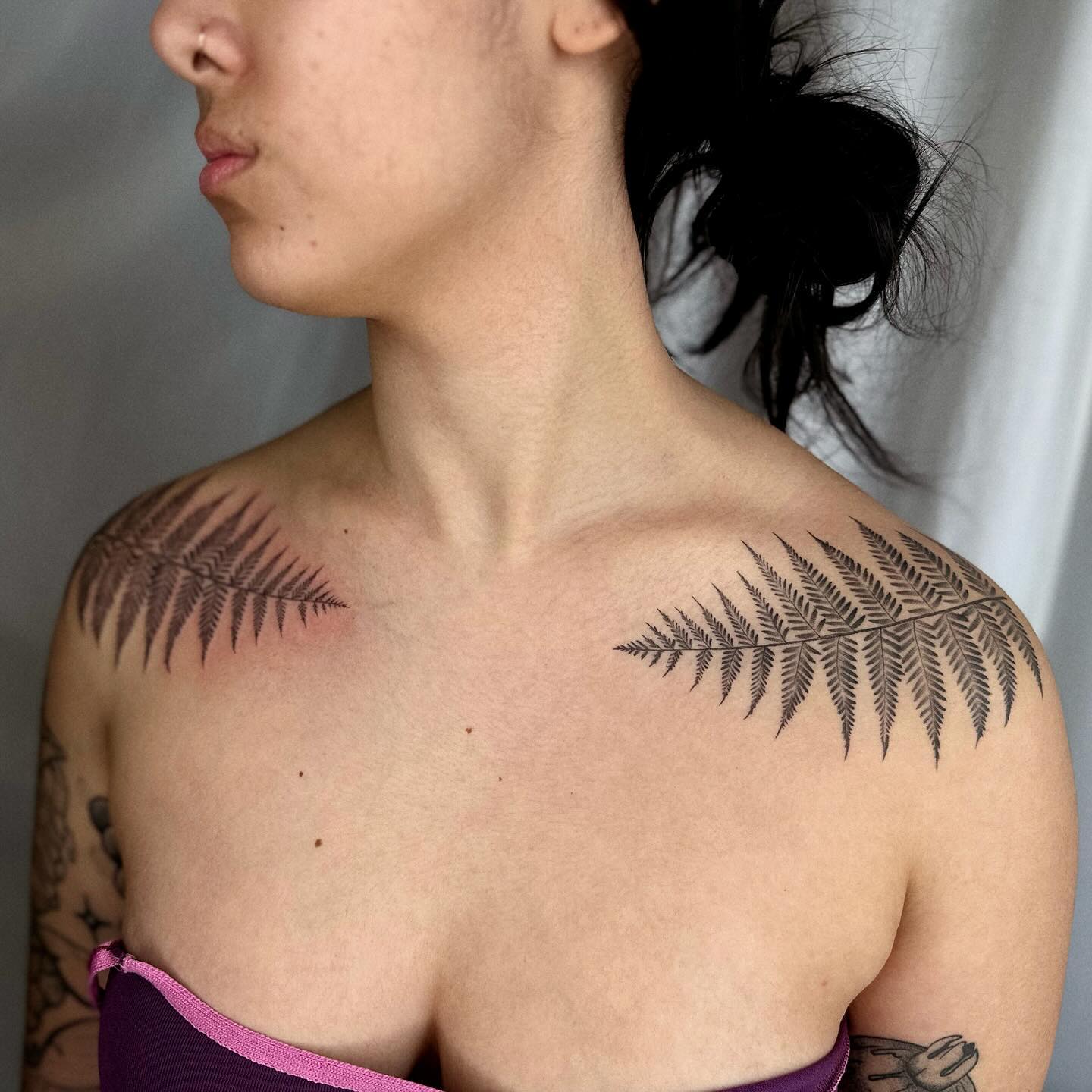
The shoulder’s curve does something nice to a fern: fronds arching from the shoulder blade over the deltoid follow the body instead of fighting it.
It also means the piece looks different from the front, the side and the back, which is more than most flat botanical designs manage.
Mirrored and Paired Ferns
Two fronds arching away from a centre line — either side of the sternum, along the collarbones, or at the tops of both thighs — give you symmetry without needing a mandala.
Ferns suit this better than most plants because a frond is already close to symmetrical about its own stem.
Wreaths and Other Closed Shapes
Bending fronds into a ring makes a closed frame around open skin, which is useful if you want space left for a date, a name or simply nothing at all.
The same logic applies to interrupted patterns: a repeating fern motif broken deliberately, which reads as designed rather than unfinished as long as the break is decisive.
How to Brief Your Artist for a Fern Tattoo
Bring a photograph of a real fern, not a Pinterest tattoo. Artists can work from a plant; working from someone else’s tattoo mostly produces a copy of someone else’s tattoo.
Say out loud how big you want it, then let the artist tell you whether that size supports the detail level you are asking for. On ferns, the artist is almost always right about this and the client is almost always disappointed for about ten minutes.
Ask specifically about spacing between leaflets, and ask to see healed work — at least a year old — in the same style. Fresh photos tell you about the artist’s linework; healed photos tell you about their judgement.
Aftercare is not fern-specific, but fine botanical line work is less forgiving of a badly healed patch than a bold traditional piece. Follow your artist’s instructions, keep it out of the sun, and read a general tattoo aftercare guide before the appointment rather than after. If you see spreading redness, swelling, heat or discharge, that is a doctor’s call rather than an internet one — the American Academy of Dermatology has plain guidance on caring for tattooed skin and when to seek help.
Common Mistakes I See With Fern Tattoos
Going too small is the big one. A fern’s appeal is its repetition, and repetition needs room. Most of the disappointing fern tattoos I have seen were fine designs executed at two-thirds the size they needed.
A tattoo size guide is worth a look if you are unsure how a design translates from screen to skin — phone screens flatter small detail in a way that skin does not.
Second: picking a delicate species for a high-movement, high-friction placement. Fingers, feet and inner wrists are hard on fine line work no matter what the subject is.
Third: underestimating the session. A spine or rib fern is a long sit in a sensitive area, and it helps to look at a tattoo pain chart honestly before booking rather than discovering it mid-session.
Fourth: choosing a symbol from a living culture without engaging with it. If the koru is what you want, do the reading and talk to the right artist.
And last: treating a fern as filler when you actually want a focal point. It can be either — but the design decisions are completely different, so decide which one you are asking for before the stencil goes on.
Frequently Asked Questions
Do fern tattoos age well?
In most cases yes, but it depends heavily on style and size. Blackwork and bold silhouette ferns hold their shape very well over time, while very fine, tightly packed leaflets can blur together as lines soften with age. The single biggest factor is whether the design was tattooed large enough for the gaps between leaflets to survive line spread. Ask your artist to show you healed work at least a year old in the style you want.
What does a fern tattoo symbolise?
The most common readings are resilience, new beginnings and a connection to ancient nature. The resilience association comes from the plant itself, which thrives in deep shade where little else grows, and the new-beginnings meaning comes from the unfurling frond opening into new growth. In New Zealand, the silver fern and the koru carry specific cultural significance rather than general symbolism. Many people also simply choose a species that grew where they did, which makes the meaning personal rather than borrowed.
How much does a fern tattoo cost?
There is no single answer, because pricing depends on your artist’s hourly or day rate, your location, the size and the detail level. As a rough shape of the thing, a small single frond is usually a short session, while a full botanical sleeve element or a spine piece is measured in hours. Detailed fine line work often costs more than a simple blackwork version of the same size because it takes longer. Get a quote in consultation rather than relying on any online average.
Where is the best place on the body for a fern tattoo?
The forearm, calf, spine and outer thigh all suit ferns well, because a frond is a long tapering shape that fits a long tapering area. The shoulder works nicely too, since the fern’s natural arch follows the curve of the deltoid. I would generally avoid fingers, feet and the inner wrist for delicate fine line ferns, as those areas are hard on thin lines. Placement should also account for how much sun the area gets if there is colour involved.
Should I get a koru if I am not Māori?
This is a question worth taking seriously rather than answering with a quick yes or no. The koru is a specific motif from Māori art with real cultural meaning attached, and it is not the same as a generic spiral. Many people choose a naturalistic unfurling frond instead, which gives you the same visual idea and the same new-beginnings symbolism without borrowing a cultural symbol. If the koru specifically is what you want, talk to an artist who has a genuine relationship with that tradition and be guided by what they tell you.
Quick Summary
- Ferns give you botanical structure without a flower — repetition, symmetry and detail rather than a bloom.
- Style decides everything: fine line for accuracy, blackwork for longevity, watercolour for softness, negative space for drama.
- Size is the most common mistake. Every gap between leaflets needs to still be a gap in fifteen years.
- Picking a real species — maidenhair, tree fern, silver fern, a tropical variety — makes the piece specific instead of generic.
- The koru carries Māori cultural meaning; a naturalistic unfurling frond is the culturally neutral alternative.
- Forearm, calf, spine, thigh and shoulder all suit the frond’s long arching shape; fingers and feet do not suit fine line versions.
- Ferns pair well with moons, mushrooms and small skulls, and work brilliantly as connective filler in a botanical sleeve.
- Bring a photo of a real plant to your consultation and ask to see healed work, not just fresh work.