The frog has quietly become one of the most requested small-animal tattoos of the last few years, and it has earned the attention. It sits at the intersection of the cute and the uncanny — wide expressive eyes, improbable proportions, and a species range that runs from thumbnail-sized glass frogs to dart frogs coloured like warning signs.
I have been collecting and comparing frog pieces for a while now, and the thing that keeps surprising me is how far the subject stretches. The same animal reads as whimsical in soft watercolour and genuinely eerie in heavy blackwork.
That flexibility is why the frog works across so many tattoo styles. It also carries real symbolic weight in several cultures, so it can be a light piece or a loaded one depending on how you build it.
The look that pulled the frog into the mainstream is the cottagecore frog — mushroom, tiny hat, storybook palette — and it is still the version most people picture first.
Which Frog Tattoo Style Is Right for You?
Every style handles the frog differently, and the differences matter more than they look on a reference photo. Here is how the main approaches compare.
| Style | Best For | Workable Size | How It Ages |
|---|---|---|---|
| Cottagecore / illustrative | Soft, storybook mood with props | 3–6 inches | Good if linework carries the design; pale washes fade first |
| American traditional | A frog that still reads clearly in 20 years | 2–5 inches | Best in class — heavy outline, flat fill |
| Colour realism | Dart frogs, tree frogs, anything vivid | 5 inches and up | Needs sun protection and often a touch-up |
| Blackwork / dotwork | Graphic, slightly strange versions | 3–8 inches | Very well; solid black holds longest |
| Fine line / micro | Tiny wrist and ankle frogs | 1–2.5 inches | Softens noticeably; expect line spread |
| Japanese (irezumi) | Larger, culturally grounded pieces | 6 inches and up | Excellent — the style is built for longevity |
What the Frog Means Across Cultures
The frog is one of the few animals that carries a broadly positive meaning almost everywhere it appears, which makes it an unusually safe subject to put on skin.
In Japanese tradition the frog — kaeru — is a luck charm, because the word sounds like the verb meaning to return. It became an emblem of safe homecoming, and travellers still carry frog charms for exactly that reason.
In ancient Egypt the frog goddess Heket was tied to fertility and birth. In Celtic lore the frog is associated with water and healing, and in a number of Indigenous American traditions it appears as a rainmaker and a keeper of water.
The thread running through all of these is transformation. A frog’s life cycle — egg, tadpole, adult — is one of the most visible metamorphoses in nature, and that is the meaning most clients I have spoken to are actually reaching for.
Worth being honest about, though: most people getting a frog tattoo today are not doing it for the symbolism. They are doing it because frogs are charming. That is a completely valid reason and you do not need to justify it with folklore.
20 Frog Tattoo Ideas Worth Stealing
These span the full range, from the whimsical to the genuinely unsettling. I have noted where each one tends to work best.
1. Cottagecore Frog
The frog sitting in a mushroom cap, holding a flower, wearing a tiny hat, posed beside a teacup — the cottagecore frog is a whole aesthetic compressed into one small animal.
It is usually done in soft illustrative linework or gentle watercolour, with a muted palette: sage, cream, dusty pink, soft brown.
My one piece of advice here is to make sure the linework can stand alone. Pale watercolour washes are the first thing to soften as a tattoo settles, and if the colour is doing all the work you will lose the design’s shape within a few years.
Best placed somewhere it can breathe — outer forearm, calf, or upper arm at around four to six inches.
2. Japanese Frog (Kaeru)
In the irezumi tradition the frog appears as a luck symbol, often in a comic or heroic pose, sometimes riding a leaf or squaring up to something much larger than itself.
It is drawn with the style’s signature heavy outlines and formal decorative structure, usually with water, waves or maple leaves as background elements.
This is not a small tattoo. The conventions of Japanese tattoo designs assume room for background, and a kaeru crammed into three inches loses everything that makes the style work.
If you have a connection to Japan or its visual traditions, this is the most substantial frog on the list. If you do not, it is still a legitimate choice — just go to an artist who actually works in the style rather than one imitating it.
3. Poison Dart Frog
Electric blue, vivid red over black, brilliant yellow and green — dart frogs have the most saturated colouration of any animal you could reasonably put on your arm.
Their warning colours evolved to be as conspicuous as possible, which is exactly the quality you want in a colour realism piece. The Smithsonian’s National Zoo has good reference material on the range of species if you want to pick a specific one rather than a generic ‘blue frog’.
The catch is upkeep. Saturated colour in skin needs sun protection to stay saturated, and most colour realism pieces I have seen benefit from a touch-up somewhere around the five-year mark.
Give it five inches minimum. Dart frog patterning does not survive being shrunk.
4. Traditional American Frog
Bold black outlines, flat green fill, the animal in a graphic posed position — the American traditional frog is the version that will still read clearly when you are seventy.
It is far less common than the traditional eagle, panther or snake, which is part of the appeal. Within the style’s usual vocabulary a frog is a genuine curveball.
If you like the approach, it is worth browsing American traditional animal tattoos generally to see how the style handles creatures that are not part of the classic flash canon.
Small, confident and durable. Two to five inches is plenty.
5. Glass Frog
Glass frogs have translucent underside skin through which the internal organs are genuinely visible — you can see the heart beating.
As a tattoo this is a real technical problem: the artist has to render transparency on opaque skin, working almost entirely through careful colour layering and restraint.
It is not a piece to hand to someone who does not already do strong colour work. When it lands, though, it is one of the most striking animal tattoos I have seen.
Bring several reference photos and be explicit that the transparency is the point, or you will end up with a green frog that happens to be slightly pale.
6. Frog on a Lily Pad
The most classical frog composition there is, and it holds up because the shapes are good: a round frog on a round pad, with room for water, reeds or a dragonfly.
It works in almost every style. Blackwork makes it graphic, watercolour makes it soft, Japanese framing makes it formal.
The lily pad also gives the artist a natural base, which solves the problem most animal tattoos have of floating in empty skin with nothing to sit on.
Calf and outer arm are the natural placements — both give you a slightly vertical frame that suits the composition.
7. Tree Frog
The red-eyed tree frog is the poster animal of the rainforest for a reason: green body, blue and yellow flanks, orange toes, and those enormous red eyes.
It gives a colour artist three or four strong hues in a compact design, and the gripping pose — toes wrapped around a branch or stem — adds movement that a seated frog does not have.
In my experience this is the frog people choose when they want something colourful but not as aggressive as a dart frog.
The branch matters. Ask for it to wrap or follow the limb rather than sitting flat, and the piece will look like it belongs on your arm instead of being stuck to it.
8. Frog and Moon
Put a frog in front of a crescent or full moon and the whole tone shifts from cute to folkloric — suddenly it reads like an illustration from a story you half remember.
The moon also solves a compositional problem by giving you a strong circular frame behind an otherwise irregular shape.
It pairs naturally with dark linework and stippled shading rather than colour. A lot of the best versions I have seen are entirely black and grey.
Spine, forearm and outer thigh all work well, because the circle wants a flat, uninterrupted area.
9. Frog Prince
A small golden crown is all it takes. The fairy-tale reference lands instantly and needs no explanation.
It is a playful piece, and people usually get it for playful reasons — though it also works as a quiet joke about patience, or about people not being what they appear.
Keep the crown simple. Ornate crowns at small scale turn into a gold smudge within a few years, and the whole gag depends on that shape staying readable.
This is one of the few frog designs that genuinely works as a matching tattoo, which is worth knowing if you are planning one with someone.
10. Geometric Frog
The frog rebuilt from clean shapes: triangular facets, mandala patterning inside the body, or a silhouette overlaid with precise linework.
This approach strips the animal back to structure, which suits people who like the frog as a form more than as a character.
It sits comfortably alongside other geometric tattoo designs, so it is a good choice if you are building a sleeve with a consistent visual language.
Precision is everything here. Geometric work exposes a shaky hand more than almost any other style, so look hard at an artist’s healed photos, not just their fresh ones.
11. Meditating Frog
A frog sitting cross-legged in a lotus pose, eyes closed, hands resting. It is a little absurd, which is exactly why it works.
The tone is calm rather than comic — most versions I have seen play it fairly straight, with soft shading and a restrained palette.
It suits quieter placements: inner forearm, ribs, back of the calf. Somewhere you see it rather than somewhere it announces itself.
If you want it to read as serene rather than silly, ask your artist to keep the eyes closed and the proportions closer to a real frog than a cartoon.
12. Frog and Mushroom
The single most requested pairing in the whole cottagecore category, and the imagery genuinely fits — both are damp-woodland things, both are faintly magical.
The mushroom cap gives the design a canopy and a strong silhouette, and the spotted red-and-white amanita shape is recognisable at almost any size.
You can push it in either direction: sweet and storybook, or darker with heavier linework and a more realistic frog.
Small versions work better here than in most frog designs because the mushroom shape survives simplification far better than frog anatomy does.
13. Frog Life Cycle
Egg, tadpole, half-legged tadpole, adult frog — laid out in sequence, this is metamorphosis made literal.
It is the most meaningful frog tattoo on the list for most people who choose it, and it works beautifully along a forearm, a spine, or wrapping a calf.
The sequence needs room. Four stages at readable size means eight inches or more, and cramming it smaller turns the early stages into indistinct blobs.
In my experience this is the frog design people come back to add to — the water, the reeds and the surrounding environment get built out over later sessions.
14. Bullfrog Realism
Heavy, warty, unglamorous and completely convincing. The bullfrog is what you choose when you want the animal rather than the cartoon.
Black and grey realism suits it better than colour, because the appeal is texture — the folds, the bumps, the wet sheen on the eye.
It reads as a serious piece and holds its own next to realism work of any other subject, which is not something you can say about most frog tattoos.
Six inches and up. Realism at small scale is where texture goes to die.
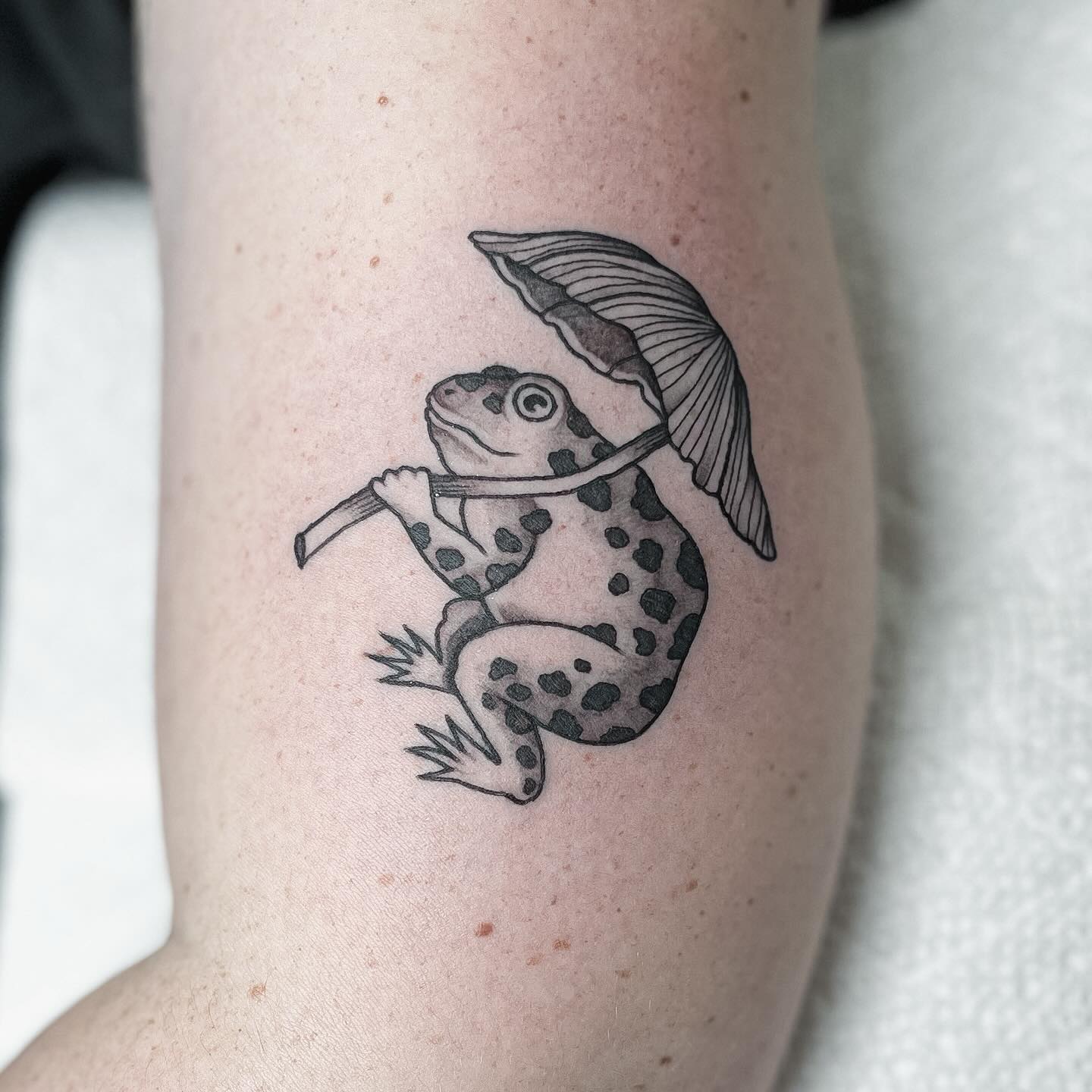
15. Frog with Umbrella
A frog sheltering under a leaf or a tiny parasol, usually with rain drawn in around it. Pure whimsy, and it ages well because the shapes are simple.
The umbrella gives you a second strong shape and a natural place for a colour accent if the rest of the piece is black and grey.
It suits the upper arm and the outer thigh, where the falling rain has room to extend past the frog without crowding anything.
Ask for the rain to be suggested rather than fully rendered. Dense rain lines close up over time and can turn into a grey haze.
16. Frog and Lotus
The lotus brings its own symbolism — emergence, renewal, something clean rising out of muddy water — and the frog sits inside that story naturally.
It is a more elegant composition than the lily pad version, with the open flower giving the piece a clear focal point.
If the flower is the part you are drawn to, it is worth looking at lotus flower tattoo designs on their own before committing to the pairing.
Works in fine line, blackwork and full colour equally well, which is unusual. Thigh, forearm and shoulder blade are the strongest placements.
17. Blackwork Frog
Solid black, sometimes with dotwork shading or negative-space highlights. No colour at all.
Stripped of colour the frog gets stranger — the silhouette and the eyes carry everything, and the result often lands somewhere between folk art and specimen illustration.
This is the frog with the best long-term prognosis on the list. Solid black holds its edge longer than any other application, which is why blackwork tattoo designs tend to look sharp decades in.
Be aware that heavy black is harder to cover or rework later, so be more certain about this one than you would be about a fine line piece.
18. Small Cute Frog
A simplified frog in a couple of inches: inner wrist, ankle, behind the ear, back of the arm.
The rule at this size is ruthless simplification. Toes, skin texture and eye detail all close up as the tattoo settles, so the design has to survive on silhouette alone.
If you are collecting small pieces, a frog slots in easily alongside other cute little tattoos without clashing.
Expect some line spread over time. That is normal for micro work and not a sign anything went wrong — just budget for the possibility of a refresh.
19. Frog and Rain
Not the umbrella version — this is the frog as rainmaker, drawing on the Indigenous American associations between frogs, water and the arrival of rain.
Usually built with the frog low in the composition and rain or clouds above, sometimes with linework suggesting a downpour.
It is a quieter, more atmospheric piece than most on this list, and it works especially well in black and grey with soft washes.
If you are drawing on a specific cultural tradition, it is worth doing the reading first. The symbolism is not generic, and treating it as decoration is the kind of thing people regret later.
20. Frog Skull
An amphibian skull is a strange, delicate object — broad, flat, oddly geometric — and it makes for a far less obvious memento mori than a human one.
Fine black linework suits it best, letting the structure do the work. Some versions pair it with botanicals or a single flower growing through the eye socket.
This is the frog for people who like the animal but do not want anything approaching cute. It is the tonal opposite of the cottagecore version and sits in a completely different kind of collection.
Accuracy helps. Amphibian skulls look wrong when invented, so bring your artist a real reference image.
Where Frog Tattoos Actually Work Best
Placement decides more about how a frog tattoo turns out than style does. Here is what I would consider.
Forearm and Inner Arm
The default for a reason. Flat, visible, easy to sit through, and the shape suits both a single frog and a vertical sequence like the life cycle.
Inner forearm skin holds fine detail slightly better than the outer arm and gets less sun, which matters for colour pieces.
Calf and Ankle
The calf is one of the best canvases on the body for a mid-sized animal piece — plenty of flat area, good healing, and a natural vertical frame.
Ankles are fine for small frogs but they sit close to bone, and tattoo pain levels climb sharply anywhere the skin sits directly over it.
Thigh and Upper Arm
Where you go if you want scale. A dart frog with full background, or a Japanese kaeru with waves, needs this much room to work.
Both areas also stay covered day to day, which extends the life of saturated colour considerably.
Hands, Fingers and Behind the Ear
Possible, but be realistic. Hands and fingers break down faster than anywhere else on the body and often need touching up within a couple of years.
Most artists I have asked will do a small frog on a hand, but will tell you upfront that it is a maintenance tattoo rather than a permanent one.
Getting a Frog Tattoo That Still Looks Good in Ten Years
Pick the artist for the style, not the subject. Almost nobody specialises in frogs, but plenty of artists specialise in colour realism, in blackwork, or in soft illustrative work — and that is the thing that determines your result.
Ask to see healed photos rather than fresh ones. A tattoo photographed an hour after it was finished tells you very little about how that artist’s work settles.
Size up rather than down. Almost every frog tattoo I have seen go wrong went wrong because it was made too small for the amount of detail in the design.
On healing: follow whatever aftercare instructions your artist gives you, since they are matched to the work they just did. Keep it clean, do not pick at it, and stay out of pools and direct sun until it has settled.
If the area becomes hot, increasingly painful after the first few days, swollen well beyond the tattooed area, or starts weeping pus, see a doctor rather than asking the internet. The American Academy of Dermatology has straightforward guidance on tattoo safety and warning signs. Nothing in this article is medical advice.
And never attempt to remove or alter a tattoo yourself. Removal is a clinical procedure and DIY approaches cause scarring, not fading.
Common Mistakes, and What to Do If You Are Still Not Sure
The most common mistake is copying a reference photo exactly. A frog design built for someone else’s forearm will not sit correctly on yours, and good artists would rather adapt it than trace it.
The second is under-committing on size to save money. If budget is the constraint, it is better to get a smaller, simpler design done well — small tattoo costs are more predictable than most people expect.
The third is choosing colour without thinking about upkeep. A dart frog is spectacular and it is also a long-term commitment to sunscreen.
If the frog itself is not quite landing for you, the wider category of amphibian reference material is worth a browse, and so is our broader collection of nature tattoo ideas — toads, newts and salamanders scratch a similar itch with a different silhouette.
Frequently Asked Questions
What does a frog tattoo symbolise?
Most commonly transformation, because of the frog’s visible metamorphosis from tadpole to adult. It also carries luck and safe return in Japanese tradition, fertility and new life in ancient Egyptian symbolism, and rain and water in several Indigenous American traditions. That said, plenty of people get frog tattoos simply because they like frogs, and that is a perfectly good reason. The meaning you assign it matters more than the historical one.
How much does a frog tattoo cost?
It depends far more on size, style and your artist’s rate than on the subject. A small fine line frog is usually a shop-minimum piece, while a full-colour dart frog with background is typically several hours of work. Colour realism generally costs more per square inch than blackwork because it takes longer. Ask for a quote based on a rough size and reference before you book.
Do frog tattoos hurt more than other tattoos?
No — pain comes from placement, not subject matter. A frog on the outer thigh or calf is comfortable for most people, while the same design on the ribs, ankle or hand will be noticeably sharper. Larger colour pieces hurt more mainly because they take longer. If pain is a real concern, pick a fleshy area and keep the first session short.
What is the best style for a small frog tattoo?
Simplified linework or a small traditional design. At one to two inches you are working with silhouette alone, so anything relying on fine internal detail — skin texture, toe pads, realistic eyes — will close up over time. A mushroom or lily pad paired with the frog helps, because those shapes stay readable when the frog itself is reduced to its outline.
Will a colourful frog tattoo fade quickly?
Colour fades faster than black, and bright greens, yellows and light blues are usually the first to soften. Sun exposure is the single biggest factor, so a covered placement and regular sunscreen make a real difference. In most cases a well-done colour piece will still look good for years, but expect that a touch-up somewhere down the line is likely rather than unusual. Your artist can tell you what to expect from the specific inks they use.
Quick Summary
- The frog works across almost every tattoo style, from cottagecore watercolour to heavy blackwork — the style you pick changes the tone completely.
- Its core symbolism is transformation, with luck (Japan), fertility (Egypt) and rain (Indigenous American traditions) layered on top.
- Cottagecore frogs, mushroom pairings and small wrist frogs are the most requested versions right now.
- American traditional and blackwork frogs age the best; fine line and pale watercolour age the least well.
- Colour realism dart frogs and tree frogs are the most visually striking option, but need sun protection and probably a touch-up.
- Size up rather than down — nearly every frog tattoo that disappoints was made too small for its level of detail.
- Forearm, calf and thigh are the strongest placements; hands and fingers are maintenance tattoos.
- Choose your artist by style specialism, not by whether they have tattooed a frog before, and always ask to see healed work.