I have been sketching and researching nature tattoos for men for years, and the thing I keep coming back to is this: a nature tattoo only works when the subject means something specific to you, not when it simply looks rugged.
A generic pine treeline is a pine treeline. The same treeline drawn from the ridge you hiked every summer as a kid is a different tattoo entirely, even if the linework is identical.
That distinction is what this guide is built around. Below you will find thirty designs I have collected and studied, grouped by subject — mountains, forests, single trees, wolves and bears, deer, water, and full landscape scenes — with honest notes on how each style behaves once it is actually in skin.
If you already know you want peaks and pines specifically, the dedicated guide to mountain and tree tattoos goes deeper on that one combination than I can here.
Which Nature Tattoo Style Is Right for You?
Most of the disappointment I see with nature tattoos is not about the subject. It is about picking a rendering style that does not match the size, the placement, or how much time someone is willing to sit.
This is the comparison I run through with anyone asking me where to start.
| Style | Best for | Smallest size that works | How it ages | Session load |
|---|---|---|---|---|
| Fine line | Single trees, small stags, ripples, minimal silhouettes | Palm-sized | Softens and spreads fastest; usually needs a touch-up eventually | One short sitting |
| Blackwork silhouette | Pine treelines, armbands, mountain ranges | Wrist band width | Holds up best of any style here; solid black stays readable | One to two sittings |
| Black and grey realism | Wolves, bears, elk, waves, waterfalls | Forearm panel | Light greys can fade; the darks carry it | Several sittings for a sleeve |
| Illustrative / sketch | Bare trees, botanical layering, geometry blends | Forearm panel | Depends heavily on line weight; ask to see healed work | One to three sittings |
| Colour realism | Sunsets, waterfalls, full landscape sleeves | Half sleeve and up | Needs the most sun protection of anything on this list | Multiple long sittings |
What Actually Makes a Nature Tattoo Work
Nature is not one subject. It is dozens of them, and they do not all behave the same way in skin.
A wolf portrait needs contrast and a clear focal point. A forest treeline needs rhythm and negative space. A wave needs movement. When I look at nature tattoos that have gone wrong, the design was usually treated as a picture to copy rather than a shape that has to sit on a curved, moving body part.
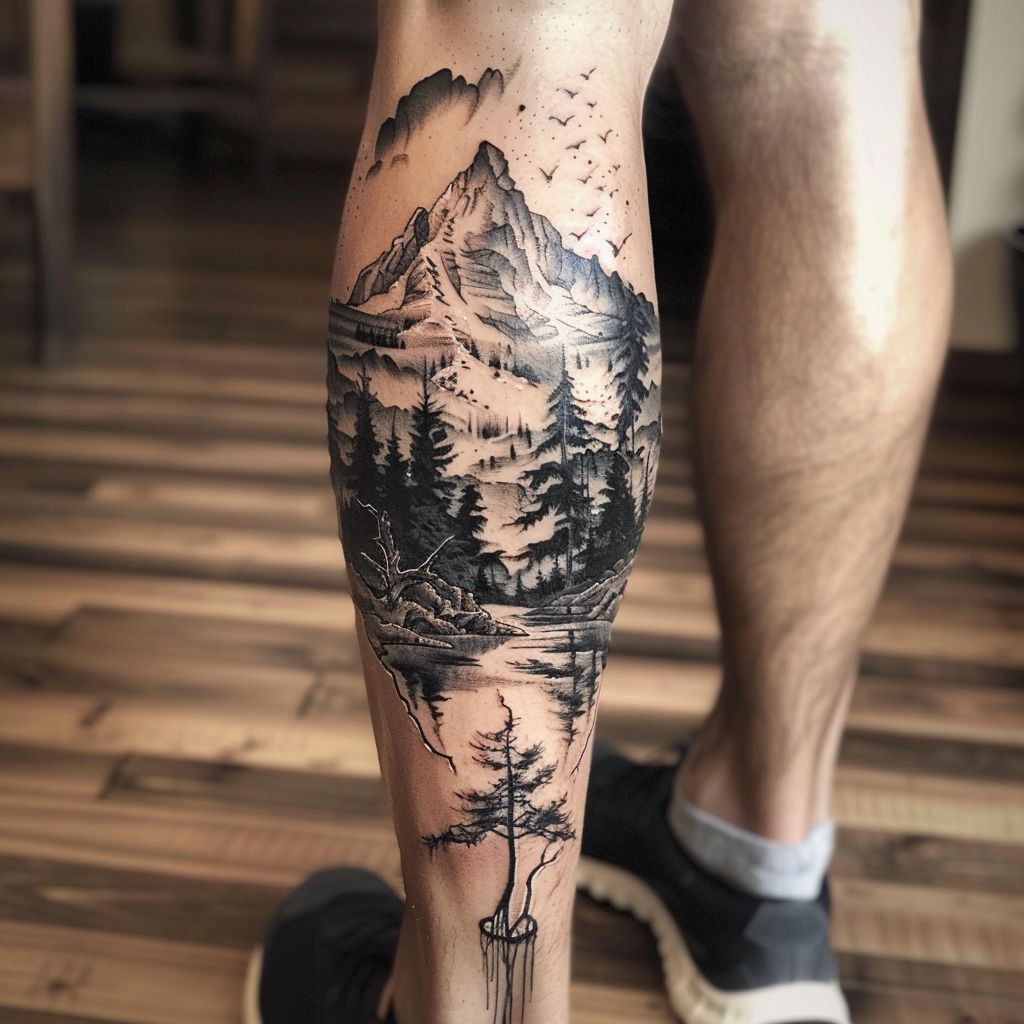
The second factor is depth. Landscapes read as flat stickers when everything is drawn at the same darkness. Good artists push the foreground dark, keep the mid-ground mid-grey, and let the background go pale — which is exactly why the forest-and-river calf piece further down this page reads as three-dimensional and a lot of amateur versions do not.
The third is honest scale. I have watched people ask for a mountain range, a treeline, a river, a bear and a flock of birds inside a five-inch square, and the artist has to either refuse or compress the detail until it turns into a grey smudge within a decade.
In most cases the fix is simple: pick one hero element, let everything else support it, and give the piece the room it needs.
Nature Tattoo Ideas for Men, by Subject
Everything below is grouped by what the tattoo actually shows, because that is how most people arrive at the decision — subject first, style second.
Mountain Tattoos
Mountains are the entry point into nature tattoos for a lot of men, and there is a good reason for that: a ridge line is basically a jagged horizontal shape, which fits the arm better than almost any other natural subject.
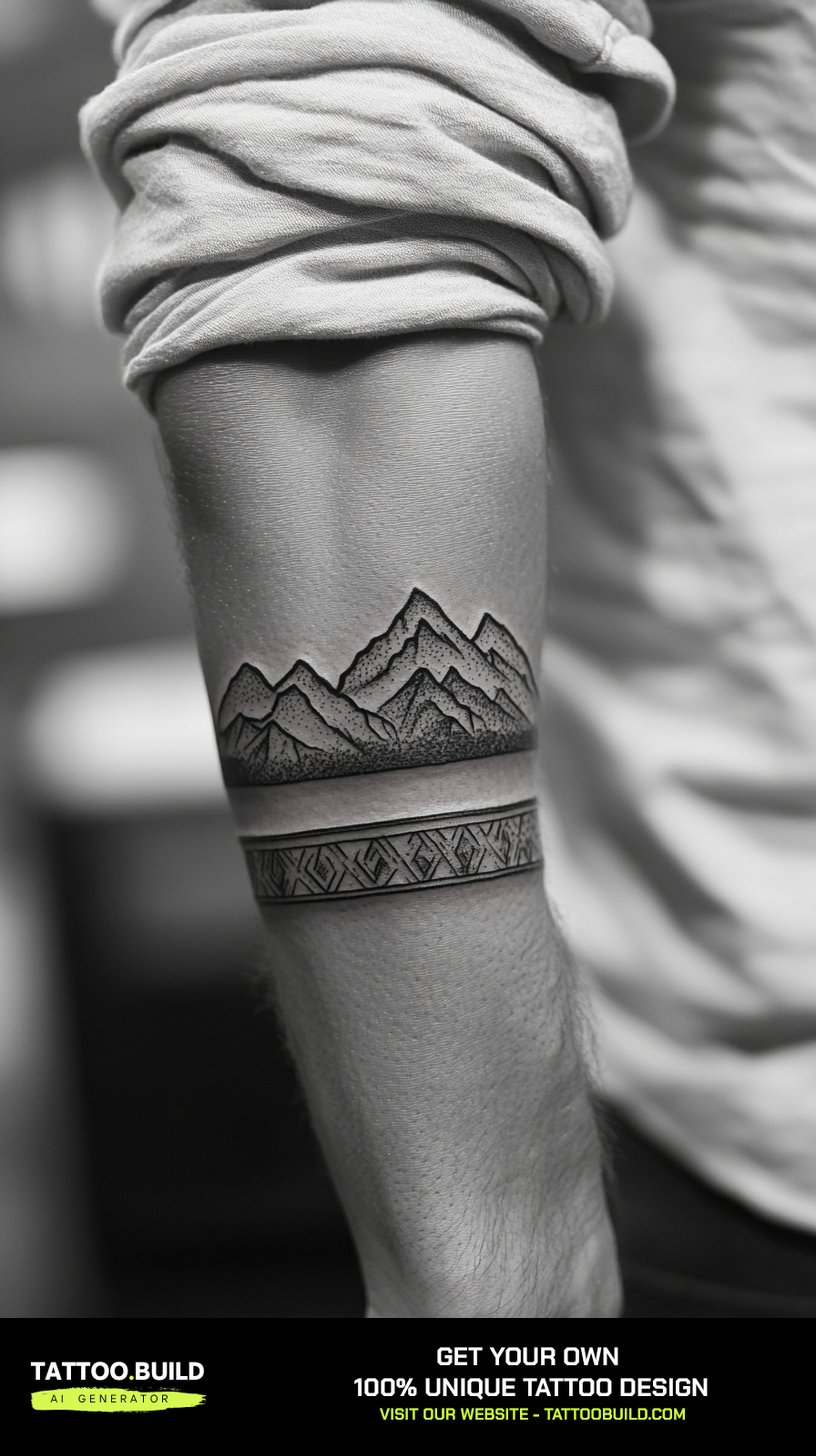
The armband version wraps the forearm and reads cleanly from every angle. The version sitting on a solid black band is my personal favourite of the three, because the band gives the peaks a hard baseline instead of leaving them floating on bare skin.
Keep mountain ranges simple. Every artist I have asked about small ranges says the same thing — the snow highlights and rock texture are the first details to blur, so a range under about three inches wide should be drawn as shape and silhouette, not texture.
A small shoulder range like the third one here is also one of the better first tattoos, and it sits comfortably alongside the broader ideas in our guide to simple tattoo designs for men.
Forest and Pine Tree Tattoos
Pine silhouettes are the most forgiving nature subject I know of. They are solid black, they have an obvious rhythm, and they hold their shape for decades.
The wrist band version is the one I recommend most often to people who want something visible but are not ready for a sleeve. It reads as a landscape at arm’s length and as a texture up close.
The dense forest-and-river calf piece is the opposite end of the same idea — that one is layered greys with almost no hard outlines, and it needs an artist who can genuinely handle soft shading.
In my experience the deciding question is whether you want a band or a scene. Bands wrap. Scenes need a flat-ish panel like the outer calf, the outer forearm, or the back.
Single Tree Tattoos
A single tree is the most personal nature tattoo on this list, and usually the most symbolic. Roots, branches, seasons, family — the meaning is built into the shape before you add anything.
The bare tree with fully drawn roots is worth studying. Most people ask for the canopy and forget the roots, and the roots are where half the visual weight and most of the meaning actually sits.
The windswept sketch-style tree takes a different route: loose, broken linework instead of solid black. It looks lighter on skin, but thin scratchy lines are exactly the lines that soften first, so ask your artist to show you a healed photo of that style before committing.
If the symbolism is the point, look at the classic form first. Our roundup of tree of life tattoos covers the version with the most established meaning behind it.
Wolf and Bear Tattoos
Predator portraits are where nature tattoos most often either sing or fall apart, because faces are unforgiving — one eye slightly off and the whole piece looks wrong.
The snarling wolf fading into smoke is a good example of doing less. There is no hard border, the grey wash carries the edges, and the darkest values are concentrated in the mouth and eyes where you want the viewer to look.
The geometric wolf takes the opposite approach, framing a realistic head inside thin diamond linework. I like this combination, but it only works when the geometry is genuinely precise — wobbly straight lines are far more obvious than wobbly organic ones.
Bears scale up better than wolves in my view. A grizzly with a pine backdrop uses the full width of a chest naturally. If you want to compare big-cat energy with canine energy before deciding, our wolf tattoo ideas and lion tattoo ideas guides sit side by side on this point.
Deer and Stag Tattoos
Stags give you antlers, and antlers are a gift to a tattoo designer — they branch, they fill space asymmetrically, and they follow the collarbones almost perfectly on a chest piece.
The small fine-line stag on the sternum is the one I point to when someone insists a meaningful nature tattoo has to be big. It is palm-sized and it still carries the whole idea.
The elk-dissolving-into-forest piece is the technically hardest design on this page. That double-exposure effect depends entirely on value control — the artist has to hold the animal’s outline while the interior turns into trees, and there is no outline to hide behind.
If you are drawn to that style, budget for a specialist rather than the nearest available appointment.
Ocean and Water Tattoos
Water is the most underrated subject in men’s nature tattoos. It moves, it wraps, and it fills awkward areas that a rigid subject cannot.
The large Japanese-style wave across the chest and shoulder is a good demonstration — the curl follows the deltoid rather than fighting it, which is why it still reads correctly when the arm is raised.
The palm and shoreline piece is the softest option here, built almost entirely from grey wash. It is a lovely tattoo, but pale grey is also the first thing the sun takes, so this style asks the most of your aftercare habits.
At the other extreme, the single ripple with falling droplets is about as minimal as a nature tattoo gets. There are more directions like it in our ocean tattoo ideas collection.
Animals Blended with Botanicals
Pairing an animal with flowers or foliage is the fastest way to stop a wildlife tattoo looking like clip art, and it is a technique I have seen work on almost every subject.
The tiger buried in oversized blooms is the clearest example. The flowers do two jobs at once: they frame the face, and they give the artist somewhere to put pale values so the tiger reads as the darkest thing in the piece.
The hippo pieces are the ones that make me smile. A hippo resting under a bare tree is not a design anyone picks by accident — it is almost always tied to a specific place or trip, and that specificity is exactly what the best nature tattoos have.
Heavy blackwork florals are the most durable botanical option. The bold-bloom forearm piece below will still be legible long after a delicate fine-line version of the same flowers has softened.
Combined Landscape Scenes
Combined scenes are the most ambitious nature tattoos for men, and the ones most likely to be over-packed.
The mountain-and-pine band on the upper arm works because it is cropped to a clean horizontal edge — it does not try to be an entire wilderness, just one slice of one.
The colour waterfall sleeve is the heaviest commitment on this page. Full-colour landscape sleeves take multiple long sittings and demand ongoing sun protection, but nothing else on this list has the same depth.
The forearm piece with mountains, treeline, a bear and birds is honestly at the upper limit of what that space can hold. I would happily wear it, but I would also ask the artist to drop one element before starting.
The compass-and-forest combination is the classic pairing for anyone who navigates for work or sport, and it sits comfortably inside a larger half sleeve design if you plan to expand later.
Variations Worth Considering
If none of the subjects above are quite it, these four variations change the character of a nature tattoo without changing what it depicts.
The Wrapping Armband
A band commits you to far less skin than a panel while still being visible in short sleeves. Ranges, treelines and wave patterns all convert into bands cleanly.
Negative Space and Silhouette
Instead of drawing the trees, some artists ink the sky and leave the trees as bare skin. It is striking, it ages well because it is mostly solid black, and it is worth asking about.
Micro and Fine-Line Versions
Almost every design here has a palm-sized version. The trade is durability — expect fine-line work to soften over the years and plan for a touch-up rather than being surprised by one.
Colour Accents on Black and Grey
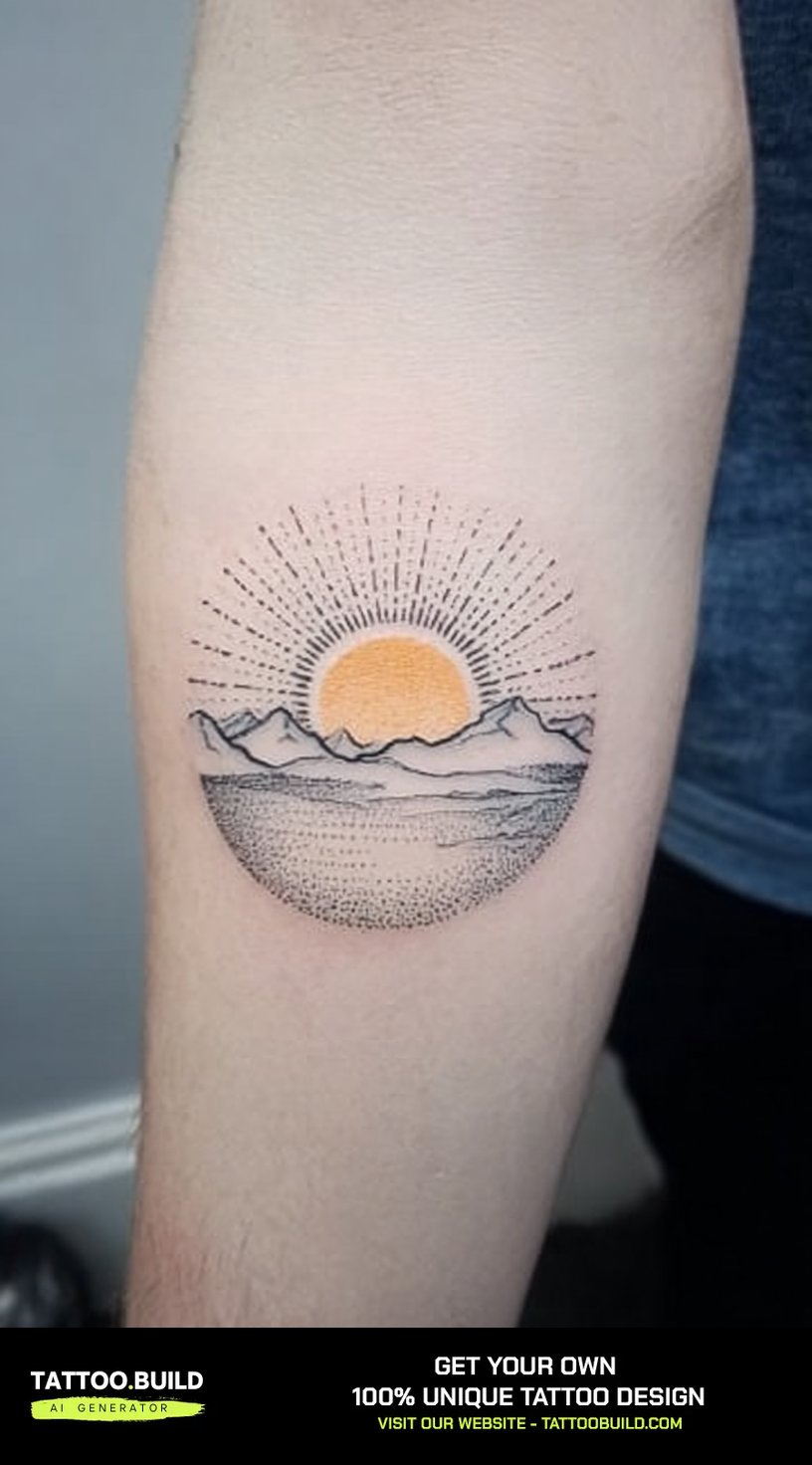
A single colour — a sunset band, one blue river, one red maple leaf — in an otherwise black and grey piece draws the eye exactly where you want it, at a fraction of a full-colour sleeve’s cost and session time.
Placement, Sizing and Aftercare
Placement should follow the shape of the design, not the other way around. Horizontal subjects like ranges and treelines want the forearm, the upper arm or a band. Vertical subjects like single trees and giraffes want the calf, the thigh or the outer arm.
Size up rather than down when you are unsure. Tattoos spread slightly as they settle over the years, and detail that is already tight on day one has nowhere to go.
On healing, follow the aftercare instructions your artist gives you over anything you read online, including this page. The American Academy of Dermatology publishes sensible general guidance on caring for new tattoos and protecting them long term, and the Mayo Clinic overview of tattoo risks is worth reading before a first session.
If a healing tattoo becomes increasingly painful, hot, swollen or starts weeping after the first few days, or if you develop a rash or fever, that is a doctor’s question rather than a tattoo forum’s question. Nothing in this article is medical advice, and no reputable artist will be annoyed at you for getting something checked.
Long term, sunlight is the main enemy — especially for colour and pale grey work. The FDA fact sheet on tattoos and permanent makeup covers ink safety and reaction basics if you want a primary source.
Still Not Sure? The Mistakes I See Most Often
Booking on price alone. A nature tattoo is a portfolio decision — look specifically for healed photos of the style you want, not fresh ones taken in the studio.
Cramming a whole landscape into a small space. If your artist suggests removing an element, that is expertise, not laziness.
Choosing a subject because it looks masculine rather than because it means something. If nothing on this page connects, browse wider — forearm tattoo ideas and sun tattoos for men both cover ground this guide does not.
Skipping the flow conversation. Ask your artist how the design will sit when your arm is down, raised and bent, before the stencil goes on.
Frequently Asked Questions
Are nature tattoos still popular for men?
Yes, and in my experience they have stayed popular precisely because they are not tied to a trend cycle the way lettering styles or specific pop-culture pieces are. Mountains, pines, wolves and waves have been tattooed in some form for a very long time. What changes is the rendering style rather than the subject. A well-drawn treeline done today will not look dated in ten years.
Where is the best place for a first nature tattoo?
The outer forearm and the outer upper arm are the two I suggest most often. Both are relatively flat, both sit at a comfortable pain level for most people, and both suit the horizontal shapes that nature subjects naturally form. The calf is a strong third option if you want something larger. Ribs, hands and feet are all harder first experiences.
How long does a nature sleeve take?
It depends entirely on detail and style, but a full black and grey landscape sleeve is normally a multi-session project spread over months rather than a single long day. Colour realism takes longer again. Your artist will give you a realistic session count once they have seen the design, and that estimate is worth more than any general figure I could quote here.
Do fine-line nature tattoos last?
They last, but they change. Very thin lines tend to soften and spread slightly as the skin settles, so a delicate fine-line tree will look a little heavier and less crisp after several years than it did in the healed photo. That is normal rather than a failure. If you love the style, go in expecting an eventual touch-up.
Can I combine several nature elements in one tattoo?
You can, and some of the best pieces on this page do exactly that — a bear with a treeline, an elk merged into a forest, a compass inside a landscape. The rule I would apply is that one element has to be clearly the hero. When three subjects compete for attention at the same level of detail, the eye has nowhere to rest and the tattoo reads as busy.
Quick Summary
- Pick the subject first and the rendering style second — the subject is what carries the meaning.
- Match the shape to the body part: horizontal ranges and treelines on arms, vertical trees and animals on calves and thighs.
- Solid blackwork silhouettes are the most durable option here; fine line is the least.
- Depth comes from value contrast — dark foreground, mid-grey middle, pale background.
- Do not compress a full landscape into a small panel; drop an element instead.
- Ask to see healed photographs in your chosen style, not just fresh work.
- Follow your artist’s aftercare instructions, protect the piece from sun, and see a doctor about anything that looks like infection or an allergic reaction.