Simple tattoo designs for men are the easiest style to live with for the next thirty years: clean lines, small footprint, and a look that does not date the way heavy shading or trend-driven styles do.
In my experience helping guys pick their first piece, the ones who go simple almost never regret it. The ones who go big and busy on day one are the ones asking me about cover-ups five years later.
This guide walks through the seven simple designs I get asked for most often for men, how each one ages, where to place it, and the honest trade-offs behind the look. If you want a broader library first, browse our simple tattoo ideas collection to see what the style can do.
Everything below assumes black ink, single-needle or fine-line technique, and a design that would fit inside a business card. That is what most people mean by “simple,” and it is what artists mean when they quote you a short session.
Which Simple Style Is Right for You?
Not every simple tattoo behaves the same. Some hold up better on darker skin, some heal faster, and some are cheaper because they take less time in the chair. This table is how I actually explain the differences to first-timers.
| Style | Typical Session | How It Ages | Best For |
|---|---|---|---|
| Fine-line | 30-60 min | Softens noticeably in 5-7 years; needs a touch-up | Small icons, script, discreet placements |
| Single-needle | 45-90 min | Delicate; can blur if placed on high-friction areas | Detail-heavy small designs on the arm or chest |
| Bold-line minimalist | 45-75 min | Holds shape well for a decade or more | Icons that need to read from a few feet away |
| Silhouette / negative-space | 1-2 hours | Very well; solid fill hides small blur | Animals, mountains, and figures |
| Dotwork minimalist | 1-2 hours | Fades gently; even fading looks intentional | Geometry, small globes, subtle shading |
If the choice still feels overwhelming, our roundup of minimalist tattoo ideas is a good next stop for finding a visual language you connect with before you commit.
What Actually Makes a Tattoo “Simple”
Simple is not a synonym for small. A five-inch mountain range in single line-weight is still a simple tattoo; a two-inch mandala with fifteen layers of dotwork is not.
The three things that make a design simple are line count, weight consistency, and negative space. Every artist I have asked defines it roughly the same way: if you can describe it in one short sentence and draw it in under a minute, it is simple.
This matters because simple designs are the ones that age well. Ink migrates a little over decades; when the design already has room to breathe, that migration is invisible. When the design is packed with detail, migration turns it into a blur.
Simple designs are usually cheaper too. Most artists work on hourly rates or a shop minimum. A crisp icon takes 30 to 60 minutes; a full-color scene can take four hours or more. For a first tattoo, sitting for one hour is a very different experience from sitting for four.
For a broader look at what suits guys just getting started, our first tattoo ideas for men guide covers placement, size, and pain in more depth than I can fit here.
Seven Simple Tattoo Designs Guys Ask Me For Most
1. Cross
The cross is the design I stencil most often for men who want one meaningful piece and nothing else. It reads as faith, memorial, or heritage depending on placement and context, and it survives the years better than almost anything I do.
A plain outlined cross around one to two inches sits well on the inner forearm, the outer bicep, or the ribcage. Guys who want something more layered often ask for a small crucifix or a Celtic-style knotwork base, both of which stay legible at small scale.
A note on aging: crosses with negative space between the arms hold their shape better than solid black. When black fill migrates over 15 or 20 years, the edges get soft; when the design is built around clean outlines, the softening actually reads as character.
My rule of thumb: pick the placement before the design. A cross behind the ear reads very differently from one on the inner bicep, even at the same size. For more variations, browse our cross tattoo drawings gallery.
2. Mountain
Mountain tattoos have become the default “outdoors guy” design for good reason. They translate to line-work beautifully, they scale from the size of a thumbnail to the width of a chest, and they carry personal meaning without needing an explanation.
The two big variants I get asked for are a single silhouette peak and a small mountain range. Single peaks read cleaner on the inner forearm; ranges look better on the outer forearm or the ribs where you have a longer horizontal space to work with.
Fine-line mountains age well because there is nothing to blur. Solid-fill silhouettes hold even longer, though they take longer to sit for. If you like the idea of a mountain paired with a tree, our mountain and tree tattoo ideas cover that combination in detail.
Usually I steer guys away from mountains that include a sun, moon, birds, and clouds all at once. Every element you add pushes it toward busy. Pick one anchor and stop.
3. Tree
Trees are a great candidate for simple design because a single-needle tree can carry as much personality as a full-color forearm piece, at a fraction of the sit time.
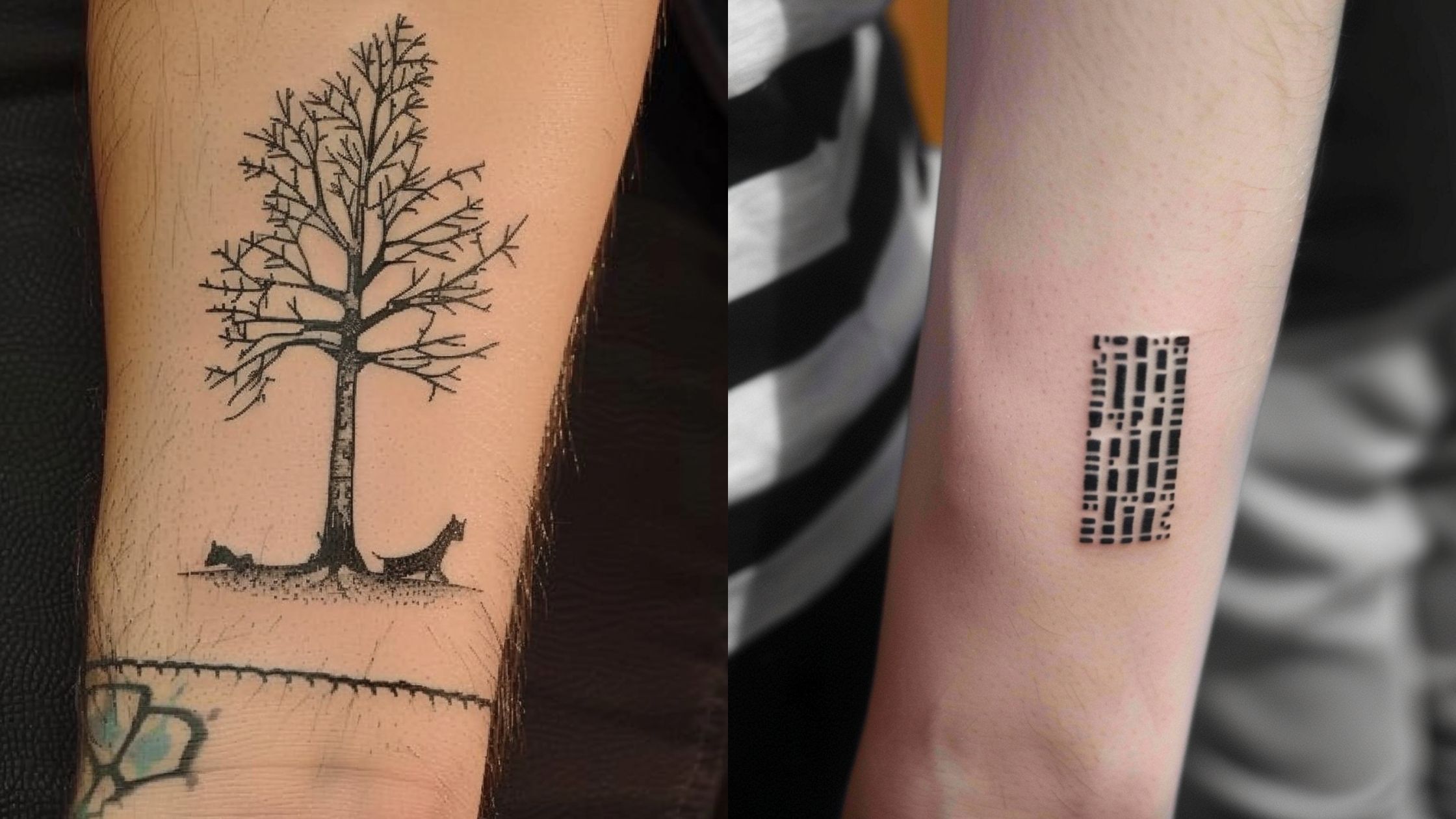
A pine on the ribs, a bare-branch tree on the inner arm, and a Tree-of-Life on the shoulder are the three shapes I stencil most often. Each fits a different mood. The bare branch reads reflective; the pine reads outdoor; the Tree-of-Life reads spiritual.
When I tested single-needle pines on healed forearm skin at the two-year mark, the sharpest ones were the ones the artist did NOT try to shade. Even one pass of dotwork inside a tiny tree tends to blur into a smudge within a few years.
If a tree feels too generic, adding a small silhouette below it (a dog, a hiker, a tent) turns it into a scene without ever crossing into busy. That is the trick behind most of the small men’s tree tattoos I have done that hold up.
4. Lion
Lions are the most-asked animal tattoo for men, and I understand why. They read as strength without needing color, and the mane gives an artist a lot of room to play with texture.
For a simple lion, three approaches work: a pure outline head, a geometric lion built from angled shapes, and a silhouette head. All three sit well on the inner forearm at three to four inches. Larger than that and “simple” starts sliding into “portrait,” which is a completely different job.
The single most common mistake I see with small lion tattoos is over-detailing the mane. If the design is under three inches, the mane should be five to seven strokes total. Anything more will merge into a black blob within a decade.
If you want more direction, our lion tattoo ideas collection covers geometric, realistic, and neotraditional interpretations side by side.
5. Diamond
A diamond is the cleanest geometric option in the simple category. Straight lines, a small footprint, and one meaning that most people read the same way: something valued, something enduring.
The two shapes I stencil are the outline diamond (five lines, nothing else) and the faceted diamond (five outer lines plus two to four inner ones). Both hold their form for years because the lines are straight and the eye compensates for tiny drift better on straight edges than curves.
Wrist placement is very popular here, but the wrist is a high-motion area and lines can spread. In my experience, diamonds on the inner forearm hold up longer than diamonds on the wrist, even though the wrist looks more “iconic” in photos.
Pair a small diamond with initials, a date, or a word underneath and it stops being a stock design and starts being yours. Nothing else has to change.
6. Globe
Globes are for guys who travel and want something more subtle than a world map on the chest. Done simply, a globe is the equator, two meridians, and a couple of continent outlines – no more.
I like globes on the inner forearm because you look at them constantly. A globe on the shoulder or back is technically valid but you never see it, which defeats the point of a personal reminder.
The best simple globes I have done leave the continents as loose outlines rather than trying to render every landmass. Africa and South America usually stay; Europe and the Pacific islands go. That editing is what keeps the design from turning into a busy sphere.
A subtle grid built from dotwork holds up better than one built from thin lines – the eye reads a broken dot line as “intentionally soft” and a broken thin line as “the tattoo is failing.” That is a small thing that changes how the piece ages.
7. Barcode
Barcodes are a modern, slightly ironic design that a lot of guys underrate. Done well, they are geometrically satisfying and unmistakably contemporary. Done badly, they look like a smudge.
The trick is line-weight consistency. Every artist I have watched do a barcode used a ruler on the stencil; freehand barcodes almost never look right because the human eye is unforgiving about uneven parallel lines.
Placement matters more than you would think. A barcode on the inner wrist reads as a fashion piece; a barcode on the back of the neck reads as commentary; a barcode across the forearm reads as decorative. Pick the read you want before you pick the location.
If you want to see more variations before you commit, our barcode tattoo designs gallery covers vertical, horizontal, and hybrid options.
Other Simple Directions Worth Considering
The seven above cover the requests I get most often, but a handful of other shapes are worth putting on your shortlist if none of these landed.
Small script or single word
A single meaningful word in a clean serif or hand-written script takes 20 minutes to sit for and lasts for decades. Keep it short (six letters or fewer at the smallest sizes) and pick a font your artist can actually reproduce at scale, not just render in a Photoshop mockup.
Roman numeral date
A significant date in Roman numerals is a low-risk simple design. It has meaning built in, it does not date visually the way a stylized graphic can, and it is easy to place discreetly on the inner bicep, wrist, or forearm.
Small geometric shape
Beyond the diamond, a small triangle, a circle divided by a single line, or a square with negative-space corners are all durable, quiet designs. They work well as “first tattoos” because they leave room to add pieces around them later without clashing.
Single-line drawings
Continuous line drawings (an outline of a face, an animal, a mountain drawn in one unbroken stroke) are having a moment. They photograph well, they are undeniably minimalist, and they read as “art” more than “tattoo,” which some guys prefer.
Tips Before You Sit Down (and What to Do After)
Before the appointment, eat a real meal within two hours and hydrate well the day before. A first tattoo on an empty stomach is how you find out you get lightheaded. Wear something loose that gives the artist access to the placement without you having to strip down mid-session.
Ask your artist to draw the design on you first with skin-safe marker, then walk around for five minutes before saying yes. What looks right in a mirror is not always what looks right in profile or when you check the phone against your leg.
During healing, follow whatever aftercare the artist gives you rather than mixing in advice from the internet. Every shop has slightly different post-care based on the ink and technique they use. Our general tattoo aftercare guide covers the fundamentals but should not override your artist.
The one universal rule: no sun on a fresh tattoo for at least four weeks, and sunscreen forever after. UV is the single biggest reason simple line-work tattoos need touch-ups years later. If your line-work fades early, it is almost always because of the sun.
If anything about the healing looks wrong (spreading redness, warmth, oozing beyond the first 48 hours, fever), do not diagnose yourself from a forum. Contact your artist first and, if they flag it, a doctor. Tattoo infections are uncommon but they are real, and they get worse fast when ignored.
Common Mistakes Guys Make with Their First Simple Tattoo
The most frequent regret I hear is going too small. A design that looks perfect at one inch on your phone can lose all detail at that size on skin, especially over time. When in doubt, go 20% larger than your instinct says.
The second most frequent is picking placement based on Instagram. Wrist and finger tattoos photograph beautifully but hold ink poorly compared with the forearm or upper arm. If you want a piece that stays sharp for decades, the meat of the arm is your friend.
A third mistake is treating “simple” as a shortcut around finding a good artist. Simple designs actually punish weak line work more than complex ones, because there is nowhere for a shaky line to hide. Look at healed photos, not fresh ones, when you shop for an artist.
Still not sure what would suit you? Our broader library of tattoo ideas for men is a solid next step, and our wrist tattoo ideas for men covers that specific placement in more depth.
Frequently Asked Questions
How much does a simple tattoo for men usually cost?
Most shops in North America charge a minimum of $80 to $150 regardless of how small the piece is, and a typical simple tattoo runs $100 to $300 depending on placement and artist experience. Established artists in bigger cities can charge more; that premium usually buys you cleaner line work and a design that holds up longer. I would rather pay double and sit once than get a cheaper tattoo and pay for touch-ups every three years.
Do simple tattoos hurt less than bigger ones?
Usually yes, but not because the needle is different – it is because the session is shorter. Pain is cumulative. A 45-minute simple tattoo is genuinely tolerable for almost everyone; a four-hour piece in the same spot is a different experience by the third hour. Placement matters more than size for how sharp the sensation feels: ribs and inner arm are meaningfully more uncomfortable than the outer bicep.
Where do simple tattoos hold up the longest?
The outer forearm, upper arm, calf, and outer thigh keep line work sharpest over decades because those areas have less friction, less sun exposure with clothing, and thicker skin than the wrist, hand, or ribs. In my experience, the same design on the outer forearm and on the wrist will look meaningfully different after ten years, and the forearm will win.
Should I get my first simple tattoo in color or in black?
For a simple design, black almost always ages better. Color ink fades faster than black, especially lighter colors like yellow and pale blue, and simple designs do not have enough surface area to hide that fading gracefully. Save color for larger, more forgiving pieces later on if you decide you want it.
How long before a simple tattoo is fully healed?
The surface heals in two to three weeks and looks normal to other people almost immediately; the deeper layers take three to four months to finish settling. During that longer window the ink can still shift subtly and the piece can look slightly cloudy. Do not judge a healed result until at least the three-month mark, and do not book a touch-up before then either.
Quick Summary
- Pick a design you can describe in one sentence – if you cannot, it is not a simple tattoo.
- Black ink outperforms color for small designs over the long term, every time.
- The outer forearm, upper arm, and calf hold line work best; the wrist and hand are the hardest placements.
- Ask your artist to draw the piece on your skin with marker before you sit down.
- Do not confuse “simple” with “quick” – a good simple tattoo still needs a skilled artist and a clean line.
- Budget between $100 and $300 for most simple designs; a lower quote almost always means a compromise.
- Keep your fresh tattoo out of the sun for the first month, and use sunscreen on it for the rest of its life.
- Look at healed portfolios rather than fresh photos when picking an artist – fresh ink lies.
For additional aftercare and safety guidance from clinical sources, the American Academy of Dermatology and the U.S. Food and Drug Administration both publish plain-language overviews that are worth a read before your first appointment.