I have been collecting reference sheets for tattoo consultations for years, and the cross folder is easily the fattest one I own. The reason is simple: a cross is one of the few tattoo subjects where the shape is fixed and everything interesting happens in the ornament around it.
Two crosses can share the exact same proportions and read completely differently depending on whether the artist filled them with acanthus scrollwork, lilies, or nothing at all.
The drawings below are the ornate end of that range — pencil-style black and grey work, heavy on filigree, the sort of thing you hand an artist as a starting point rather than a stencil. If you want something plainer or more script-led, the faith tattoo ideas collection is a better place to start.
I will go through what actually survives on skin, which builds shrink well, and the questions worth asking before you book.
Which Cross Style Is Right for You?
This is the comparison I sketch out for people who arrive with twenty screenshots and no idea which one to commit to.
| Style | Best For | Smallest Size I Would Ask For | How It Tends to Age |
|---|---|---|---|
| Ornate filigree | Forearm, outer arm, spine | Around 5 inches tall | Fine scrolls soften; the silhouette holds if the artist left gaps |
| Floral cross | Thigh, ribs, upper arm | Around 6 inches tall | Petals blur first; larger blooms hold longer than small ones |
| Heraldic or symmetrical | Chest, back, shoulder blade | Around 4 inches tall | Well — symmetry stays readable even as lines spread |
| Gothic and spiked | Forearm, calf, outer thigh | Around 5 inches tall | Sharp points round off; heavy black stays strong |
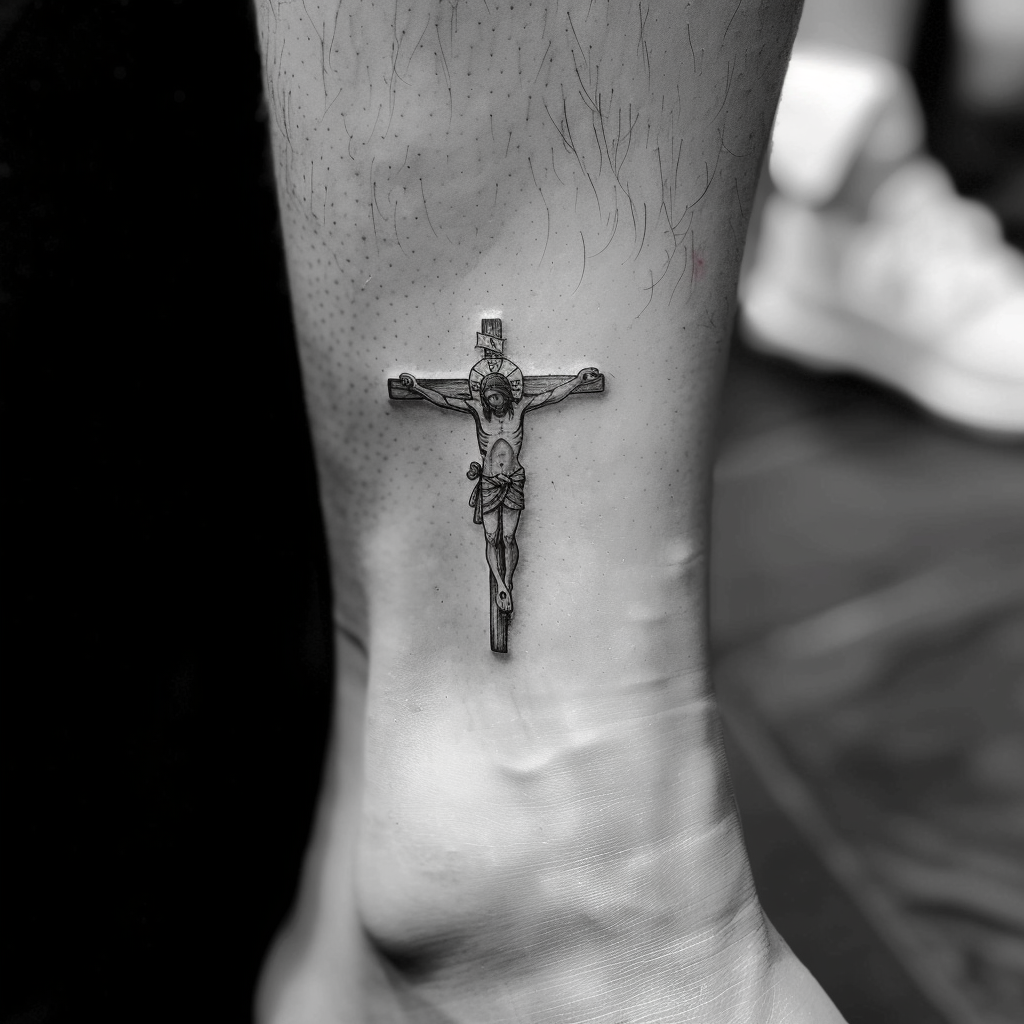
| Plain Latin cross | Wrist, ankle, behind the ear | Around 1 inch tall | Best of the lot — almost nothing to lose |
| Fine-line minimal | Inner forearm, collarbone, finger | Around 2 inches tall | Thin lines can fade or spread; expect a touch-up eventually |
What Actually Makes a Cross Drawing Work on Skin
A drawing on paper and a tattoo are not the same object, and cross designs are where that gap bites hardest.
Paper holds detail forever. Skin does not — ink spreads slightly in the dermis over years, and the gaps between fine lines are the first thing to close up.
So when I look at an ornate cross reference, I stop looking at the detail and start looking at the negative space. If there is clear breathing room between the scrolls, the design will still read as a cross in fifteen years. If the scrolls are touching on paper, they will be a grey mass on skin.
The second thing that matters is the silhouette. Squint at the drawing until it blurs. If the outer shape still says “cross”, you are fine. If it turns into a vague leafy blob, the ornament has overwhelmed the subject.
Every artist I have asked about this says roughly the same thing in different words: they would rather scale a design up than thin it out. Size is the cheapest fix available.
Cross Tattoo Drawings Worth Bringing to Your Artist
These are grouped by how they are built rather than by meaning, because the build is what determines whether a design works on your body.
1. Filigree and Baroque Scrollwork Crosses
This is the dominant look in the set below — a cross whose arms are made entirely of curling scroll ornament rather than solid bars.
It borrows directly from baroque and rococo carving, the same vocabulary you see on old church furniture and picture frames.
In my experience these are the most requested and the most often undersized. The scrollwork needs room to breathe, and a five-inch minimum on the forearm is realistic rather than cautious.
Ask your artist to draw the ornament at final size before you agree to it. A reference that looks airy at A4 can be solid grey at three inches.
2. Floral Crosses
Adding flowers changes the emotional register completely. A bare ornate cross reads as formal; the same cross with lilies or roses running through it reads as personal.
Lilies are the traditional pairing — they carry funerary and Easter associations in a lot of Christian art. Roses tend to get used for the same reason people use them everywhere: they are legible at almost any size.
When I have watched these get tattooed, the flowers are usually where the artist spends the most time, because petals need soft grey transitions rather than hard outlines.
If you are leaning this direction, the cross tattoos for women gallery has more softly-styled variations worth comparing against.
3. Heraldic and Symmetrical Crosses
These are the ones built on strict mirror symmetry, often with a quatrefoil or rosette at the centre point.
They come out of heraldry and church decoration rather than tattooing, and they carry a slightly formal, crest-like feel.
Symmetry is the most forgiving property a tattoo can have. Because the eye reads the whole shape at once, these stay recognisable at smaller sizes than any other ornate build in this list.
The trade-off is that symmetry is unforgiving of a shaky stencil — any drift is instantly visible. This is not a design to hand to someone who is still learning.
4. Gothic and Sharp-Edged Crosses
Pointed arms, spiked terminals, and heavy shading that fades out rather than stopping cleanly.
These lean darker and colder than the floral or heraldic builds, and they suit people who want the shape without the devotional softness.
The smoke-like shading behind some of these is the part that dates fastest, in my experience — soft grey washes lighten more than solid black does, so the black structure is what will still be there in a decade.
If you want that structure to last, ask for the spikes to be built from solid black rather than fine hatching.
5. Tall Crosses with Trailing Ornament
A specific and underrated build: normal proportions at the top, then ornament that trails down well past where the shaft would normally end.
It is designed for vertical real estate — the inner forearm, the spine, the outside of the calf.
I like these because the trailing section gives the artist somewhere to lose the design into the skin rather than ending on a hard border, which almost always looks more natural.
Measure your placement before falling for one of these. A twelve-inch drawing does not fit on a seven-inch forearm without losing the part that made it good.
6. Acanthus-Leaf Crosses
Acanthus is the curled leaf motif that has been carved into European stonework for roughly two thousand years, and it maps onto a cross shape almost too easily.
The distinguishing feature is weight: acanthus builds have thicker, rounder forms than pure filigree, which means they hold up better as they age.
If you want ornate but you are nervous about longevity, this is the compromise I would point you toward.
Every one of these I have seen healed still read clearly at arm’s length after several years, which is more than I can say for the finest scrollwork designs.
7. Slim Upright Crosses
Narrow, vertical, with ornament hugging the stem rather than spreading outward.
These are the practical answer for a placement that has height but no width — the inside of the forearm, the back of the neck, the side of the ribcage.
They also sit well alongside existing work, since they do not demand horizontal clearance from their neighbours.
8. Plain and Fine-Line Crosses
Not represented in the drawings above, but worth naming because it is what a lot of people actually end up getting.
A plain Latin cross at one to two inches is the single most durable tattoo in this entire article. There is nothing in it to blur.
Fine-line versions — a single hairline outline, sometimes with a small break in the stroke — look beautiful fresh but are the most likely of any style here to need a touch-up within a few years.
If placement is your main question rather than style, the meaning behind an ankle cross covers one of the most common small-cross spots in detail.
Variations Worth Considering
A few directions that sit adjacent to the drawings above and get asked about constantly.
Celtic Knotwork Crosses
The ringed cross with interlaced knotwork is its own tradition, and Britannica lists it among the eight principal historical cross forms alongside the Latin, Greek and Jerusalem crosses.
Knotwork demands precision — an over-under weave that breaks anywhere stops reading as a weave. The Celtic cross designs collection shows how much variation exists within that one form.
Crosses Combined with Figures
Praying hands, a dove, or a portrait built into or beside the cross. This turns a symbol into a scene, and it roughly doubles the session time.
If that is the direction you are heading, look at praying hands designs and portrait-led religious work before committing, because the skill ceiling is much higher.
Crosses with Lettering
A date, a name, or a verse wrapped around or beneath the cross.
My honest advice: keep the text short and the font boring. Decorative scripts at small sizes are the number one thing I see people regret. There are sensible examples in the verse tattoo collection.
Preparing a Cross Drawing for the Needle
Bring more than one reference. One design plus two images showing the shading style you want gives an artist far more to work with than a single pinned photo.
Ask for the stencil to be placed and then walk to a mirror before any ink goes down. A cross that is one degree off vertical on the forearm is obvious forever, and this is the last free moment to fix it.
On healing, follow whatever aftercare your artist gives you rather than advice from the internet, including mine. The general shape of it — gentle washing, light moisturiser, no sun and no swimming until healed — matches what the Mayo Clinic sets out, and they also note that allergic reactions, skin infections and bloodborne infection are the real risks worth taking seriously.
If a tattoo becomes hot, swollen, increasingly painful, or starts weeping after the first couple of days, that is a doctor’s question, not an artist’s one. Nothing in this article is medical advice, and no home remedy substitutes for having an infection looked at.
Common Mistakes — and What to Do If You Are Still Not Sure
The mistake I see most often is choosing a design at screen size and never checking it at skin size. Print it at the actual dimensions and tape it to your arm for a day.
Second is over-detailing. People add scrollwork, flowers, script and a background because each element sounds good alone, and the result has no focal point.
Third is rushing the artist match. An ornate black-and-grey cross needs someone whose healed portfolio shows ornate black-and-grey work, not someone whose fresh photos look impressive.
If you are still undecided on the overall direction, it is worth browsing the wider Christian tattoo collection, and if the piece is meant to mark someone you have lost, the memorial tattoo ideas are a more honest starting point than a generic cross.
There is no deadline on this. In most cases the people happiest with their cross tattoo sat with the design for months before booking.
Frequently Asked Questions
What do cross tattoos usually mean?
For most people the cross is a marker of Christian faith, and Britannica describes it as the principal symbol of the religion, recalling the Crucifixion. That said, plenty of people wear one for reasons that are cultural, ancestral, or tied to a specific person rather than to belief. A cross tattoo can also be purely aesthetic, and there is nothing dishonest about that. The meaning is whatever you can explain in a sentence when someone asks.
How big should an ornate cross tattoo be?
For the heavily ornamented drawings in this article, around five inches tall on a forearm is a sensible floor, and six or more is safer for floral versions. The reason is spacing rather than showing off — fine scrollwork needs visible gaps between lines, and those gaps shrink as ink spreads over the years. A plain Latin cross has no such constraint and works fine at an inch. Ask your artist to show you the design printed at actual size before you agree.
Do cross tattoos age well?
It depends almost entirely on how much detail is packed into the design. Simple crosses and symmetrical heraldic builds age very well because there is little fine detail to lose. Dense filigree and hairline fine-line work are the most likely to soften and may need a touch-up eventually. Solid black holds its density longer than soft grey shading does.
Where do cross tattoos hurt least?
Generally the fleshier, less bony areas — the outer arm, the thigh, the outer forearm — are reported as more comfortable than the ribs, sternum, spine, ankle or the inside of the wrist. Pain varies a lot between individuals, so treat this as a rough ordering rather than a rule. A long ornate piece also means a longer session, which matters as much as the location. If you are unsure, ask your artist how they usually split a piece of that size across sittings.
Can I bring one of these drawings straight to a shop?
You can bring it as a reference, and you should. Most artists will not tattoo someone else’s drawing line for line, partly for originality and partly because a drawing made for paper usually needs restructuring to work on a curved body part. Expect your artist to redraw it to fit your placement, and treat that redraw as a good sign rather than a rejection.
Quick Summary
- Ornate cross tattoo drawings live or die on negative space — check the gaps, not the detail.
- Squint at any reference; if the silhouette still reads as a cross, the design will survive ageing.
- Around five inches is a realistic minimum for filigree work on a forearm; six for floral versions.
- Symmetrical and heraldic builds are the most forgiving as lines spread over time.
- Acanthus-leaf designs are the best compromise between ornate and durable.
- Solid black outlasts soft grey shading, so ask for structure in black.
- Print the design at actual size and wear it for a day before booking anything.
- For healing questions go to your artist, and for anything that looks infected go to a doctor.