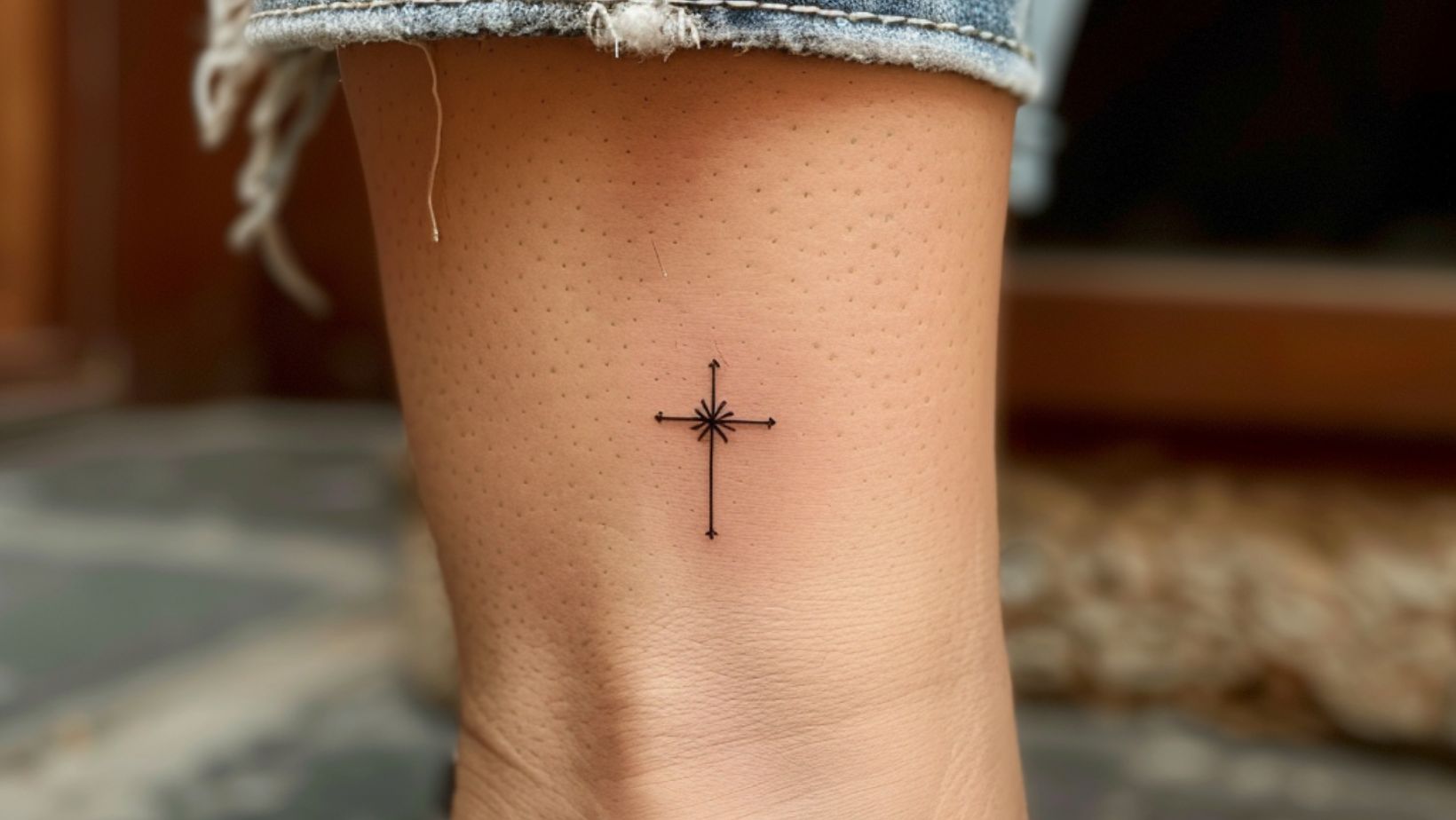
A cross on the ankle is one of the few tattoos I see people get for a reason they can say out loud in a single sentence. It is a permanent, quietly placed statement of faith — small enough to live under a sock all week, visible enough to mean something the moment you take your shoes off.
I have watched this design come through studios for years now, and the pattern barely changes: someone wants the symbol, they want it discreet, and they want it somewhere they will actually see it themselves.
The ankle answers all three. It sits at the edge of the dress code, it costs less than most placements because the design stays small, and unlike a wrist piece you are not looking at it during every meeting.
Below I have laid out what the cross actually means in this spot, which styles hold up over a decade, what the session honestly feels like, and how the design sits alongside other ankle tattoo ideas if you are still weighing options.
Which Cross Style Is Right for Your Ankle?
Not every cross survives at ankle scale. This is the comparison I walk people through before they commit.
| Style | Typical Size | Best For | How It Ages |
|---|---|---|---|
| Plain Latin cross | 1–2 in | Anyone who wants the symbol and nothing else | Excellent — two clean lines have almost nothing to blur |
| Fine-line / single needle | 1–1.5 in | A whisper-quiet piece that reads as jewellery | Softens noticeably; often wants a touch-up in 5–8 years |
| Celtic or knotwork cross | 2–3 in | Heritage as well as faith | Very well if the knots are spaced — badly if they are crowded |
| Crucifix with figure | 2.5–4 in | Devotional pieces where the figure is the point | Needs the size to survive; too small and the face fills in |
| Rosary or ankle wrap | Wraps 6–9 in | Turning the cross into a piece of worn jewellery | Beads hold up; the thin connecting chain is the weak point |
| Ornamental / mandala cross | 2–3 in | Decorative faith pieces with a softer feel | Dotwork holds; the finest stippling tends to merge |
What the Ankle Placement Actually Adds to the Meaning
The cross carries its meaning before you choose where to put it. It is the central symbol of Christianity, recalling the crucifixion, and it existed as a symbolic form in other cultures long before that, as Britannica’s entry on the cross lays out.
What the ankle adds is direction. This is the part of the body that carries you somewhere, and almost every person I have asked about this placement described it in those terms without being prompted.
Some describe it as walking with their faith rather than displaying it. Others put it plainly — they wanted it low, private, and theirs.
There is a practical layer too, and I would not pretend otherwise. The ankle is the easiest placement to cover for work, for a funeral, for a family member who would rather not see it.
If you are drawn to the symbol but not certain the ankle is the right home for it, it is worth looking at how cross tattoos read on the wrist, the ribs and the shoulder before you book.
Cross on the Ankle Tattoo Meanings and Design Ideas
These are the seven versions that come up again and again, and what each one tends to mean to the person wearing it.
The Plain Latin Cross — Faith Without Decoration
Two lines, one crossbar set a little above centre. That is the entire design, and it is the one I would recommend to most first-timers.
It reads as faith with nothing added: no era, no style trend, no artist’s signature on top of it. In ten years it will look exactly like it does the week it heals.
Most sit between one and two inches, placed on the outer ankle just behind the bone where the skin is flattest. The flatter the surface, the cleaner the lines stay.
When people tell me they are worried about regretting a tattoo, this is usually the version that settles it. There is very little here to go out of date.
Fine-Line and Micro Crosses
Single-needle work has pulled a lot of people toward this placement over the last few years, and at its best it looks less like a tattoo than a thin piece of jewellery.
The honest trade-off is longevity. Very fine black lines spread slightly as they settle into the skin, and on the ankle — where circulation and friction from shoes both work against you — that spread is a little faster than on the forearm.
In my experience a fine-line ankle cross looks its absolute best in the first few years and usually wants a touch-up somewhere between year five and year eight.
That is not a reason to avoid it. It is a reason to budget for it and to pick an artist who does this style constantly rather than occasionally.
The Crucifix With the Figure
A crucifix carries the corpus — the figure of Christ — and for a lot of Catholic wearers that distinction is the whole point rather than a stylistic choice.
It is also the design most often ruined by going too small. A face, a ribcage and draped cloth need room, and squeezed into an inch and a half they turn into a dark smudge within a few years.
If you want the figure, give it at least two and a half inches. Every artist I have raised this with has said some version of the same thing, usually more bluntly.
The inner ankle and the space just above the bone both give you a little more canvas than the outer ankle does. If devotional imagery is what you are after, the wider range of Jesus tattoo ideas is worth a look before you settle on scale.
Celtic and Knotwork Crosses
The ringed Celtic cross does double duty: it says faith, and it says where a family came from. That second layer is why people travel for it.
Knotwork lives or dies on spacing. A well-drawn knot leaves visible gaps between the strands so the eye can follow the weave; a crowded one fills in and becomes a grey blob.
On an ankle I would not go below two inches for anything with a ring and interlace. Below that, the artist is fighting the design rather than drawing it.
The Celtic cross also suits the wrap of the ankle nicely, since the ring gives the whole piece a natural centre point to sit on.
Ornamental and Mandala Crosses
This is the version for people who want the symbol without the severity — dotwork, filigree, and ornamental shading built around a cross-shaped frame.
It photographs beautifully and it suits the ankle’s shape, because ornamental work can taper to follow the leg rather than sitting as a rigid rectangle.
The detail that survives is the structure. The detail that fades first is the finest stippling, so ask your artist to keep some deliberate contrast rather than filling every gap.
I have seen these age gracefully when the cross underneath is bold and the ornament is the decoration — and badly when the ornament is the cross.
Rosary and Ankle-Wrap Crosses
A rosary wrapping the ankle with the cross hanging at the inner side is one of the oldest versions of this idea, and it still turns up constantly.
It reads as worn jewellery, which is exactly the appeal. It also means committing to a wrap rather than a single small mark, so plan for a longer session.
The beads hold up well over time because each one is a small solid shape. The thin chain between them is the part that softens, and a good artist will draw it slightly heavier than looks necessary for that reason.
Ask to see healed photos of a wrap before booking one. Fresh wraps all look good; healed ones separate the artists who understand the placement from the ones who do not.
Crosses With Script, Dates or Names
Adding a name, a date or a short line of text turns the cross from a symbol into a memorial, and for a lot of people that is the actual reason they are in the chair.
Keep it short. Three or four words, or a single date, is about the ceiling for an ankle before the text has to shrink past the point where it will stay readable.
Small script fills in faster than almost anything else on the body. If the words matter more than the size, move up the leg or accept a slightly larger piece.
I would also say plainly: check the spelling yourself, on the stencil, out loud, before the needle touches you. It is the single most common permanent mistake I have seen.
Crosses Softened With Florals
Roses, olive branches and small wildflowers wrapped around the upright are the most popular way to soften a cross without changing what it means.
The florals do a structural job as well as a decorative one — they break up the hard geometry so the piece flows with the ankle instead of sitting on top of it.
Olive branches carry their own meaning of peace, which is why they turn up so often on memorial pieces alongside a cross.
If you want a piece that reads as faith first and decoration second, keep the flowers behind and below the cross rather than crossing over it.
Variations and Alternatives Worth Considering
If the standard upright cross is not quite it, these are the directions people most often move in.
The Sideways or Tilted Cross
Laid horizontally along the ankle rather than standing upright, the cross becomes far more abstract and much easier to miss at a glance.
It suits people who want the meaning without the immediate visual announcement, and it follows the natural line of the ankle better than a vertical piece.
The Anchor Cross
An anchor whose upright doubles as a cross is an old maritime-Christian symbol tying faith to steadiness. On an ankle it is almost too on-the-nose — and people love it for exactly that.
It also gives you a heavier, bolder shape than a plain cross, which is useful if you want something that will still read clearly from across a room in twenty years.
Cross as Part of an Ankle Bracelet
Rather than a standalone piece, the cross hangs as a charm on a drawn chain or band. It is the most jewellery-like version of this idea.
This works especially well if you already like the look of ankle bracelet tattoos and want the faith element built in rather than added later.
Matching or Memorial Pairs
Siblings, spouses and friends often take the same small cross on the same ankle. Because the design is simple, it copies across two people far more reliably than a detailed piece would.
For memorial pairs I would suggest agreeing on the exact size and placement in advance, in writing if you are getting them at different studios.
Aftercare: Why the Ankle Is Harder Than It Looks
The ankle is not a difficult tattoo to get. It is a slightly difficult tattoo to heal, and almost nobody is warned about that in advance.
The problem is shoes. Socks, boots and trainer collars all rub across exactly the spot most people choose, and constant friction on a healing tattoo is the fastest route to patchy ink and a longer recovery.
For the first two weeks I would plan around it deliberately: low-cut shoes or sandals where you can, clean loose socks where you cannot, and no soaking the area — no baths, pools, lakes or hot tubs — until it has fully closed over. Swelling around the ankle and foot in the first few days is common and normal, and elevating your leg in the evening helps more than people expect.
Follow the written aftercare your artist gives you rather than anything you read online, including this. If you see spreading redness, heat, swelling that worsens after day three, pus, or you run a fever, that is a doctor’s call and not a studio one — the Mayo Clinic’s overview of tattoo risks covers the infections and allergic reactions worth knowing about. Our full tattoo aftercare guide walks through the day-by-day routine.
Still Not Sure? The Mistakes Worth Avoiding
Going too small is the mistake I see most. People choose an inch because they want it subtle, then find the detail has closed up by year six — the fix is usually a slightly larger, simpler design rather than a smaller complicated one.
Underestimating the sting is the second. The ankle sits directly over bone with very little padding, and most people rate it as sharper than the forearm or the thigh — short, though, because the piece is small. It is worth reading a tattoo pain comparison before you decide.
The third is choosing the artist by price. A cross is unforgiving: a crooked crossbar or an upright that is a degree off vertical is obvious to everyone forever, in a way a wonky flower petal never is.
And the fourth is rushing the design because the symbol feels simple. If you want to see how the same idea reads across other placements and styles first, browse our wider collections of Christian tattoo ideas and wider faith-themed designs before you book.
Frequently Asked Questions
What does a cross on the ankle tattoo mean?
For most wearers it means faith, and specifically a faith they want to carry rather than display. The cross itself is the central symbol of Christianity, recalling the crucifixion and the promise of salvation. The ankle placement adds a sense of direction and grounding — nearly everyone I have asked about it described walking with their faith rather than announcing it. Some also choose it as a memorial, marking a person they lost, in which case the meaning is tied to that person more than to doctrine.
How much does a cross ankle tattoo hurt?
More than most people expect, but not for long. The ankle has very little fat or muscle between the skin and the bone, so the needle registers as a sharper, more direct sting than it does on the forearm or the outer thigh. The inner ankle and the area directly over the bone are usually reported as the worst spots. The saving grace is duration — a simple cross is often finished in twenty to forty minutes.
How small can a cross ankle tattoo be?
A plain two-line Latin cross works down to about an inch and will still read clearly in a decade. Anything with interior detail — knotwork, a figure, script, fine stippling — needs more. In my experience two inches is a sensible floor for a Celtic cross and two and a half for a crucifix carrying a figure. Going smaller than the design supports is the most common reason people end up wanting a cover-up later.
How long does an ankle tattoo take to heal?
The surface usually closes over in roughly two weeks, with the deeper layers settling over the following month or two. Ankles often heal a little slower than upper-body placements because shoes and socks rub the area constantly and swelling in the lower leg is common. Keeping footwear off the spot where you can makes a real difference. Follow your artist’s written aftercare, and see a doctor rather than a studio if you notice spreading redness, worsening pain after day three, pus or a fever.
Will a cross ankle tattoo fade faster than other placements?
Somewhat, in most cases. The lower leg gets steady friction from footwear, and the ankle is exposed to sun in summer more than people realise. Bold, simple linework handles this far better than fine-line or heavily detailed work. Sunscreen on the healed tattoo and a touch-up somewhere in the five-to-ten-year range will keep it looking close to new.
Quick Summary
- A cross on the ankle reads as faith carried quietly — easy to cover, easy to see when you want to.
- The plain Latin cross is the safest choice: nothing in it can blur, and it will not date.
- Fine-line and micro crosses look superb early but usually want a touch-up at five to eight years.
- Celtic knotwork needs at least two inches, and a crucifix with a figure needs about two and a half.
- Rosary wraps read as jewellery; ask your artist for healed photos before booking one.
- The ankle stings sharply because it sits over bone, but a small cross is a short session.
- Shoes and socks are the enemy of healing — keep friction off the area for the first two weeks.
- Pick your artist on straight linework, not on price. A crooked cross is obvious forever.
Design Your Tattoo With Tattoobuild AI
If you want to see your idea before you commit to it, our AI tattoo design generator will render several versions of a cross ankle tattoo in seconds.
Describe the style, the size and the details you want, pick the version that feels right, and take it to your artist as a reference. You can try it here.