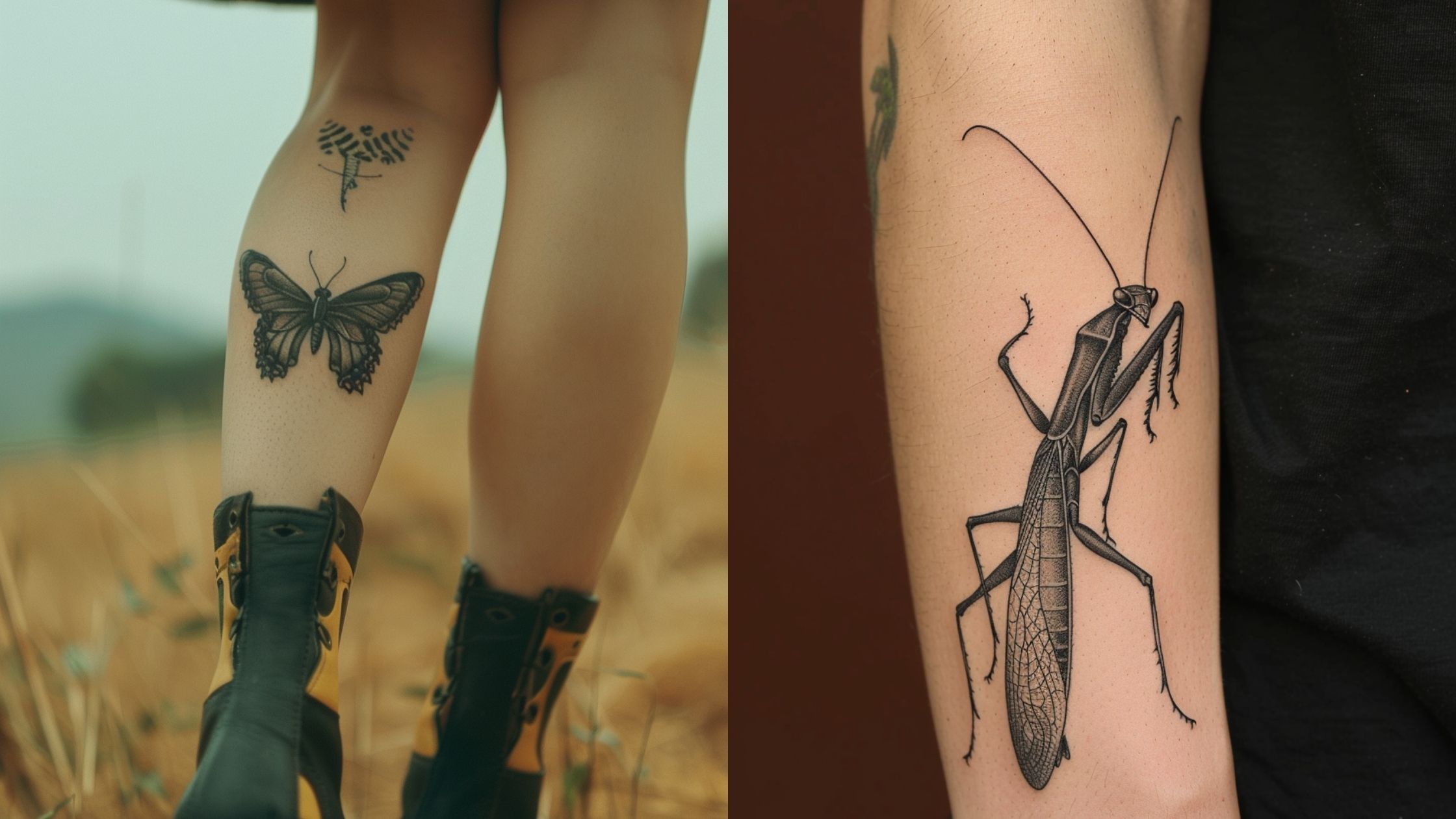
I have watched clients agonise over a full back piece and then book a bug tattoo in under five minutes. Insects are one of the few subjects that work at almost any size, on almost any placement, in almost any style — which is exactly why they keep showing up in artists’ portfolios.
Part of it is design logic. A bug already has symmetry, a hard outline and internal pattern built in, so an artist is not inventing structure from nothing the way they are with a portrait.
The other part is meaning. Every insect in this guide carries centuries of symbolism, and most of it is unexpectedly hopeful — transformation, patience, luck, rebirth. If you like the visual language but want something softer, butterfly tattoo ideas cover similar ground with a gentler read.
Below are the designs I see requested most, what each one actually means, and the practical notes — sizing, placement, aging — that decide whether a bug tattoo still looks sharp in ten years.
Which Bug Tattoo Style Is Right for You?
Style matters more than subject with insects, because the same beetle can read as scientific, decorative or cartoonish depending entirely on how it is rendered.
| Style | Best minimum size | How it ages | Best suited to |
|---|---|---|---|
| Fine line | 5–8 cm | Softens noticeably; lines can blur together | Delicate moths, fireflies, single insects |
| Blackwork | 6–10 cm | Very well; solid black holds for decades | Beetles, spiders, bold silhouettes |
| Dotwork | 8–12 cm | Well if dots are spaced; muddies if packed tight | Beetle shells, cicada wings, textured bodies |
| Black and grey realism | 10–15 cm | Grey washes lighten; contrast flattens over time | Praying mantis, large beetles, spiders |
| Watercolour | 8–12 cm | Fades fastest; needs a line anchor to survive | Butterflies, dragonflies, fireflies |
| Traditional / bold line | 5–8 cm | Best of any style; built for longevity | Ladybugs, bees, beetles, scarabs |
If you take one thing from that table, take the size column. The single most common regret I hear about insect tattoos is that they were done too small, not that the subject was wrong.
Why Bug Tattoos Carry So Much Meaning
Insects show up in the symbolism of nearly every culture, largely because their life cycles are so visibly dramatic. A creature that dissolves itself and rebuilds into something else is hard to ignore.
Scarab beetles were carved into Egyptian amulets as symbols of renewal and the daily rebirth of the sun. That association is old enough that it has survived intact into modern tattooing.
Moths, meanwhile, sit on the opposite side of the same idea — attraction to light, vulnerability, and the acceptance of an ending. Neither reading is wrong; they are the same story told at different points.
Then there is the practical symbolism. People choose ladybugs for luck, bees for community and industry, and cicadas for patience, because those meanings genuinely map onto how the insects behave.
Every artist I have asked about insect work says roughly the same thing: clients almost always arrive with a reason attached. Very few people get a bug purely for decoration, which is not true of, say, florals or lettering.
Bug Tattoo Ideas by Insect
These are the eight insects I see requested most often, roughly in order of how commonly they walk through a studio door.
1. Ladybug Tattoos
Ladybugs are the entry point. They are small, universally recognised, and one of the very few insects most people already feel warmly about.
The design is nearly foolproof: a solid black outline, a red dome, a few black spots. That is a shape that survives fading better than almost anything else in this guide.
A common myth is that the number of spots reveals the beetle’s age. It does not — spot count relates to species, not years lived. I mention it because people occasionally ask for a specific number for the wrong reason.
If you want a ladybug under three centimetres, ask the artist to drop the spots entirely and let the silhouette do the work. Tiny dots inside a tiny red field blur into a smudge within a few years.
For a deeper look at variations, colour choices and placement, I have collected more in this guide to ladybug tattoo ideas.
2. Beetle and Scarab Tattoos
Beetles are the designer’s favourite. The elytra — those hard wing covers — form a naturally symmetrical panel that an artist can fill with almost any pattern.
Scarabs specifically carry the Egyptian rebirth symbolism, and they tend to be drawn more stylised and geometric than other beetles.
Stag beetles and rhinoceros beetles go the other direction: heavy, architectural, and well suited to blackwork where the mandibles or horn become the focal point.
When I have tested beetle designs at different sizes, the break point is around six centimetres. Below that, the shell pattern stops reading and you are left with a dark oval.
Beetles are the strongest choice if you want a tattoo that still looks intentional in twenty years, because the design tolerates line spread better than fine detail work does.
3. Spider Tattoos
Spiders are technically arachnids rather than insects, but they live in the same visual category and I am not going to be precious about it.
The symbolism is genuinely broad: patience, creation, fate, and in several West African and Indigenous traditions, cleverness and storytelling.
Design-wise, the challenge is the legs. Eight thin lines radiating from a small body is a lot of fine detail packed into a small area, and it is the first thing to blur.
In my experience the fix is counterintuitive — go slightly thicker on the legs than looks right on paper. Fresh, it will seem heavy; healed, it will look correct.
Webs are the other decision. A web reads well across an elbow or shoulder where the natural creases give it somewhere to sit. There are far more variations in this collection of spider tattoo ideas.
4. Moth Tattoos
Moths have quietly overtaken butterflies in a lot of studios, and I think it is because they are more interesting to draw.
The death’s-head hawkmoth, with its skull-like thorax marking, is the single most requested variety I encounter — helped along by decades of film posters.
Luna moths are the other favourite: pale green, long tailed, and softer in tone. They suit fine line and colour work in a way the hawkmoth does not.
Symbolically moths sit with transformation, intuition, and the pull toward something you know might harm you. It is a heavier read than a butterfly, which is precisely the appeal for most people who ask.
Placement matters more here than with any other insect. A moth’s symmetry wants a symmetrical body part — sternum, spine, the back of the neck. I have written more about the layered meanings in this breakdown of moth tattoo meanings.
5. Firefly Tattoos
Fireflies are the sentimental choice, and I mean that as a compliment. Almost everyone who asks for one is chasing a specific childhood memory.
The technical problem is obvious: you are trying to tattoo light. Skin does not glow, and white ink is unreliable — it yellows, it fades, and on many skin tones it barely shows at all.
The approaches that actually work are negative space, a soft grey halo around the abdomen, or a warm yellow gradient with a solid line anchor holding the shape.
Be wary of any design that relies entirely on white ink to carry the glow, because in a decade that glow will likely be invisible and you will be left with a small brown beetle.
My favourite variation is the literal one — a filament bulb trailing behind the insect. It sidesteps the whole problem and gives the piece a bit of wit.
6. Grasshopper and Cricket Tattoos
Grasshoppers are uncommon, which is half the reason to get one. In Chinese and Japanese symbolism they are associated with good fortune, abundance and, in some readings, courage.
The design hinges entirely on the hind legs. Get the angle of that back joint right and the insect reads instantly; get it wrong and it becomes a generic bug.
Crickets carry a slightly different meaning — luck and household protection — and are usually drawn rounder and more compact.
These work best angled along a limb rather than sitting flat. A grasshopper running diagonally up a forearm or calf follows the muscle instead of fighting it.
7. Cicada Tattoos
Cicadas are the patience tattoo. Periodical species in North America spend 13 or 17 years underground before emerging for a few short weeks — a life cycle that hardly needs a metaphor written for it.
Visually they are one of the best insects for skin. The broad, veined, largely transparent wings are mostly negative space, which means the design breathes instead of turning solid.
In Greek and Chinese traditions the cicada also stands for immortality and rebirth, partly because of the empty shell it leaves behind after moulting.
That discarded shell is worth considering as a design in its own right. I have seen a few pieces that tattoo only the exuvia, and they are quietly devastating.
Cicadas scale up better than any other insect here — a sternum or spine piece can hold real wing detail without crowding.
8. Praying Mantis Tattoos
The mantis is the most striking silhouette in the whole category. Those folded forelegs are recognisable in outline alone, which is rare.
It symbolises stillness, focus and calculated patience across a number of traditions — a predator that succeeds by not moving.
There is a darker association too. Sexual cannibalism does occur in some mantis species, though it is far less universal than popular culture suggests. Plenty of people choose the mantis specifically for that edge.
Realistic mantis work needs size. When I have seen it attempted under ten centimetres, the head detail and the segmented forelegs collapse into a green scribble.
Fine line versions can work smaller, but only if the artist simplifies rather than shrinks — fewer segments, cleaner joints, no attempt at the compound eye texture.
Variations Worth Considering
If none of the eight above quite fits, these are the directions I most often steer people toward.
Anatomical and Scientific Illustration
Drawn like a plate from a Victorian entomology text, complete with pin, label or specimen box. It suits collectors, scientists and anyone who wants the tattoo to look studied rather than decorative.
Dotwork is the natural partner here, since it mimics the engraving texture of old print. There is a broader range of that approach in these dotwork tattoo ideas.
Insect and Botanical Pairings
A bug alone can float awkwardly on skin. Adding a stem, leaf or flower gives it context and makes the composition feel deliberate.
This is also the easiest way to soften an insect that reads as harsh. A spider on a peony lands very differently from a spider on bare skin.
Geometric and Sacred Geometry Hybrids
Insect symmetry maps neatly onto geometric frameworks — a beetle inside a hexagon, a moth split across a mandala. It works because you are reinforcing structure the insect already has.
Micro and Fine Line Insects
Small, single-needle bugs on the ankle, ribs or behind the ear. Beautiful fresh, but honest expectations matter: these need touching up sooner than any other option. The trade-offs are covered in these fine line tattoo ideas.
Swarms and Multiples
Three to seven small insects scattered up a forearm or across a shoulder. It creates movement across the body and lets you add to the piece over years, which single designs rarely allow.
Placement, Sizing and Aftercare
Placement decides longevity more than style does. Hands, fingers, feet and the outer forearm take the most friction and sun, and insect detail there fades noticeably faster than on the inner arm, ribs or thigh.
For pain, most insect tattoos are small enough that the session is short — usually 45 minutes to two hours. Sternum, ribs and ankle are the placements clients consistently rate hardest; if that is a concern, this tattoo pain chart maps it out by area.
On healing, follow whatever your artist tells you over anything you read online, including this. In general terms, the American Academy of Dermatology advises keeping a new tattoo clean, moisturised and out of direct sun, and avoiding swimming while it heals.
Watch for warning signs rather than assuming. Spreading redness, increasing pain after the first few days, swelling, pus or fever are reasons to see a doctor, not to wait it out. The US Food and Drug Administration also notes that reactions to red pigment in particular can appear months or even years later — worth knowing if you are planning a red ladybug.
Long term, sunscreen does more for a bug tattoo than any product marketed at tattoos. UV exposure is the main cause of the fading that ruins fine insect detail.
Still Not Sure? Mistakes I See Most Often
Going too small is the big one. An insect that looks charming at four centimetres on paper has the same detail crammed into a fraction of the space once it is on skin.
Copying a photograph exactly is the second. A real insect has detail that skin cannot hold; a good artist will simplify, and you should let them.
Ignoring the body’s contours is the third. Insects have a strong directional axis, and a bug placed against the flow of a limb always looks slightly wrong without people being able to say why.
Chasing a meaning you do not actually feel is the fourth. If you like how a scarab looks, that is a complete reason. You do not owe anyone a symbolism essay.
If you are still weighing options, it can help to look sideways at related subjects — dragonfly designs sit in similar territory with a lighter feel, while scorpion tattoo ideas push further toward the bold and defensive end.
Frequently Asked Questions
Do bug tattoos hurt more than other tattoos?
Not because of the subject — pain comes from placement, not what is being drawn. Most bug tattoos are small enough that the session is short, which helps considerably. Ribs, sternum, ankle and the tops of the feet are the placements clients most often describe as difficult. Fleshier areas like the outer thigh, upper arm and forearm are generally the easiest.
What is the smallest a bug tattoo can realistically be?
Around three centimetres for a simple silhouette like a ladybug or bee, and closer to six for anything with internal detail such as a beetle shell or spider legs. Below those sizes, an artist has to remove detail rather than shrink it. In my experience the pieces people are still happy with a decade later are the ones that were sized generously from the start. Ask your artist for their honest minimum and take the answer seriously.
Which bug tattoo ages the best?
Bold-line and blackwork insects, usually beetles, scarabs and traditional ladybugs. Solid black holds its shape for decades, while grey wash lightens and fine lines spread. Cicadas also age unusually well because their wings are mostly open space. Watercolour and single-needle micro insects generally need touching up soonest.
Are bug tattoos considered unlucky?
The opposite, in most traditions. Ladybugs, crickets and scarabs are all long-standing symbols of luck, protection or renewal, and bees represent community and industry. Spiders and moths carry more ambiguous readings, though even those lean toward creation and transformation rather than misfortune. Cultural associations vary, so if a specific tradition matters to you, it is worth checking that meaning before committing.
Can I get a bug tattoo in colour, or is black and grey safer?
Colour is fine and often suits ladybugs, luna moths and beetle iridescence beautifully. The practical caveats are that colour fades faster than black, and that red pigments are the most common cause of delayed allergic reactions according to the FDA. A solid black outline underneath colour packing gives the design something to fall back on as the colour softens. If you have reacted to a tattoo pigment before, raise it with your artist and a doctor first.
Quick Summary
- Bug tattoos work at almost any size and style because insects already have built-in symmetry and structure.
- Size is the most common regret — aim for six centimetres or more on anything with internal detail.
- Ladybugs, beetles and scarabs age best; fine line and watercolour insects fade soonest.
- Cicadas and moths suit symmetrical placements like the sternum and spine.
- Fireflies should not rely on white ink for their glow; use negative space or a grey halo instead.
- Praying mantis designs need room — ten centimetres or more for realism.
- Pair an insect with a botanical element if the design feels like it is floating.
- Sun exposure, not age, is what destroys insect detail — sunscreen is the best long-term care.