A spider tattoo is one of the few designs that reads completely differently depending on how you draw it — the same eight legs can look elegant, menacing, delicate, or darkly funny.
I have been collecting and writing about spider tattoos for years, and the thing that still surprises me is how small the gap is between a spider that looks beautiful and one that looks like a smudge.
Most of that gap comes down to leg weight, spacing, and placement — not the spider itself. When I have watched artists sketch these on skin, they redraw the legs three or four times before they commit.
Below are the spider tattoo styles that actually hold up, what each one costs you in healing and upkeep, and how they compare with a close cousin, the cobweb tattoo.
Which Spider Tattoo Style Is Right for You?
This is the comparison I sketch out for anyone who tells me they want “a spider” and nothing more specific.
| Style | Typical size | Session length | How it ages | Best for |
|---|---|---|---|---|
| Realistic | 3–6 inches | 2–4 hours | Fine hairs soften first; body holds well | Forearm, calf, shoulder |
| Fine line / minimalist | 1–2 inches | 30–60 minutes | Legs can blur or fade within a few years | Wrist, ankle, behind the ear |
| Blackwork / tribal | 4–8 inches | 2–5 hours | Ages best of all — solid black stays readable | Upper arm, thigh, back |
| Spider with web | Varies with the web | 1–4 hours | Web lines thicken slightly over time | Elbow, shoulder cap, hand |
| Black widow (color accent) | 2–4 inches | 1–3 hours | Red hourglass may need a touch-up sooner | Forearm, ribs, thigh |
| Mandala / geometric | 4–7 inches | 3–5 hours | Strong if line weights vary; muddy if uniform | Sternum, spine, outer thigh |
What Spider Tattoos Actually Mean
Spiders are one of the oldest symbols in human storytelling, and the meanings are genuinely split — the same animal is a creator in one culture and an omen in another.
In West African and Caribbean folklore, Anansi is a spider trickster who is credited in many tellings with owning or spreading stories themselves, which is where the “weaver of tales” association comes from. You can read a short overview at Britannica.
In Greek myth, Arachne is the mortal weaver turned into a spider after out-weaving a goddess — a story about skill, pride, and consequence rolled into one image.
Most people I have talked to about their spider tattoo land on one of four ideas: patience, craft, transformation, or protection. A web takes a night to build and a morning to destroy, which is a fairly blunt metaphor for starting over.
Worth being honest about: a spider web on the elbow has carried prison associations in some regions, and in a few contexts it still does. In my experience most artists will tell you that reading has faded a lot, but if the placement matters to you, ask locally rather than assuming.
Popular Spider Tattoo Designs
1. Realistic Spider Tattoo
A realistic spider is the hardest version to pull off and the most rewarding when it works. The illusion lives in the leg joints, not the body.
When I have watched artists build these, they spend most of the session on shadow underneath the spider — the small cast shadow is what makes it sit on the skin instead of floating in it.
Ankle and lower calf placements work unusually well because the leg’s curve gives the spider somewhere to “walk” around. Expect two to four hours for a palm-sized piece with full shading.
One limitation: the fine hairs on the legs are the first detail to soften as the tattoo settles. Ask your artist to keep those hairs slightly heavier than looks right on day one.
2. Spider Web and Cobweb Tattoos
A web is really a placement decision disguised as a design. It should follow a joint, a shoulder cap, or a corner of the body where a real web would anchor.
Webs stretched across a flat, featureless patch of skin tend to look like graphics rather than webs. The elbow, the web of the hand, and the outer shoulder all give the design something to hang from.
Every artist I have asked about webs says the same thing: vary the line weight. Radial threads slightly heavier, spiral threads lighter, and a few broken strands so it does not read as a spiderweb clip-art.
You can also skip the spider entirely — a bare web with a single dangling thread is one of the most understated tattoos in this whole category.
3. Black Widow Spider Tattoo
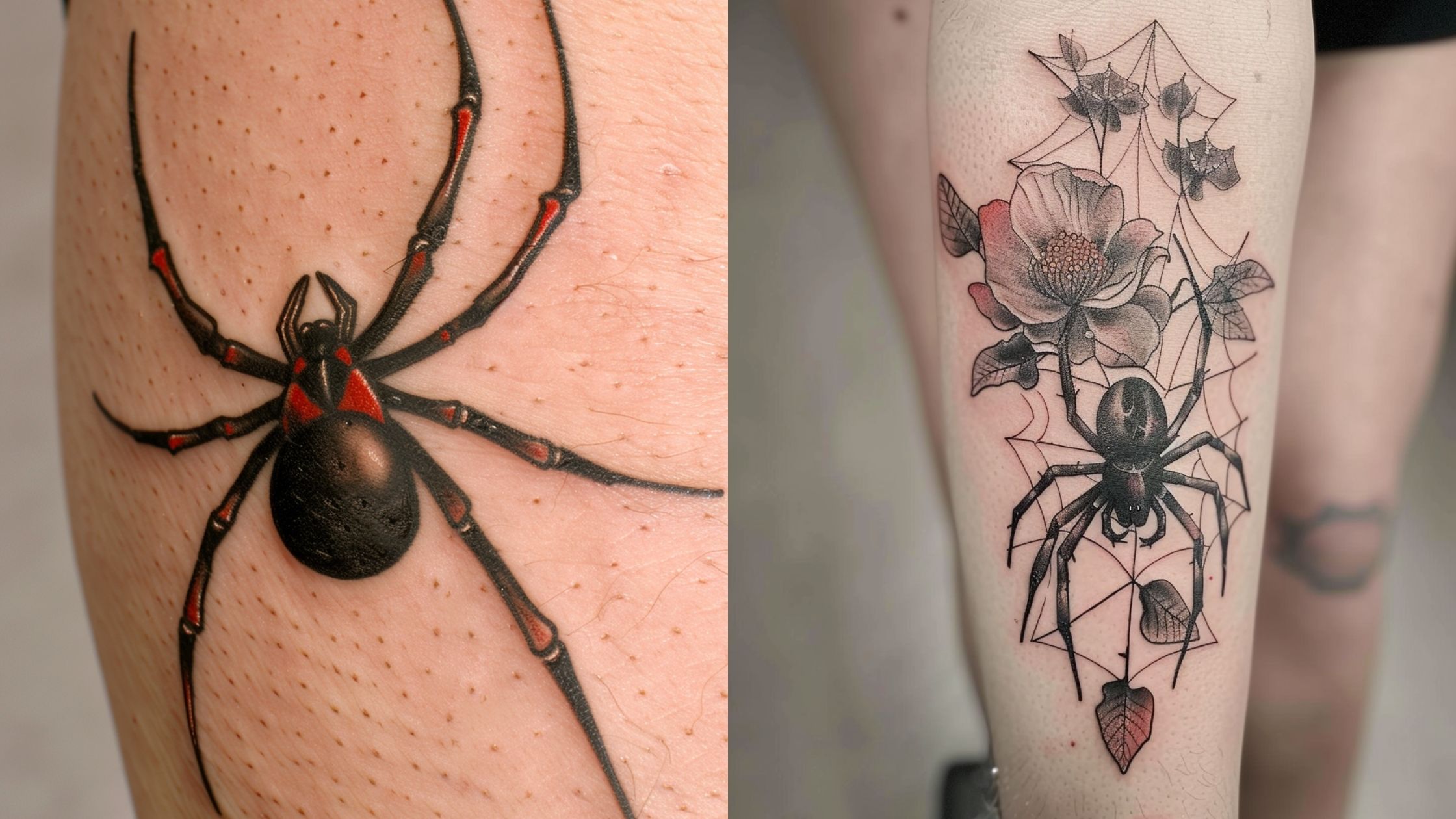
The black widow is the most recognisable spider in tattooing, entirely because of one red hourglass. That single mark of colour does all the work.
Because the body is glossy black, this design is very forgiving on aging skin — solid black holds its shape far longer than fine detail does.
In my experience the red is the part that needs watching. Reds sit differently on different skin tones and can lift during healing, so a touch-up after the first year is common and not a sign anything went wrong.
If you would rather stay entirely in black, some artists render the hourglass as negative space instead. It reads just as clearly and skips the colour question completely.
4. Tribal and Blackwork Spider Tattoo
Tribal and blackwork spiders trade realism for silhouette, and they are the version most likely to still look sharp in twenty years.
Solid black is the most stable thing you can put in skin — it does not depend on fine gaps staying open, which is what kills detailed work over decades.
The design risk here is symmetry. A perfectly mirrored spider looks like a logo; slight asymmetry in the leg curl makes it look alive. I have seen artists deliberately drop one leg lower than its pair for exactly this reason.
If you like the graphic approach more broadly, the same logic drives most tribal tattoo designs — shape first, detail second.
5. Spider and Skull Tattoo
Pairing a spider with a skull is the classic memento mori move: something that decays, and something that keeps living on top of it.
The composition works best when the spider is clearly smaller than the skull — roughly a quarter of its width — so the eye lands on the skull first and finds the spider second.
A common arrangement is the spider emerging from an eye socket or resting on the cranium with one or two legs breaking the outline. That broken outline is what stops the pair from looking like two separate tattoos side by side.
If the skull is doing the heavy lifting in your design, it is worth browsing dedicated skull tattoo ideas before you commit to a shape.
6. Spider and Flower Tattoo
This is my favourite category in the whole list, because the contrast does something neither element manages alone.
Soft petals make the spider look deliberate rather than creepy, and the spider stops the florals from tipping into decoration.
Roses, poppies, and peonies are the usual partners because their petal mass gives the spider somewhere to sit. Wildflowers and stems work too, though you need at least one dense bloom as an anchor.
Practical tip from watching these get inked: keep the spider entirely on the flower or entirely off it. Half-on reads as an accident. If you want floral ideas to pair with, the wildflower tattoo shapes are a good starting point.
7. Minimalist and Fine Line Spider Tattoo
A tiny single-needle spider is often someone’s first tattoo, and it is a genuinely good choice — quick, cheap, and easy to place discreetly.
Most of these take under an hour and sit comfortably on the wrist, the ankle, or behind the ear.
The honest trade-off is longevity. Very fine lines placed close together can soften and merge over the years, and hands, fingers, and feet lose crispness faster than most other spots.
The fix is spacing, not size: ask for slightly wider gaps between the legs than the sketch suggests. I have seen the same design age beautifully at 2 inches and turn into a blot at 1 inch. More minimalist tattoo ideas follow the same rule.
8. Spider and Crescent Moon Tattoo
Spiders build at night, so pairing one with a crescent moon is one of the few symbolic combinations that is actually literal.
The moon gives the design a frame, which solves the most common problem with standalone spiders — they float without a container.
Two arrangements dominate: the spider hanging beneath the crescent on a single thread, or sitting inside the curve. The hanging version suits vertical placements like the spine and the back of the arm.
Keep the moon’s line weight lighter than the spider’s, otherwise the crescent wins the composition. If lunar imagery is what drew you here, moon phase tattoo ideas pair well with the same linework.
Variations Worth Considering
Mandala and Geometric Spiders
A mandala spider replaces the abdomen with concentric ornamental patterning, which turns an insectlike shape into something closer to jewellery.
The success factor is varied line weight — if every ring and leg uses the same needle, the whole thing greys out into a smudge within a few years.
These sit best on flat, symmetrical real estate: sternum, spine, outer thigh. Budget three to five hours and expect a follow-up session for detail.
Unexpected Placements
Spiders reward placements where the body itself suggests movement — the side of the neck, the back of the arm, the inside of the bicep.
A spider tucked behind the ear or just under the collarbone catches people off guard, which is often the whole point.
Be realistic about pain. Ribs, sternum, neck, and the tops of the feet are consistently reported as some of the sharper spots, and a two-hour session there feels longer than four hours on a thigh.
Colour and Style Twists
Neo-traditional spiders with bold outlines and limited colour palettes age well and read clearly from across a room.
Watercolour spiders look beautiful in a fresh photo but usually need an underlying black structure to survive; ask for the linework version underneath the wash.
Negative-space spiders — where the spider is left as bare skin inside a solid black patch — are the most striking version I have seen, and among the least common.
Aftercare and Practical Advice
Fresh tattoos are open wounds, and the healing rules matter more for detailed spider work than for a solid block of black.
Follow the aftercare instructions your artist gives you over anything you read online, including this page — they know their ink, their equipment, and your skin.
The general shape of it: keep it clean with mild fragrance-free soap, moisturise thinly, do not pick scabs, and keep it out of the sun and out of pools while it heals. The American Academy of Dermatology has straightforward guidance on caring for tattooed skin.
See a doctor rather than your artist if you get spreading redness, swelling that worsens after the first few days, pus, fever, or a rash — those are medical issues, not design ones. The FDA outlines the risks worth knowing before you book. Nothing here is medical advice.
Our own tattoo aftercare guide covers the day-by-day timeline in more detail.
Common Mistakes — and What to Do If You Are Still Not Sure
The mistake I see most often is going too small. A spider at 1 inch has eight lines converging on one point, and skin does not hold that forever.
Second most common: bringing a reference photo of a real spider and expecting a literal copy. Photographs have detail that skin cannot store — a good artist will simplify, and that is a feature.
Third: ignoring how the spider will orient when your arm is at your side. Ask to see the stencil in a mirror, standing, before anyone starts.
If you are undecided, it usually helps to look at neighbouring categories: the most painful tattoo spots if placement is your sticking point, or scorpion tattoo ideas if it is the arachnid symbolism rather than the spider specifically that appeals to you.
Frequently Asked Questions
What does a spider tattoo mean?
There is no single meaning, and that is part of the appeal. The most common readings are creativity and craft, patience, transformation, and protection, drawn from figures like Anansi in West African folklore and Arachne in Greek myth. Some people choose one purely because they like spiders or find the shape beautiful. In my experience, whatever meaning you assign it yourself is the one that sticks.
How small can a spider tattoo be?
Around 1.5 to 2 inches is where most fine line spiders stay readable long-term. Below that, the eight legs converge in too small an area and can blur together as the ink settles over the years. If you want something genuinely tiny, ask for a simplified spider with fewer visible leg joints and wider spacing. Your artist will tell you honestly where their linework stops holding up.
Does a spider tattoo hurt more than other designs?
The design itself does not change the pain — placement and session length do. A small spider on the outer forearm is one of the gentler tattoos you can get, while the same spider on the ribs, sternum, neck, or foot is considerably sharper. Fine line work is generally quicker but involves more passes over the same spot. Eat beforehand and speak up if you need a break.
Is a spider web tattoo on the elbow still associated with prison?
Historically, elbow web tattoos carried associations with prison time in some regions, and in a few places that reading persists. It has faded considerably as the design became mainstream, and most artists today treat it as a purely aesthetic choice. If you live somewhere the association might still be read into it, ask a local artist before committing. Placement elsewhere on the arm avoids the question entirely.
How much does a spider tattoo cost?
It depends far more on your artist’s hourly rate and your city than on the spider. A small fine line piece is usually a shop-minimum job taking under an hour, while a detailed realistic spider or a mandala version can run several hours across one or two sessions. Ask for a quote with the stencil in front of you rather than over email. Budgeting for a touch-up in the first year is sensible, especially with red ink.
Quick Summary
- Spider tattoos read as craft, patience, transformation, or protection — the meaning is yours to set.
- Blackwork and tribal spiders age best; solid black holds its shape longest.
- Fine line spiders are quick and affordable, but keep them at least 1.5 to 2 inches with wide leg spacing.
- Webs need an anchor point — an elbow, shoulder cap, or joint — or they read as clip art.
- Pair a spider with a skull, flower, or crescent moon to give the composition a frame.
- Red on a black widow may need a touch-up sooner than the black does.
- Check the stencil standing up, in a mirror, before the needle starts.
- Follow your artist’s aftercare instructions, and see a doctor for any sign of infection.