A scorpion tattoo works because it says two things at once: leave me alone, and I can handle myself. That double meaning is why the design has never really gone out of fashion.
I have watched this one come through shops for years, and the requests fall into clear camps. Some people want a scorpion because of their Scorpio star sign. Others just like the shape.
Both are fine reasons. But the two groups usually want very different tattoos, and mixing up which camp you are in is how people end up with something that does not sit right.
Below is what I have learned about which scorpion styles hold up, where they sit best on the body, and what to talk through with your artist before the needle starts.
Which Scorpion Tattoo Style Is Right for You?
Here is how the main styles compare on the things that actually matter once you are living with the tattoo.
| Style | Best Size | Typical Sitting | How It Ages | Good If You Want |
|---|---|---|---|---|
| Realistic / black and grey | Palm-sized and up | 3–6 hours | Soft greys lighten; needs a touch-up eventually | Detail and drama |
| Tribal / blackwork | Medium to large | 2–5 hours | Excellent — solid black holds decades | Impact from a distance |
| Minimalist / fine line | Small, 2–4 inches | 30–90 minutes | Thin lines can soften and spread | Something subtle |
| Neo-traditional | Medium to large | 3–5 hours | Very well — bold outlines carry it | Colour and personality |
| Scorpion with florals | Medium and up | 4–7 hours | Depends on line weight in the botanicals | Contrast and softness |
Sitting times are what I have seen in practice for a competent artist working at a normal pace. Your artist may quote differently, and that is not a red flag.
Why the Scorpion Carries So Much Weight
The scorpion is one of the oldest symbols people have put on skin, and it has never meant just one thing.
In much of North Africa and the Middle East it has historically been treated as a guardian figure as much as a threat. In Western pop culture it leans more toward danger and revenge.
Biologically, the animal is an arachnid that has been around far longer than we have, and it survives in conditions that kill most things. You can read the basics of the order at Britannica.
That survival angle is the meaning most of my clients actually land on — not aggression, but the ability to keep going in a hostile environment.
It is worth deciding which reading you want before you design, because it changes everything. A defensive, curled scorpion reads very differently from one mid-strike with the stinger forward.
Scorpion Tattoo Designs That Actually Age Well
These are the versions I keep seeing hold up years later, rather than the ones that photograph well on day one and blur by year five.
1. Realistic Scorpion Tattoo
This is the most demanding version and the one most likely to go wrong with the wrong artist.
A realistic scorpion depends on the shadows between the body segments and the subtle sheen on the exoskeleton. Get those right and the thing looks like it landed on you.
Get them wrong and you have a grey smudge with legs. When I have looked at healed realistic work, the pieces that survived were the ones where the artist left generous space between segments instead of packing in every detail.
Ask to see healed photos, not fresh ones. Fresh black and grey always looks sharper than it will in two years.
Size honestly matters here. Below about four inches there simply is not room for the shading that makes realism work.
2. Tribal Scorpion Tattoo
If longevity is your main concern, tribal is the safest bet on this list.
Solid black packed properly into the skin is the most durable thing a tattooer can do. I have seen tribal work from the nineties that still reads perfectly.
The design language suits the animal too. A scorpion is already made of hard angles and tapering shapes, so it translates into bold black forms without much distortion.
The mistake I see most often is cramming too many points and spikes into a small area. Once the negative space between shapes drops below the width of the lines themselves, the whole thing fills in over time.
If you like this direction, it is worth browsing broader tribal tattoo ideas first so you understand the visual grammar before committing to a specific scorpion.
One caution worth stating plainly: some tribal patterns come from living cultures with specific rules about who wears what. Ask your artist about the origin of a pattern rather than pulling something off a search results page.
3. Minimalist and Fine Line Scorpion
The small scorpion has quietly become the most requested version I see.
It works because the silhouette is instantly recognisable. Two claws, a segmented tail, a hook — and your brain fills in the rest.
That is also the trap. A tiny scorpion has eight legs, and eight thin lines close together will eventually bleed into each other under the skin.
My honest advice: if you want it under three inches, ask the artist to simplify the legs rather than draw all eight at full detail. It will still read as a scorpion, and it will still read as one in fifteen years.
There is more on the general trade-offs in these minimalist tattoo ideas, and if you are drawn specifically to the hairline-thin style, the fine line approach has its own maintenance realities.
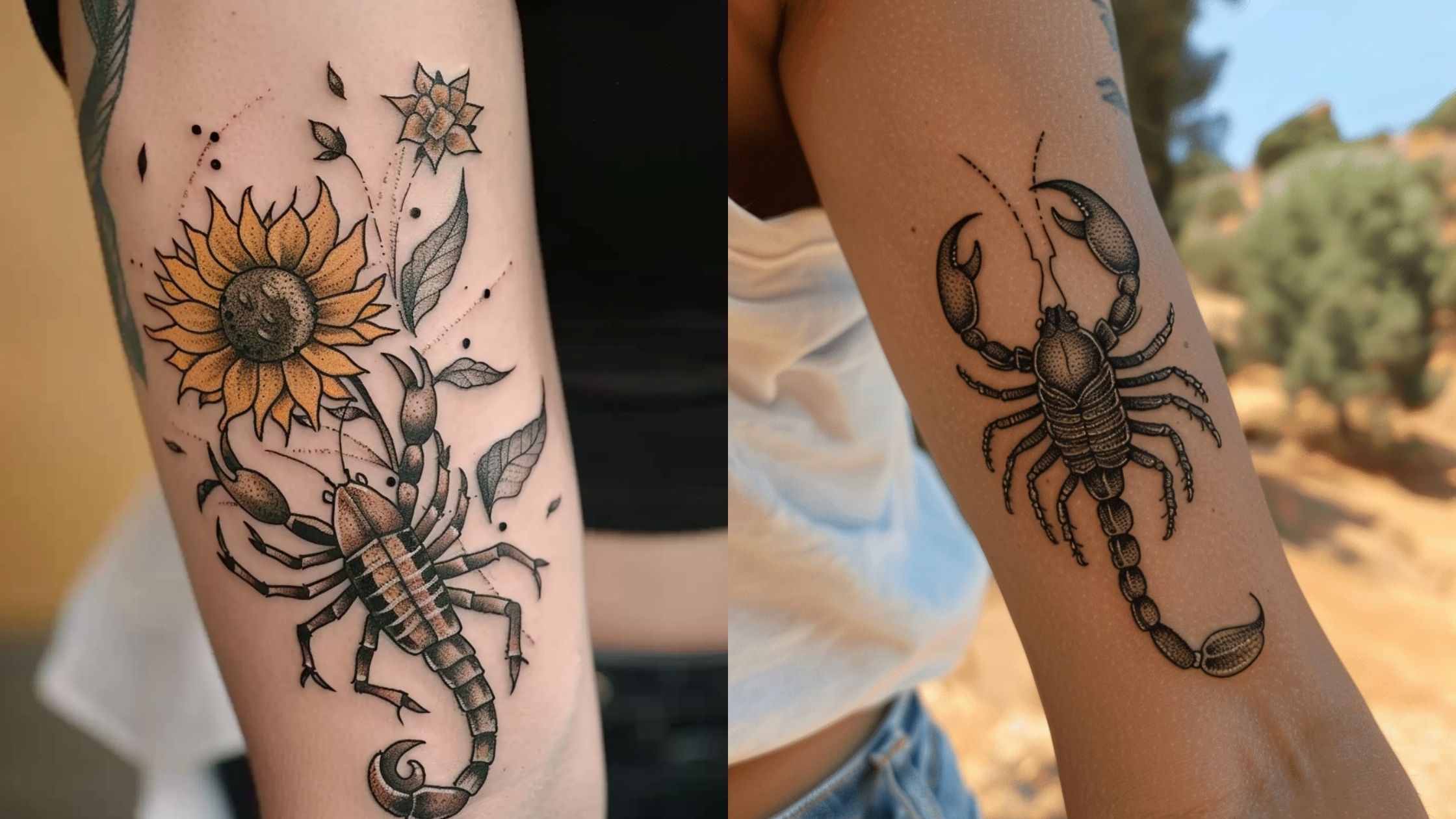
4. Scorpion and Flower Tattoo
Pairing a scorpion with botanicals is the design I have seen grow fastest in the last few years.
The logic is simple. The scorpion supplies the edge, the flowers supply the softness, and together they say something more interesting than either alone.
Peonies, roses and desert blooms all work. What matters more than the species is that the line weight of the flowers is heavier than you think it needs to be, so the botanicals do not disappear next to the solid black of the scorpion.
Composition is the hard part. The strongest versions I have seen let the scorpion break the flower shapes rather than sitting politely beside them.
5. Neo-Traditional Scorpion
Neo-traditional gives you bold outlines, a limited colour palette and a slightly stylised animal.
It is the best compromise between detail and durability. The heavy outline holds the design together for decades while the interior colour does the storytelling.
Deep reds, burnt oranges and desert golds suit the subject, though a solid black-outlined scorpion with a single accent colour is often stronger than a full palette.
This is also the style that handles ornamentation best — add a crescent moon, a jewel, or a banner and it still looks intentional.
6. Scorpio Zodiac Scorpion
If the tattoo is about the star sign, you have a choice to make: the animal, the glyph, or both.
Every artist I have asked prefers doing one properly rather than both crammed together. The Scorpio glyph is a clean, simple mark and it does not need help.
When people do combine them, the version that works is usually a detailed scorpion with the glyph small and off to one side, almost like a signature.
A third option worth considering is the Scorpius constellation itself — a line of small dots and thin connectors. It is subtle, astronomically real, and reads as personal rather than decorative.
7. Desert and Environment Scenes
Placing the scorpion in a setting is how you turn a symbol into a scene.
Sand ripples, cracked earth, a cactus silhouette, a low sun — these give the piece scale and give the eye somewhere to travel.
This works best on larger canvases like a thigh, back or half sleeve. Below a certain size the environment competes with the animal instead of supporting it.
I usually suggest keeping the background lighter in value than the scorpion itself, so contrast keeps the subject in front.
Placement and Size Variations
Where you put a scorpion changes what it says as much as how you draw it.
Forearm and Wrist
The forearm is the most common request and for good reason — it is visible, reasonably flat, and the long shape suits a scorpion with an extended tail.
You can browse a wider range of forearm tattoo ideas to see how the space handles vertical designs.
Shoulder, Chest and Back
These give you the room realistic and scenic versions need. The shoulder blade in particular suits a scorpion because the muscle movement can make the piece look alive.
Hand, Neck and Ribs
Bold placements, and painful ones. Ribs and the tops of the feet are genuinely rough sittings; the pain map by body part is worth reading before you book.
Ankle and Behind the Ear
Best suited to the simplified minimalist versions. Anywhere the skin is thin and mobile, keep the design simple and the lines a touch heavier than you would elsewhere.
Getting It Right: Practical Advice
Bring reference images of the style you want, not just the subject. Showing an artist five scorpions in five different styles tells them nothing.
Ask specifically for healed work in that style. This is the single most useful question you can ask and most people never ask it.
Expect the stencil stage to take longer than you want it to. A scorpion has to flow with the limb it sits on, and getting the angle right on the body often takes two or three placements.
Healing follows the usual pattern — a few days of tenderness, then flaking through roughly the first two weeks, with the deeper skin settling over a couple of months. Follow your artist’s instructions and the general tattoo aftercare guidance rather than improvising.
If you see spreading redness, heat, pus, or a fever, that is not normal healing. See a doctor rather than waiting it out. The FDA fact sheet on tattoos covers infection and ink allergy risks, and the Mayo Clinic overview is a reasonable plain-language summary. Nothing here is medical advice.
Common Mistakes and Still Not Sure?
The most expensive mistake is choosing an artist by price rather than portfolio. Cover-ups and reworks cost far more than getting it right once; the realistic ranges in this guide to tattoo pricing are worth reading before you shop around.
The second is going too small for the style. A realistic scorpion at two inches is not a small realistic scorpion, it is a blurry one.
The third is copying another person’s tattoo exactly. Most good artists will decline, and the ones who agree are usually not the ones you want.
If the scorpion is not quite landing, the same protective, slightly dangerous energy shows up in other creatures — the spider covers similar ground with a very different silhouette.
Sit with the idea for a few weeks. The designs my clients are happiest with are almost never the ones decided in a single afternoon.
Frequently Asked Questions
What does a scorpion tattoo actually mean?
There is no single fixed meaning. Across different cultures the scorpion has stood for protection, danger, survival and transformation, and in the West it is also strongly tied to the Scorpio star sign. Most people I speak to choose it for the survival and self-protection reading rather than aggression. The meaning that matters is the one you assign it, so it is worth being able to explain your reason in one sentence.
Does a scorpion tattoo hurt more than other designs?
The design itself does not change the pain — placement does. A scorpion on the outer forearm or thigh is a fairly comfortable sitting, while ribs, sternum, hands and feet are genuinely tough. Large blackwork versions also involve sustained solid packing, which many people find more wearing than line work. If pain is a real concern, choose a fleshier placement and book a shorter session.
How much does a scorpion tattoo cost?
It depends on size, style, your artist’s hourly rate and your city, so any specific figure would be misleading. A small minimalist scorpion is typically a shop-minimum job, while a detailed realistic piece is priced by the hour across one or more sessions. Ask for a written quote and a session estimate before booking. Paying more for the right artist is almost always cheaper than a rework later.
Will a small fine line scorpion still look good in ten years?
Usually yes, if it was designed with spacing in mind. The failure point is not the scorpion shape but the eight thin legs sitting too close together, which can blur as ink settles and spreads slightly under the skin. Asking your artist to simplify the legs and keep clear gaps between lines makes a real difference. Expect that any fine line piece may want a touch-up at some point.
Should I get the scorpion or the Scorpio glyph?
Pick one as the main element. The glyph is clean and instantly legible but very common; the animal is more visually interesting and gives an artist something to work with. If you want both, keep the glyph small and treat it as an accent beside a well-drawn scorpion. The Scorpius constellation is a good third option if you want something quieter.
Quick Summary
- Decide first whether your scorpion is about the star sign or the animal — it changes the design.
- Tribal and neo-traditional age best; solid black and bold outlines survive decades.
- Realistic scorpions need size and an artist with proven healed black and grey work.
- For anything under three inches, simplify the legs rather than drawing all eight in full detail.
- Forearms, shoulders and thighs are the friendliest placements; ribs, hands and feet are the painful ones.
- Pairing the scorpion with florals softens the design without losing its edge.
- Always ask to see healed photos in the specific style you want, not fresh ones.
- Follow your artist’s aftercare instructions, and see a doctor for spreading redness, pus or fever.