If you have been scrolling for lady bug tattoo ideas and keep landing on the same three stock designs, this guide is the one I wish I had found first. A ladybug tattoo works because it is one of the few designs that stays readable at the size of a thumbnail while still carrying real symbolic weight — luck, protection, and quiet transformation.
I have spent a lot of time sitting in studios watching artists ink tiny insects, and the ladybug comes up more than almost any other. It is usually somebody’s first tattoo, or their fifth small one, and almost never their biggest.
What surprised me is how differently it can be executed. The same six-spot beetle can read as a delicate fine-line whisper on a wrist or a saturated, glossy, almost photographic piece on a forearm.
Below I have pulled together the designs I keep seeing work, the ones that quietly fail after two years, and the practical questions worth asking your artist before the needle goes in. If insects in general are your thing, my broader guide to bug tattoo ideas covers the wider family.

Which Ladybug Tattoo Style Is Right for You?
Style choice matters more than size here, because it decides how the piece behaves five years from now. This is the shorthand I use when someone asks me to help them narrow it down.
| Style | How It Reads | Smallest Size I’d Trust | How It Ages |
|---|---|---|---|
| Minimalist / fine line | Light, quiet, easy to hide | About 2 cm across | Softens noticeably; expect a touch-up around year five |
| Realistic / illustrative | Detailed shell, visible highlight, depth | About 5 cm across | Holds well if it was given room to breathe |
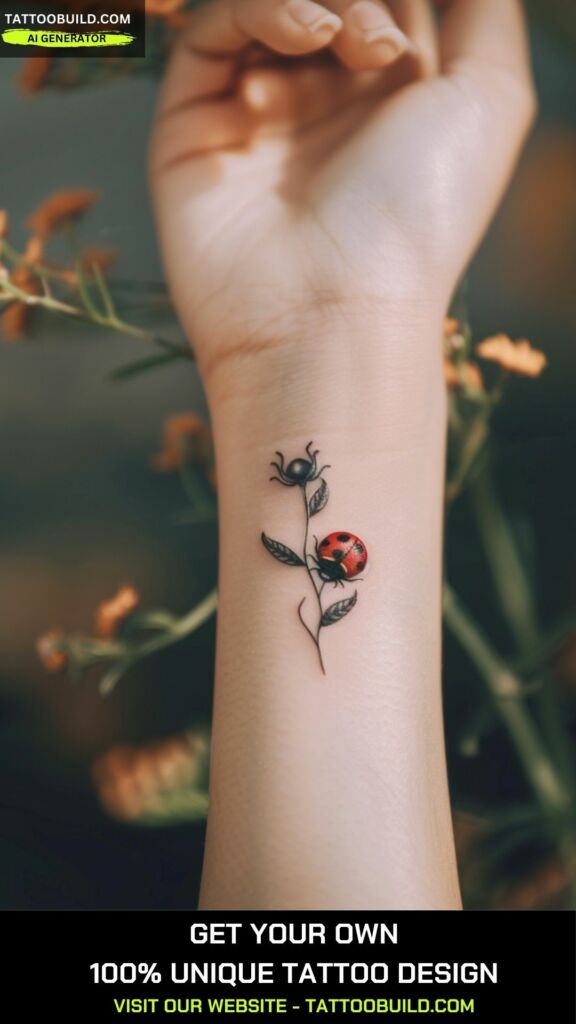
| Ladybug with florals | Decorative, storybook, feminine | About 6 cm tall | Very forgiving — the flower carries the composition |
| Black and grey | Graphic, understated, no colour commitment | About 2.5 cm across | The most durable option in this list |
| Watercolour | Loose, painterly, bleeding edges | About 7 cm tall | Fades fastest; assume repeat touch-ups |
| Ladybug on vine or leaf | Flowing, wraps a limb naturally | About 8 cm of run | Good, provided the linework is not hair-thin |
Why Red Ink Changes the Conversation
Here is the part most ladybug guides skip entirely: the red shell is the single biggest variable in how your tattoo turns out.
Red pigment sits differently in skin than black. It tends to look brilliant for the first year and then settle into something softer and slightly more orange, especially on skin that sees a lot of sun.
Red is also the colour most often named in reports of delayed tattoo reactions — bumpy, itchy patches that can appear weeks or even years after the session. The American Academy of Dermatology has a plain-language rundown of tattoo skin reactions worth reading before you commit.
That is not a reason to avoid red. It is a reason to tell your artist if you have ever reacted to a coloured tattoo before, and to ask what line of ink they are using.
If red genuinely worries you, the black and grey route below gives you the same silhouette with none of the pigment question. Plenty of people go that way, and I have never heard one regret it. For colour-forward alternatives that are not ladybugs, red ink tattoo ideas for women is a good next stop.
Ladybug Tattoo Ideas by Style
1. Minimalist Ladybug Tattoo
The minimalist ladybug strips the design to an outline, a filled shell and three or four spots. Nothing else.
It is the version I recommend most often to people getting their first piece, because it is quick, relatively low-pain in most placements, and it does not lock you into a larger composition later.
The trap is going too small. Below roughly two centimetres the spots start to crowd each other, and over the years the ink spreads just enough that they merge into a dark smudge.
Ask your artist to space the spots wider than looks correct on paper. Every artist I have asked about tiny insect work says the same thing — the design should look slightly under-detailed on the stencil to look right in a decade.


2. Realistic Ladybug Tattoo
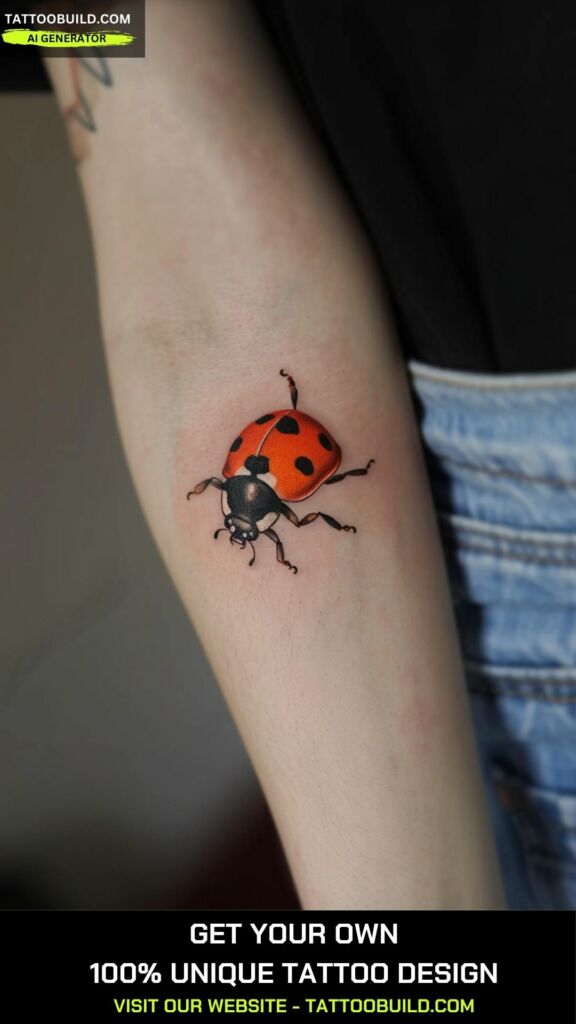
A realistic ladybug earns its place through the shell — the gloss highlight, the seam down the wing case, the slight translucency at the edges.
This is not a small tattoo. Realism needs surface area for the artist to build gradients, and squeezing it into a two-centimetre circle produces mud.
I have watched artists spend well over an hour on a single realistic beetle the size of a coin, mostly on the highlight. It is a genuine specialty, so look at healed photos rather than fresh ones when picking someone.
Placement matters here too. Flatter areas — outer forearm, calf, shoulder blade — keep the illusion of a three-dimensional insect intact. Curved, high-movement spots distort it.


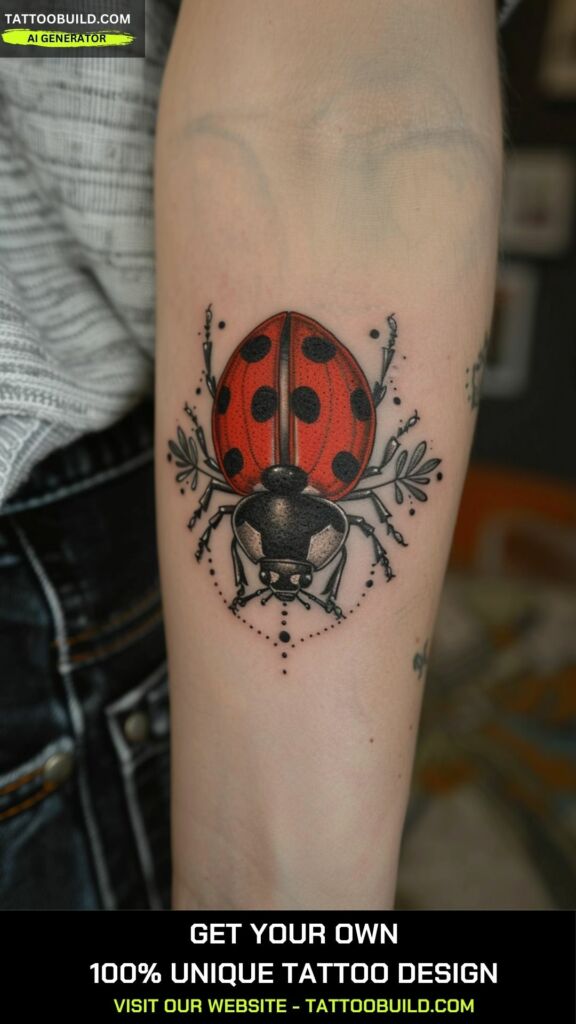
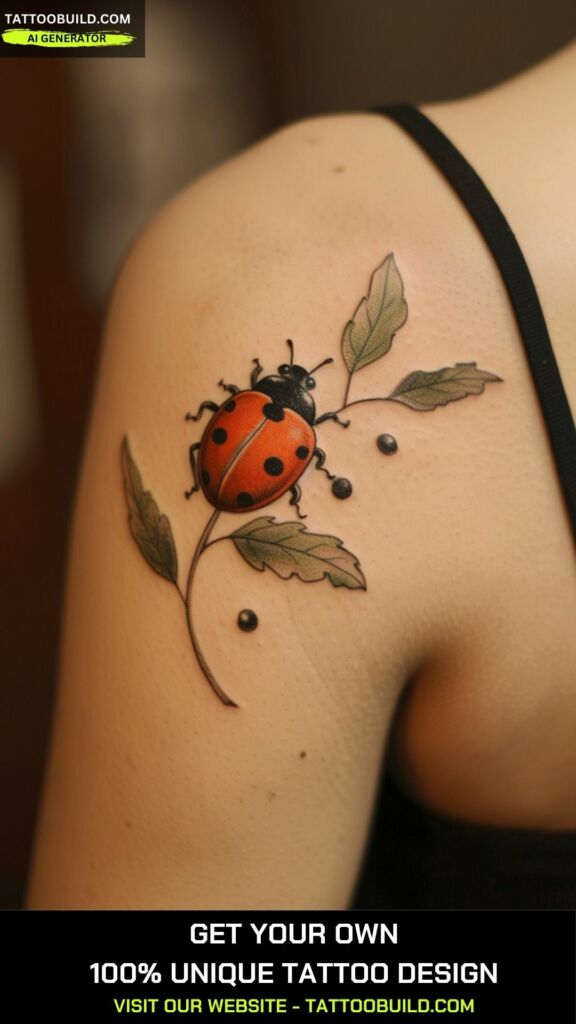
3. Ladybug and Flower Tattoo
Pairing the ladybug with a bloom is the most common request I see, and for good reason — it solves the composition problem instantly.
A lone insect floating on skin can look stranded. Give it a petal to sit on and suddenly there is a scene, a sense of scale, and somewhere for the eye to rest.
Daisies, poppies and small wildflowers work best because their shapes stay legible when scaled down. Roses tend to overpower the beetle unless the piece is large.
Keep the ladybug slightly off-centre. Dead-centre placement reads as a logo; off to one side reads as a moment. If you like the botanical direction, dandelion tattoos use the same trick with seeds instead of insects.


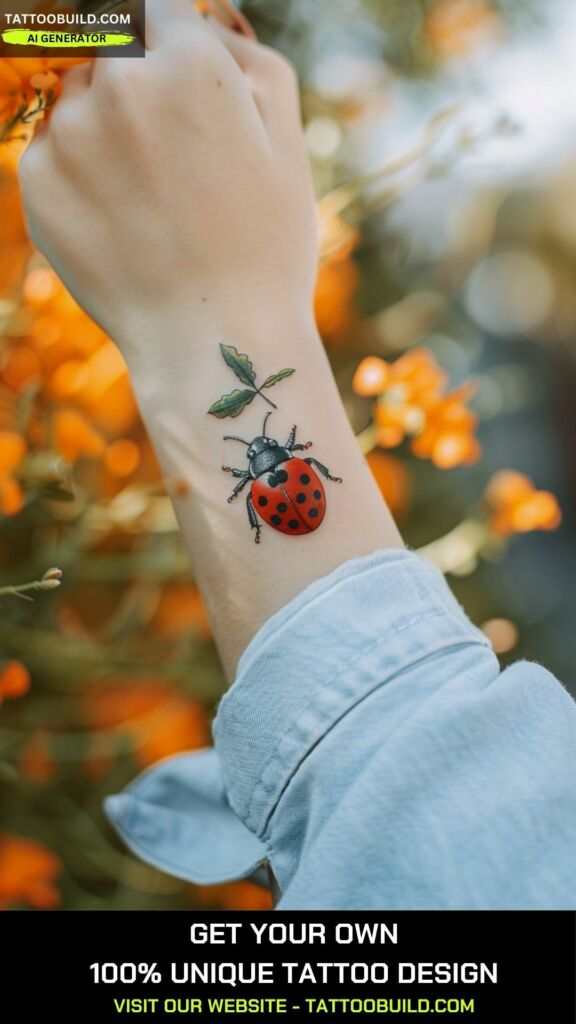
4. Ladybug and Leaf Tattoo
The leaf version is quieter than the floral one and, to my eye, ages better.
A single leaf gives the artist a clean, broad shape to anchor the design without competing for attention with detailed petals.
It also opens up placement. A leaf-and-ladybug reads well running along a forearm, down the spine, or curving over a shoulder in a way a round flower does not.
If you want understatement with a bit of narrative, this is the one. It suggests the insect is passing through rather than posing.


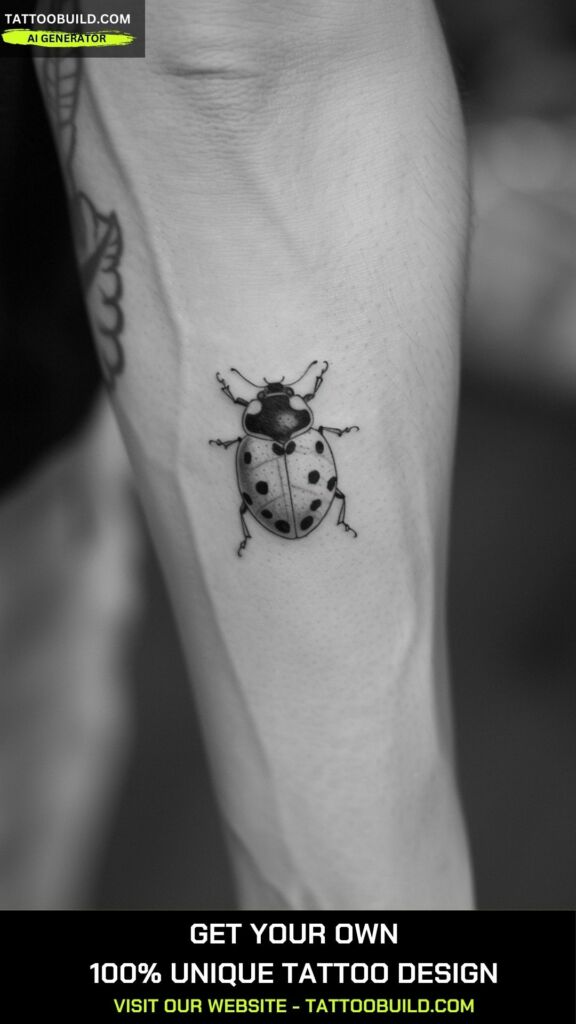
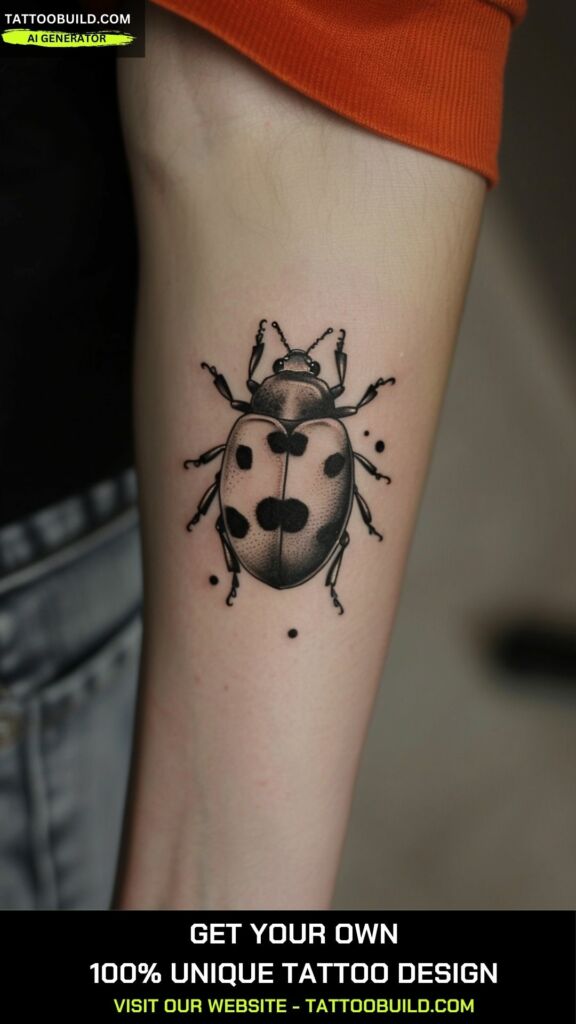
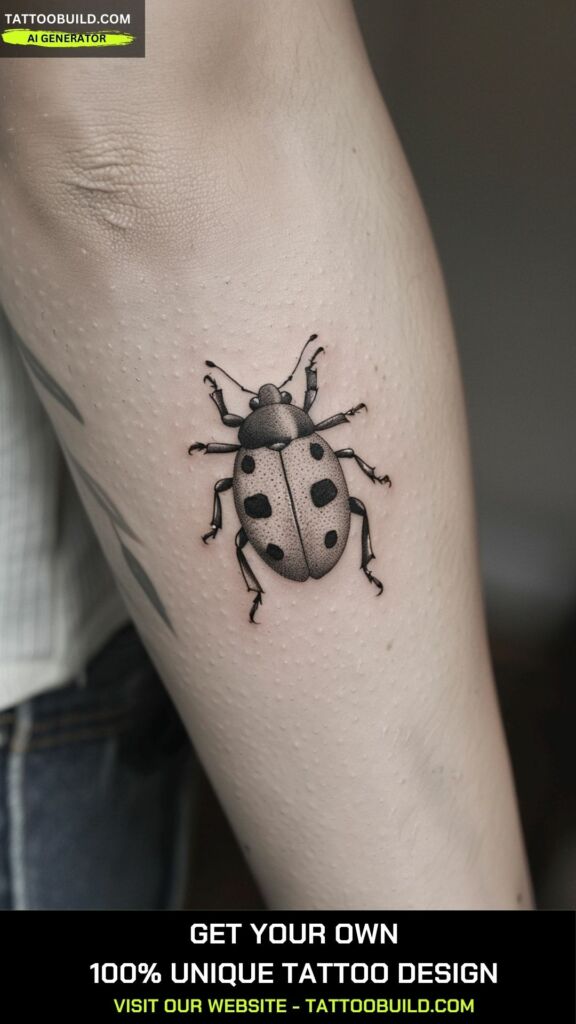
5. Black and Grey Ladybug Tattoo
Dropping the red entirely is the most underrated option on this list.
A black and grey ladybug relies on the silhouette, the spots and the seam — and because the shape is so recognisable, it still reads instantly as a ladybug.
Practically speaking, black pigment is the most stable over time and the least associated with delayed skin reactions. If you are cautious about colour, this is the safe harbour.
It also sits far more comfortably alongside existing black work. If you already have blackwork or fine-line pieces, a red beetle can feel like it wandered in from a different tattoo.


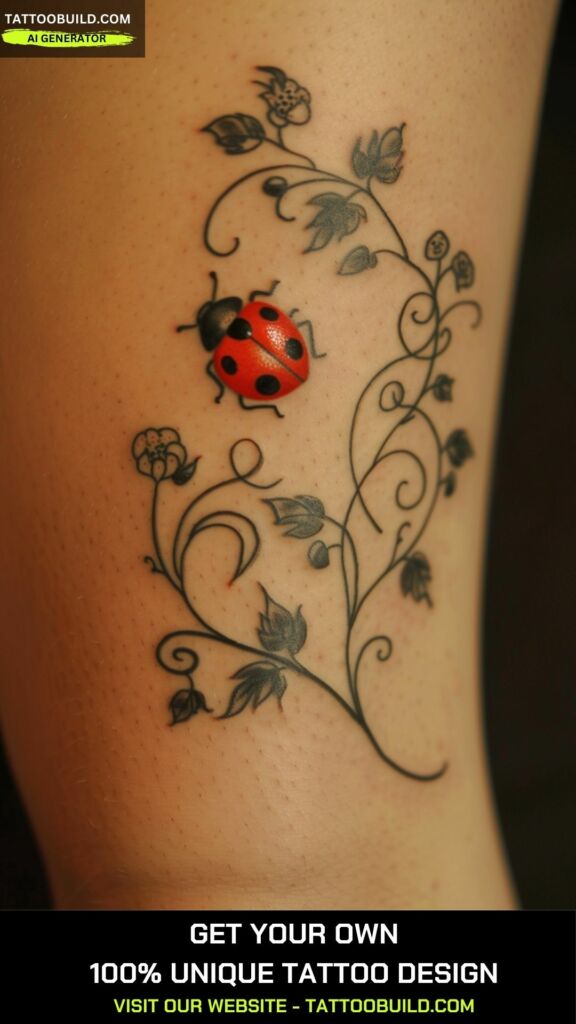
6. Ladybug and Vine Tattoo
A vine turns a single insect into a piece that travels — around a wrist, up an ankle, along a rib line.
This is the design I would pick for anyone who wants something small but not static. The ladybug becomes a detail in a longer line rather than the whole event.
Watch the line weight. Vines drawn hair-thin to look delicate are exactly the lines that blur first, particularly on the inner arm and ribs where skin is thinner.
A good compromise is a medium-weight vine with fine-line tendrils branching off it. The heavier line holds the shape long after the delicate parts have softened.


7. Watercolour Ladybug Tattoo
Watercolour treats the ladybug as a splash of red rather than a drawn object, with pigment bleeding past the outline.
It is genuinely striking when fresh. It is also the style I would be most honest about: soft-edged colour without a black anchor line fades faster than anything else here.
If you love the look, ask for a subtle line structure underneath the wash. It preserves the shape once the loose colour inevitably softens.
In most cases, plan on a refresh every few years rather than treating it as permanent-and-done. Some people are fine with that trade; decide before, not after.
Meaningful Variations and Placement Ideas
Once the style is settled, the details are where a ladybug tattoo stops being generic.
Memorial Ladybug Tattoos
A striking number of ladybug tattoos are memorial pieces. In several European folk traditions the ladybug is associated with a message being carried, and a lot of people attach that to someone they have lost.
Common treatments: a date tucked into the wing seam, initials worked into the spot pattern, or one ladybug per person remembered.
Matching and Mother-Daughter Sets
Ladybugs suit matching work because they scale and repeat cleanly. Two identical beetles, or a larger one and a smaller one, tell the story without a word of script.
I would keep matching sets simple and identical in style. Mixing a realistic ladybug with a minimalist one rarely reads as a pair.
Where to Put It
Inner wrist and the side of the ankle are the classic spots — visible when you want them to be, easy to cover otherwise.
Behind the ear and the finger look wonderful in fresh photos and are the two placements artists most often warn against, because both areas hold ink poorly and blur quickly.
Outer forearm, upper back and calf are the low-drama choices: flat, stable, and comfortable to sit through. For more on scale and placement generally, small tattoo ideas for women covers a lot of ground.
Ladybug Alongside Other Insects
Ladybugs pair naturally with bees, butterflies and dragonflies in a small collected set built over time.
If that appeals, plan the spacing before the first one goes in — retrofitting a composition around an existing tattoo is much harder. Bee tattoo designs and fly tattoo meanings are both worth a look for companion pieces.
Aftercare and Practical Tips for Small Colour Tattoos
Sun is the main enemy of a red tattoo. Once healed, sunscreen over the piece whenever it is exposed does more for its longevity than any aftercare product.
During healing, follow whatever your artist tells you over anything you read online — including this. They know what ink and technique they used. The AAD’s guide to caring for tattooed skin is a solid general reference alongside their instructions.
Expect a small colour tattoo to look slightly patchy around the second week as it flakes. That is normal and usually resolves. What is not normal is spreading redness, swelling that increases after day three, pus, or fever — those warrant a doctor, not a forum thread.
Book the touch-up conversation early. Many artists include one free touch-up within a few months, and small red-ink pieces are the ones most likely to need it.
Never try to fix, lighten or remove a tattoo yourself. Removal creams and DIY methods can scar permanently — that is a dermatologist’s job, not a kitchen-table one.
Common Mistakes — and What to Do If You’re Still Not Sure
The mistake I see most is choosing a size based on the drawing rather than the skin. A design that looks balanced on paper at 4 cm often needs 6 cm to survive on a body.
The second is picking an artist by portfolio breadth rather than by the specific style you want. Someone brilliant at traditional work may not be the right hands for delicate colour realism.
The third is booking around an event — a wedding, a holiday — and rushing the healing window. Give it space.
If you are still undecided, it usually means the ladybug is not quite the design, just the closest one you have found. Browsing wider often settles it faster than staring harder: try cute little tattoos for women, classy women’s tattoo designs, or summer tattoo ideas and see what you keep coming back to.
And if the symbolism is what pulled you in rather than the insect itself, the background on ladybirds is genuinely interesting reading and may point you somewhere unexpected.
Frequently Asked Questions
Do ladybug tattoos hurt?
For most placements, a small ladybug is one of the gentler tattoos to sit through — outer forearm, calf and shoulder are generally reported as mild. The ribs, the top of the foot, fingers and behind the ear are noticeably sharper, mostly because the skin is thin and close to bone. Colour packing adds a little time under the needle compared with an outline-only design. Pain is genuinely individual, so treat any ranking as a rough guide rather than a promise. If you are anxious about it, tell your artist — they will usually break the session into shorter passes.
How small can a ladybug tattoo be?
In my experience, about two centimetres across is the practical floor for a design with visible spots. Below that the spots sit so close together that ink spread over the years tends to merge them into a single dark shape. Black and grey versions cope with small sizes slightly better than red ones, because there is no colour boundary to blur. If you want something truly tiny, ask for fewer spots rather than smaller ones. A good artist will tell you honestly when a design has been shrunk past what it can survive.
What does a ladybug tattoo symbolise?
Across a lot of European and North American folklore, ladybugs are linked to good luck, protection and answered wishes, and they are frequently chosen as symbols of transformation because of their complete metamorphosis. Many people also read them as a sign of a message from someone who has died, which is why they turn up so often in memorial work. There is no single fixed meaning — the associations vary by culture and by family tradition. Usually the meaning that matters most is whatever brought you to the design in the first place.
Will the red ink fade or cause a reaction?
Red pigment generally holds less predictably than black and tends to soften over the years, particularly with sun exposure. Red is also the colour most often mentioned in connection with delayed tattoo reactions — raised, itchy or bumpy patches that can appear long after healing. That does not mean it will happen to you; most red tattoos heal without incident. Tell your artist about any past reaction to coloured ink, and see a dermatologist rather than self-treating if something appears later.
How much does a ladybug tattoo cost?
Small pieces are almost always priced at a studio’s shop minimum rather than by the hour, and that minimum varies enormously by city and by artist. A simple minimalist ladybug typically falls at or just above that minimum; a detailed realistic one can run several hours of shop rate. Ask for a quote from photographs of the exact design and placement you want, not a general estimate. Be wary of pricing far below local norms — with tattoos, that usually reflects experience rather than a bargain.
Quick Summary
- Style first, size second. Minimalist, realistic, floral, black and grey, watercolour and vine designs each behave very differently over time.
- Two centimetres is the practical floor for a ladybug with readable spots — space them wider than looks right on the stencil.
- Red ink is the big variable: it softens with sun exposure and is the colour most often linked to delayed skin reactions.
- Black and grey is the most durable route and still reads instantly as a ladybug.
- Give the beetle a companion element — a leaf, a flower, a vine — so it has scale and somewhere to sit.
- Avoid fingers and behind the ear unless you accept frequent touch-ups; flat, stable placements last far longer.
- Sunscreen after healing does more for longevity than any aftercare balm.
- Take healing problems to a doctor, and never attempt DIY removal or lightening.